Question Library
Browse, filter, and study verified past examination questions with step-by-step mathematical reasoning.
Searching 18,000+ Questions...
Sifting topics, KaTeX formulas & verified solutions
Showing 241–255 of 345 verified questions
Sort by:
Mathematics
WAEC / WASSCE 1995
Statistics and Probability
Solution
Two fair dice are tossed together once. Find the probability that the sum of the outcome is at least 10.
A
1/12
B
5/ 36
C
1/ 6
D
1/4
E
5/18
medium Difficulty
Verified Correct Answer: Option C
Step-by-Step Mathematical Solution
at least 10 => ≥ 10
6/36 = 1/6
Source: Myschool Past Questions Archive (Record #23789)
Mathematics
WAEC / WASSCE 1995
Statistics and Probability
Solution
From a box containing 2 red, 6 white and 5 black balls, a ball is randomly selected. What is the probability that the selected ball is black?
A
2/13
B
5/13
C
5/11
D
5/6
E
11/13
medium Difficulty
Verified Correct Answer: Option B
Step-by-Step Mathematical Solution
2r, 6w, 5b balls
Total balls = 2 + 6 + 5 = 13 balls p(black) = 5/13
Source: Myschool Past Questions Archive (Record #23790)
Mathematics
UTME / JAMB 1995
Statistics and Probability
Solution
The variance of the scores 1, 2, 3, 4, 5 is
A
1, 2
B
1, 4
C
2.0
D
3.0
medium Difficulty
Verified Correct Answer: Option C
Step-by-Step Mathematical Solution
\(x\)
1
2
3
4
5
sum =15
\(x - \bar{x}\)
-2
-1
0
1
2
\((x - \bar{x})^{2}\)
4
1
0
1
4
10
Mean = \(\frac{15}{5} = 3\)
\(Variance = \frac{\sum (x - \bar{x})^{2}}{n}\)
= \(\frac{10}{5}\)
= \(2.0\)
Source: Myschool Past Questions Archive (Record #30947)
Mathematics
UTME / JAMB 1995
Statistics and Probability
Solution
\(\begin{array}{c|c} \text{Class Interval} & Frequency & \text{Class boundaries} & Class Mid-point \\ \hline 1.5 - 1.9 & 2 & 1.45 - 1.95 & 1.7\\ 2.0 - 2.4 & 1 & 1.95 - 2.45 & 2.2\\ 2.5 - 2.9 & 4 & 2.45 - 2.95 & 2.7 \\ 3.0 - 2.9 & 15 & 2.95 - 3.45 & 3.2\\ 3.5 - 3.9 & 10 & 3.45 - 3.95 & 3.7\\ 4.0 - 4.4 & 5 & 3.95 - 4.45 & 4.2\\ 4.5 - 4.9 & 3 & 4.45 - 4.95 & 4.7\end{array}\)
Find the mode of the distribution.
A
3.2
B
3.3
C
3.7
D
4.2
medium Difficulty
Verified Correct Answer: Option B
Step-by-Step Mathematical Solution
Mode = a + \(\frac{ (b - a)(fm - Fb)}{2Fm - Fa - Fb}\)
= 3.0 + \(\frac{(3.45 - 2.95)(15 - 4)}{2(15) - 4 - 10}\)
= 3 + \(\frac{(0.5)(11)}{30 - 14}\)
= 3 + \(\frac{5.5}{16}\)
= 3 + 0.34375
= 3.34375
= 3.3cm
Source: Myschool Past Questions Archive (Record #30948)
Mathematics
UTME / JAMB 1995
Statistics and Probability
Solution
\(\begin{array}{c|c} \text{Class Interval} & Frequency & \text{Class boundaries} & Class Mid-point \\ \hline 1.5 - 1.9 & 2 & 1.45 - 1.95 & 1.7\\ 2.0 - 2.4 & 21 & 1.95 - 2.45 & 2.2\\ 2.5 - 2.9 & 4 & 2.45 - 2.95 & 2.7 \\ 3.0 - 2.9 & 15 & 2.95 - 3.45 & 3.2\\ 3.5 - 3.9 & 10 & 3.45 - 3.95 & 3.7\\ 4.0 - 4.4 & 5 & 3.95 - 4.45 & 4.2\\ 4.5 - 4.9 & 3 & 4.45 - 4.95 & 4.7\end{array}\)
The median of the distribution above is
A
4.0
B
3.4
C
3.2
D
3.0
medium Difficulty
Verified Correct Answer: Option B
Step-by-Step Mathematical Solution
Median = \(\frac{a + b}{fm}\) (\(\frac{1}{2} \sum f - CF_b\))
= 2.95 + \(\frac{0.5}{15}\)(2.-7)
= 2.95 + \(\frac{0.5}{15}\) x 13
= 2.95 + 0. 43
= 3.38
= 3.4
Source: Myschool Past Questions Archive (Record #30949)
Mathematics
UTME / JAMB 1995
Statistics and Probability
Let p be a probability function on set S, where S = (a1, a2, a3, a4). Find P(a1) if P(a2) = \(\frac{1}{3}\), p(a3) = \(\frac{1}{6}\) and p(a4) = \(\frac{1}{5}\)
A
\(\frac{7}{3}\)
B
\(\frac{2}{3}\)
C
\(\frac{1}{3}\)
D
\(\frac{3}{10}\)
medium Difficulty
Verified Correct Answer: Option D
Step-by-Step Mathematical Solution
No expanded working has been attached for this question yet. The verified answer is Option D.
Source: Myschool Past Questions Archive (Record #30950)
Mathematics
UTME / JAMB 1995
Statistics and Probability
Solution
A die has four of it's faces coloured white and the remaining two coloured black. What is the probability that when the die is thrown two consecutive time, the top face will be white in both cases?
A
\(\frac{5}{3}\)
B
\(\frac{1}{9}\)
C
\(\frac{4}{9}\)
D
\(\frac{1}{36}\)
medium Difficulty
Verified Correct Answer: Option C
Step-by-Step Mathematical Solution
\(\begin{array}{c|c} & W & W & W & W & B & B \\ \hline W & WW & WW & WW & WW & WB & WB \\ W & WW & WW & WW & WW & WB & WB\\W & WW & WW & WW & WW & WB & WB\\ W & WW & WW & WW & WW & WB & WB\\ B & BW & BW & BW & BW & BB & BB \\ B & BW & BW & BW & BW & BB & BB\end{array}\)
P(WW) = \(\frac{16}{36}\)
= \(\frac{4}{9}\)
Source: Myschool Past Questions Archive (Record #30951)
Mathematics
UTME / JAMB 1995
Statistics and Probability
Solution
The mean and the range of the set of numbers 1.20, 1.00, 0.90, 1.40, 0.80, 1.20, and 1.10 are m and r, respectively. Find m + r
A
1.11
B
1.65
C
1.85
D
2.45
medium Difficulty
Verified Correct Answer: Option B
Step-by-Step Mathematical Solution
Given:1.20, 1.00, 0.90, 1.40, 0.80, 1.20, 1.10
Sum of the numbers = 1.20 + 1.00 + 0.90 + 1.40 + 0.80 + 1.20 + 1.10
= 7.60
Number of terms = 7
Mean, m = 7.60 \div 7 = 1.0857 (to 4 d.p.)
Highest value = 1.40
Lowest value = 0.80
Range, r = 1.40 − 0.80 = 0.60
m + r = 1.0857 + 0.60 = 1.6857 closest to 1.65.
Source: Myschool Past Questions Archive (Record #33068)
Mathematics
WAEC / WASSCE 1995
Statistics and Probability
Solution
The table shows the scores of 2000 candidates in an entrance examination into a private secondary school.
% Mark
11-20
21-30
31-40
41-50
51-60
61-70
71-80
81-90
No of
pupils
68
184
294
402
480
310
164
98
(a) Prepare a cumulative frequency table and draw the cumulative frequency curve for the distribution.
(b) Use your curve to estimate the : (i) cut off mark, if 300 candidates are to be offered admission ; (ii) probability that a candidate picked at random, scored at least 45%.
medium Difficulty
Verified Correct Answer: Option
Step-by-Step Mathematical Solution
(a)(i)
Marks (x)
No of pupils (f)
Cum Freq
11 - 20
68
68
21 - 30
184
252
31 - 40
294
546
41 - 50
402
948
51 - 60
480
1428
61 - 70
310
1738
71 - 80
164
1902
81 - 90
98
2000
(ii)
(b)(i) Cut off mark = 68 marks for reading at 1700.
(ii) Candidates scoring more than 45% = 2000 - 720 = 1280
\(\therefore\) P(scoring at least 45%) = \(\frac{1280}{2000} = 0.64\)
Source: Myschool Past Questions Archive (Record #54531)
Mathematics
WAEC / WASSCE 1995
Statistics and Probability
Solution
A box contains 5 blue balls, 3 black balls and 2 red balls of the same size. A ball is selected at random from the box and then replaced. A second ball is then selected. Find the probability of obtaining
(a) two red balls ;
(b) two blue balls or two black balls ;
(c) one black and one red ball in any order.
medium Difficulty
Verified Correct Answer: Option
Step-by-Step Mathematical Solution
Number of blue balls = 5
Number of black balls = 3
Number of red balls = 2
= 10 balls.
(a) P(two red balls) = \(\frac{2}{10} \times \frac{2}{10} = \frac{1}{25}\)
(b) P(2 blue or 2 black balls) = P(2 blue) or P(2 black)
= \((\frac{5}{10} \times \frac{5}{10}) + (\frac{3}{10} \times \frac{3}{10})\)
= \(\frac{25}{100} + \frac{9}{100}\)
= \(\frac{34}{100} = \frac{17}{50}\)
(c) P( one red and one black in any order) = P(one red, one black) or P(one black, one red)
= \((\frac{2}{10} \times \frac{3}{10}) + (\frac{3}{10} \times \frac{2}{10})\)
= \(\frac{12}{100} = \frac{3}{25}\)
Source: Myschool Past Questions Archive (Record #54532)
Mathematics
WAEC / WASSCE 1994
Statistics and Probability
Diagram
Solution
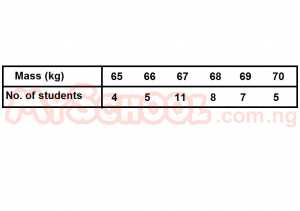
The median of the distribution is
Attached Figure / Diagram
A
9.5kg
B
11kg
C
67kg
D
65.5kg
E
68kg
medium Difficulty
Verified Correct Answer: Option E
Step-by-Step Mathematical Solution
\(\frac{67 + 68}{2} = 67.5 = 68kg\)
Source: Myschool Past Questions Archive (Record #23579)
Mathematics
WAEC / WASSCE 1994
Statistics and Probability
The mean heights of the three groups of students consisting of 20, 16 and 14 students are 1.67m, 1.50m and 1.40m respectively. Find the mean height of the students
A
1.52m
B
1.53m
C
1.54m
D
1.55m
E
1.56m
medium Difficulty
Verified Correct Answer: Option C
Step-by-Step Mathematical Solution
No expanded working has been attached for this question yet. The verified answer is Option C.
Source: Myschool Past Questions Archive (Record #23581)
Mathematics
WAEC / WASSCE 1994
Statistics and Probability
Solution
Two cards are drawn one after the other with replacement from a well-shuffled ordinary deck of 52 cards containing four Aces. Find the probability that they are both Aces
A
1/221
B
1/169
C
1/52
D
1/26
E
1/13
medium Difficulty
Verified Correct Answer: Option B
Step-by-Step Mathematical Solution
1st card prob = 4/52 2nd card prob = 4/52
prob.both are aces = (4/52) x (4/52) = 1/169
Source: Myschool Past Questions Archive (Record #23582)
Mathematics
UTME / JAMB 1994
Statistics and Probability
Solution
The mean of twelve positive numbers is 3. When another number is added, the mean becomes 5. Find the thirteenth number
A
29
B
26
C
25
D
24
medium Difficulty
Verified Correct Answer: Option A
Step-by-Step Mathematical Solution
Let the sum of the 12 numbers be x and the 13th number be y.
\(\frac{x}{12} = 3 \implies x = 36\)
\(\frac{36 + y}{13} = 5 \implies 36 + y = 65\)
\(y = 65 - 36 = 29\)
Source: Myschool Past Questions Archive (Record #30953)
Mathematics
UTME / JAMB 1994
Statistics and Probability
Solution
Age in years
10
11
12
Number of pupils
6
27
7
The table above shows the number of pupils in each age group in a class. What is the probability that a pupil chosen at random is at least 11 years old?
A
\(\frac{27}{40}\)
B
\(\frac{17}{20}\)
C
\(\frac{33}{40}\)
D
\(\frac{3}{20}\)
medium Difficulty
Verified Correct Answer: Option B
Step-by-Step Mathematical Solution
Total number of pupils = 7 + 27 + 6 = 40
n(at least 11 years old) = 27 + 7 = 34.
P(picking a pupil who is at least 11 years old) = \(\frac{34}{40} = \frac{17}{20}\).
Source: Myschool Past Questions Archive (Record #31020)