Question Library
Browse, filter, and study verified past examination questions with step-by-step mathematical reasoning.
Searching 18,000+ Questions...
Sifting topics, KaTeX formulas & verified solutions
Showing 241–255 of 573 verified questions
Sort by:
Mathematics
WAEC / WASSCE 2006
Algebra
Diagram
Solution
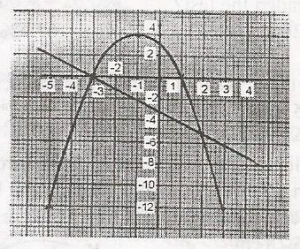
Which of these equations best describes the points of intersection of the curve and the line?
Attached Figure / Diagram
A
\(x^2 + 5x - 6 = 0\)
B
x2 - 5x - 6 = 0
C
x2 + x - 6 = 0
D
x2 - x - 6 = 0
medium Difficulty
Verified Correct Answer: Option C
Step-by-Step Mathematical Solution
The roots are -3 and 1
x = -3 and x = 1
y = (x + 3)(x - 1)
= x2 - x + 3x - 3
y = x2 + x - 6 = 0
Source: Myschool Past Questions Archive (Record #36181)
Mathematics
WAEC / WASSCE 2006
Algebra
Solution
(a) Solve for x and y in the following equations :
\(2x - y = \frac{9}{2}\)
\(x + 4y = 0\)
(b)
In the diagram, TA is a tangent to the circle at A. If \(\stackrel\frown{BCA} = 40^\circ\) and \(\stackrel\frown{DAT} = 52^\circ\), find \(\stackrel\frown{BAD}\).
medium Difficulty
Verified Correct Answer: Option
Step-by-Step Mathematical Solution
(a) \(2x - y = \frac{9}{2} .... (1)\)
\(x + 4y = 0 ....... (2)\)
From (2), x = - 4y. Put into (1), we have
\(2(- 4y) - y = \frac{9}{2}\)
\(-8y - y = \frac{9}{2} \implies - 9y = \frac{9}{2}\)
\(y = \frac{\frac{9}{2}}{-9} = -\frac{1}{2}\)
\(x = - 4y = -4(-\frac{1}{2})\)
\(x = 2\)
\((x, y) = (2, -\frac{1}{2})\)
(b)
In \(\Delta ACD, \stackrel\frown{ACD} = 52^\circ \) \(\stackrel\frown{ACD} = \stackrel\frown{DAT}\)
\(\therefore \stackrel\frown{BCD} = 40^\circ + 52^\circ = 92^\circ\)
Note \(\stackrel\frown{BCD}\) and \(\stackrel\frown{BAD}\) are supplementary = 180^\circ
\(\therefore \stackrel\frown{BAD} = 180^\circ - 92^\circ = 88^\circ\)
Source: Myschool Past Questions Archive (Record #53016)
Mathematics
WAEC / WASSCE 2006
Algebra
Solution
(a)(i) If \(4x < 2 + 3x\) and \(x - 8 < 3x\), what range of values of x satisfies both inequalities? ; (ii) Represent your result in (i) on the number line.
(b) A shop is sending out a bill for an amount less than £100. The accountant interchanges the two digits and so overcharges the customer by 45. Given that the sum of the two digits is 9, find how much the bill should be.
medium Difficulty
Verified Correct Answer: Option
Step-by-Step Mathematical Solution
(a)(i) \(4x < 2 + 3x ..... (1)\)
\(4x - 3x < 2\)
\(x < 2\)
\(x - 8 < 3x ..... (2)\)
\(-8 < 2x\)
\(x > -4\)
\(x < 2 ; x > -4\).
(ii)
(b) Let the digits of the number be x and y.
\(x + y = 9 .... (1)\)
\((10y + x) - (10x + y) = 45 \)
\(10y - y + x - 10x = 45\)
\(9y - 9x = 45 .... (2)\)
From (1), y = 9 - x. Putting it into (2), we have
\(9(9 - x) - 9x = 45\)
\(81 - 9x - 9x = 45\)
\(36 = 18x \implies x = 2\)
\(\therefore y = 9 - x\)
= \(9 - 2 = 7\)
\(\therefore\) The bill = £27.
Source: Myschool Past Questions Archive (Record #53044)
Mathematics
WAEC / WASSCE 2006
Algebra
Solution
(a)
The diagram shows a pyramid standing on a cuboid. The dimensions of the cuboid are 4m by 3m by 2m and the slant edge of the pyramid is 5m. Calculet the volume of the shape.
(b) The 2nd, 3rd and 4th terms of an A.P are x - 2, 5 and x + 2 respectively. Calculate the value of x.
medium Difficulty
Verified Correct Answer: Option
Step-by-Step Mathematical Solution
(a) From the pyramid, construct \(\Delta BFG\) by drawing a line from B to F.
\(|BF|^{2} = 4^{2} + 3^{2}\)
\(|BF| = 25 \implies |BF| = 5m\)
In calculating the height,
\(h^{2} = 5^{2} - (\frac{5}{2})^{2}\)
\(h^{2} = \frac{75}{4}\)
\(h = \sqrt{75}{4}\)
= \(4.33 m\)
Volume of a pyramid = \(\frac{1}{3} \times 4 \times 3 \times 4.33\)
= \(17.32 m^{3}\)
Volume of a cuboid = \(l \times b \times h\)
= \(3 \times 4 \times 2\)
= \(24 m^{3}\)
Total volume of the shape = \(17.32 + 24\)
= \(41.32 m^{3}\)
(b) \(5 - (x - 2) = d\)
\((x + 2) - 5 = d\)
\(\therefore (x + 2) - 5 = 5 - (x - 2)\)
\(x - 3 = 7 - x\)
\(2x = 10\)
\(x = 5\)
Source: Myschool Past Questions Archive (Record #53052)
Mathematics
WAEC / WASSCE 2006
Algebra
Solution
(a) Copy and complete the table of the relation \(y = 2\sin x - \cos 2x\).
x
0^\circ
30^\circ
60^\circ
90^\circ
120^\circ
150^\circ
180^\circ
y
0.5
-1.0
Using a scale of 2 cm to 30^\circ on the x- axis and 2 cm to 0.5 unit on the y- axis, draw the graph of \(y = 2\sin x - \cos 2x\), for \(0^\circ \leq x \leq 180^\circ\).
(b) Using the same axes, draw the graph of \(y = 1.25\).
(c) Use your graphs to find the : (i) values of x for which \(2\sin x - \cos 2x = 0\) ; (ii) the roots of the equation \(2\sin x - \cos 2x = 1.25\).
medium Difficulty
Verified Correct Answer: Option
Step-by-Step Mathematical Solution
(a) \(y = 2\sin x - \cos 2x\)
x
0^\circ
30^\circ
60^\circ
90^\circ
120^\circ
150^\circ
180^\circ
y
-1.0
0.5
2.2
3.0
2.2
0.5
-1.0
(b)
Source: Myschool Past Questions Archive (Record #53053)
Mathematics
UTME / JAMB 2005
Algebra
Solution
A polynomial in x whose zeros are -2, -1 and 3 is
A
x3 - 7x + 6
B
x3 + 7x - 6
C
x3 + 7x + 6
D
x3 - 7x - 6
medium Difficulty
Verified Correct Answer: Option D
Step-by-Step Mathematical Solution
x = -2, x = -1 and x = 3
∴x+2 = 0, x+1 = 0 and x-3 = 0
Product of the factors
(x+2)(x+1)(x-3) = 0
(x2 + 3x + 2)(x-3)
x(x2 + 3x + 2) -3(x2 + 3x + 2) = 0
x3 + 3x2 + 2x - 3x2 - 9x - 6 = 0
x3 - 7x - 6 = 0
Source: Myschool Past Questions Archive (Record #8226)
Mathematics
UTME / JAMB 2005
Algebra
Solution
The weight W kg of a metal bar varies jointly as its length L meters and the square of its diameter d meters. If w = 140 when d = 42/3 and L = 54, find d in terms of W and L.
A
\(\sqrt{\frac{42W}{5L}}\)
B
\(\sqrt{\frac{6L}{42W}}\)
C
\(\frac{42W}{5L}\)
D
\(\frac{5L}{42W}\)
medium Difficulty
Verified Correct Answer: Option A
Step-by-Step Mathematical Solution
The weight \( W \) kg of a metal bar varies jointly as its length \( L \) meters and the square of its diameter \( d \) meters. This relationship is expressed as:
\(W = k \cdot L \cdot d^2\)
where \( k \) is the constant of proportionality.
Given \( W = 140 \), \( d = 4\frac{2}{3} = \frac{14}{3} \), and \( L = 54 \), substitute to find \( k \):
\(140 = k \cdot 54 \cdot \left( \frac{14}{3} \right)^2\)
Calculate \( \left( \frac{14}{3} \right)^2 = \frac{196}{9} \):
\(140 = k \cdot 54 \cdot \frac{196}{9}\)
Simplify: \( 54 \div 9 = 6 \), so: \(140 = k \cdot 6 \cdot 196 = k \cdot 1176\)
Thus, \(k = \frac{140}{1176} = \frac{5}{42}\)
Now rearrange the original equation to solve for \( d \):
\(d^2 = \frac{W}{k \cdot L}\)
\(d = \sqrt{ \frac{W}{k \cdot L} } = \sqrt{ \frac{W}{\frac{5}{42} \cdot L} } = \sqrt{ \frac{42W}{5L} }\)
Therefore, \( d = \sqrt{ \dfrac{42W}{5L} } \).
Source: Myschool Past Questions Archive (Record #8292)
Mathematics
UTME / JAMB 2005
Algebra
Solution
Find the sum of the first 20 terms of the series 8, 12, 16, ....., 96
A
1400
B
1040
C
960
D
920
medium Difficulty
Verified Correct Answer: Option D
Step-by-Step Mathematical Solution
8, 12, 16, .....96
a = 8, d = 4, l = 96, n = 20
\(S_{20} = \frac{n}{2}(2a + (n-1)d\)
\(S_{20} = \frac{20}{2}((2\times 8) + (20-1)\times 4)\)
\(S_{20} = 10(16 + (19\times 4)) = 10 \times 92\)
=920
Source: Myschool Past Questions Archive (Record #8317)
Mathematics
UTME / JAMB 2005
Algebra
Solution
Find the equation of the perpendicular at the point (4,3) to the line y + 2x = 5
A
2y - x = 4
B
y + 2x = 3
C
y + 2x = 5
D
2y - x = 2
medium Difficulty
Verified Correct Answer: Option D
Step-by-Step Mathematical Solution
Gradient of the line y + 2x = 5 = -2
Gradient of the line perpendicular to
y + 2x + 5 = 1/2
equation of a line perpendicular to
y + 2x = 5 at the point (4, 3)
y - y1 = m(x - x1)
y - 3 = 1/2(x - 4)
2y - 6 = x -4
2y - x = 2
Source: Myschool Past Questions Archive (Record #8456)
Mathematics
WAEC / WASSCE 2005
Algebra
Solution
Find the equation whose roots are 2 and \(-3\frac{1}{2}\)
A
2x2 + 3x + 14 = 0
B
2x2 + 5x + 7 = 0
C
2x2 + 5x - 7 = 0
D
2x2 + 3x - 14 = 0
medium Difficulty
Verified Correct Answer: Option D
Step-by-Step Mathematical Solution
x2 (sum of roots)x + (product of roots) = 0
Sum of roots \(2+-3\frac{1}{2} = -1\frac{1}{2} = -\frac{1}{2}\)
Product of roots \(= 2 \times - 3\frac{1}{2}\) = -7
x\(^2\) - \(\frac{-3}{2}\)x + (-7) = 0 ⇒ 2x\(^2\) + 3x - 14 = 0
Source: Myschool Past Questions Archive (Record #26674)
Mathematics
WAEC / WASSCE 2005
Algebra
Solution
Solve the equation 2\(^7\) = 8\(^{5-x}\)
A
\(\frac{5}{8}\)
B
\(\frac{8}{3}\)
C
\(\frac{3}{2}\)
D
\(\frac{15}{4}\)
medium Difficulty
Verified Correct Answer: Option B
Step-by-Step Mathematical Solution
2\(^7\) = 8\(^{5-x}\)
2\(^7\) = 2\(^{3(5 - x)}\)
7 = 15 - 3x
7 - 15 = - 3x
-8 = -3x
x = \(\frac{8}{3}\)
Source: Myschool Past Questions Archive (Record #26681)
Mathematics
WAEC / WASSCE 2005
Algebra
Solution
Solve the equation 2x - 3y = 22; 3x + 2y = 7
A
-5
B
-4
C
4
D
5
medium Difficulty
Verified Correct Answer: Option B
Step-by-Step Mathematical Solution
2x - 3y = 22 ---- eqn I
3x + 2y = 7 ---- eqn II
multiply eqn I by 2
4x - 6y = 44 ---- eqn III
multiply eqn II by 3
9x + 6y = 21 ---- eqn IV
Adding eqn III and IV
=> 13x = 65 => x = 5
Substituting 5 for x in eqn II
3x5 + 2y = 7 => 2y = -8
y = -4
Source: Myschool Past Questions Archive (Record #26690)
Mathematics
WAEC / WASSCE 2005
Algebra
Solution
Solve the equation \(\frac{2y-1}{3} - \frac{3y-1}{4} = 1\)
A
-8
B
-13
C
13
D
19
medium Difficulty
Verified Correct Answer: Option B
Step-by-Step Mathematical Solution
\(\frac{4(2y-1)-3(3y-1)}{12}=12 \Rightarrow 8y - 4 - 9y + 3 = 12 \\
\Rightarrow -y-1=12\Rightarrow -y=13\Rightarrow y=-13\)
Source: Myschool Past Questions Archive (Record #26691)
Mathematics
WAEC / WASSCE 2005
Algebra
Solution
A sequence is given by \(2\frac{1}{2}, 5, 7\frac{1}{2}, .....\) if the nth term is 25, find n
A
9
B
10
C
12
D
15
medium Difficulty
Verified Correct Answer: Option B
Step-by-Step Mathematical Solution
\(a = 2\frac{1}{2}, nth = a + (n-1)d \Rightarrow 25 = 2\frac{1}{2} + (n-1)2\frac{1}{2}\\
25 = \frac{5}{2}+(n-1)\frac{5}{2} \Rightarrow 22\frac{1}{2} = \frac{5n-5}{2}\Rightarrow \frac{45}{2} = \frac{5n-5}{2}\\
45 = 5n - 5 \Rightarrow 5n = 50 \Rightarrow n = 10\)
Source: Myschool Past Questions Archive (Record #26693)
Mathematics
WAEC / WASSCE 2005
Algebra
Solution
Given that the root of an the equation \(2x^2 + (k+2)x+k=0\) is 2, find the value of k
A
-4
B
-2
C
-1
D
\(-\frac{1}{4}\)
medium Difficulty
Verified Correct Answer: Option A
Step-by-Step Mathematical Solution
Substituting for x in the equation
\(2(2)^2 + (k+2)2+k = 0 \Rightarrow 8 +2k + 4 + k =0 \Rightarrow 3k =-12; k=-4\)
Source: Myschool Past Questions Archive (Record #26694)