Question Library
Browse, filter, and study verified past examination questions with step-by-step mathematical reasoning.
Searching 18,000+ Questions...
Sifting topics, KaTeX formulas & verified solutions
Showing 25366–25380 of 29811 verified questions
Sort by:
English Language
WAEC / WASSCE 1990
Lexis, Structure & Register (Cloze & Vocabulary)
Solution
In question number 91 above, choose the best option from letters A-E that best completes the gap.
A
fees
B
sums
C
accounts
D
charges
E
premiums
medium Difficulty
Verified Correct Answer: Option E
Grammar & Contextual Explanation
"Premiums" is the correct term for regular payments made to an insurance company in exchange for coverage.
Source: Myschool Past Questions Archive (Record #23426)
English Language
WAEC / WASSCE 1990
Lexis, Structure & Register (Cloze & Vocabulary)
Solution
In question number 92 above, choose the best option from letters A-E that best completes the gap.
A
dangers
B
claims
C
subjects
D
risks
E
ltems
medium Difficulty
Verified Correct Answer: Option D
Grammar & Contextual Explanation
"Risks" is the most appropriate word because insurance payments (premiums) vary based on the level of risk being covered.
Source: Myschool Past Questions Archive (Record #23427)
English Language
WAEC / WASSCE 1990
Lexis, Structure & Register (Cloze & Vocabulary)
Solution
In question number 93 above, choose the best option from letters A-E that best completes the gap.
A
agreed
B
entered
C
included
D
undertaken
E
covered
medium Difficulty
Verified Correct Answer: Option E
Grammar & Contextual Explanation
"Covered" is the best choice because in insurance, risks are "covered" by policies.
Source: Myschool Past Questions Archive (Record #23428)
English Language
WAEC / WASSCE 1990
Lexis, Structure & Register (Cloze & Vocabulary)
Solution
In question number 94 above, choose the best option from letters A-E that best completes the gap.
A
damage
B
loss
C
harm
D
injury
E
grievance
medium Difficulty
Verified Correct Answer: Option D
Grammar & Contextual Explanation
"Injury" is the best choice because it refers to physical harm that can be sustained during work, which is a common risk covered by insurance policies.
Source: Myschool Past Questions Archive (Record #23429)
English Language
WAEC / WASSCE 1990
Lexis, Structure & Register (Cloze & Vocabulary)
Solution
In question number 95 above, choose the best option from letters A-E that best completes the gap.
A
overdrawn
B
unsecured
C
illegal
D
overdue
E
careless
medium Difficulty
Verified Correct Answer: Option B
Grammar & Contextual Explanation
"Unsecured" fits best because "unsecured business debts" refers to loans or financial obligations that are not backed by collateral, which insurance can help cover.
Source: Myschool Past Questions Archive (Record #23430)
English Language
WAEC / WASSCE 1990
Lexis, Structure & Register (Cloze & Vocabulary)
Solution
In question number 96 Above, choose the best option from letters A-E that best completes the gap.
A
policy
B
significant
C
particular
D
typical
E
contract
medium Difficulty
Verified Correct Answer: Option A
Grammar & Contextual Explanation
"Policy" fits best because insurance companies assign a policy number to each insured person or business for identification and record-keeping.
Source: Myschool Past Questions Archive (Record #23431)
English Language
WAEC / WASSCE 1990
Lexis, Structure & Register (Cloze & Vocabulary)
Solution
In question number 97 above, choose the best option from letters A-E that best completes the gap.
A
recognition
B
entry
C
identification
D
accounting
E
auditing
medium Difficulty
Verified Correct Answer: Option C
Grammar & Contextual Explanation
"Identification" is the most appropriate choice because policy numbers help in uniquely identifying the insured person or business.
Source: Myschool Past Questions Archive (Record #23432)
English Language
WAEC / WASSCE 1990
Lexis, Structure & Register (Cloze & Vocabulary)
Solution
In question number 98 above, choose the best option from letters A-E that best completes the gap.
A
comprehensive
B
conditional
C
total
D
compact
E
correct
medium Difficulty
Verified Correct Answer: Option A
Grammar & Contextual Explanation
"Comprehensive" fits best because a comprehensive insurance policy provides broad coverage, including damages, theft, and accidents.
Source: Myschool Past Questions Archive (Record #23433)
English Language
WAEC / WASSCE 1990
Lexis, Structure & Register (Cloze & Vocabulary)
Solution
In question number 99 above, choose the best option from letters A-E that best complete the gap.
A
second hand
B
winning party
C
third party
D
subsidiary
E
second party
medium Difficulty
Verified Correct Answer: Option C
Grammar & Contextual Explanation
A comprehensive insurance policy covers more risks than a third-party insurance policy.
Source: Myschool Past Questions Archive (Record #23434)
English Language
WAEC / WASSCE 1990
Lexis, Structure & Register (Cloze & Vocabulary)
Solution
In question number 100 above, choose the best option from letters A-E that best completes the gap.
A
later
B
previous
C
first
D
other
E
latter
medium Difficulty
Verified Correct Answer: Option E
Grammar & Contextual Explanation
"Former" refers to the first-mentioned item (comprehensive policy). "Latter" refers to the second-mentioned item (third-party policy).
Source: Myschool Past Questions Archive (Record #23435)
Physics
UTME / JAMB 1990
Current Electricity & Electric Circuits
Diagram
What is the reading of the vernier scale above
Attached Figure / Diagram
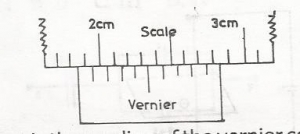
A
1.88cm
B
1.80cm
C
1.28cm
D
1.97cm
medium Difficulty
Verified Correct Answer: Option A
Physical Principles & Numerical Solution
No expanded working has been attached for this question yet. The verified answer is Option A.
Source: Myschool Past Questions Archive (Record #41692)
Physics
UTME / JAMB 1990
Current Electricity & Electric Circuits
Diagram
Two horizontal forces, 10N and 8N and another force F1 inclined at 30 to the vertical acting as shown in the diagram above, keep the body P in equilibrium, The weight of the body is
Attached Figure / Diagram
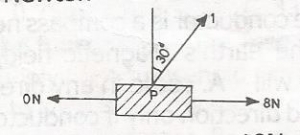
A
2√3/3N
B
√2N
C
4√3/3
D
2V3N
medium Difficulty
Verified Correct Answer: Option D
Physical Principles & Numerical Solution
No expanded working has been attached for this question yet. The verified answer is Option D.
Source: Myschool Past Questions Archive (Record #41693)
Physics
UTME / JAMB 1990
Linear Motion, Projectiles & Kinematics
Diagram
Solution
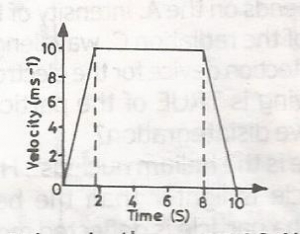
What is the average velocity of the sprinter whose velocity time graph is as shown above
Attached Figure / Diagram
A
85.0ms-1
B
17.0ms-1
C
8.5ms-1
D
1.7ms-1
medium Difficulty
Verified Correct Answer: Option C
Physical Principles & Numerical Solution
Average velocity = \(\frac{total speed}{total time}\)
Total distance = Area under the graph i.e area of trapezium = \(\frac{1}{2}\)(a + b) x h
= 0.5(6 + 10) x 10 = 80m
Total time = 10secs
Average velocity = \(\frac{total speed}{total time}\) = \(\frac{80}{10}\) = 8m/s
so closest answer is 8.5m/s
Source: Myschool Past Questions Archive (Record #41694)
Physics
UTME / JAMB 1990
Current Electricity & Electric Circuits
Diagram
Solution
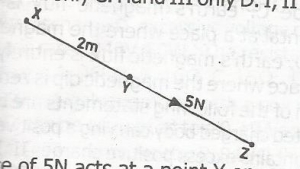
A force of 5N act at a point Y on a rod XYZ as shown in the diagram above, if XY is 2m. What is the moment of the force about point X?
Attached Figure / Diagram
A
0Nm
B
3Nm
C
7Nm
D
10Nm
medium Difficulty
Verified Correct Answer: Option A
Physical Principles & Numerical Solution
X is in the line of action of the force, Therefore moment is equal to zero.
Moment = force x perpendicular distance. ( x is horizontal distance, not perpendicular distance)
Source: Myschool Past Questions Archive (Record #41695)
Physics
WAEC / WASSCE 1990
Linear Motion, Projectiles & Kinematics
Solution
(a) Using a suitable diagram, explain how the following can be obtained from a velocity-time graph (i) acceleration; (ii) retardation; (iii) total distance covered.
(b) Show that the displacement of a body moving with uniform acceleration a is given by \(s = ut + \frac{1}{2} at^{2}\) where u is the velocity of the body at time t = 0.
(c) A particle moving in a straight line with uniform deceleration has a velocity of 40ms\(^{-1}\) at a point P, 20ms\(^{-1}\) at a point Q and comes to rest at a point R where QR = 50m. Calculate the: (i) distance PQ; (ii) time taken to cover PQ; (iii) time taken to cover PR.
medium Difficulty
Verified Correct Answer: Option
Physical Principles & Numerical Solution
(a)
Velocity- time graph:
(i) Acceleration : Gradient of AB in the graph above; (ii) retardation: Gradient of CD in the graph above; (iii) total distance covered is the area under the graph.
(b) S = average velocity x time
\(S = (\frac{u +v}{2}) \times t ... (1)\)
but \(v = u + at ... (2)\), substitute (2) in (1)
\(S = (\frac{u + u + at}{2}) \times t\)
\(S = (\frac{2u + at}{2}) \times t \)
\(S = ut + \frac{1}{2} at^{2}\)
(c) P ----------- Q ----50m------- R
40 ms\(^{-1}\) 20 ms\(^{-1}\)
Since the acceleration is uniform and using equation
\(v^{2} = u^{2} + 2as\) for the motion along QR.
\(0 = 20^{2} - 2a(50)\) (retardation)
\(0 = 400 - 100a \implies 100a = 400\)
\(a = 4 ms^{-2}\) (retardation, hence it is negative)
\(20^{2} = 40^{2} + 2(-4) s\)
\(400 = 1600 - 8s \implies 8s = 1200\)
\(s = 150m\)
(ii) Time taken to cover PQ
Apply the equation
v = u + at
from P to Q:
20 = 40 + (-4)t
4t = 20
t = 5s
Time to cover PQ = 5s
(iii) Time taken to cover PR
PR = PQ + QR = 150 + 50 = 200s
Apply the equation
v = u + at
from P to R (initial velocity \(40\,\text{m s}^{-1}\), final velocity \(0\)):
0 = 40 + (-4)t
4t = 40
t = 10s.
Source: Myschool Past Questions Archive (Record #54764)