Question Library
Browse, filter, and study verified past examination questions with step-by-step mathematical reasoning.
Searching 18,000+ Questions...
Sifting topics, KaTeX formulas & verified solutions
Showing 24421–24435 of 29811 verified questions
Sort by:
Mathematics
UTME / JAMB 1991
Fractions, Decimals, Percentages & Approximations
Solution
3% of a family's income is spent on electricity, 59% on food, 20% on transport, 11% on education and 7% on extended family. The angles subtended at the centre of the pie chart under education and food are respectively
A
76.8o and 25.2o
B
10.8o and 224.6o
C
112.4o and 72.0o
D
39.6o and 212.4o
medium Difficulty
Verified Correct Answer: Option D
Step-by-Step Mathematical Solution
Education = 11% = \(\frac{11}{100} \times 360^\circ = 39.6^\circ\)
Food = 59% = \(\frac{59}{100} \times 360^\circ = 212.4^\circ\)
Source: Myschool Past Questions Archive (Record #31425)
Mathematics
UTME / JAMB 1991
Statistics (Data Representation, Central Tendency & Dispersion)
Solution
Fifty boxes each of 50 bolts, were inspected for the number which were defective. The following was the result
No of defective per box
4
5
6
7
8
9
No. of boxes
2
7
17
10
8
6
The mean and the median of the distribution are, respectively
A
6.7, 6
B
7.6, 5
C
5.7, 87
D
34, 6
medium Difficulty
Verified Correct Answer: Option A
Step-by-Step Mathematical Solution
No of defective(x)
No of boxes (f)
\(fx\)
4
2
8
5
7
35
6
17
102
7
10
70
8
8
64
9
6
54
\(\sum\)
50
333
\(Mean = \frac{\sum fx}{\sum f}\)
= \(\frac{333}{50} = 6.66 \approxeq 6.7\)
The median is the average of the 25th and 26th position = 6.
Source: Myschool Past Questions Archive (Record #31426)
Mathematics
UTME / JAMB 1991
Fractions, Decimals, Percentages & Approximations
Solution
No. defective per box
4
5
6
7
8
9
No. of boxes
2
7
17
10
8
6
Find the percentage of boxes containing at least 5 defective bolts each
A
96
B
94
C
92
D
90
medium Difficulty
Verified Correct Answer: Option A
Step-by-Step Mathematical Solution
% of boxes containing at least 5 defective bolts each
= \(\frac{7 + 17 + 10 + 8 + 6}{50}\)
= \(\frac{48}{50}\) x \(\frac{100}{1}\)
= 96%
Source: Myschool Past Questions Archive (Record #31427)
Mathematics
UTME / JAMB 1991
Permutations, Combinations & Probability
Solution
A crate of soft drinks contains 10 bottles of Coca-cola, 8 of Fanta and 6 of sprite. If one bottle is selected at random, what is the probability that it is NOT a Cocacola bottle?
A
\(\frac{5}{12}\)
B
\(\frac{1}{3}\)
C
\(\frac{3}{4}\)
D
\(\frac{7}{12}\)
medium Difficulty
Verified Correct Answer: Option D
Step-by-Step Mathematical Solution
Coca-cola = 10 bottles, Fanta = 8 bottles
Sprite = 6 bottles, Total = 24
P(cola-cola) = \(\frac{10}{24}\)
P(not coca-cola) = 1 - \(\frac{10}{24}\)
\(\frac{24 - 10}{24}\) = \(\frac{14}{24}\)
= \(\frac{7}{12}\)
Source: Myschool Past Questions Archive (Record #31428)
Mathematics
UTME / JAMB 1991
Plane Geometry, Polygons & Circle Theorems
Diagram
Solution
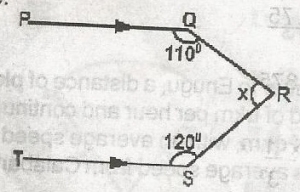
In the figure above, Find the value of x
Attached Figure / Diagram
A
130o
B
110o
C
100o
D
90o
medium Difficulty
Verified Correct Answer: Option A
Step-by-Step Mathematical Solution
From the diagram above
x = 60 + 70 = 130º
(sum of angles on a straight line was used to obtain 60º and 70º, and alternate angles are equal to obtain the value of x)
Source: Myschool Past Questions Archive (Record #32968)
Mathematics
UTME / JAMB 1991
Indices, Logarithms & Surds
Diagram
Solution
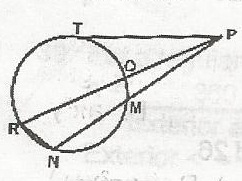
PMN and PQR are two secants of the circle MQTRN and PT is a tangent. If PM = 5cm, PN = 12cm and PQ = 4.8cm, calculate the respective lengths of PR and PT in centimeters
Attached Figure / Diagram
A
7.3, 5.9
B
7.7, 12.5
C
12.5, 7.7
D
5.9, 7.3
medium Difficulty
Verified Correct Answer: Option C
Step-by-Step Mathematical Solution
\(\frac{PQ}{PN} = \frac{PM}{PR} = \frac{QM}{NR}\)
\(\frac{4.8}{12} = \frac{5}{PR}\)
PR = \(\frac{5 \times 12}{4.8} = \frac{50}{4}\)
= 12.5
\(\frac{PQ}{PN} = \frac{PM}{PT} = \frac{TM}{NT}\)
\(\frac{PT}{12} = \frac{5}{PR}\)
PT2 = 60
PT = \(\sqrt{60}\)
= 7.746
= 7.7
Source: Myschool Past Questions Archive (Record #32972)
Mathematics
UTME / JAMB 1991
Plane Geometry, Polygons & Circle Theorems
Diagram
Solution
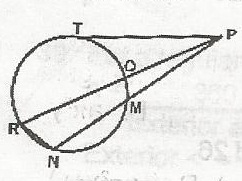
PMN and PQR are two secants of the circle MQTRN and PT is a tangent. If PNR = 110o and PMQ = 55o, find MPQ
Attached Figure / Diagram
A
40o
B
30o
C
25o
D
15o
medium Difficulty
Verified Correct Answer: Option D
Step-by-Step Mathematical Solution
PQM = 110o(Ext. o - (110 + 55)
= 180o - 165o
= 15o
Source: Myschool Past Questions Archive (Record #32975)
Mathematics
UTME / JAMB 1991
Plane Geometry, Polygons & Circle Theorems
Diagram
Solution
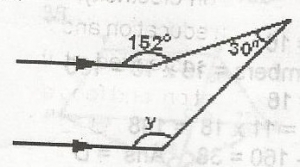
In the figure above, find the value of y
Attached Figure / Diagram
A
28o
B
122o
C
150o
D
152o
medium Difficulty
Verified Correct Answer: Option B
Step-by-Step Mathematical Solution
ADB = 180o - 152o = 28o
28o + y + 30o = 180o
y = 180o - 58o
= 122o
Source: Myschool Past Questions Archive (Record #32978)
Mathematics
UTME / JAMB 1991
Plane Geometry, Polygons & Circle Theorems
Diagram
Solution
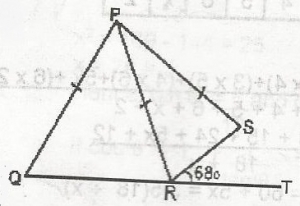
In this figure, PQ = PR = PS and SRT = 68o. Find QPS
Attached Figure / Diagram
A
136o
B
124o
C
12o
D
68o
medium Difficulty
Verified Correct Answer: Option A
Step-by-Step Mathematical Solution
Since PQRS is quadrilateral 2y + 2x = QPS = 360o
i.e. 2(y + x) + QPS = 360o
QPS = 360o - 2(y + x)
But x + y + 68o = 180o
x + y = 180o - 68o = 180o
x + y = 180o - 68o
= 112o
QPS = 360o - 2(112o)
360o - 224o = 136o
Source: Myschool Past Questions Archive (Record #32980)
Mathematics
UTME / JAMB 1991
Indices, Logarithms & Surds
Diagram
Solution
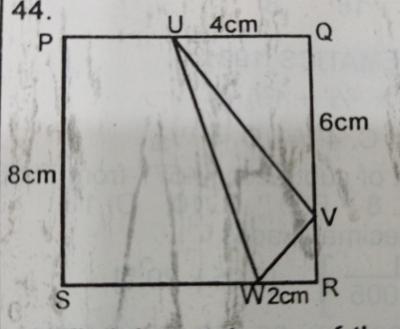
In the figure, PQRS is a square of sides 8cm. What is the area of \(\bigtriangleup\)UVW?
Attached Figure / Diagram
A
64 sq. cm
B
40 sq.cm
C
50 sq.cm
D
10 sq.cm
medium Difficulty
Verified Correct Answer: Option D
Step-by-Step Mathematical Solution
In △ UQV
|UV|\(^2\) = 6\(^2\) + 4\(^2\) (Pythagora's theorem)
|UV| = \(\sqrt{52}\) = 7.21cm
Also, in △ WVR
|WV|\(^2\) = 2\(^2\) + 2\(^2\) = 4 + 4 = 8 (same reason as above)
|WV| = \(\sqrt{8}\) = 2.83
Therefore, the area of △ UVW = \(\frac{1}{2}\) x 2.83 x 7.21 = 10.21 ≈ 10cm\(^2\)
Source: Myschool Past Questions Archive (Record #32981)
Mathematics
UTME / JAMB 1991
Mensuration (Areas, Perimeters & Volumes)
Diagram
Solution
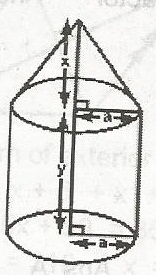
Find the volume of the figure
Attached Figure / Diagram
A
\(\frac{a \pi^2}{3} (x + 3y) \)
B
a\(\pi ^2\)y
C
\(\frac{a \pi ^2}{3}\)(y + x)
D
(\(\frac{1}{3} a \pi ^2 x + y\))
medium Difficulty
Verified Correct Answer: Option A
Step-by-Step Mathematical Solution
Volume of cylinder = \(\pi\)r\(^2\)h = \(\pi\)a\(^2\)y
Volume of cone = \(\frac{1}{3}\) \(\pi\)r\(^2\)h = \(\frac{1}{3}\) \(\pi\)a\(^2\)x
Total Volume = \(\pi\)a\(^2\)y + \(\frac{1}{3}\) \(\pi\)a\(^2\)x = \(\frac{3\pi a^2y + \pi a^2x}{3}\)
= \(\frac{\pi a^2}{3}(x + 3y)\)
Source: Myschool Past Questions Archive (Record #32982)
Mathematics
WAEC / WASSCE 1991
Plane Geometry, Polygons & Circle Theorems
Solution
Simplify :
(i) \(2\frac{2}{3} - (2\frac{1}{2} - 1\frac{4}{5})\)
(ii) \(\frac{3.25 - 1.64}{2.47 - 2.01}\)
medium Difficulty
Verified Correct Answer: Option
Step-by-Step Mathematical Solution
(i) \(2\frac{2}{3} - (2\frac{1}{2} - 1\frac{4}{5})\)
= \(2\frac{2}{3} - (\frac{5}{2} - \frac{9}{5})\)
= \(\frac{8}{3} - (\frac{25 - 18}{10})\)
= \(\frac{8}{3} - \frac{7}{10}\)
= \(\frac{80 - 21}{30}\)
= \(\frac{59}{30}\)
(ii) \(\frac{3.25 - 1.64}{2.47 - 2.01}\)
= \(\frac{1.61}{0.46}\)
= \(\frac{7}{2}\)
= \(3\frac{1}{2}\)
Source: Myschool Past Questions Archive (Record #54606)
Mathematics
WAEC / WASSCE 1991
Indices, Logarithms & Surds
Solution
(a) Using logarithm table, evaluate \(\frac{\sqrt[3]{1.376}}{\sqrt[4]{0.007}}\) correct to three significant figure.
(b) Without using Mathematical tables, find the value of \(\frac{\log 81}{\log \frac{1}{3}}\).
medium Difficulty
Verified Correct Answer: Option
Step-by-Step Mathematical Solution
(a)
No
Log
\(\sqrt[3]{1.376}\)
\(0.1386 \div 3 \) = \(0.0462\)
\(\sqrt[4]{0.007}\)
\(\bar{3}.8451 \div 4\) = \(\bar{1}.4613\)
\(\frac{\sqrt[3]{1.376}}{\sqrt[4]{0.007}}\) =
\(0.5849\)
Antilog = 3.845
\(\therefore \frac{\sqrt[3]{1.376}}{\sqrt[4]{0.007}} \approxeq 3.85\) (to 3 s.f)
(b) \(\frac{\log 81}{\log \frac{1}{3}}\)
= \(\frac{\log 3^{4}}{\log 3^{-1}}\)
= \(\frac{4 \log 3}{-1 \log 3}\)
= \(-4\)
Source: Myschool Past Questions Archive (Record #54607)
Mathematics
WAEC / WASSCE 1991
Sets, Logic & Venn Diagrams
Solution
In a certain class, 22 pupils take one or more of Chemistry, Economics and Government. 12 take Economics (E), 8 take Government (G) and 7 take Chemistry (C). Nobody takes Economics and Chemistry and 4 pupils take Economics and Government.
(a)(i) Using set notation and the letters indicated above, write down the two statements in the last sentence; (ii) Draw a Venn diagram to illustrate the information.
(b) How many pupils take (i) both Chemistry and Government ? (ii) Government only?
medium Difficulty
Verified Correct Answer: Option
Step-by-Step Mathematical Solution
(a)
(i) Nobody takes Economics and Chemistry \(n(E \cap C) = \null \).
(ii) 4 pupils take Economics and Government; \(n(E \cap G) = 4\)
(b) (i) Suppose \(n(C \cap G) = x\)
\(22 = 8 + 4 + 8 - 4 - x + x + 7 - x\)
\(22 = 23 - x \implies x = 1\)
Only 1 person does Chemistry and Government.
(ii) Number taking only Government = \(8 - (4 + x)\)
\(8 - (4 + 1) = 3\)
Source: Myschool Past Questions Archive (Record #54608)
Mathematics
WAEC / WASSCE 1991
Permutations, Combinations & Probability
Solution
A man has 9 identical balls in a bag. Out of these, 3 are black, 2 are blue and the remaining are red.
(a) If a ball is drawn at random, what is the probability that it is (i) not blue? (ii) not red?
(b) If 2 balls are drawn at random, one after the other, what is the probability that both of them will be (i) black, if there is no replacement? (ii) blue, if there is a replacement?
medium Difficulty
Verified Correct Answer: Option
Step-by-Step Mathematical Solution
Total number of balls = 9, No of blue = 2, No of black = 3
\(\therefore\) No of red = 4.
(a)(i) P(not blue) = \( 1 - P(blue)\)
= \(1 - \frac{2}{9} = \frac{7}{9}\)
(ii) P(not red) = \(1 - P(red)\)
= \(1 - \frac{4}{9} = \frac{5}{9}\)
(b) Picking two balls;
(i) P(black) with no replacement = \(\frac{3}{9} \times \frac{2}{8} = \frac{1}{12}\)
(ii) P(blue) with replacement = \(\frac{2}{9} \times \frac{2}{9} = \frac{4}{81}\)
Source: Myschool Past Questions Archive (Record #54609)