Question Library
Browse, filter, and study verified past examination questions with step-by-step mathematical reasoning.
Searching 18,000+ Questions...
Sifting topics, KaTeX formulas & verified solutions
Showing 24316–24330 of 29811 verified questions
Sort by:
Biology
WAEC / WASSCE 1992
Nervous, Hormonal Coordination & Sense Organs
Solution
(a) Explain the following terms: (i) voluntary action. (ii) involuntary action.
(b) State three functions each of: (I) insulin; (ii) auxins.
(c) Describe an experiment to show that plant roots respond positively to gravity.
medium Difficulty
Verified Correct Answer: Option
Biological Concept & Syllabus Guide
(a)(1) Voluntary action - involves the response to a stimulus that is controlled at will by the brain. in this action, an impulse is carried from a sensory neurone via the spinal cord to the brain which interprets and sends the message back through the motor neurone to effector organ. The action is not automatic. e.g. running, writing, jumping, laughing, reading, smiling.
(II) Involuntary action or reflex action-It is a rapid or automatic response to a stimulus. It does not involve the brain for initiation. Therefore, the action is not under the control of the will, e.g. sneezing, coughing, knee jerk, salivation, secretion of grand, blinking
(b)(i) Functions of insulin:
(1) Assists in oxidation of glucose to produce energy
(2) regulates the amount or level of glucose in the blood
(3) assists in protein synthesis in some cells
(ii) Functions of auxin
(1) Promotes lateral bud development
(2) promotes reproduction, flowering and fruit formation in plants
(3) promotes the production of adventitious roots.
(c) Experiment to show that plant roots respond positively to gravity:
Aim - To demonstrate that plant roots respond positively to gravity.
Apparatus: A bean seedling, Wet blotting paper, damp saw dust, cupboard.
Procedure: Put some dust on a wet blotting paper and place the bean seedling on the saw dust horizontally. Carry the set up and place it inside a dark cupboard to eliminate light for few days.
Observation: When observed after few days, one will discover that the root has curved and growing downwards while the shoot grow upward. Conclusion: Since the root has grown downwards and the shoot upwards, we can say that roots respond to gravity, showing positive geotropism while the shoot shows negative geotropism.
Source: Myschool Past Questions Archive (Record #53051)
Biology
WAEC / WASSCE 1992
Cell & Its Environment (Diffusion, Osmosis & Transport)
Solution
Name the physical processes responsible for the following (a) entry of carbon dioxide into the leaf through the stomata (b) entry of soil water into the root hair (c) shrinkage of plant tissue in hypertonic sugar solution
medium Difficulty
Verified Correct Answer: Option
Biological Concept & Syllabus Guide
(a) Diffusion (b) Osmosis (c) Plasmolysis (d) Hepatic portal vein
Source: Myschool Past Questions Archive (Record #59927)
Biology
WAEC / WASSCE 1992
Nutrition in Plants & Animals (Photosynthesis & Food Substances)
Solution
Name the blood vessel that carries digested food to the liver.
medium Difficulty
Verified Correct Answer: Option
Biological Concept & Syllabus Guide
They are specific in their actions, Example starch- splitting enzymes can only act on starch (ii) They work best at a particular temperature. Example - the human enzymes work best between 35^\circG and 40^\circC. They are denatured at about 60^\circC. (iii) They are protein in nature
Source: Myschool Past Questions Archive (Record #59930)
Biology
WAEC / WASSCE 1992
Variety of Organisms & Classification of Living Things
Solution
List three harmful effects of noise pollution.
medium Difficulty
Verified Correct Answer: Option
Biological Concept & Syllabus Guide
(i) Noise causes hearing defects (ii) Noise can make us lose concentration (iii) Noise pollution quickens heartbeat rate and blood circulation
Source: Myschool Past Questions Archive (Record #59931)
Biology
WAEC / WASSCE 1992
Variety of Organisms & Classification of Living Things
Solution
Name one example of symbiotic relationship in animals
medium Difficulty
Verified Correct Answer: Option
Biological Concept & Syllabus Guide
(i) Escherichia coli are bacteria found in the intestinal tract of ruminants (and other vertebrates) where they synthesize Vitamin K from cellulose (ii) - Others are protozoa living in the gut of termites - Sea anemone and the hermit crab
Source: Myschool Past Questions Archive (Record #59932)
Biology
WAEC / WASSCE 1992
Reproduction in Plants & Animals
(a) (i) identify specimens A. B, C, D and E (ii) To which class of fruits does each specimen belong? (iii) Give two reasons each for your answers (b) Examine specimen C carefully (i) State the agent of dispersal of specimen C (ii) Give one structural feature of specimen C carefully (iii) State the agent of dispersal of specimen C (iv) Give one structural feature of specimen C to support your answer (c) State two advantages of dispersal of fruit and seeds
medium Difficulty
Verified Correct Answer: Option
Biological Concept & Syllabus Guide
No expanded working has been attached for this question yet. The verified answer is Option .
Source: Myschool Past Questions Archive (Record #59935)
Biology
WAEC / WASSCE 1992
Reproduction in Plants & Animals
Diagram
Solution
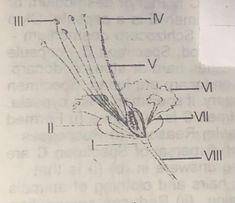
Which of the labellled parts represent the (a) female reproductive system (b) petal?
Attached Figure / Diagram
medium Difficulty
Verified Correct Answer: Option
Biological Concept & Syllabus Guide
. (a) IV, V and VIl (b) VI
Source: Myschool Past Questions Archive (Record #59818)
Biology
WAEC / WASSCE 1992
Reproduction in Plants & Animals
Diagram
Solution
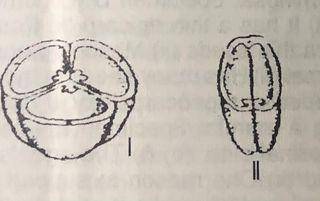
What types of placentation are represented by diagrams I and II
Attached Figure / Diagram
medium Difficulty
Verified Correct Answer: Option
Biological Concept & Syllabus Guide
. (i) Axile placentation (ii) Marginal placentation
Source: Myschool Past Questions Archive (Record #59819)
Biology
WAEC / WASSCE 1992
Cell Structure, Organization & Cell Division
Diagram
Solution
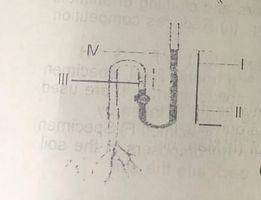
Study the diagram below and use it to answer questions (a)-(d)
(a) Name the set-up illustrated in the diagram (b) What is the apparatus used for? (c) What is contained in the part of the apparatus labelled IV? (d) From which part(s) of the apparatus would the reading(s) be taken after the experiment?
Attached Figure / Diagram
medium Difficulty
Verified Correct Answer: Option
Biological Concept & Syllabus Guide
(a) Monometer (b) It is used to measure chloroplast which is the main centre for photosynthesis (c) Mercury (d) From 1
Source: Myschool Past Questions Archive (Record #59820)
Biology
WAEC / WASSCE 1992
Nutrition in Plants & Animals (Photosynthesis & Food Substances)
Solution
(a) State two ways in which the mesophyll layer of the leaf is adapted for photosynthesis (b) In the test for starch in a leaf, why is the leaf boiled in warm alcohol?
medium Difficulty
Verified Correct Answer: Option
Biological Concept & Syllabus Guide
(a) (i) It posses chloroplast which is the main centre for photosynthesis (ii) it has air spaces in which carbon (iv) oxide accumulates and is used to carry out photosynthesis (b) in order to remove the chlorophyll
Source: Myschool Past Questions Archive (Record #59821)
Biology
WAEC / WASSCE 1992
Variety of Organisms & Classification of Living Things
Solution
List three uses of fibres to plants.
medium Difficulty
Verified Correct Answer: Option
Biological Concept & Syllabus Guide
(i) Mechanical support (ii) rigidity to plant (iii) flexibility to plant
Source: Myschool Past Questions Archive (Record #59822)
Mathematics
UTME / JAMB 1991
Linear, Simultaneous & Quadratic Equations
Solution
A car travels from calabar to Enugu, a distance of P km with an average speed of U km per hour and continues to benin, a distance of Q km, with an average speed of Wkm per hour. Find its average speed from Calabar to Benin
A
\(\frac{(p + q)}{pw + qu}\)
B
\(\frac{uw(p + q)}{pw + qu}\)
C
\(\frac{uw(p + q)}{pw}\)
D
\(\frac{uw}{pw + qu}\)
medium Difficulty
Verified Correct Answer: Option B
Step-by-Step Mathematical Solution
Average speed = \(\frac{total Distance}{Total Time}\)
from Calabar to Enugu in time t1, hence
t1 = \(\frac{P}{U}\) also from Enugu to Benin
t2 \(\frac{q}{w}\)
Av. speed = \(\frac{p + q}{t_1 + t_2}
= p + q * \frac{p}{u} + \frac{q}{w}\)
= p + q x \(\frac{uw}{pw + qu}\)
= \(\frac{uw(p + q)}{pw + qu}\)
Source: WAEC / JAMB / NECO Classroom Archive (Record #31395)
Mathematics
WAEC / WASSCE 1991
Mensuration (Areas, Perimeters & Volumes)
Diagram
Solution
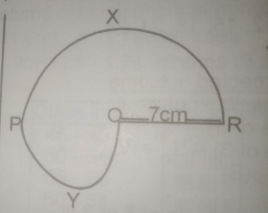
In the diagram above, PXR and PYO are two semicircles with diameters 14cm and 7cm respectively. Find the perimeter of the region (take \(\pi\) = \(\frac{22}{7}\) )
Attached Figure / Diagram
A
22cm
B
33cm
C
40cm
D
47cm
E
66cm
medium Difficulty
Verified Correct Answer: Option C
Step-by-Step Mathematical Solution
P = \(\pi\)r + \(\pi\)r + R = \(\frac{22}{7}\) x 7 + \(\frac{22}{7}\) x \(\frac{7}{2}\) + 7
P = 22 + 11 + 7 = 40cm
Source: WAEC / JAMB / NECO Classroom Archive (Record #22912)
Mathematics
UTME / JAMB 1991
Fractions, Decimals, Percentages & Approximations
Solution
What is the product of \(\frac{27}{5^1}\)(3)-3 and \(\frac{(1)^{-1}}{5}\)?
A
5
B
3
C
1
D
\(\frac{1}{25}\)
medium Difficulty
Verified Correct Answer: Option D
Step-by-Step Mathematical Solution
\(\frac{27}{5^1}\)(3)-3 x \(\frac{(1)^{-1}}{5}\) = \(\frac{27}{5}\) x \(\frac{1}{3^3}\) x \(\frac{1}{\frac{1}{5}}\)
= \(\frac{27}{5}\) x \(\frac{1}{27}\) x \(\frac{1}{5}\)
= \(\frac{1}{25}\)
Source: WAEC / JAMB / NECO Classroom Archive (Record #31376)
Mathematics
UTME / JAMB 1991
Fractions, Decimals, Percentages & Approximations
Solution
Musa borrows N10.00 at 2% per month simple interest and repays N8.00 after 4 months. How much does he still owe?
A
N10.80
B
N10.67
C
N2.80
D
N2.67
medium Difficulty
Verified Correct Answer: Option C
Step-by-Step Mathematical Solution
I = \(\frac{PRT}{100}\)
= \(\frac{10 \times 2 \times 4}{100}\)
= \(\frac{4}{5}\)
= 0.8
Total amount = N10.80
He pays N8.00
Remainder = 10.80 - 8.00
= N2.80
Source: WAEC / JAMB / NECO Classroom Archive (Record #31374)