
Question Library

Browse, filter, and study verified past examination questions with step-by-step mathematical reasoning.
Launch Interactive Practice
Searching 18,000+ Questions... Sifting topics, KaTeX formulas & verified solutions
Showing 24151–24165 of 29811 verified questions
Sort by:
Chemistry UTME / JAMB 1992 Stoichiometry, Mole Concept & Volumetric Analysis
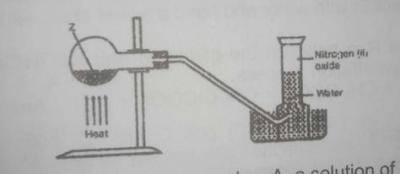
In the experiment above. Z can be
Attached Figure / Diagram
Question diagram
A
a solution of sodium dioxonitrate (lll) and ammonium chloride
B
a solution of lead trioxnitrate (V)
C
a solution of sodium trioxonitrate (V) and ammonium chloride
D
concentrated tetraoxosulphate (VI) acid and sodium trioxonitrate (V)
medium Difficulty
Chemistry UTME / JAMB 1992 Organic Chemistry II: Functional Groups, Polymers & Biomolecules
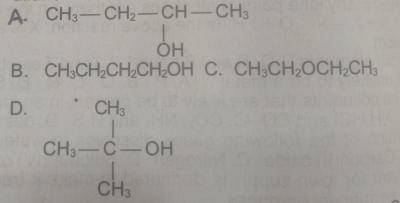
Which of the following compounds is a secondary alkanol?
Attached Figure / Diagram
Question diagram
A
A
B
B
C
C
D
D
medium Difficulty
Chemistry WAEC / WASSCE 1992 Non-Metals & Their Compounds
When steam is passed over white-hot coke, the products are
A
carbon (IV) oxide and nitrogen
B
carbon (II) oxide and hydrogen
C
carbon (ll) oxide and nitrogen
D
carbon (lV) oxide and steam
medium Difficulty
Chemistry WAEC / WASSCE 1992 Atomic Structure, Orbitals & Nuclear Chemistry
The maximum number of electrons that can accommodated in the shell having the principal quantum number 3 is
A
3
B
9
C
10
D
18
E
32
medium Difficulty
Chemistry WAEC / WASSCE 1992 Organic Chemistry II: Functional Groups, Polymers & Biomolecules
Methanol is obtained from wood by
A
esterification
B
bacterial decomposition
C
combustion
D
fractional distillation
E
destructive distillation
medium Difficulty
Chemistry WAEC / WASSCE 1992 Acids, Bases, pH & Salts
Which of the following processes is a physical reaction?
A
Electrolysis
B
Hydrolysis
C
Allotropic change
D
Neutralization
E
Corrosion
medium Difficulty
Chemistry WAEC / WASSCE 1992 Stoichiometry, Mole Concept & Volumetric Analysis
The following acids are monobasic except
A
methanoic acid
B
dioxonitrate lll acid
C
ethanedioic acid
D
oxochlorate (l) acid
E
hydrobromic acid
medium Difficulty
Chemistry WAEC / WASSCE 1992 Organic Chemistry I: Hydrocarbons & Crude Oil
The reactions ethyne are mainly
A
substitution reactions
B
addition reactions
C
addition polymerization
D
catalytic hydrogenation
E
catalytic halogenation
medium Difficulty
Chemistry WAEC / WASSCE 1992 Periodic Table & Periodicity
When air is passed through potash and then pyrogallol, the components are noble gases,
A
oxygen and carbon (IV) oxide
B
oxygen and nitrogen
C
nitrogen and water vapour
D
water vapour and carbon (IV) oxide
E
oxygen and water vapour
medium Difficulty
Chemistry WAEC / WASSCE 1992 Stoichiometry, Mole Concept & Volumetric Analysis
The halide used widely in photography is
A
ammonium chloride
B
calcum chloride
C
silver bromide
D
sodium brmide
E
aluminium fluroide
medium Difficulty
Chemistry WAEC / WASSCE 1992 Water, Solutions & Solubility
The scum formed when soap is mixed with hard water could be
A
calcium trioxocarbonate (IV)
B
propane- 1, 2, 3 - triol
C
calcium hydrogentrioxocarbonate (IV)
D
magnesium tetraoxosulphate (IV)
E
calcium stearate
medium Difficulty
Chemistry WAEC / WASSCE 1992 Electrolysis & Electrochemical Cells
What is the quantity of electricity produced when a current of 0.5A is passed for 5 hours 45 mins? (1F = 96500C)
A
0. 11F
B
0.12F
C
0.22F
D
1.1F
E
2.2F
medium Difficulty
Chemistry WAEC / WASSCE 1992 Reaction Rates & Chemical Equilibrium
''The rate a reaction is proportional to the number of effective collisions occurring per second between the reactants''. This statement is associated with the
A
Kinetic theory
B
rate law
C
atomic theory
D
collision theory
E
gas laws
medium Difficulty
Chemistry WAEC / WASSCE 1992 Stoichiometry, Mole Concept & Volumetric Analysis
What is the following compounds will not decompose when heated strongly ?
A
NaHCO3
B
K2CO3
C
MgCO3
D
Ca(HCO3)2
E
ZnCO3
medium Difficulty
Chemistry WAEC / WASSCE 1992 Atomic Structure, Orbitals & Nuclear Chemistry
What is the change in the oxidation number of phosphorus in the the reaction represented by the following equation? 4P (s) + 5O(2)(g) → 2P2O5(g)
A
0 to + 2
B
0 to 5
C
+4 to + 2
D
+4 to +5
E
+4 to +7
medium Difficulty
Page 1611 of 1988