Question Library
Browse, filter, and study verified past examination questions with step-by-step mathematical reasoning.
Searching 18,000+ Questions...
Sifting topics, KaTeX formulas & verified solutions
Showing 226–240 of 29811 verified questions
Sort by:
Mathematics
WAEC / WASSCE 2025
Mensuration
Solution
The positions of two countries, P and Q, are (15ºN, 12ºE) and (65ºN, 12ºE) respectively. What is the difference in latitude?
A
50°
B
104°
C
80°
D
100°
medium Difficulty
Verified Correct Answer: Option A
Step-by-Step Mathematical Solution
Latitude of P = 15ºN; Latitude of Q = 65ºN P and Q both lies in northern hemisphere Latitudinal difference = 65º - 15º = 50º
Source: WAEC / JAMB / NECO Classroom Archive (Record #75843)
Mathematics
WAEC / WASSCE 2025
Mensuration
Solution
A 120º sector of a circle of radius 21 cm is bent to form a cone. What is the base radius of the cone?
A
3\(\frac{1}{2}\) cm
B
10\(\frac{1}{2}\) cm
C
14 cm
D
7 cm
medium Difficulty
Verified Correct Answer: Option D
Step-by-Step Mathematical Solution
PQ = circumference of the base of the cone = 2\pir
PQ = \(\frac{120}{360}\) \times 2\pir = \(\frac{120}{360}\) \times 2 \times \(\frac{22}{7}\) \times 21 = 44 cm
∴ 44 = 2\pir; 44 = 2 \times \(\frac{22}{7}\) \times r
44 = \(\frac{44}{7}\) r
r = 7 cm
OR
r = \(\frac{R\theta}{360}\) = \(\frac{21 \times 120}{360}\) = 7cm.
Source: WAEC / JAMB / NECO Classroom Archive (Record #75845)
Mathematics
WAEC / WASSCE 2025
Mensuration
Diagram
Solution
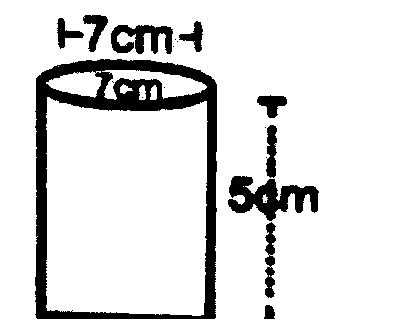
A cylindrical container, closed at both ends, has a radius of 7 cm and a height of 5 cm. Use this information to answer the questions below. What is the volume of the container?
Attached Figure / Diagram
A
770 cm\(^3\)
B
35 cm\(^3\)
C
220 cm\(^3\)
D
154 cm\(^3\)
medium Difficulty
Verified Correct Answer: Option A
Step-by-Step Mathematical Solution
Volume of tin = \pir\(^2\)h = \(\frac{22}{7}\) \times 7\(^2\) \times 5 = 770 cm\(^3\)
Source: WAEC / JAMB / NECO Classroom Archive (Record #75847)
Mathematics
WAEC / WASSCE 2025
Angles & Parallel Lines
Diagram
Solution
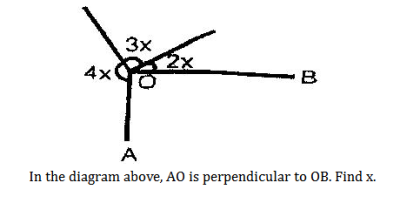
In the diagram above, AO is perpendicular to OB. Find x.
Attached Figure / Diagram
A
15°
B
22.5°
C
7.5°
D
30°
medium Difficulty
Verified Correct Answer: Option D
Step-by-Step Mathematical Solution
Since OA is ⊥ to OB
∴ ∠ AOB = 90º.
Hence, 4x + 3x + 2x + 90º = 360º (sum of angles at a point) 9x + 90º = 360º
9x = 270º;
x = 30º
Source: WAEC / JAMB / NECO Classroom Archive (Record #75857)
Mathematics
WAEC / WASSCE 2025
Angles & Parallel Lines
Diagram
Solution
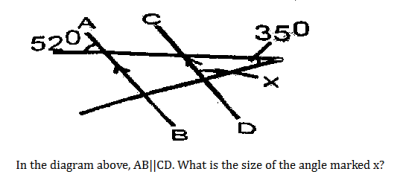
In the diagram above, AB||CD. What is the size of the angle marked x?
Attached Figure / Diagram
A
93°
B
77°
C
103°
D
62°
medium Difficulty
Verified Correct Answer: Option A
Step-by-Step Mathematical Solution
If P and E are points on CD and AB, respectively
∠ CPE = 52^\circ (corresponding angles are equal)
∴ ∠ TPD = 52^\circ (vertically opposite angles are equal)
∴ 52^\circ + x^\circ + 35^\circ = 180^\circ (sum of angles in a triangle)
∴ x^\circ + 87^\circ = 180^\circ
x = 93^\circ
Source: WAEC / JAMB / NECO Classroom Archive (Record #75908)
Mathematics
WAEC / WASSCE 2025
Angles & Parallel Lines
Diagram
Solution
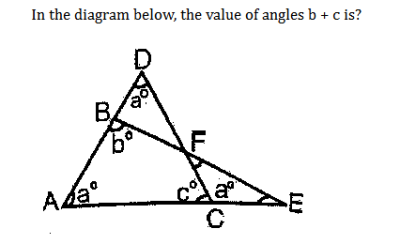
In the diagram above, the value of angles b + c is
Attached Figure / Diagram
A
a°
B
90°
C
180°
D
d°
medium Difficulty
Verified Correct Answer: Option C
Step-by-Step Mathematical Solution
∠BFC = 180^\circ - a^\circ (adjacent angles on a straight line)
∴ a^\circ + b^\circ + c^\circ + ∠BFC = 360^\circ (quadrilateral) a^\circ + b^\circ + c^\circ + (180^\circ - a^\circ) = 360^\circ
b^\circ + c^\circ = 360^\circ - (180^\circ - a^\circ) - a^\circ
b^\circ + c^\circ = 360^\circ - 180^\circ + a^\circ - a^\circ
b^\circ + c^\circ = 180^\circ
Source: WAEC / JAMB / NECO Classroom Archive (Record #75909)
Mathematics
UTME / JAMB 2025
Triangles and Polygons
Solution
Calculate the interior angle of a 5 - sided regular polygon
A
120º
B
90º
C
108º
D
180º
medium Difficulty
Verified Correct Answer: Option C
Step-by-Step Mathematical Solution
To calculate the interior angle of a regular polygon, we use the formula:
\(\text{Interior Angle} = \frac{(n - 2) \times 180^\circ}{n}\)
where \( n \) is the number of sides. For a 5-sided polygon (pentagon):
\(\text{Interior Angle} = \frac{(5 - 2) \times 180^\circ}{5} = \frac{3 \times 180^\circ}{5} = \frac{540^\circ}{5} = 108^\circ\)
Thus, the interior angle of a regular pentagon is \( 108^\circ \).
Source: WAEC / JAMB / NECO Classroom Archive (Record #74159)
Mathematics
UTME / JAMB 2025
Triangles and Polygons
Diagram
Solution
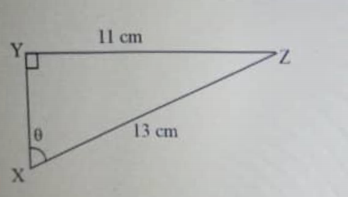
Given the triangle XYZ above, calculate the value of Cot \(\theta\) and the length XY, respectively
Attached Figure / Diagram
A
\(\frac{\sqrt{48}}{13}\), \(\sqrt{48}\)
B
\(\frac{\sqrt{48}}{11}\), \(\sqrt{48}\)
C
\(\frac{\sqrt{13}}{11}\), \(\sqrt{13}\)
D
\(\frac{13}{\sqrt{48}}\), \(\sqrt{48}\)
medium Difficulty
Verified Correct Answer: Option B
Step-by-Step Mathematical Solution
The triangle XYZ is a right-angled triangle at Y, with opposite side to \theta (YZ) = 11 cm and hypotenuse (XZ) = 13 cm.
The length of XY = \(\sqrt{(13^2 - 11^2)}\) = \(\sqrt{(169 - 121)}\) = \(\sqrt{48}\) cm (or 4\(\sqrt{3}\) cm in simplified form).
Cot \theta = \(\frac{\text{adjacent}}{\text{opposite}}\) = \(\frac{\text{XY}}{\text{YZ}}\) = \(\frac{\sqrt{48}}{11}\)
Source: WAEC / JAMB / NECO Classroom Archive (Record #74203)
Mathematics
WAEC / WASSCE 2025
Triangles and Polygons
Solution
Which of the following angles is an exterior angle of a regular polygon?
A
95°
B
78°
C
72°
D
85°
medium Difficulty
Verified Correct Answer: Option C
Step-by-Step Mathematical Solution
\(\frac{360^\circ}{\text{n}}\) must be a positive integer
\(\frac{360^\circ}{72^\circ}\) = 5
Source: WAEC / JAMB / NECO Classroom Archive (Record #75902)
Mathematics
WAEC / WASSCE 2025
Triangles and Polygons
Diagram
Solution
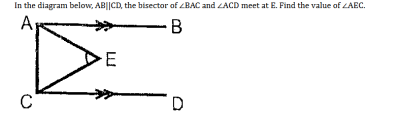
In the diagram below, AB||DC, the bisectors of < BAC and < ACD meet at E. Find the value of < AEC
Attached Figure / Diagram
A
45°
B
60°
C
30°
D
90°
medium Difficulty
Verified Correct Answer: Option D
Step-by-Step Mathematical Solution
∠BAC = 90^\circ
∠ACD = 90^\circ if AE and CE are the bisectors of ∠BAC and ∠ACD respectively ∠BAE = 45^\circ; ∠DCE = 45^\circ
∴ ∠EAC = ∠ECA = 45^\circ
But ∠EAC + ∠ACE + ∠AEC = 180^\circ (angle in a △)
∴ 45^\circ + 45^\circ + ∠AEC = 180^\circ
∠AEC = 180^\circ - 90^\circ
∠AEC = 90^\circ
Source: WAEC / JAMB / NECO Classroom Archive (Record #75907)
Mathematics
WAEC / WASSCE 2025
Triangles and Polygons
Diagram
Solution
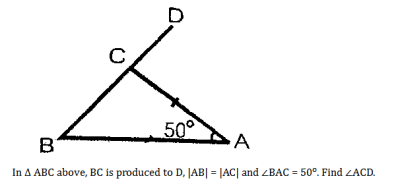
In △ABC above, BC is produced to D, |AB| = |AC|, and ∠BAC = 50°. Find ∠ACD.
Attached Figure / Diagram
A
115°
B
65°
C
60°
D
50°
medium Difficulty
Verified Correct Answer: Option A
Step-by-Step Mathematical Solution
∴ Triangle ABC is isosceles.
:∠ACB = ∠ABC
∠ACD = 180^\circ - ∠ACB (angle on a straight line)
Let ∠ACB = ∠ABC = x
.: 2x + 50 = 180^\circ (sum of angles in a triangle)
2x = 130^\circ
x = 65^\circ
.: ∠ACB = 65^\circ ==> ∠ACD = 180^\circ - 65^\circ = 115^\circ
Source: WAEC / JAMB / NECO Classroom Archive (Record #75910)
Mathematics
WAEC / WASSCE 2025
Triangles and Polygons
Diagram
Solution
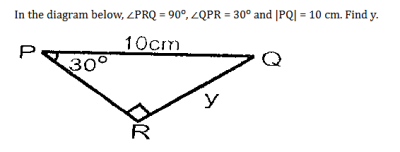
In the diagram above, < PRQ = 90º, < QPR = 30º and |PQ| = 10 cm. Find y
Attached Figure / Diagram
A
6cm
B
4cm
C
5cm
D
3cm
medium Difficulty
Verified Correct Answer: Option C
Step-by-Step Mathematical Solution
From the figure, sin 30^\circ = \(\frac{\text{y}}{10}\)
∴ 10 \times sin 30^\circ = y
y = (10 \times \(\frac{1}{2}\)) = 5 cm
Source: WAEC / JAMB / NECO Classroom Archive (Record #75911)
Mathematics
UTME / JAMB 2025
Geometric Construction
Solution
Which of the following angles cannot be constructed using a protractor, a compass, and a sharpened pencil?
A
135°
B
90°
C
145°
D
60°
medium Difficulty
Verified Correct Answer: Option C
Step-by-Step Mathematical Solution
In classical constructions with compass and straightedge, 60^\circ (equilateral), 90^\circ (square), and 135^\circ (90^\circ + 45^\circ) are constructible. 145^\circ is not constructible in general (not a multiple resulting from bisections of constructible angles).
Source: WAEC / JAMB / NECO Classroom Archive (Record #74098)
Mathematics
WAEC / WASSCE 2025
Geometric Construction
Solution
The locus of a point which is equidistant from two given fixed points is the
A
Angle bisector of the straight lines joining them.
B
Parallel line to the straight line joining them.
C
Perpendicular to the straight line joining them.
D
Perpendicular bisector of the straight line joining them.
medium Difficulty
Verified Correct Answer: Option D
Step-by-Step Mathematical Solution
Locus theorem states that: The locus of a point that moves so that it is equidistant from two given fixed points is the perpendicular bisector of the straight line joining them.
Source: WAEC / JAMB / NECO Classroom Archive (Record #75903)
Mathematics
WAEC / WASSCE 2025
Geometric Construction
Solution
a. Using a ruler and a pair of compasses only, construct triangle ABC with |AB| = 7.5cm, |BC| = 8.1cm, and < ABC = 105º
b. Locate a point D on \(\overline{BC}\) such that |BD| : |DC| is 3:2
c. Through D, construct a line L perpendicular to \(\overline{BC}\)
d. If the line L meets \(\overline{AC}\) at P, measure |BP|
medium Difficulty
Verified Correct Answer: Option
Step-by-Step Mathematical Solution
a. EXPLANATION FOR CONSTRUCTION
i. Measure AB = 7.5 cm with a compass from a ruler.
ii. Make an arc with this compass, placing the needle at point B
iv. Construct an angle of 105^\circ at B
v. Join the angle until it touches the previous arc made with a length of 8.1 cm
vi. Call this point of intersection C, then join CA
vii. Draw a line BQ to any length
viii. Divide BQ into 5 equal parts with a compass
ix. Join the fifth division to C and draw a line parallel to this to join the third division to line BC, and call the point where they meet D.
x. At D, construct angle 90^\circ, the point where the line of construction of 90^\circ meets AC, call it "P"
xi. Measure BP
b.
c.
d |BP| = 5.5cm.
Source: WAEC / JAMB / NECO Classroom Archive (Record #75959)