Question Library
Browse, filter, and study verified past examination questions with step-by-step mathematical reasoning.
Searching 18,000+ Questions...
Sifting topics, KaTeX formulas & verified solutions
Showing 23686–23700 of 29811 verified questions
Sort by:
Biology
WAEC / WASSCE 1993
Reproduction in Plants & Animals
The changing of colour by a chameleon to that of the environment is
an example of
A
adaptive radiation
B
protective coloration
C
courtship display
D
display of body colour
E
territorial behaviour
medium Difficulty
Verified Correct Answer: Option B
Biological Concept & Syllabus Guide
No expanded working has been attached for this question yet. The verified answer is Option B.
Source: Myschool Past Questions Archive (Record #16854)
Biology
WAEC / WASSCE 1993
Adaptation & Evolution
The division of labour in social insects is an example of
A
structural adaptation
B
physiological adaptation
C
commensalism
D
behavioural adaptation
E
hormonal influence
medium Difficulty
Verified Correct Answer: Option D
Biological Concept & Syllabus Guide
No expanded working has been attached for this question yet. The verified answer is Option D.
Source: Myschool Past Questions Archive (Record #16856)
Biology
UTME / JAMB 1993
Variety of Organisms & Classification of Living Things
After circulation in the lungs, the blood returns to the left auricle through
A
1
B
4
C
5
D
6
medium Difficulty
Verified Correct Answer: Option D
Biological Concept & Syllabus Guide
No expanded working has been attached for this question yet. The verified answer is Option D.
Source: Official Exam / Past Question Archive
Biology
UTME / JAMB 1993
Variety of Organisms & Classification of Living Things
Diagram
Solution
Which of the following is the correct order of the developmental stages?
Attached Figure / Diagram
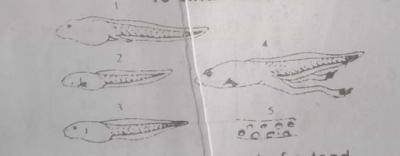
A
1->2->3->4->5
B
5->1->3->2->4
C
2->1->3->4->5
D
5->3->2->1->4
medium Difficulty
Verified Correct Answer: Option D
Biological Concept & Syllabus Guide
.
Source: Myschool Past Questions Archive (Record #41356)
Biology
UTME / JAMB 1993
Respiration & Gaseous Exchange
Diagram
Stage 3 breathes
Attached Figure / Diagram
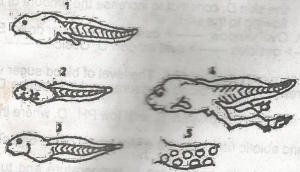
A
with the lungs
B
with the external gills
C
with the internal gills
D
through the skin
medium Difficulty
Verified Correct Answer: Option D
Biological Concept & Syllabus Guide
No expanded working has been attached for this question yet. The verified answer is Option D.
Source: Myschool Past Questions Archive (Record #41357)
Biology
UTME / JAMB 1993
Variety of Organisms & Classification of Living Things
Diagram
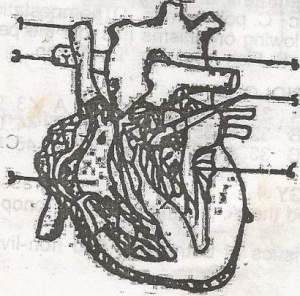
Blood is pumped into the right ventricle by the contraction of the auricle wall through
Attached Figure / Diagram
A
1
B
3
C
5
D
6
medium Difficulty
Verified Correct Answer: Option B
Biological Concept & Syllabus Guide
No expanded working has been attached for this question yet. The verified answer is Option B.
Source: Myschool Past Questions Archive (Record #41358)
Biology
UTME / JAMB 1993
Variety of Organisms & Classification of Living Things
Diagram
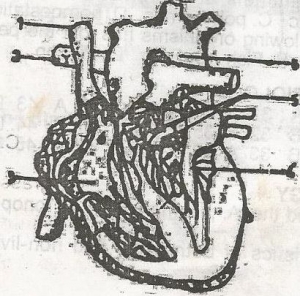
After circulation in the lungs, the blood returns to the left auricle through
Attached Figure / Diagram
A
1
B
4
C
5
D
6
medium Difficulty
Verified Correct Answer: Option D
Biological Concept & Syllabus Guide
No expanded working has been attached for this question yet. The verified answer is Option D.
Source: Myschool Past Questions Archive (Record #41360)
Biology
WAEC / WASSCE 1993
Nutrition in Plants & Animals (Photosynthesis & Food Substances)
Solution
SECTION A
Answer all the questions in both sections
1. State the importance of the following elements to plants: (a) iron: (b) phosphorus (c) calcium (d) potassium
2. Give one example each of the following (a) plant parasite (b) saprophytic plant (c) carnivorous plant.
3. List two structural modifications each of one named bird which feeds on: (a) nectar, (b) flesh.
4. State three principles on which the use of the quadrat for determining population density is based on
5. (a) Name the nucleic acid that caries inherited traits (b) Name four elements found in the named nucleic acid.
6. Diagrams A and B below represent the reaction of some structures in the mammalian skin to different environmental conditions.
Use them to answer questions (a) and (b)
(a) Which of the diagrams represents tne reactions of the skin to cold condition? (b) List four observations from the diagrams to support your answer.
7. State three methods of controlling growth of micro- organisms.
8. In an experiment it was found that auxin was concentrated more on the shaded side of the shoot as shown in the diagram below
Use the diagram to answer questions (a) to (c):
(a) From which direction did light reach the shoot? (b) Towards which of the directions, side A or side B will the tip grow? (c)Suggest a title for this experiment. Layer of trapped air Layer of- trapped air.
SECTION B
Answer all the questions
9 Examine specimens A and B carefully, (a) State: (i) two similarities (ii) four differences. In structure between them (b) Make a labeled drawing 6-8 cm wide of the cut surface of specimen A.
10. (a) identify specimens C and D without giving reasons for your answer.
(b) In a tabular form state three differences in external features between specimens C and D.
(c) Remove a quill feather from specimen D and label it D. Make a fully labeled diagram 10 to 20 cm long of specimen D
(d) Explain how four observable features of specimen C adapt the organism to life in water. Shoot.
11. The amount of starch hydrolyzed by the enzyme ptyalin over a period of time at three different temperature are given in the table below
Time in Minutes
Volume of Starch hydrolyzed at different Temperature
15^\circC 25^\circC 45^\circC
5
10.0cm\(^3\) 21.5cm\(^3\) 4.0cm\(^3\)
10
20.0 cm\(^3\) 40.0 cm\(^3\) 6.5cm\(^3\)
15
30.0 cm\(^3\) 56.5cm\(^3\) 10.0cm\(^3\)
20
40.0 cm\(^3\) 68.5cm\(^3\) 17.0cm\(^3\)
25
50.0 cm\(^3\) 70.0cm\(^3\) 19.0cm\(^3\)
(a) Placing time on the horizontal axis and the amount of starch hydrolyzed on the vertical axis, plot the date given for the different temperatures on the sam graph (b) From the graph deduce the effect(s) of temperature on the action of ptyalin on starch (C) Calculate the amount of starch hydrolyzed at the (i) 7th minute at 15^\circC (ii) 12th minute at 25^\circC (i) 24th minute at 45^\circC.
medium Difficulty
Verified Correct Answer: Option
Biological Concept & Syllabus Guide
SECTION A
1. (a) Iron - Required for formation of chlorophyll
(b) Phosphorus - Formation of nucleic acids, enzymes, controls cell division
(c) Calcium - For cel formation, neutralization of some organic acids
(d) Potassium - Required for cell formation and regulation of cell activities
2. (a) Plant parasite Cassytha, Mistletoe
(b) Saprophytic plant - Rhizopus, mucor
(c) Carnivorous plant - Bladderwort, drosera, Venus plant.
3. Structural modifications of named birds that feed on (a) Nectar,: (i) The weight is light (ii) The beak is long and pointed
(iii) The name of the bird is Sunbird (b) Flash: (i) The beak is sharp and curved (ii) eyes are keen and bulging (iii) The claws are sharp curved (iv) The name of the bird is Hawk.
4. Principles on which the use of quadrat for determining population are based: (i) The quadrant is used for stationary organisms
(ii) At least ten throws must be made
(iii) The size of the quadrat depends on the organism being sampled.
5. (a) Deoxyribonucleic acid or ribonucleic acid (b) Phosphorus, carbon, hydrogen, nitrogen, sulfur
6. (a) Diagram B (b) (i) The hair stands erect (ii) There is no sweating (iii) Blood vessels constrict (iV) The erector muscle of the hair contracts.
7. Using high temperature (auto clearing) (i) By the application of salt (ii) By the user of antibiotics (iii) By the use of antiseptic.
8. (a) Direction B (b) Direction B (c) Experiment to show phototropism of shoot to unilateral supply of light OR. To show the effect of auxin on plant growth.
SECTION B
9. (a) The similarities are: (choose any two from the following: (1) Presence of epicarp, mesocarp and endocarp (2) Seed present (3) Spherical in shape (4) Scar or point of attachment or remains of. style present (ii) Differences. (Choose any four from the following):
Orange
Palm fruit
Coconut
(a) Small seed.
Large seed
Large seed
(b) Has soft endocarp
Has hard endocarp
Has hard endocarp
(c) Possesses many seeds
Has one to three seeds
Has one seed
(d) Has juicy soft and fleshy mesocarp
Fibrous
Spongy and fibrous for older ones
(e) Has rough epicarp
Has smooth epicarp
Has smooth epicarp
(b) Drawing of longitudinal section of orange fruit
10. (a) Specimen C is toad or frog, specimen D is bird or chicken or cockerel (b) Differences (Choose any three from the following answers)
Specimen C
Specimen D
(i) Bulging eyes
No bulging eyes
(ii) Has no tail
Has tail
(ii) Scales present
No Scales present
(iv) No-beak
Has beak
(V) Has digits without claws
Has digit with claws
(vii) Absence of feathers or wings
Presence of feathers or wings
(VIl) No nect
Has a short nect
(d) (Choose any four from the following) (i) Possesses webbed hind limbs for swimming (ii) Possesses big eyes for looking over the water when the whole body is submerged (iii) Has a streamlined shape, for swimming through the water easily (iv) Position of the nostril, helps the animal to breath atmospheric air while the body is still submerged (v) Dark dorsal side and lighter ventral side. The dark dorsal side enables the ventral side. animal to blend with the dark floor when viewed from above, while the lighter ventral side blends with the sky when viewed from underneath (vi) Nictating membrane protecting the eye when submerged in water.
Working: 20 - 10cm|(^3\) in 10 - 5 minutes
5 minutes = 10cm\(^3\)
(i) 12th minute of 25^\circC
1 minute = 10/5 cm\(^3\)
7 minutes = 10\5 X 7/1 cm\(^3\),
= 14cm\(^3\)
5 minutes = 16.5cm\(^3\)
1 minute = 16.5/5 2/1cm\(^3\)
2 minutes = 6.6 cm\(^3\)
40+ 6.6cm\(^3\) = 46.6cm\(^3\) or 46.5cm\(^3\) if read from graph
11. (a) (b) (i) 25^\circC gave the best ptyalin action (ii) Increasing temperature above 25^\circC reduces ptyalin action (iii) Amount of starch hydrolyzed increases with time
(c) 7th minute at 15^\circC
(iii) 24th minute at 45^\circC
worked out as in (c) (ii)
25 - 20 i.e
5 minutes = 19 - 17 = 2.0cm\(^3\)
1 minute = 2/5cm\(^3\)
4 minutes = 2/5 X 2/1cm\(^3\), i.e 1.6cm\(^3\)
in 24th minutes 17 + 1.6cm\(^3\) = 18.6cm\(^3\)
or 18.5 / 18.6cm\(^3\) if read from the graph.
Source: Official Exam / Past Question Archive
Biology
WAEC / WASSCE 1993
Growth, Micro-organisms & Public Health
Solution
(a) (i) List two diseases each of plants and animals caused by bacteria.
(ii) State three ways in which bacteria are useful.
(b) State three methods by which mosquitoes can be controlled and state the reason for each method
(c) Describe an experiment to demostrate the presence of bacteria under the finger nails
medium Difficulty
Verified Correct Answer: Option
Biological Concept & Syllabus Guide
(a)(i) Diseases of plants caused by bacteria are:
(i) Soft roots
(ii) fire blight, wilts, crown gall. Disease of animals caused by bacteria are tuberculosis, cholera, leprosy , gonorrhoea, syphilis, diptheria, tetanus
(ii) Ways in which bacteria are useful are:
(1) Some bacteria are used in the preparation of cheese, butter and vinegar.
(2) Some are used in the production of antibiotics, enzymes, vitamins and amino acids for commercial purposes.
(3) In leguminous plants, bacteria such as Rhizobium found in the root nodules convert atmospheric nitrogen to soil nitrogen thus enhancing the nitrogen content of the soil.
(4) Some bacteria help in the digestion of cellulose
(5) Some bacteria help in the fermentation of alcohol and beverages.
(6) Certain bacteria known as sewage bacteria assist in the decomposition of sewage into harmless substances that could be used as manure.
(b) Mosquitoes can be controlled in the following ways:
(1) Bush around the surrounding should be cleared to prevent breeding grounds for mosquitoes.
(2) Mosquito net should be provided or fitted to our windows to prevent mosquitoes from coming within to suck human blood.
(3) Apply insecticides to kill mosquito or pour kerosine or oil on stagnant water around the house to prevent breeding.
(c) Aim: To show the presence of bacteria under the finger nails.
Apparatus: Incubator, innoculating loop, nail cutter, petridish, blood agar, microscope and cover slip.
Procedure: Cut the finger nails and place them in a petridish which have the blood agar. Then incubate at 37^\circC for two days.
Observation: It was discovered that colonies of bacteria were growing on the blood agar. On gram staining, one saw clusters of cocci bacteria. Conclusion: The growth of cocci bacteria indicates that bacteria grow on finger nails.
Source: Myschool Past Questions Archive (Record #53031)
Biology
WAEC / WASSCE 1993
Respiration & Gaseous Exchange
Solution
(a) Describe the process of inhalation in man .
(b) Describe briefly the process of gaseous exchange in the shoo: system of flowering plants.
(c) Describe an experiment to demonstrate the effect of distilled water on mammalian red blood cell.
medium Difficulty
Verified Correct Answer: Option
Biological Concept & Syllabus Guide
(a)(i) Inhalation involves the contraction of the outer muscles of the diaphragm which makes the diaphragm to pull downward and the intercostal muscles to contract to raise the ribs. The two movements increase the volume of the lungs, thereby reducing the pressure of the air inside them. This enables the air at atmospheric pressure to go into the lungs.
(b) In the shoot system of flowering plants, gaseous exchange takes place through the stomata of the leaves, the green parts and the lenticels at the bark of stem. Stoma is a hole enclosed by two guard cells which change in volume due to osmotic pressure in the guard cells. When the osmotic pressure in the guard cells is high, they become turgid and this makes the stoma to open and when the pressure is low, the guard cells become flaccid and this makes the stoma to close. Generally, exchange of gases in and out of the leaves and lenticels is controlled by the opening and closing of the stomata.
(c) Experiment to demonstrate the effect of distilled water on mammalian red blood cell:
Aim: To show that distilled water has effect on the red blood cell.
Apparatus: Beaker, distilled water, thistle funnel, ether, pig's bladder and red blood cells.
Method: The pig's bladder is dissolved in ether to make it soft and used to close or seal the stem end of the thistle funnel. Then pour the red blood cells into the thistle funnel and immerse in water inside the beaker. Mark the initial level of both solutions.
Observation and conclusion: It was observed that the level of red blood cells had risen in the thistle funnel indicating that the distilled water moved into the thistle funnel via the pig's bladder.
Source: Myschool Past Questions Archive (Record #53035)
Biology
WAEC / WASSCE 1993
Basic Ecological Concepts, Ecosystems & Biomes
Solution
(a) Give a brief description of the characteristics of the Northern Guinea Savanna.
(b) Describe how you can estimate the density of a plant species using a quadrat.
medium Difficulty
Verified Correct Answer: Option
Biological Concept & Syllabus Guide
(a). The characteristics of Northern Guinea Savanna are:
(i) It has bare soil with scanty trees.
(ii) Has long twisted roots to facilitate the absorption of water and mineral salts.
(iii) Possesses thick barks which enable it to withstand harsh weather, e.g. fire and intensive sunlight.
(iv) Has twisted and gnarled trunks, which enable it to resist fire and excessive transpiration.
(v) Availability of herbivorous animals such as zebra, squirrel, antelope, grasscutter etc.
(vi).Availability of perennial grasses that grow in tufts and resist fire.
(vii) Presence of underground stems, e.g. spear grass which make the plants to be able to survive, after long period of dry season or fire out break.
(viii) Temperature is usually above 18^\circC throughout the year.
(ix) Trees shed their leaves during the dry season and this enables them to conserve water.
(b) Aim: To estimate the density of a plant species using quadrat sampling technique (a method of studying plant species).
Method: A quadrat is a rectangular frame which is constructed from wire or wood of known dimension. Before usage, mark the area where the species to be measured occurs. Then throw the quadrat to land randomly on any part of the marked off area. Note the area covered at each landing of the quadrat. In the process, each species of plant is counted and recorded. To determine the density, calculate the average frequency of the plant species as the number of times the plant species occurs divided by the total number of quadrat throws made.
Formula= Number of times plant species occurs
Total number of quadrat throws made
Finally, divide the average frequency by the area of the quadrat =
Average Frequency
Area of quadrat .
Source: Myschool Past Questions Archive (Record #53038)
Biology
WAEC / WASSCE 1993
Variation & Genetics (Heredity)
Solution
(a) List four characters which can be transmitted from parent to offspring in man.
(b) State two differences between mitosis and meiosis.
(c) Explain briefly the importance of meiosis and fertilization in the reproduction of organisms.
(d) In a monohybrid cross between a pure breeding plant that produces blue flowers and a pure breeding plant that produces white flowers, the F1 generation produced only blue flowers. By means of labelled cross diagrams, state the type of flowers you would expect if the Fl generation is (i) self-pollinated; (ii) cross-pollinated with a pure breeding plant that produces white flowers. Give reasons for your answers in (d) (i) and (ii).
medium Difficulty
Verified Correct Answer: Option
Biological Concept & Syllabus Guide
(a) Characters which can be transmitted from parents to offspring in man are:
(i) Tongue rolling
(ii) Sickle cell anaemia
(iii) Colour blindness
(iv) Height (Tallness or shortness)
(v) Haemophilia
(vi) Colour of skin
(vii) Colour of hair
(viii) ColoOr of eyes
(ix) Shape (wrinkle or round).
(b) Two differences between mitosis and meiosis are:
Mitosis
Meiosis
(1) End of mitosis results in two daughter cells formed from one parent cell.
(2) During mitosis, separation or segregation of pairs of genes located on the chromosomes does not occur
-End of meiosis results in formation of one gamete.
-During meiosis, separation or segregation of pairs of genes located on, chromosomes occurs
(c)(i) Meiosis has contributed a lot in the development of quality organisms by bringing together good characters from both parents into an offspring. Mostly used in animal husbandry and crops improvement, Meiosis also involves exchange of materials which bring about variation in the offspring.
(ii) Fertilization is the first stage in the formation of a new organism. Without fertilization, it would be impossible to produce new organisms through sexual reproduction. Hence, it has erased the possibility of most organisms going into extinction because most offspring resemble their parents.
Reasons for the answer in (d)(i):
In F1 generation, all the numbers produced are heterozygous (dominant recessive) blue. When self pollinated, the F2 generation produced three blue offsprings which are homozygous blue, two heterozygous blue and one white.
Reason for (d)(ii):
Two of the offsprings produced are heterozygous blue and two homozygous recessive white (2:2) or (50:50). This result is due to F1 parents
which are heterozygous blue and the pure breeding white flowers which are homozygous recessive white.
Source: Myschool Past Questions Archive (Record #53043)
Mathematics
WAEC / WASSCE 1992
Fractions, Decimals, Percentages & Approximations
Solution
Simplify (\(\frac{3}{4} + \frac{1}{3}) \times 4\frac{1}{3} \div 3\frac{1}{4}\)
A
1/2
B
13/12
C
10/9
D
17/12
E
13/9
medium Difficulty
Verified Correct Answer: Option E
Step-by-Step Mathematical Solution
(\(\frac{3}{4} + \frac{1}{3}) \times 4\frac{1}{3} \div 3\frac{1}{4}\)
= \(\frac{13}{12} \times \frac{13}{3} \times\frac{4}{13}\)
= \(\frac{13}{9}\) or 1\(\frac{4}{9}\))
Source: WAEC / JAMB / NECO Classroom Archive (Record #23140)
Mathematics
WAEC / WASSCE 1992
Fractions, Decimals, Percentages & Approximations
Solution
Factorize the expression 2y\(^2\) + xy - 3x\(^2\)
A
2y (y + x) - 3x2
B
(2y - x)(2y + x)
C
(3x - 2y(x - y)
D
(2y + 3x)(y - x)
E
(x – y)(2y + 3x)
medium Difficulty
Verified Correct Answer: Option D
Step-by-Step Mathematical Solution
2y\(^2\) + xy - 3x\(^2\)
2y\(^2\) + 3xy - 2xy - 3x\(^2\)
y(2y + 3x) - x(2y + 3x)
= (y - x)(2y + 3x)
Source: WAEC / JAMB / NECO Classroom Archive (Record #23147)
Mathematics
UTME / JAMB 1992
Sequences & Series (AP & GP)
Solution
What is the n-th term of the sequence 2, 6, 12, 20...?
A
4n - 2
B
2(3n - 1)
C
n2 + n
D
n2 + 3n + 2
medium Difficulty
Verified Correct Answer: Option C
Step-by-Step Mathematical Solution
Given that 2, 6, 12, 20...? the nth term = n\(^2\) + n
check: n = 1, u1 = 2
n = 2, u2 = 4 + 2 = 6
n = 3, u3 = 9 + 3 = 12
∴ n = 4, u4 = 16 + 4 = 20
Source: WAEC / JAMB / NECO Classroom Archive (Record #31322)