Question Library
Browse, filter, and study verified past examination questions with step-by-step mathematical reasoning.
Searching 18,000+ Questions...
Sifting topics, KaTeX formulas & verified solutions
Showing 22921–22935 of 29811 verified questions
Sort by:
Chemistry
WAEC / WASSCE 1994
Stoichiometry, Mole Concept & Volumetric Analysis
Solution
A is a solution containing 0.050 mol. dm of tetraoxosulphate (VI) acid. B is a solution of anhydrous trioxocarbonate (IV).
(a) Put A into the burette and titrate with 20cm\(^3\) or 25cm\(^3\) portions of B using methyl orange as an indicator. Record the volume of your pipette. Tabulate your burette readings and calculate the average volume of A used
(b) From your results and the information provided, calculate the:
(i) Concentration of solution B in mol. dm\(^{-3}\)
(ii) mass of sodium tetraoxosulphate (VI) that would be formed in solution of 1dm\(^3\) of solution B were neutralized by solution A
(iii) volume of carbon (IV) oxide at s.t.p. that would be liberated in (b)(ii) above. The equation for the reaction is: N\(_2\)CO\(_{3(aq)}\) + H\(_2\)SO\(_{4(aq)}\) \(\to\) Na\(_2\)SO\(_{4(aq)}\) + H\(_2\)O\(_{(l)}\) + CO\(_{2(g)}\) [O = 16; Na = 23, S = 32; molar volume of gases of s.t.p. = 22.4dm\(^3\)
A
86g
B
92g
C
98g
D
110g
E
112g
medium Difficulty
Verified Correct Answer: Option D
Chemical Principles & Mechanism
Volume of pipette = 25 cm\(^3\)
Indicator - methyl orange
Burette readings
Rough
1st
2nd
3rd
Final burette readings (cm\(^3\))
23.10
45.00
23.60
22.40
Initial burette readings (cm\(^3\))
0.50
22.60
1.20
0.00
burette reading (cm\(^3\))
22.60
22.40
22.40
22.40
(i) Average volume of A used = \(\frac{22.40 + 22.40 + 22.40}{3}\) = 22.40cm\(^3\)
(b)(i) Equation for the reaction, mole ratio of acid to base (salt) is 1 : 1
\(\frac{\text{Molar concentration of A(C\(_A\)) x volume of A(V\(_A\))}}{\text{Molar concentration of B(C\(_B\)) x volume of B(V\(_B\))}}\) = mole reaction of \(\frac{A}{B}\) = \(\frac{0.05 \times 22.40}{C_B \times 25} = \frac{1}{1}\)
C\(_B\) = \(\frac{0.05 \times 22.40 \times 1}{25}\) = 0.0448 mol. dm\(^3\)
(ii) Molar mass of Na\(_2\)SO\(_4\) = (23 x 2) + 32 + (16 x 4) = 142g
Amount of Na\(_2\)CO\(_3\) in 1 dm\(^3\) of B = 0.0448 mole
from equation
1 mole of Na\(_2\)CO\(_3\) = 0.0488 x 142 = 6.36g
(iii) From the equation, 1 mole of Na\(_2\)CO\(_3\) produces 1 mole of CO\(_2\) at s.t.p.
i.e. mole of Na\(_2\)CO\(_3\) produces 22.4 dm\(^3\) of CO\(_2\) at s.t.p
Mole of Na\(_2CO_3\) produces \(\frac{22.4}{1}\) x 0.0448 = 1.00 dm\(^3\)
Source: Official Exam / Past Question Archive
Chemistry
UTME / JAMB 1994
Oxidation, Reduction & Redox Reactions
Solution
MnO4(aq) + 8H + 5Fe2+ \(\to\) Mn2+(aq) + 5Fe3+(aq) + H2O. The oxidation number of maganese in the above reaction changed from
A
+7 to +2
B
+6 to +2
C
+5 to +2
D
+4 to +2
medium Difficulty
Verified Correct Answer: Option A
Chemical Principles & Mechanism
\(MnO_{{4}{(aq)}}\) has a charge of \(-1\)
Let the oxidation number of \(Mn\) in \(MnO_{{4}{(aq)}}\) be X
Recall, the oxidation number of \(O_{2}\) is \(-2\)
\(\therefore\) \(X + (-2\times 4) = -1\)
\(X - 8 = -1\)
\(X = +7\)
Source: Myschool Past Questions Archive (Record #44422)
Chemistry
UTME / JAMB 1994
Acids, Bases, pH & Salts
Solution
which of these metals CANNOT replace hydrogen from alkaline solutions?
A
Aluminium
B
Zinc
C
Tin
D
Iron
medium Difficulty
Verified Correct Answer: Option D
Chemical Principles & Mechanism
Aluminum, Zinc, and Tin react with both acids and alkalis to liberate hydrogen and so all are amphoteric metals except iron.
Iron can displace hydrogen from acids, but not from alkaline solutions. Iron is a metal that is more reactive than hydrogen and therefore can displace hydrogen from acids, but not from alkaline solutions.
In general, metals that are more reactive than hydrogen can displace hydrogen from acids. This means that when a metal reacts with an acid, the metal replaces the hydrogen in the acid, forming a salt and releasing hydrogen gas. Iron is considered a reactive metal and is placed above hydrogen in the reactivity series, which means it can displace hydrogen from acids. In alkaline solutions (solutions with a high pH, like those containing hydroxide ions), the hydrogen is not in a form that can be easily displaced by metals. Instead, the alkaline solution contains hydroxide ions (OH-) and the metal will react with these ions to form a hydroxide or oxide.
Source: Myschool Past Questions Archive (Record #44423)
Chemistry
UTME / JAMB 1994
Stoichiometry, Mole Concept & Volumetric Analysis
Clothes should be properly rinsed with water after bleaching because
A
the bleach decolourizes the clothes
B
chlorine reacts with fabrics during bleaching
C
the clothes are sterilized during bleaching
D
hydrogen chloride solution is produced during bleaching
medium Difficulty
Verified Correct Answer: Option D
Chemical Principles & Mechanism
No expanded working has been attached for this question yet. The verified answer is Option D.
Source: Myschool Past Questions Archive (Record #44425)
Chemistry
UTME / JAMB 1994
Organic Chemistry II: Functional Groups, Polymers & Biomolecules
Solution
When sodium ethanoate is treated with a few drops of concentrated tetraoxosulphate(vi)acid. one of the products is
A
CH3COOH
B
CH3COOCH3
C
CH3COOC2H5
D
C2H5COOCH3
medium Difficulty
Verified Correct Answer: Option A
Chemical Principles & Mechanism
When sodium ethanoate (CH\(_3\)COONa) is treated with concentrated tetraoxosulphate(VI) acid (H\(_2\)SO\(_4\)), a displacement reaction occurs. The strong mineral acid (H\(_2\)SO\(_4\)) reacts with the salt of the weaker organic acid to displace and liberate the organic acid, which is ethanoic acid (also known as acetic acid, CH\(_3\)COOH).
Source: Myschool Past Questions Archive (Record #44427)
Chemistry
UTME / JAMB 1994
Organic Chemistry I: Hydrocarbons & Crude Oil
Diagram
Solution
From the above diagram, the caustic soda in the conical flask serves to
Attached Figure / Diagram
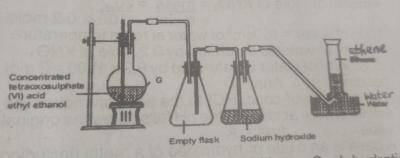
A
dry ethene gas
B
remove carbon (iv) oxides from ethene
C
remove carbon (ii) oxide from ethene
D
remove sulphur (iv) oxide from ethene
medium Difficulty
Verified Correct Answer: Option B
Chemical Principles & Mechanism
Caustic soda, \(NaOH\) , serves to remove gaseous impurities from the gas evolved during the laboratory preparation of ethene. Basically, the major impurities are Sulphur (IV) oxide and Carbon (IV) oxide.
Source: Myschool Past Questions Archive (Record #44428)
Chemistry
WAEC / WASSCE 1994
Metals, Transition Elements & Extraction
Solution
(a) State two differences in the chemical properties of metals and non-metals.
(b) List two general methods of extract metals from their ores.
medium Difficulty
Verified Correct Answer: Option
Chemical Principles & Mechanism
(a) Two differences in the chemical properties of metals and non-metals Metals Non-Metals
Metals
Non-Metals
1. it can form basic oxides
2. It can form electrovalent compounds
1. It can form acidic oxides
2. It can form covalent compounds
(b) Two general methods of extracting metals from their ores are:-
(i) Reduction by electrolysis and
(ii) By reduction with carbon II oxide.
Source: Myschool Past Questions Archive (Record #54392)
Chemistry
WAEC / WASSCE 1994
Stoichiometry, Mole Concept & Volumetric Analysis
Solution
(1)(a) State Avogadro's law
(b) Which of the state of matter contains particles that are: (i) readily used
(ii) held firmly together by some forces of cohesion;
(iii) involved in rapid random motion?
medium Difficulty
Verified Correct Answer: Option
Chemical Principles & Mechanism
(a) Avogadro's law states that equal volumes of all gases at the same temperature and pressure contain the same number of molecules.
(b)(i) Gaseous state (ii) Solid state (iii) Gaseous state.
Source: Myschool Past Questions Archive (Record #54393)
Chemistry
WAEC / WASSCE 1994
Periodic Table & Periodicity
Solution
A shortened form of the Periodic Table is shown below. Use it to answer questions (a) and (b)
(a) Which of the elements represented as A to E in the table, above is:
(i) transition metal;
(ii) an alkaline earth meta
(iii) the least reactive;
(iv) the most electronegative?
(b)(i) What type of bond would exist in a compound formed when element D reacts with oxygen?
(ii) Write the formula of the compound formed in (b)(i) above.
medium Difficulty
Verified Correct Answer: Option
Chemical Principles & Mechanism
(a) (i) E
(ii) D
(iii) A
(iv) B
(b)(i) Electrovalent bond
(ii) DO.
Source: Myschool Past Questions Archive (Record #54394)
Chemistry
WAEC / WASSCE 1994
Organic Chemistry I: Hydrocarbons & Crude Oil
Solution
(a) Give one example each of a naturally occurring substance that;
(i) conforms to the general formula C(_x\)(H\(_2\)O)\(_y\);
(ii) contains the carboxyl group as its functional group.
(b) Name the process for obtaining: (i) paraffin oil from crude oil; (ii) benzene from ethyne.
medium Difficulty
Verified Correct Answer: Option
Chemical Principles & Mechanism
(a) (i) Glucose
(ii) Citric acid
(b)(i) The process of obtaining paraffin from crude oil is called fractional distillation
(ii) The process of obtaining benzene from ethyne is called polymerization.
Source: Myschool Past Questions Archive (Record #54395)
Chemistry
WAEC / WASSCE 1994
Reaction Rates & Chemical Equilibrium
Solution
(a) Define oxidation in terms of electron transfer.
(b) Consider the following: Cu\(_{(s)}\) + 2Ag\(^{+}_{(Ag)}\) \(\to\) Cu\(^{2+}_{(aq)}\) + 2Ag\(_{(s)}\)
(i) State the species that is reduced
(ii) Write half-cell equation for each of the species.
medium Difficulty
Verified Correct Answer: Option
Chemical Principles & Mechanism
(a) Oxidation is defined as the loss or removal of electron.
(b)(i) The species that is reduced is Ag\(^+\)
(ii) Cu \(\rightleftharpoons\) Cu\(^{2+}\) + 2e\(^-\)
2Ag\(^+\) + 2e\(^-\) \(\rightleftharpoons\) 2Ag
Source: Myschool Past Questions Archive (Record #54396)
Chemistry
WAEC / WASSCE 1994
Stoichiometry, Mole Concept & Volumetric Analysis
Solution
(a) When MgSO\(_4\).XH\(_2\)O crystals were exposed to the atmosphere for several days, three was a loss in mass
(i) What name is given to this phenomenon?
(ii) Give another example of a compound that exhibits this phenomenon
(b) If 0.50 mole of MgSO\(_4\).XH\(_2\)O has a mass of 123g. calculate the value of X. (H = 1, O = 16, Mg = 24, S = 32)
medium Difficulty
Verified Correct Answer: Option
Chemical Principles & Mechanism
(a)(i) The name of the phenomenon is Efflorescence
(ii) Another example is Na\(_2\)CO\(_3\).10H\(_2\)O.
(b) Molar mass of MgSO\(_4\) x H\(_2\)O = 2x
123 = 246 i.e. 24 + 32 + (4 x 16) + x (2X 1 + 16) = 246
120 + 18x = 246;
18x = 246 - 120;
18x = 126
x = \(\frac{126}{18}\)
x = 7
Source: Myschool Past Questions Archive (Record #54400)
Chemistry
WAEC / WASSCE 1994
Organic Chemistry II: Functional Groups, Polymers & Biomolecules
Solution
(a) Write an equation to show the action of strong heat on:
(i) potassium trioxonitrate (V):
(ii) sucrose.
(b) State two observations in respect of the reaction between granulated zinc and dilute tetraoxosulphate (VI) acid.
medium Difficulty
Verified Correct Answer: Option
Chemical Principles & Mechanism
(a)(i) 2KNO\(_3\) \(\to\) 2KNO\(_2\) + O\(_2\)
(ii) C\(_{12}\)H\(_{22}\)O\(_{11}\) + 11H\(_2\)O
(b) Two observations include:
(i) gas is given off
(ii) The zinc disappears to form a colourless solution.
Source: Myschool Past Questions Archive (Record #54401)
Chemistry
WAEC / WASSCE 1994
Oxidation, Reduction & Redox Reactions
Solution
When ethane - 1,2-dioic acid is heated with concentrated tetraoxosulphate (VI) acid, a reaction represented by the following equation occurs:
(a) State the type of process involved in the reaction
(b) What is the basicity of ethane-1, s-dioic acid?
(c) List three differences in the chemical properties of the two oxides of carbon produced during the reaction
medium Difficulty
Verified Correct Answer: Option
Chemical Principles & Mechanism
(a) The type of process involved in the reaction is called dehydration
(b) The basicity of the acid is 2
(c)
Carbon (ii) oxide (CO)
Carbon (iv) oxide (CO\(_2\))
1. It burns in air
2. It is a reducing agent
3. No action on lime water
1. Does not burn in air
2. Has no reducing properties
3. It turns lime water milky.
Source: Myschool Past Questions Archive (Record #54403)
Chemistry
WAEC / WASSCE 1994
Chemical Energetics & Thermochemistry
Solution
(a) State whether entropy increases or decreases during each of the following processes
(i) condensation of steam;
(ii) melting of wax;
(iii) dissolution of sugar in water;
(iv) abscas on charcoal.
(b) What deduction can be made in each case given that the value of the free energy change for a particular reaction is:
(i) zero;
ii) negative
medium Difficulty
Verified Correct Answer: Option
Chemical Principles & Mechanism
(a) (i) The entropy decreases
(ii) The entropy increases
(iii) The entropy increases
(iv) The entropy decreases.
(b)(i) The reaction is at equilibrium.
(iii) The reaction is feasible.
Source: Myschool Past Questions Archive (Record #54405)