Question Library

Browse, filter, and study verified past examination questions with step-by-step mathematical reasoning.

Launch Interactive Practice
Searching 18,000+ Questions... Sifting topics, KaTeX formulas & verified solutions
Showing 22876–22890 of 29811 verified questions
Sort by:
Chemistry UTME / JAMB 1994 Organic Chemistry I: Hydrocarbons & Crude Oil
One mole of a hydrocarbon contains 48 g of carbon. If it vapour density is 28, the hydrocarbon is?
A
an alkane
B
an alkene
C
an alkyne
D
aromatic (C = 12, H = 1)
medium Difficulty
Chemistry UTME / JAMB 1994 Organic Chemistry II: Functional Groups, Polymers & Biomolecules
Which of the following reagents will confirm the presence of unsaturation in a compound?
A
Fehling's solution
B
Bromine water
C
Tollen's reagent
D
Benedict's solution
medium Difficulty
Chemistry UTME / JAMB 1994 Atomic Structure, Orbitals & Nuclear Chemistry
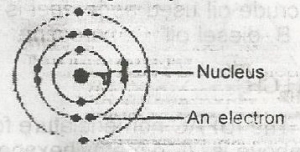
The diagram above represents an atom of
Attached Figure / Diagram
Question diagram
A
magnesium
B
helium
C
chlorine
D
neon
medium Difficulty
Chemistry UTME / JAMB 1994 Stoichiometry, Mole Concept & Volumetric Analysis
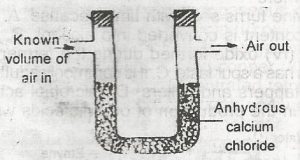
The set-up above would be useful for determining the amount of
Attached Figure / Diagram
Question diagram
A
oxygen in air
B
water vapour in air
C
CO2 in air
D
arygen in air
medium Difficulty
Chemistry UTME / JAMB 1994 Chemical Energetics & Thermochemistry
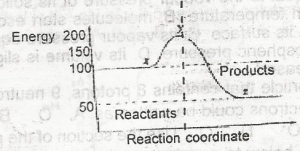
The ∆H for the reaction represented by the energy profile above is
Attached Figure / Diagram
Question diagram
A
-100 kJ mol--1
B
+ 100 kJ mol-1
C
+50 kJ mol-1
D
-50 kJ mol-1
medium Difficulty
Chemistry UTME / JAMB 1994 Reaction Rates & Chemical Equilibrium
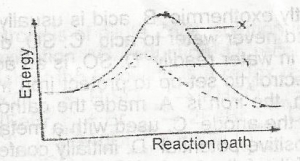
In the diagram above the activation energy is represented by
Attached Figure / Diagram
Question diagram
A
y - x
B
x
C
x - z
D
y
medium Difficulty
Chemistry UTME / JAMB 1994 Stoichiometry, Mole Concept & Volumetric Analysis
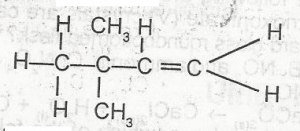
The IUPAC name of the compound above is
Attached Figure / Diagram
Question diagram
A
2,2-dimethyl but -1-yne
B
2,2-dmethyl but -1-ene
C
3,3-dimethyl but -1-ene
D
3,3-dimethyl but-1-yne
medium Difficulty
Chemistry UTME / JAMB 1994 Organic Chemistry II: Functional Groups, Polymers & Biomolecules
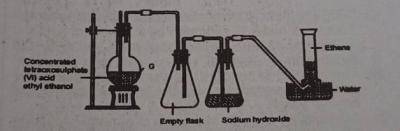
Use the diagram above to answer this question. The reaction taking place in flask G is known as?
Attached Figure / Diagram
Question diagram
A
hydrolysis
B
double decomposition
C
dehydration
D
pyrolysis
medium Difficulty
Chemistry UTME / JAMB 1994 Organic Chemistry I: Hydrocarbons & Crude Oil
From the above diagram, the caustic soda in the conical flask serves to
A
dry ethene gas
B
remove carbon (iv) oxides from ethene
C
remove carbon (ii) oxide from ethene
D
remove sulphur (iv) oxide from ethene
medium Difficulty
Chemistry WAEC / WASSCE 1994 Nature of Matter & Separation Techniques
The components of universal indicator solution can best be separated by
A
chromatography
B
filtration
C
evaporation
D
crystallization
E
fractional distillation
medium Difficulty
Chemistry WAEC / WASSCE 1994 Acids, Bases, pH & Salts
The number of replaceable hydrogen atoms in one acid indicates its
A
basicity
B
acidity
C
alkalinity
D
reactivity
E
pH value
medium Difficulty
Chemistry WAEC / WASSCE 1994 Organic Chemistry I: Hydrocarbons & Crude Oil
Catalytic hydrogenation of alkenes produces compounds with the general formula
A
CnH2n+1 OH
B
CnH2n+1
C
CnH2n+2
D
CnH2n-2
E
Cx(H2O)y
medium Difficulty
Chemistry WAEC / WASSCE 1994 Chemical Energetics & Thermochemistry
A measure of the degree of disorder in a chemical system is known as the
A
enthalpy
B
free energy
C
activation energy
D
entrophy
E
equilibrium
medium Difficulty
Chemistry WAEC / WASSCE 1994 Particulate Nature of Matter, Laws & Formulae
In any chemical reaction, the total mass of the products is always equal to that of the reactants. This is statement of the law of
A
definite proportion
B
conservation of matter
C
multiple proportions
D
reciprocal proportions
E
constant composition
medium Difficulty
Chemistry WAEC / WASSCE 1994 Atomic Structure, Orbitals & Nuclear Chemistry
Which of the following is not a property of magnesium oxide?
A
High melting point
B
Dissolution in polar solvents
C
Presence of ionic bonds
D
Possession of crystal lattice
E
Low binding energy
medium Difficulty
Page 1526 of 1988