Question Library
Browse, filter, and study verified past examination questions with step-by-step mathematical reasoning.
Searching 18,000+ Questions...
Sifting topics, KaTeX formulas & verified solutions
Showing 211–225 of 1709 verified questions
Sort by:
Physics
UTME / JAMB 2018
Mechanics and Properties of Matter
Solution
The product of force and time is?
A
Impulse
B
Momentum
C
Inertia
D
Friction
medium Difficulty
Verified Correct Answer: Option A
Physical Principles & Numerical Solution
An impulse is equal to the net force on the object times the time period over which this force is applied. Impulse is derive from the equation F = ma, which comes from Newton's second law of motion
Source: Myschool Past Questions Archive (Record #47720)
Physics
UTME / JAMB 2018
Mechanics and Properties of Matter
Solution
A solid cube of side 50cm and mass 75kg floats in a liquid with \(\frac{1}{3}\) of its height above the liquid surface. The relative density of the liquid is?
A
0.33
B
0.50
C
0.67
D
0.90
medium Difficulty
Verified Correct Answer: Option D
Physical Principles & Numerical Solution
Volume of liquid displaced
= \(\frac{2}{3}\)(0.5)\(^3\) = 0.0833cm3
Mass of liquid displaced = mass of floating cube = 75kg
Density of liquid = \(\frac{mass}{volume}\)
= \(\frac{75}{0.0833}\)
= 900kgm\(^{-3}\)
R.D of liquid = \(\frac{(900 )}{(1000)}\)
= 0.9
Source: Myschool Past Questions Archive (Record #47723)
Physics
UTME / JAMB 2018
Mechanics and Properties of Matter
Solution
Mercury which is spilled onto a glass surface forms ball-like shapes because____.
A
Mercury is a metal
B
The cohesive force between its molecules is greater than the adhesive force between mercury and glass molecules
C
The cohesive force between its molecules is less than the adhesive force between mercury and glass molecules
D
The viscosity of mercury is height
medium Difficulty
Verified Correct Answer: Option B
Physical Principles & Numerical Solution
In case of small drops of mercury, the gravitational potential energy is negligible in comparison to the potential energy due to surface tension.Consequently, to keep the drop in equilibrium, the mercury drop’s surface tends to contract so that its surface area will be the least for a sphere and the drops will be spherical.
But in the case of bigger drops of mercury, the potential energy due to gravity is predominant over the potential energy due to surface tension.Consequently, to keep equilibrium , the mercury drop tends to assume minimum potential energy as possible, the drop becomes oval in shape and lower center of gravity.
Source: Myschool Past Questions Archive (Record #47727)
Physics
UTME / JAMB 2018
Mechanics and Properties of Matter
Diagram
Solution
A force of 5N acts at a point Y on a rod XYZ as shown in this diagram. If XYZ is 2m, what is the moment of the force about point X?
Attached Figure / Diagram
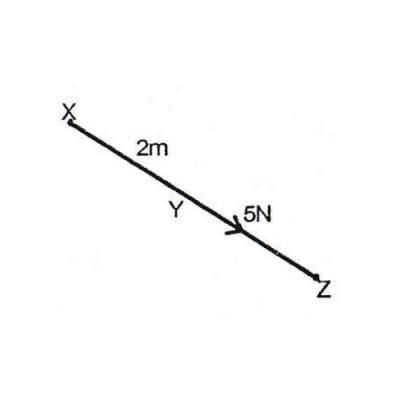
A
0Nm
B
3Nm
C
7Nm
D
10Nm
medium Difficulty
Verified Correct Answer: Option A
Physical Principles & Numerical Solution
using the formular :
Moment = Force \times Distance
5 X 0 = 0Nm
Source: Myschool Past Questions Archive (Record #47697)
Physics
UTME / JAMB 2018
Mechanics and Properties of Matter
Solution
An electric heating coil rated at 1Kw is used to heat 2kg of water for 2 minutes. The initial water temperature is 30\(^o\)C. Taking the specific heat of the water as 4,000Jkg \(^{-1}\) and neglecting that of the container, the final water temperature is
A
15.0\(^o\)C
B
45.0\(^o\)C
C
52.5\(^o\)C
D
60.0\(^o\)C
medium Difficulty
Verified Correct Answer: Option B
Physical Principles & Numerical Solution
Power = 1kw=100W
Time = 2mins = 2 \times 60 = 120secs
Energy = power \times time
1000 \times 120 = 120,000J
Energy = mc(\theta\(_2\) – \theta\(_1\))
120,000 = 2 \times 4000(\theta\(_2\) – \theta\(_1\))
\theta2 = 30 + 15 = 45 \(^o\) C
Source: Myschool Past Questions Archive (Record #47717)
Physics
UTME / JAMB 2018
Mechanics and Properties of Matter
Solution
The process by which protons are converted into helium atoms with a tremendous release of energy is called?
A
thermionic emission
B
nuclear fission
C
thermonuclear fusion
D
photoelectric emission
medium Difficulty
Verified Correct Answer: Option C
Physical Principles & Numerical Solution
Thermonuclear fusion is the process that occurs when two atoms combine to make a larger atom, creating a whole lot of energy. Fusion already happens naturally in stars — including the sun — when intense pressure and heat fuse hydrogen atoms together, generating helium and energy.
Thermionic emission: thermally induced flow of charge
Nuclear fission: nuclear reaction or a radioactive decay process
Photoelectric emission: emission of electrons or other free carriers when light shines on a material
Source: Myschool Past Questions Archive (Record #47730)
Physics
UTME / JAMB 2018
Mechanics and Properties of Matter
Solution
A room is heated by means of a charcoal fire, an occupants of the room standing away from the fire is warmed mainly by
A
Convection
B
Radiation
C
Conduction
D
Reflection
medium Difficulty
Verified Correct Answer: Option B
Physical Principles & Numerical Solution
Radiation refers to the transmission of energy as electromagnetic radiation from its emission at a heated surface to its absorption on another surface, a process requiring no medium to convey the energy.
Conduction is the transferring of heat by direct contact.
Convection is transferring heat through the motions of fluids (gases and liquids).
Source: Myschool Past Questions Archive (Record #47732)
Physics
UTME / JAMB 2018
Mechanics and Properties of Matter
Solution
Which of the following phenomena cannot be explained by the molecular theory of matter?
A
Conduction
B
Convection
C
Expansion
D
Radiation
medium Difficulty
Verified Correct Answer: Option D
Physical Principles & Numerical Solution
Conduction: the flow of internal energy from a region of higher temperature to lower temperature
Convection: heat transfer due to bulk movement of molecules within fluids
Expansion: the action of becoming larger or more extensive
Source: Myschool Past Questions Archive (Record #47734)
Physics
UTME / JAMB 2018
Mechanics and Properties of Matter
Solution
The friction which exist between two layers of liquid in relative motion is called.
A
Capillary
B
Surface
C
Viscosity
D
Cohesion
medium Difficulty
Verified Correct Answer: Option C
Physical Principles & Numerical Solution
Viscosity, resistance of a fluid (liquid or gas) to a change in shape, or movement of neighboring portions relative to one another. Viscosity denotes opposition to flow. The reciprocal of the viscosity is called the fluidity, a measure of the ease of flow. Molasses, for example, has a greater viscosity than water. Because part of a fluid that is forced to move carries along to some extent adjacent parts, viscosity may be thought of as internal friction between the molecules; such friction opposes the development of velocity differences within a fluid. Viscosity is a major factor in determining the forces that must be overcome when fluids are used in lubrication and transported in pipelines. It controls the liquid flow in such processes as spraying, injection molding, and surface coating.
Source: Myschool Past Questions Archive (Record #47735)
Physics
UTME / JAMB 2018
Mechanics and Properties of Matter
A particle of mass M initially at rest splits into two. If one of the particles of mass M1 moves with velocity V1 , the second particle moves with velocity
A
\(\frac{M1V1}{M-M1}\)
B
\(\frac{M1V1}{M1-M}\)
C
\(\frac{M1V1}{M}\)
D
\(\frac{MV}{M-M1}\)
medium Difficulty
Verified Correct Answer: Option B
Physical Principles & Numerical Solution
No expanded working has been attached for this question yet. The verified answer is Option B.
Source: Myschool Past Questions Archive (Record #47736)
Physics
UTME / JAMB 2018
Mechanics and Properties of Matter
Solution
To keep a vehicle moving at a constant speed V requires power P from the engine. The force provided by the engine is
A
\(\frac{P}{v}\)
B
(\(\frac{1}{2}\))V
C
PV
D
\(\frac{P}{V^2}\)
medium Difficulty
Verified Correct Answer: Option A
Physical Principles & Numerical Solution
P = F \times \(\frac{S}{1}\)
P = F x V
F = \(\frac{P}{V}\)
Source: Myschool Past Questions Archive (Record #47737)
Physics
UTME / JAMB 2018
Mechanics and Properties of Matter
Solution
Which of the following is the dimension of pressure
A
ML\(^{−1}\)T\(^{−2}\)
B
MLT\(^{−2}\)
C
ML\(^{2}\)T\(^{3}\)
D
ML\(^{−3}\)
medium Difficulty
Verified Correct Answer: Option A
Physical Principles & Numerical Solution
Pressure = \(\frac{Force}{Area}\)
Pressure = m \times \(\frac{a}{t}\)
= \(\frac{MLT^{−2}}{L \times L}\)
= ML\(^{−1}\)T\(^{−2}\)
Source: Myschool Past Questions Archive (Record #47738)
Physics
UTME / JAMB 2018
Mechanics and Properties of Matter
Solution
Palm oil from a bottle flows out more easily after it has been heated because the
A
Molecules do not increase speed during the heating
B
Viscosity of oil is reduced
C
Oil molecules force each other out
D
Adhesion between the oil molecules and those of the bottle is increased
medium Difficulty
Verified Correct Answer: Option B
Physical Principles & Numerical Solution
If a liquid is heated the particles are given more energy and move faster and faster expanding the liquid.The result is that liquids show a reduction in viscosity with increasing temperature. With high temperatures, viscosity increases in gases and decreases in liquids, the drag force will do the same.
Source: Myschool Past Questions Archive (Record #47739)
Physics
UTME / JAMB 2018
Mechanics and Properties of Matter
Solution
A ball of mass 5.0kg hits a smooth vertical wall normally with a speed of 2ms\(^{-1}\). Determine the magnitude of the resulting impulse
A
20.0kgms\(^{-1}\)
B
10.0kgms\(^{-1}\)
C
5.0kgms\(^{-1}\)
D
2.5kgms\(^{-1}\)
medium Difficulty
Verified Correct Answer: Option B
Physical Principles & Numerical Solution
Impulse = Change in momentum
m (v - u)
5 (2.0)
= 5 x 2 = 10.0kgm\(^{-1}\)
= 10.0kgms\(^{-1}\)
Source: Myschool Past Questions Archive (Record #47740)
Physics
UTME / JAMB 2018
Mechanics and Properties of Matter
Solution
An object weighs 30N in air and 21N in water. The weight of the object when completely immersed in a liquid of relative density 1.4 is
A
25.2N
B
17.4N
C
12.6N
D
9.0N
medium Difficulty
Verified Correct Answer: Option B
Physical Principles & Numerical Solution
Weight of water displaced = upthrust = 30 - 21 = 9N
Mass of water displaced = \(\frac{9}{10}\) = 0.9kg
Volume of object = 9 \times 10\(^{-4}\)m\(^3\)
= (9 \times 10\(^{-4}\)) (1.4 \times103)
= 1.26kg = 12N
30 - 12.6 = 17.4N
Source: Myschool Past Questions Archive (Record #47743)