Question Library
Browse, filter, and study verified past examination questions with step-by-step mathematical reasoning.
Searching 18,000+ Questions...
Sifting topics, KaTeX formulas & verified solutions
Showing 211–225 of 5315 verified questions
Sort by:
Physics
UTME / JAMB 2025
Mechanics and Properties of Matter
Solution
In electromagnetic induction, the generated electricity is actually a voltage called
A
Induced emf
B
Eddy current
C
Inductor voltage
D
Watts
medium Difficulty
Verified Correct Answer: Option A
Physical Principles & Numerical Solution
Induced emf (electromotive force) refers to the voltage generated across a conductor or circuit due to a changing magnetic field, as explained by Faraday's laws of induction. This voltage drives the flow of induced current when the circuit is complete.
Source: Myschool Past Questions Archive (Record #74559)
Physics
UTME / JAMB 2025
Electricity and Magnetism
Solution
Which of the following is a basic Unit?
A
Joule
B
Volt
C
Ohm
D
Ampere
medium Difficulty
Verified Correct Answer: Option D
Physical Principles & Numerical Solution
The ampere is a fundamental SI base unit, representing electric current, and is one of the seven base units used in physics
Source: Myschool Past Questions Archive (Record #74560)
Physics
UTME / JAMB 2025
Electricity and Magnetism
Solution
A boat or airplane has a pointed front or head. This is to
A
Reduce the friction of fluid
B
Enables it to stop anytime
C
Increased the friction of fluid
D
Look good
medium Difficulty
Verified Correct Answer: Option A
Physical Principles & Numerical Solution
A. Reduce the friction of fluid.
The pointed front of a boat or airplane is designed to minimize drag and reduce the frictional resistance as it moves through water or air, enhancing efficiency and improving performance.
Source: Myschool Past Questions Archive (Record #74571)
Physics
UTME / JAMB 2025
Electricity and Magnetism
Solution
Two identical cells, each of emf 1.5V and internal resistance 1\(\Omega\), are connected in parallel to supply current to a 2 \(\Omega\) resistor. What is the total current
A
O.8A
B
1.0A
C
0.4A
D
0.6A
medium Difficulty
Verified Correct Answer: Option D
Physical Principles & Numerical Solution
Equivalent \(\, emf \, E_{eq} = 1.5 \, \text{V} \, (\text{same as single cell})\).
Equivalent \(\, internal \, resistance \, r_{eq} = \frac{1}{2} = 0.5 \, \Omega \, (\text{parallel})\).
Total \(\, resistance \, R_{total} = r_{eq} + 2 = 2.5 \, \Omega\).
Current \(\, I = \frac{E_{eq}}{R_{total}} = \frac{1.5}{2.5} = 0.6 \, \text{A}\).
Source: Myschool Past Questions Archive (Record #74566)
Physics
UTME / JAMB 2025
Mechanics and Properties of Matter
Solution
Which light source operates primarily based on stimulated emission of radiation?
A
laser
B
fluorescent lamp
C
led
D
incandescent bulb
medium Difficulty
Verified Correct Answer: Option A
Physical Principles & Numerical Solution
LASER stands for Light Amplification by Stimulated Emission of Radiation. It works when an incoming photon makes an excited electron release another identical photon, producing a coherent, highly focused beam of light.
Source: Myschool Past Questions Archive (Record #76117)
Physics
UTME / JAMB 2025
Mechanics and Properties of Matter
Diagram
Solution
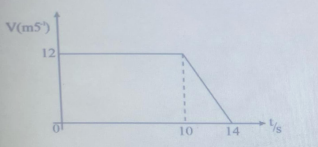
From the above graph, what is the distance covered in the last stage of the motion?
Attached Figure / Diagram
A
56m
B
24m
C
140m
D
46m
medium Difficulty
Verified Correct Answer: Option B
Physical Principles & Numerical Solution
The velocity-time graph has three stages:
0 - 10s: constant \(12 \, \text{m/s}\)
10 - 14s: deceleration from \(12 \, \text{m/s}\) to \(0 \, \text{m/s}\) (last stage)
The area of the triangle gives the distance in the last stage:
\(\text{Area} = \frac{1}{2} \times \text{base} \times \text{height} = \frac{1}{2} \times (14 - 10) \, \text{s} \times 12 \, \text{m/s}\)
\(= \frac{1}{2} \times 4 \times 12 = 24 \, \text{m}\).
Source: Myschool Past Questions Archive (Record #74658)
Physics
WAEC / WASSCE 2025
Mechanics and Properties of Matter
Diagram
Solution
1a. (i) Using the spring balance provided, determine the weight of an object of mass M = 5.0 g. Record this weight as W\(_1\).
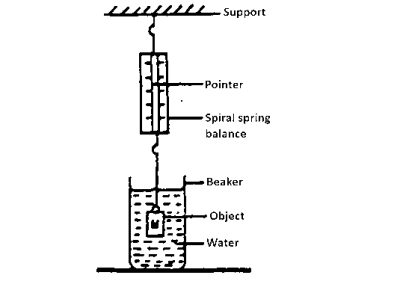
(ii) Determine the weight of the object when completely immersed in water contained in a beaker as shown in the diagram. Record the weight as W\(_2\).
(iii) Determine the weight of the object when it is completely immersed in the liquid labelled "L". Record the weight as W\(_3\). Evaluate u = (W\(_1\) - W\(_2\)) and v = (W\(_1\) - W\(_3\)).
(iv) Repeat the procedure with the objects of masses M = 10, 15, 20, and 25 g. In each case, evaluate v = (W\(_1\) - W\(_3\)) on the vertical axis against u = (W\(_1\) - W\(_2\)) on the horizontal axis.
(v) Determine the slope, s, of the graph.
(vi) State two precautions taken to ensure accurate results.[21 marks]
bi. A piece of brass of mass 20.0 g is hung on a spring balance from a rigid support and completely immersed in kerosene of density 8.0 \times 10\(^2\) kgm\(^{-3}\). Determine the reading on the spring balance. [g = 10 ms\(^{-2}\), density of brass = 8.0 \times 10\(^3\) kgm\(^{-3}\)]
(Provide your answer with unit e.g 123.123 m)
bii. Archimedes' Principle and Law of Floatation [2 marks]
Attached Figure / Diagram
medium Difficulty
Verified Correct Answer: Option
Physical Principles & Numerical Solution
1a. Tables of values
M(g)
W\(_1\)(g)
W\(_2\)(g)
W\(_3\)(g)
U = (W\(_1\) - W\(_2\)(g)
V = (W\(_1\) - W\(_3\)(g)
5.0
5.00
4.20
4.70
0.80
0.30
10.0
10.00
7.90
8.60
2.10
1.40
15.0
15.00
12.75
13.50
2.25
1.50
20.0
17.10
17.10
16.40
2.90
3.60
25.0
22.10
22.10
21.40
2.90
3.60
S = \(\frac{y_2 - y_1}{x_2 - x_1}\) = \(\frac{3 - 0.8}{2.8 - 1.4}\) = \(\frac{11}{7}\) = 1.57.
Precaution
(i) I carefully avoided parallax error while reading the scale of the spring balance to ensure accurate measurements.
(ii) I checked and accounted for any zero error on the spring balance before taking measurements.
(iii) I handled the liquid carefully to prevent any splashing, which could lead to loss of material or inaccurate readings.
(iv) I ensured that the object did not touch the bottom or sides of the beaker to avoid interference with the force readings.
(v) I thoroughly cleaned the object (mass) before dipping it into the liquid to prevent contamination or alteration of the liquid's properties.
bii) Law of Floatation: The law of floatation states that an object will float in a fluid if its weight is equal to the weight of the fluid it displaces. For a floating object, the weight of the object is balanced by the upward buoyant force.
Source: Myschool Past Questions Archive (Record #76565)
Physics
UTME / JAMB 2025
Heat Energy & Temperature
Solution
A method of demagnetization is
A
placing the magnetic bar in a solenoid
B
double-stroking the magnet with soft in n-s direction
C
heating a magnetic bar red hot and allowed to cool e-w direction
D
hammering the magnetic bar repeatedly in n-s direction
medium Difficulty
Verified Correct Answer: Option C
Physical Principles & Numerical Solution
This process disrupts the alignment of magnetic domains, effectively demagnetizing the bar.
Source: Official Exam / Past Question Archive
Physics
WAEC / WASSCE 2025
Heat Energy & Temperature
Solution
2a.
(i) Fix a metre rule on the bench with the graduated face up.
(ii) Place the illuminated object at the zero end of the rule and the screen at the other end as illustrated in the diagram above.
(iii) Measure and record D, the distance between the object and the screen. Evaluate D\(^2\)
(iv) Place and move the converging lens between the illuminated object and the screen until a diminished, sharp image of the object is formed on the screen. Read and record the position, x\(_1\), of the lens. From this position, move the lens towards the object until another sharp image of the object is formed on the screen. Read and record the position, x\(_2\), of the lens.
(v) Evaluate and record L = (x\(_1\) - x\(_2\)), L\(^2\) and (D\(^2\) - L\(^2\)).
(vi) Repeat the procedure for D = 90, 80, 70, and 60 cm. In each case, evaluate L, L\(^2\), and (D\(^2\) - L\(^2\)). Tabulate your readings.
(vii) Plot a graph of D\(^2\) - L\(^2\) on the vertical axis against D on the horizontal axis.
(viii) Determine the slope, s, of the graph and evaluate K = \(\frac{\text{s}}{4}\). State two precautions taken to ensure accurate results.[21 marks]
bi. Distinction Between Real and Virtual Images [2 marks]
ii. Draw a ray diagram to show how a converging lens may be used to form a real diminished image of an object [2 marks]
A
50.0\(\Omega\)
B
0.50\(\Omega\)
C
5.00\(\Omega\)
D
0.05\(\Omega\)
medium Difficulty
Verified Correct Answer: Option A
Physical Principles & Numerical Solution
2a. Table of observations
D(cm)
D\(^2\)(cm\^2\)
X\(_1\)(cm)
L = (X\(_1 - X_2\))
L\(^2\)(cm\(^2\))
100
10000
80.50
62.20
3868.8
90
8100
70.20
51.20
2621.4
80
6400
59.10
39.10
1528.8
70
4900
46.70
24.70
610.09
60
3600
29.00
21.40
457.96
S = \(\frac{y_2 - y_1}{x_2 - x_1}\) = \(\frac{6250 - 3250}{100 - 60}\) = \(\frac{3000}{40}\) = 75
K = \(\frac{\text{s}}{4}\) = \(\frac{75}{4}\) = 18.75
Precautions:
(i) I carefully avoided parallax error by ensuring my eyes were directly in line with the markings on the metre rule while taking measurements to improve accuracy.
(ii) I adjusted the setup and focused precisely to ensure a sharp and well-defined image was formed on the screen, minimizing errors due to blurriness or misalignment.
(iii) I made sure that the experimental apparatus was stable and free from vibrations to avoid any disturbance during measurements.
(iv) I ensured that the metre rule was properly calibrated and positioned perpendicular to the setup to prevent measurement inaccuracies due to angle errors.
bi. A real image is formed when light rays converge and meet at a point, allowing it to be projected onto a screen. It is typically inverted relative to the object, as seen in concave mirrors or convex lenses when the object is beyond the focal point.
On the other hand, a virtual image is formed when light rays appear to diverge from a point but do not actually meet. This type of image cannot be projected onto a screen and is always upright, as seen in plane mirrors or convex mirrors.
bii. See diagram above.
Source: Official Exam / Past Question Archive
Physics
UTME / JAMB 2024
Heat Energy & Temperature
Solution
According to kinetic theory of gases, the pressure exerted by the gas on the wall is equal
A
change in momentum per unit volume
B
rate of change of momentum imparted by the walls per second per unit area
C
momentum imparted to the walls per unit area
D
change in momentum imparted to the walls per unit area
medium Difficulty
Verified Correct Answer: Option B
Physical Principles & Numerical Solution
Pressure is defined as force per unit area. In the context of gas molecules colliding with the walls of a container, the force exerted by the gas can be understood as the rate at which momentum is transferred to the walls.
As gas molecules collide with the walls, they change momentum, and this change occurs over time. Thus, the pressure can be described as the rate of change of momentum (change in momentum per collision multiplied by the number of collisions per second) divided by the area over which the collisions occur.
Source: WAEC / JAMB / NECO Classroom Archive (Record #70467)
Physics
WAEC / WASSCE 2024
Heat Energy & Temperature
Solution
(a)(i) What is a thermometric liquid?
(ii) State the reason for the following design features of a clinical thermometer. I. Narrow bore: II. Thin wall of the bulb
(b) Distinguish between heat and temperature of an object in terms of the energy of a particle
(c) Explain why evaporation leads to cooling
(d) A kettle rated 2000W, contains water at 20ºC. The kettle is switched on and after two minutes, the water starts boiling. After another six minutes, 45% of the water in the kettle boils away. (i) Determine the specific latent heat of the vaporization of the water (ii) State one assumption made in your calculation 9d(i) above
medium Difficulty
Verified Correct Answer: Option
Physical Principles & Numerical Solution
(a) A thermometric liquid is a liquid used in thermometers to measure temperature. It expands and contracts uniformly with changes in temperature, allowing for accurate readings.
(ii) I. Narrow Bore
Reason: Allows precise measurement by controlling the movement of the thermometric liquid, ensuring quick and accurate readings
II. Thin Wall of the Bulb
Reason: Enhances thermal conductivity, enabling faster heat transfer for quicker and more accurate temperature readings.
(b) Heat is a measure of the change in total internal energy in a body while temperature is a measure of the average kinetic energy of a molecule of the body.
(c) Evaporation leads to cooling for these reasons:
Energy Absorption: Molecules at the surface absorb energy to break free, often from the liquid and its surroundings.
Loss of High-Energy Molecules: Higher-energy molecules evaporate, reducing the average kinetic energy of the remaining liquid.
Temperature Decrease: As the average kinetic energy drops, the temperature of the liquid decreases, resulting in cooling.
(d)(i) Given: P = 2000W, \(\theta\) = 20ºC, t = 2 mins = 120 secs.
P x t = mc\(\Delta\)\(\theta\)
m = \(\frac{P \times t}{c \times \Delta \theta}\)
m = \(\frac{2000 \times 120}{4200 \times (100 - 20)}\) = 0.714 kg
Also, Pt = ml
l = \(\frac{Pt}{m}\)
where m = 45% of 0.714, t = 6mins = 360secs
l = \(\frac{2000 \times 60 \times 6}{0.714 \times 0.45}\) = 2.29 x 10\(^6\)Jkg\(^{-1}\)
(d)(i) Assumption made: there is no loss of heat to the surroundings, and the heat capacity of the material of the kettle is negligible.
Source: WAEC / JAMB / NECO Classroom Archive (Record #72092)
Physics
WAEC / WASSCE 2024
Waves & Wave Motion
Solution
The maximum displacement of particles from equilibrium position in a wave motion is known as
A
wave length.
B
amplitude.
C
frequency.
D
polarization.
medium Difficulty
Verified Correct Answer: Option B
Physical Principles & Numerical Solution
The maximum displacement of particles from equilibrium position in a wave motion is known as "amplitude".
Source: WAEC / JAMB / NECO Classroom Archive (Record #72074)
Physics
UTME / JAMB 2024
Light & Geometrical Optics
Solution
Rainbow is formed when sunlight undergoes
A
reflection
B
refraction
C
dispersion
D
diffraction
medium Difficulty
Verified Correct Answer: Option C
Physical Principles & Numerical Solution
A rainbow is formed by the DISPERSION of sunlight by spherical raindrops floating in the air.
Source: WAEC / JAMB / NECO Classroom Archive (Record #70355)
Physics
UTME / JAMB 2024
Light & Geometrical Optics
Solution
An object is placed 25cm in front of a convex mirror has its image formed 5cm behind the mirror. what is the focal length of the convex mirror
A
8.20cm
B
6.25cm
C
5.60cm
D
4.50cm
medium Difficulty
Verified Correct Answer: Option B
Physical Principles & Numerical Solution
Object distance (u) = -25 cm (negative because the object is in front of the mirror)
Image distance (v) = +5 cm (positive because the image is behind the convex mirror)
Using \(\frac{1}{f}\) = \(\frac{1}{u}\) + \(\frac{1}{v}\)
\(\frac{1}{f}\) = \(\frac{1}{-25}\) + \(\frac{1}{5}\)
f = \(\frac{25}{4}\) = 6.250cm.
Source: WAEC / JAMB / NECO Classroom Archive (Record #70497)
Physics
UTME / JAMB 2024
Light & Geometrical Optics
Solution
The power of a convex lens of focal length 20cm is
A
0.05D
B
0.50D
C
5.00D
D
50.00D
medium Difficulty
Verified Correct Answer: Option C
Physical Principles & Numerical Solution
The Power is given by: P = \(\frac{1}{f}\)
f = 20cm → 0.2m
P = \(\frac{1}{0.2}\) = 5 dioptres
Source: WAEC / JAMB / NECO Classroom Archive (Record #70506)