Question Library
Browse, filter, and study verified past examination questions with step-by-step mathematical reasoning.
Searching 18,000+ Questions...
Sifting topics, KaTeX formulas & verified solutions
Showing 211–225 of 345 verified questions
Sort by:
Mathematics
UTME / JAMB 2000
Statistics and Probability
Solution
The variance of x, 2x, 3x, 4x and 5x is
A
x√2
B
2x2
C
x2
D
3x
medium Difficulty
Verified Correct Answer: Option B
Step-by-Step Mathematical Solution
Hint: prepare a three-columned table, one for (x), another for the (deviation), and the last for the (squared-deviation).
Sum of (x) = 15x, algebraic sum of (deviation) = zero (0)
Sum of (squared-deviation) = 10x\(^2\)
Variance = \(\frac{∑(squared-deviation)}{\text{n}}\) = \(\frac{10x^2}{5}\) = 2x\(^2\)
Source: Myschool Past Questions Archive (Record #1083)
Mathematics
UTME / JAMB 2000
Statistics and Probability
Solution
Find the sum of the range and the mode of the set of numbers 10, 9, 10, 9, 8, 7, 7, 10, 8, 10, 8, 4, 6, 9, 10, 9, 10, 9, 7, 10, 6, 5
A
16
B
14
C
12
D
10
medium Difficulty
Verified Correct Answer: Option A
Step-by-Step Mathematical Solution
Range = Highest - lowest number => 10-4 = 6
Mode is the number with highest occurrence => Mode = 10
Sum = 6 + 10 = 16
Source: Myschool Past Questions Archive (Record #1106)
Mathematics
UTME / JAMB 2000
Statistics and Probability
Diagram
Solution
The cumulative frequency curve represents the ages of ages of students in a school. What age group do 70% of the students belongs?
Attached Figure / Diagram
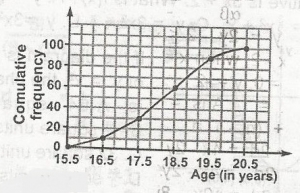
A
17.5 - 20.5
B
16.5 - 19.5
C
15.5 - 19.5
D
15.5 - 18.5
medium Difficulty
Verified Correct Answer: Option A
Step-by-Step Mathematical Solution
If the total number of students represents 100%, then 70% corresponds to the point on the graph where the cumulative frequency reaches 70
From the graph, find where the cumulative frequency line intersects the 70% mark. This typically corresponds to a specific age on the X-axis
Source: WAEC / JAMB / NECO Classroom Archive (Record #33094)
Mathematics
UTME / JAMB 1999
Statistics and Probability
Solution
Three boys play a game of luck in which their respective chances of winning are \(\frac{1}{2}\), \(\frac{1}{3}\), and \(\frac{1}{4}\). What is the probability that one and only one of the boys wins the game?
A
\(\frac{1}{24}\)
B
\(\frac{1}{12}\)
C
\(\frac{11}{24}\)
D
\(\frac{23}{24}\)
medium Difficulty
Verified Correct Answer: Option C
Step-by-Step Mathematical Solution
The probabilities of the three boys winning are independent and are given as:
- Boy A: \( \frac{1}{2} \), - Boy B: \( \frac{1}{3} \), - Boy C: \( \frac{1}{4} \)
"One and only one wins" means exactly one boy wins (the other two lose).
The three possible cases are:
A wins, B loses, C loses
\( P = \frac{1}{2} \times \left(1 - \frac{1}{3}\right) \times \left(1 - \frac{1}{4}\right) = \frac{1}{2} \times \frac{2}{3} \times \frac{3}{4} = \frac{6}{24} \)
B wins, A loses, C loses
\( P = \left(1 - \frac{1}{2}\right) \times \frac{1}{3} \times \frac{3}{4} = \frac{1}{2} \times \frac{1}{3} \times \frac{3}{4} = \frac{3}{24} \)
C wins, A loses, B loses
\( P = \left(1 - \frac{1}{2}\right) \times \left(1 - \frac{1}{3}\right) \times \frac{1}{4} = \frac{1}{2} \times \frac{2}{3} \times \frac{1}{4} = \frac{2}{24} \)
Add them up:
\( \frac{6}{24} + \frac{3}{24} + \frac{2}{24} = \frac{11}{24} \)
Source: Myschool Past Questions Archive (Record #10415)
Mathematics
WAEC / WASSCE 1999
Statistics and Probability
Solution
A group of 11 people can speak either English or French or Both. Seven can speak English and six can speak French. What is the probability that a person chosen at random can speak both English and French?
A
\(\frac{2}{11}\)
B
\(\frac{4}{11}\)
C
\(\frac{5}{11}\)
D
\(\frac{11}{13}\)
medium Difficulty
Verified Correct Answer: Option A
Step-by-Step Mathematical Solution
Let the number of people that speak both English and French = x
Then (7 - x) + x + (6 - x) = 11
13 - x = 11 \(\implies\) x = 2.
\(\therefore\) P(picking a person that speaks both languages) = 2/11
Source: Myschool Past Questions Archive (Record #26386)
Mathematics
WAEC / WASSCE 1999
Statistics and Probability
Solution
A survey shows that 28% of all the men in a village wear size 9 shoes. What is the probability that a man selected at random in the village wears size 9 shoes?
A
\(\frac{7}{25}\)
B
\(\frac{41}{50}\)
C
\(\frac{1}{2}\)
D
1
medium Difficulty
Verified Correct Answer: Option A
Step-by-Step Mathematical Solution
P(man picked at random wears size 9 shoes) = \(\frac{28}{100}\)
= \(\frac{7}{25}\)
Source: Myschool Past Questions Archive (Record #26415)
Mathematics
WAEC / WASSCE 1999
Statistics and Probability
Solution
The table gives the frequency distribution of marks obtained by a group of students in a test.
Marks
3
4
5
6
7
8
Frequency
5
x - 1
x
9
4
1
If the mean is 5,
(a) Calculate the value of x;
(b) Find the : (i) mode ; (ii) median of the distribution.
(c) If one of the students is selected at random, find the probability that he scored at least 7 marks.
medium Difficulty
Verified Correct Answer: Option
Step-by-Step Mathematical Solution
Marks
3
4
5
6
7
8
Frequency
5
x - 1
x
9
4
1
fx
15
4x - 4
5x
54
28
8
\(\sum fx = 15 + 4x - 4 + 5x + 54 + 28 + 8 = 101 + 9x\)
\(\sum f = 5 + x - 1 + x + 9 + 4 + 1 = 18 + 2x\)
\(\bar{x} = \frac{\sum fx}{\sum f}\)
\(5 = \frac{101 + 9x}{18 + 2x} \implies 101 + 9x = 5(18 + 2x)\)
\(101 + 9x = 90 + 10x \implies 101 - 90 = 10x - 9x\)
\(11 = x \)
(b)(i) Mode = 5.
(ii) Median
Frequency = 18 + 2(11) = 40.
Median position = \(\frac{40}{2} = 20\)
20th position = 5.
(c) No of students that scored at least 7 marks = 4 + 1 = 5.
Probability of scoring at least 7 marks = \(\frac{5}{40} = \frac{1}{8}\)
Source: Myschool Past Questions Archive (Record #54421)
Mathematics
UTME / JAMB 1999
Statistics and Probability
Solution
The mean of four numbers is 5, and the mean deviation is 3. Find the fourth number if the mean deviation of the first three numbers is 2
A
6
B
10
C
11
D
12
medium Difficulty
Verified Correct Answer: Option C
Step-by-Step Mathematical Solution
Let the four numbers be \(a, b, c, d\).
- Mean of the four numbers = 5
→ a + b + c + d = 20
- Mean deviation of the four numbers = 3
Mean deviation = \(\frac{|a-5| + |b-5| + |c-5| + |d-5|}{4} = 3\)
→ Sum of absolute deviations = 12
- Mean deviation of the first three numbers a, b, c = 2
→ \(\frac{|a-5| + |b-5| + |c-5|}{3} = 2\)
→ Sum of absolute deviations for first three = 6
- Therefore, absolute deviation for the fourth number:
|d - 5| = 12 - 6 = 6
The fourth number = 6 + 5 = 11.
Source: Myschool Past Questions Archive (Record #77197)
Mathematics
WAEC / WASSCE 1998
Statistics and Probability
Solution
A die with faces numbered 1 to 6 is rolled once. What is the probability of obtaining 4?
A
\(\frac{1}{36}\)
B
\(\frac{1}{6}\)
C
\(\frac{1}{3}\)
D
\(\frac{1}{2}\)
E
\(\frac{2}{3}\)
medium Difficulty
Verified Correct Answer: Option B
Step-by-Step Mathematical Solution
When the die is rolled, occasion of getting 4
P(obtaining a 4) = \(\frac{1}{6}\)
= \(\frac{1}{6}\)
Source: Myschool Past Questions Archive (Record #26343)
Mathematics
WAEC / WASSCE 1998
Statistics and Probability
Solution
A box contain 2 white and 3 blue identical balls. If two balls are picked at random, one after the other, without replacement, what is the probability of picking two balls of different colours?
A
\(\frac{5}{25}\)
B
\(\frac{7}{20}\)
C
\(\frac{3}{5}\)
D
\(\frac{2}{3}\)
E
\(\frac{5}{6}\)
medium Difficulty
Verified Correct Answer: Option C
Step-by-Step Mathematical Solution
Balls were picked without replacement
n( white balls) = 2, n( black balls ) = 3
Total Balls = 2 + 3 = 5 balls
Pr( two balls of different colours ) = WB OR BW
= \(\frac{2}{5} \times \frac{3}{4} + \frac{3}{5} \times \frac{2}{4}\)
= \(\frac{6}{20} + \frac{6}{20}\) = \(\frac{12}{20}\) = \(\frac{3}{5}\)
Source: Myschool Past Questions Archive (Record #26347)
Mathematics
UTME / JAMB 1998
Statistics and Probability
Solution
If m and n are the mean and median respectively of the set of numbers 2, 3, 9, 7, 6, 7, 8, 5, find m + 2n to the nearest whole number
A
19
B
18
C
13
D
12
medium Difficulty
Verified Correct Answer: Option A
Step-by-Step Mathematical Solution
mean(x) = \(\frac{\sum x}{N}\)
= \(\frac{48}{8}\)
= 5.875
re-arranging the numbers;
2, 3, 5, 6, 2, 7, 8, 9
median = \(\frac{6 + 7}{2}\)
= \(\frac{1}{2}\)
= 6.5
m + 2n = 5.875 + (6.5)2
= 13 + 5.875
= 18.875
= \(\approx\) = 19
Source: Myschool Past Questions Archive (Record #30741)
Mathematics
UTME / JAMB 1998
Statistics and Probability
Solution
\(\begin{array}{c|c} \text{Average hourly earnings(N)} & 5 - 9 & 10 - 14 & 15 - 19 & 20 - 24\\ \hline \text{No. of workers} & 17 & 32 & 25 & 24\end{array}\)
Estimate the mode of the above frequency distribution
A
12.2
B
12.27
C
12.9
D
13.4
medium Difficulty
Verified Correct Answer: Option C
Step-by-Step Mathematical Solution
\(\begin{array}{c|c} \text{Class intervals} & F & \text{Class boundary}\\ \hline 5 - 7 & 17 & 4.5 - 9.5\\ 10 - 14 & 32 & 9.5 - 14.5\\ 15 - 19 & 25 & 14.5 - 19.5\\ 20 - 24 & 24 & 19.5 - 24.5 \end{array}\)
mode = 9.5 + \(\frac{D_1}{D_2 + D_1}\) x C
= 9.5 + \(\frac{5(32 - 17)}{2(32) - 17 - 25}\)
= 9.5 + \(\frac{75}{22}\)
= 12.91
\(\approx\) 12.9
Source: Myschool Past Questions Archive (Record #30745)
Mathematics
UTME / JAMB 1998
Statistics and Probability
Solution
Find the variance of the numbers k, k+1, k+2,
A
\(\frac{2}{3}\)
B
1
C
k + 1
D
(k + 1)2
medium Difficulty
Verified Correct Answer: Option A
Step-by-Step Mathematical Solution
mean (x) = \(\frac{\sum x}{N}\)
= k + k + 1 + k + 3
= \(\frac{3k + 3}{3}\)
= k + 1
\(\begin{array}{c|c} X & (X -X) & (X -X)^2\\ \hline k & -1 & 1 \\ k + 1 & 0 & 0\\ k + 2 & 1 \\ \hline & & 2\end{array}\)
Variance (52) = \(\frac{\sum (x - x)^2}{N}\)
= \(\frac{2}{3}\)
Source: Myschool Past Questions Archive (Record #30749)
Mathematics
UTME / JAMB 1998
Statistics and Probability
Solution
A bag contains 16 red balls and 20 blue balls only. How many white balls must be added to the bag so that the probability of randomly picking a red ball is equal to \(\frac{2}{5}\)
A
4
B
20
C
24
D
40
medium Difficulty
Verified Correct Answer: Option A
Step-by-Step Mathematical Solution
Number of red balls = 16,
Number of blue balls = 20
Let x represent the No of white balls to be added
∴ Total number of balls = 36 + x
Pr( red ball) = \(\frac{ 16}{ 36 + x } = \frac{2}{5}\) (remember that Pr( red ball ) = \frac{2}{5}\))
cross multiplying
2(36 + x) = 80
2x = 80 - 72
2x = 8
x = \(\frac{8}{2}\)
= 4
Source: Myschool Past Questions Archive (Record #30754)
Mathematics
UTME / JAMB 1998
Statistics and Probability
Solution
In a recent zonal championship games involving 10 teams, teams X and Y were given probabilities \(\frac{2}{5}\) and \(\frac{1}{3}\) respectively of winning the gold in the football event. What is the probability that either team will win the gold?
A
\(\frac{2}{15}\)
B
\(\frac{7}{15}\)
C
\(\frac{11}{15}\)
D
\(\frac{13}{15}\)
medium Difficulty
Verified Correct Answer: Option C
Step-by-Step Mathematical Solution
To find the probability that either team X or team Y wins the gold, we can use the formula for the probability of the union of two events: P(x or y) = p(x) + p(y) - p(x n y)
But p(x n y ) = 0
p(x) = \(\frac{2}{5}\) p(y) = \(\frac{1}{3}\)
p(x or y) = p(x ∪ y)
= p(x) + p(y)
= \(\frac{2}{5}\) + \(\frac{1}{3}\)
= \(\frac{11}{5}\)
Source: Myschool Past Questions Archive (Record #30757)