Question Library
Browse, filter, and study verified past examination questions with step-by-step mathematical reasoning.
Searching 18,000+ Questions...
Sifting topics, KaTeX formulas & verified solutions
Showing 211–225 of 1462 verified questions
Sort by:
Mathematics
WAEC / WASSCE 2018
Geometry and Trigonometry
Solution
Given that Y is 20cm on a bearing of 300\(^o\) from x, how far south of y is x?
A
10cm
B
15cm
C
25cm
D
30cm
medium Difficulty
Verified Correct Answer: Option A
Step-by-Step Mathematical Solution
In \(\bigtriangleup\)YSC, sin 30\(^o\) = \(\frac{YS}{20}\)
|YS| = 20 sin 30\(^o\)
= 20 x 0.5
10m
Source: Myschool Past Questions Archive (Record #49615)
Mathematics
WAEC / WASSCE 2018
Geometry and Trigonometry
Solution
The diagonals of a rhombus WXYZ intersect at M. If |MW| = 5cm and |MX| = 12cm, calculate its perimeter
A
42cm
B
48cm
C
52cm
D
60cm
medium Difficulty
Verified Correct Answer: Option C
Step-by-Step Mathematical Solution
Let the length of a side of the rhombus be n
Then, n\(^2\) = 5\(^2\) + 12\(^2\)
= 25 + 144 = 169
n = \(\sqrt{169}\)
= 13cm
Hence, perimeter of rhombus = 4n = 4 x 13
= 52cm
Source: Myschool Past Questions Archive (Record #49623)
Mathematics
WAEC / WASSCE 2018
Geometry and Trigonometry
Solution
(a) The graph of \(y = 2px^{2} - p^{2}x - 14\) passes through the point (3, 10). Find the values of p.
(b) Two lines, \(3y - 2x = 21\) and \(4y + 5x = 5\) intersect at the point Q. Find the coordinates of Q.
medium Difficulty
Verified Correct Answer: Option
Step-by-Step Mathematical Solution
(a) \(y = 2px^{2} - p^{2}x - 14\)
At point (3, 10), y = 10 when x = 3.
\(\implies 10 = 2p(3^{2}) - p^{2}(3) - 14\)
\(10 = 18p - 3p^{2} - 14\)
\(-10 = 3p^{2} - 18p + 14 \implies 3p^{2} - 18p + 24 = 0\)
\(3p^{2} - 12p - 6p + 24 = 0\)
\((p - 4)(3p - 6) = 0 \implies \text{p = 2 or 4}\).
(b) \(3y - 2x = 21 ... (1)\)
\(4y + 5x = 5 ....(2)\)
Using elimination method, multiply (1) by 4 and (2) by 3.
\((1) \times 4 : 12y - 8x = 84 ... (3)\)
\((2) \times 3 : 12y + 15x = 15 ... (4)\)
Subtracting (3) - (4), we have:
\(-23x = 69 \implies x = -3\)
Putting x = -3 in (1), we have
\(3y - 2(-3) = 3y + 6 = 21\)
\(3y = 15 \implies y = 5\)
Hence, the coordinates of Q are (-3, 5).
Source: Myschool Past Questions Archive (Record #52242)
Mathematics
WAEC / WASSCE 2018
Geometry and Trigonometry
Solution
(a) The diagonals of a rhombus are 10.2 cm and 9.3 cm long. Calculate, correct to one decimal place, the perimeter of the rhombus.
(b) Given that \(\sin x = \frac{3}{5}, 0^\circ < x < 90^\circ\), find the value of \(5\cos x - 4\tan x\).
medium Difficulty
Verified Correct Answer: Option
Step-by-Step Mathematical Solution
(a) see diagram above
Let a side of the rhombus be n.
Then \(n^{2} = 4.65^{2} + 5.1^{2}\)
= \(21.6225 + 26.01 \)
\(n^{2} = 47.6325\)
\(n = \sqrt{47.6325} = 6.902 cm\)
Hence, the perimeter of the rhombus = 4n
= \(4 \times 6.902\)
= \(27.608 cm \approxeq 27.6 cm\) (to 1 d.p)
(b) Right-angled triangle ABC
see diagram above
\(\sin x = \frac{3}{5}\), Thus, \(m^{2} = 5^{2} - 3^{2} = 25 - 9 = 16\)
\(m = 4\).
\(\cos x = \frac{4}{5} \implies 5\cos x = 5 \times \frac{4}{5} = 4\)
\(\tan x = \frac{3}{4} \implies 4\tan x = 4 \times \frac{3}{4} = 3\)
\(5\cos x - 4\tan x = 4 - 3 = 1\).
Source: Myschool Past Questions Archive (Record #52247)
Mathematics
WAEC / WASSCE 2018
Geometry and Trigonometry
Diagram
Solution
(a)
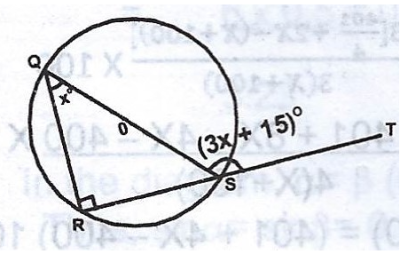
In the diagram
(i) The value of x; (ii)
(b) If \(2N4_{seven} = 15N_{nine}\), find the value of N.
Attached Figure / Diagram
medium Difficulty
Verified Correct Answer: Option
Step-by-Step Mathematical Solution
(a)
(i) In the diagram,
\(x^\circ + 90^\circ = (3x + 15)^\circ\) (Sum of opposite interior angles)
Thus, \(90^\circ - 15^\circ = 3x - x \implies 75^\circ = 2x\)
\(x = 37.5^\circ\)
(ii)
< RSQ = 90^\circ - 37.5^\circ = 52.5^\circ
(b) \(2N4_{seven} = 15N_{nine}\)
\(2N4_{seven} = (2 \times 7^{2}) + (N \times 7^{1}) + (4 \times 7^{0})\)
= \(98 + 7N + 4\)
= \(102 + 7N\)
\(15N_{nine} = (1 \times 9^{2}) + (5 \times 9^{1}) + (N \times 9^{0})\)
= \(81 + 45 + N\)
= \(126 + N\)
\(\implies 102 + 7N = 126 + N\)
\(7N - N = 126 - 102 = 24\)
\(6N = 24 \implies N = 4\)
Therefore, \(244_{seven} = 154_{nine}\).
Source: Myschool Past Questions Archive (Record #52249)
Mathematics
WAEC / WASSCE 2018
Geometry and Trigonometry
Diagram
Solution
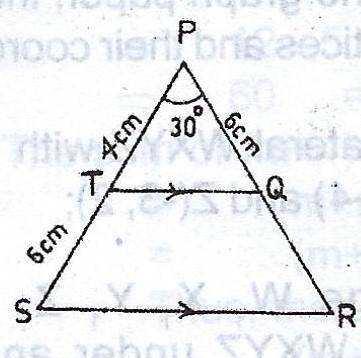
In the diagram, |PT| = 4 cm, |TS| = 6 cm, |PQ| = 6 cm and < SPR = 30^\circ. Calculate, correct to the nearest whole number:
(a) |SR| ;
(b) area of TQRS.
Attached Figure / Diagram
medium Difficulty
Verified Correct Answer: Option
Step-by-Step Mathematical Solution
\(|TQ|^{2} = 4^{2} + 6^{2} - 2 \times 4 \times 6 \times \cos 30^\circ\)
= \(16 + 36 - 48 \times 0.8660\)
= \(52 - 41.568 = 10.432\)
\(\therefore |TQ| = \sqrt{10.432} \approxeq 3.23 cm\)
(a) By the rules of similar triangles,
\(\frac{|PT|}{|TQ|} = \frac{|PS|}{|SR|}\)
\(\frac{4}{3.23} = \frac{10}{|SR|}\)
\(|SR| = \frac{3.23 \times 10}{4}\)
= \(8.075 cm \approxeq 8 cm\)
(b) Using sine rule,
\(\frac{|PQ|}{\sin \alpha} = \frac{|TQ|}{\sin 30}\)
\(\frac{6}{\sin \alpha} = \frac{3.23}{\sin 30}\)
\(\sin \alpha = \frac{6 \sin 30}{3.23}\)
sin \(\alpha\) = 0.9288
From the diagram, \(\alpha\) = \(\beta\)
\(\sin \alpha = \sin \beta = 0.9288\)
\(\sin \beta = \frac{h}{6}\)
h = \(6 \sin \beta\)
Hence, area of quadrilateral
TQRS = \(\frac{1}{2} (TQ + SR) \times h\)
= \(\frac{1}{2} (3.23 + 8.075) \times 6\sin \beta\)
= \(\frac{1}{2} (11.305) (6 \times 0.9288)\)
= 31.501 cm\(^2\)
\(\approxeq\) 32 cm\(^2\) (to the nearest whole number)
Source: Myschool Past Questions Archive (Record #52293)
Mathematics
WAEC / WASSCE 2018
Geometry and Trigonometry
Diagram
Solution
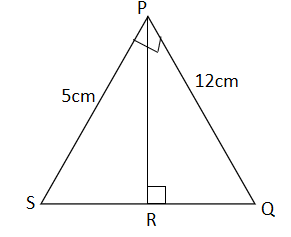
(a) In < PQS, |PQ| = 12 cm, |PS| = 5 cm, < SPQ = < PRQ = 90^\circ, Find, correct to three significant figures, |PR|.
(b) The lengths of two ladders, L and M are 10m and 12m respectively. They are placed against a wall such that each ladder makes angle with the horizontal ground. If the foot of L is 8m from the foot of the wall.
(i) Draw a diagram to illustrate this information; (ii) Calculate the height at which M touches the wall.
Attached Figure / Diagram
medium Difficulty
Verified Correct Answer: Option
Step-by-Step Mathematical Solution
(a)
In triangle SPQ, \(|SQ|^{2} = 5^{2} + 12^{2}\) (Pythagoras theorem)
= \(25 + 144 = 169\)
\(|SQ| = \sqrt{169} = 13 cm\)
Angle b is common to triangles SPQ and PRS are similar.
Using \(\sin b = \frac{12}{|SQ|} = \frac{|PR|}{5}\)
\(\sin b = \frac{12}{13} = \frac{|PR|}{5}\)
\(|PR| = \frac{12 \times 5}{13} \approxeq 4.62 cm\) (to 3 s.f)
(b)(i)
\(h^{2} = 10^{2} - 8^{2} = 36\)
\(h = \sqrt{36} = 6 cm\)
(ii) In the smaller triangle, \(\cos x = \frac{8}{10} = 0.8\)
\(\cos^{-1} (0.8) = 36.87^\circ\)
Since these are corresponding angles, x = x in the bigger triangle.
\(\sin x = \frac{y}{12}\)
\(y = 12 \sin x = 12 \sin 36.87\)
= \(12 \times 0.6\)
= 7.20 m
The ladder M touches the wall at a height 7.2 m above the horizontal ground.
Source: Myschool Past Questions Archive (Record #52308)
Mathematics
WAEC / WASSCE 2018
Geometry and Trigonometry
Diagram
Solution
The diagram shows an athletics track with two parallel sides and two semi-circular ends Each of the parallel sides is 60 metres, long and the diameter of each semi-circular end is 120 metres long.
(a) Calculate the distance covered by an athlete who runs round the tack the two times. [Take \(\pi\) = \(\frac{22}{7}\)]
(b) If the athlete spends 200 seconds for the race, calculate the speed in km/h.
Attached Figure / Diagram

medium Difficulty
Verified Correct Answer: Option
Step-by-Step Mathematical Solution
The Chief Examiner reported that quite a handful of the Candidates' got part (a) correctly but couldn't establish the relationship between km/h and m/s.
(a) The distance covered = (2 x 60) + (2 x \(\frac{22}{7}\)) = 120 + 377.142 = 497.1429m so that if the athlete runs two times will covered = 2 x 497.1429
m = 994.2857m (at least one decimal place).
(b) The speed m/s = \(\frac{994,2857}{200}\) and converting to km/h we will have \(\frac{994,2857}{1000} \times \frac{200}{3600}\) = 17.8973 km/h
Source: Myschool Past Questions Archive (Record #56139)
Mathematics
WAEC / WASSCE 2018
Geometry and Trigonometry
Solution
(a) Using ruler a pair of compasses only, construct:
(i) a trapezium PQRS such that |PQ| = 6.8 cm, < PQR = 120\(^o\), QR||PS, |PS| =10.6 cm, and IPRI = 93 cm;
(ii) locus \(l_1\) of points equidistant from P and R;
(iii) locus \(l_2\) of points equidistant from Q and R
(b) Measure: (i) |QR|;
ii. < PSR
ii. < PSR
iii. |QY|, where Y is the point of intersection h and h.
medium Difficulty
Verified Correct Answer: Option
Step-by-Step Mathematical Solution
(a) The trapezium PQRS is as shown
(b) |QR| = (3.9 \pm 0.1) cm, < PSR = (60 \pm 1)\(^o\) and |QY| = (5.2 \pm 0.1) cm.
Source: Myschool Past Questions Archive (Record #56197)
Mathematics
WAEC / WASSCE 2018
Geometry and Trigonometry
Solution
a) Copy and complete the following table of values for y = 2 cos x – sin x ,\(0^o \leq x \leq 300^o\)
\[\begin{array}{c|c} x & 0^o & 30^o & 60^o & 90^o & 120^o & 150^o & 180^o & 210^o & 240^o & 270^o& 300^o \\ \hline Y & 2.00 & & 0.13 & & -1.87 & & -2.00 & & -0.13 & & \end{array}\]
(b) Using scales of 2 cm to 30\(^o\) on the x-axis and 2cm to 1 unit on the y-axis, draw the graph of y = 2 cos x – sin x for \(0^o \leq x \leq 300^o\)
(c) Use the graph to find the value(s) of x for which:
(i) 2 cos x – sin x = 1;
(ii) tan x = 2.
medium Difficulty
Verified Correct Answer: Option
Step-by-Step Mathematical Solution
a) Table
\[\begin{array}{c|c} x & 0^o & 30^o & 60^o & 90^o & 120^o & 150^o & 180^o & 210^o & 240^o & 270^o& 300^o \\ \hline Y & 2.00 & 1.23 & 0.13 & -1.00 & -1.87 & -2.23 & -2.00 & -1.23 & -0.13 & 1.00 &1.87 \end{array}\]
(b)(i) The value of x for which 2 cos x - sinx = 1
x = \((36 \pm 3)^o\) or \((270 \pm 3)^o\)
(ii) The value of x for which tan x = 3
x = \((64 \pm 3)^o\) or \((244 \pm 3)^o\)
Source: Myschool Past Questions Archive (Record #56237)
Mathematics
WAEC / WASSCE 2018
Geometry and Trigonometry
Solution
Using ruler and a pair of compasses only, construct:
(a) (i) quadrilateral PQRS with |PQ| = 6 cm, |PS| = 8 cm, < PSR = 90\(^o\), |SR| = 12 cm and |QR| = 11 cm;
(ii) perpendicular from Q to cut \(\over{SR}\) at K.
(b) Measure:
(i) IQRI;
(ii) < QRS.
medium Difficulty
Verified Correct Answer: Option
Step-by-Step Mathematical Solution
(a) The following solution was expected from the candidates
(b) (i) |QK| = 9.3cm
(ii) < QRS = 55\(^o\)
Source: Myschool Past Questions Archive (Record #56403)
Mathematics
WAEC / WASSCE 2018
Geometry and Trigonometry
Solution
The table shows the distribution of marks scored by students in a test.
Mark
(%)
10 - 19
20 - 29
30 - 39
40 - 49
50 - 59
60 - 69
70 - 79
80 - 89
90 - 99
Frequency
4
7
12
18
20
14
9
4
2
(a) Construct a cumulative frequency table for the distribution.
(b) Draw a cumulative frequency curve for the distribution.
(c) Use the curve to estimate the:
(i) median;
(ii) probability that a student selected at random obtained distinction, if the lowest mark for distinction is 75%.
medium Difficulty
Verified Correct Answer: Option
Step-by-Step Mathematical Solution
(a)
Marks
Class
Boundaries
Frequency
Cumulative
Frequency
10 - 19
9.5 - 19.5
4
4
20 - 29
19.5 - 29.5
7
11
30 - 39
29.5 - 39.5
12
23
40 - 49
39.5 - 49.5
18
41
50 - 59
49.5 - 59.5
20
61
60 - 69
59.5 - 69.5
14
75
70 - 79
69.5 - 79.5
9
84
80 - 89
79.5 - 89.5
4
88
90 - 99
89.5 - 99.5
2
90
(b) The cumulative frequency curve
(c)(i) using the curve, the median was 51.5.
(ii) Using the curve, the estimate of tbe number of students who scored at least 75% was 90 - 80 = 10
Therefore, Prob(that a student selected at random obtained distinction) = \(\frac{10}{90} = \frac{1}{9}\)
Source: Myschool Past Questions Archive (Record #56404)
Mathematics
WAEC / WASSCE 2018
Geometry and Trigonometry
Solution
A man starts from a point X and walk 285 m to Y on a bearing of 078\(^o\). He then walks due South to a point Z which is 307 m from X.
(a) Illustrate the information on a diagram.
(b) Find, correct to the nearest whole number, the:
(i) bearing of X from Z;
(ii) distance between Y and Z.
medium Difficulty
Verified Correct Answer: Option
Step-by-Step Mathematical Solution
(a) They sketched the required diagram as follows:
(b) (i), using sine rule \(\frac{285}{\sin z} = \frac{307}{\sin 307}\)
Then sin z \(\frac{285 \times \sin 78^o}{307} = \frac{285 \times 0.9781}{307}\) = 0.9080
Z = \(\sin^{-1}(0.9080)\) = 65.23\(^o\)
The bearing of X from Z = 360\(^o\) - 65.23\(^o\) = 294.77\(^o\) \(\approx\) 295\(^o\) or N65\(^o\)W correct to the nearest whole number.
(b)(ii) They obtained < YXZ = 180\(^o\) - 143.23\(^o\) = 36.77\(^o\)
Then, using sine rule, \(\frac{\text{|YZ|}}{\sin 36.77^o} = \frac{307}{\sin 78^o}\) and computing for |YZ|,
|YZ| = \(\frac{307 \times 0.5986}{0.9781}\) = 187.88m
and Therefore, the distance between Y and Z \(\approx\) 188 m correct to the nearest whole number
Source: Myschool Past Questions Archive (Record #56410)
Mathematics
WAEC / WASSCE 2018
Geometry and Trigonometry
(a) Using a scale of 2cm to 2units on both axes, draw on a sheet of graph paper two perpendicular axes 0x and 0y for - 10 \(\leq\) x \(\leq\) 10 and -10 \(\leq\) y \(\leq\)10
(b) Given the points P(3, 2). Q(-1. 5). R(0. 8) and S(3, 7). draw on the same graph, indicating clearly the vertices and their coordinates, the:
(i) quadrilateral PQRS;
(ii) image P\(_1\)Q\(_1\)R\(_1\)S\(_1\) of PQRS under an anticlockwise rotation of 90\(^o\) about the origin where P \(\to\) P\(_1\), Q \(\to\) \(Q_1\), R \(\to\) \(R_1\) and S \(\to\) \(S_1\)
(iii) image P\(_2\)Q\(_2\)R\(_2\)S\(_2\) of P\(_1\)Q\(_1\)R\(_1\)S\(_1\) under a reflection in the line y - x = 0 where P\(_1\) \(\to\) P\(_2\), Q\(_1\) \(\to\) \(Q_2\), R\(_1\) \(\to\) \(R_2\) and S\(_1\) \(\to\) \(S_2\)
(c) Describe precisely the single transformation T for which T : PQRS \(\to\) P\(_2\)Q\(_2\)R\(_2\)S\(_2\)
(d) The side P\(_1\)Q\(_1\) of the quadrilateral P\(_1\)Q\(_1\)R\(_1\)S\(_1\) cuts the x-axis at the point W. What type of quadrilateral is P\(_1\)S\(_1\)R\(_1\)W?
medium Difficulty
Verified Correct Answer: Option
Step-by-Step Mathematical Solution
No expanded working has been attached for this question yet. The verified answer is Option .
Source: Myschool Past Questions Archive (Record #56419)
Mathematics
WAEC / WASSCE 2017
Geometry and Trigonometry
Diagram
Solution
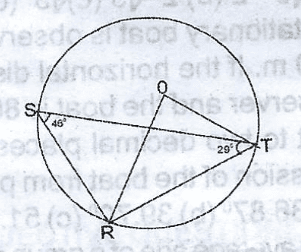
The diagram shows a circle centre O. if
Attached Figure / Diagram
A
12\(^o\)
B
15\(^o\)
C
29\(^o\)
D
34\(^o\)
medium Difficulty
Verified Correct Answer: Option B
Step-by-Step Mathematical Solution
SOT = 2 x 46 (< at the centre is twice < at circumference) = 92
2x + 92 = 180( sum of
x = \(\frac{180- 92}{2}\) = 44º
< STO = 44º - 29º
= 15\(^o\)
Source: WAEC / JAMB / NECO Classroom Archive (Record #50152)