Question Library
Browse, filter, and study verified past examination questions with step-by-step mathematical reasoning.
Searching 18,000+ Questions...
Sifting topics, KaTeX formulas & verified solutions
Showing 211–225 of 4783 verified questions
Sort by:
Chemistry
UTME / JAMB 2024
Acids, Bases, and Salts
Solution
Fats and oils are esters of fatty organic acids combined with a trihydric alkanol commonly referred to as
A
ethanol
B
methanol
C
glycol
D
glycerol
medium Difficulty
Verified Correct Answer: Option D
Chemical Principles & Mechanism
Fats and oils are esters of fatty acids and a trihydric alkanol called glycerol or triacylglycerol.
An ester is any of a class of organic compounds that react with water to produce alcohols and organic or inorganic acids.
Source: Myschool Past Questions Archive (Record #70287)
Chemistry
UTME / JAMB 2024
Matter & Separation Techniques
Solution
Determine the half-life of a first order reaction with constant 4.5 x 10\(^{-3}\) sec\(^{-1}\).
A
154 s
B
15.4 s
C
1540 s
D
1.54 s
medium Difficulty
Verified Correct Answer: Option A
Chemical Principles & Mechanism
The half-life of a first-order reaction can be calculated using the formula t\(\frac{1}{2}\) = \(\frac{0.693}{k}\)
Where t\(\frac{1}{2}\) = the half-life and k = the rate constant
From the question, we were given the value for k, which is the constant to be 4.5 x 10\(^{-3}\) sec\(^{-1}\)
t\(\frac{1}{2}\) = \(\frac{0.693}{k}\) = \(\frac{0.693}{4.5 x 10\(^{-3}\)}\)
t\(\frac{1}{2}\) = 154 s
Source: Myschool Past Questions Archive (Record #70288)
Chemistry
UTME / JAMB 2024
Organic Chemistry
Solution
Alkanoates are naturally found in
A
lipids
B
vitamins
C
proteins
D
rubbers
medium Difficulty
Verified Correct Answer: Option A
Chemical Principles & Mechanism
Alkanoates, also known as esters, are naturally found as fats and oils in plants and animals. However, lipids are the building blocks of fats and oils.
Source: Myschool Past Questions Archive (Record #70293)
Chemistry
UTME / JAMB 2024
Stoichiometry & Mole Concept
Solution
CH\(_3\)-CH\(_2\)-OH and CH\(_3\)-O-CH\(_3\)
The relationship between the two compounds above, is that they are
A
allotropes
B
isotopes
C
isomers
D
isobars
medium Difficulty
Verified Correct Answer: Option C
Chemical Principles & Mechanism
CH3-CH2-OH and CH3-O-CH3 are functional isomers, meaning they have the same molecular formula but different functional groups:
CH3-CH2-OH: This is the chemical formula for ethanol, an alcohol. The structure of ethanol is an ethyl group linked to a hydroxyl group.
CH3-O-CH3:This is the chemical formula for dimethyl ether, an ether. The structure of dimethyl ether is R – O – R, where R is alkyl groups.
Source: Myschool Past Questions Archive (Record #70295)
Chemistry
UTME / JAMB 2024
Stoichiometry & Mole Concept
Solution
A factor that does not affect the rate of a chemical reaction is
A
surface area
B
temperature
C
volume
D
catalyst
medium Difficulty
Verified Correct Answer: Option C
Chemical Principles & Mechanism
When the surface area of a reactant increases, more particles are exposed to the other reactant, which increases the chance of collisions. This leads to more successful collisions per second, which increases the rate of reaction.
When the temperature of a chemical reaction increases, the average kinetic energy of the reactant molecules increases. This causes the molecules to move faster and collide with each other more often and with more energy.
Volume itself doesn't directly affect the rate of reaction, changes in volume can affect pressure and, in cases involving gaseous reactants, the equilibrium position, which can indirectly influence the rate of reaction.
A catalyst is a substance that speeds up a chemical reaction without being used up in the process. It does this by providing an alternative reaction pathway with a lower activation energy. This means that more reactant molecules can collide effectively, increasing the reaction rate.
Source: Myschool Past Questions Archive (Record #70305)
Chemistry
UTME / JAMB 2024
Acids, Bases, and Salts
Solution
In contact process, the catalyst used in the conversion of sulphur(IV)oxide to sulphur(VI) oxide is
A
nickel
B
platinum
C
vanadium(V)oxide
D
magnesium(IV)oxide
medium Difficulty
Verified Correct Answer: Option C
Chemical Principles & Mechanism
The contact process is an industrial method for producing sulphuric acid. Vanadium(V) oxide (V\(_2\)O\(_5\)) is the catalyst used in the contact process to convert sulphur(IV)oxide to sulphur(VI) oxide
The process involves:
Burning sulphur: Molten sulfur is burned in the presence of air to produce sulphur dioxide.
Conversion to sulphur trioxide: Sulphur dioxide is converted to sulphur trioxide using the catalyst vanadium pentoxide. This reaction is exothermic, meaning it releases heat.
Formation of oleum: Sulphur trioxide is dissolved in a 94% H\(_2\)SO\(_4\)solution to create oleum, also known as fuming sulphuric acid. Platinum was originally used as the catalyst in the contact process, but vanadium pentoxide is now preferred because it's less likely to react with arsenic impurities in the sulphur feedstock.
Source: Myschool Past Questions Archive (Record #70306)
Chemistry
UTME / JAMB 2024
Acids, Bases, and Salts
Solution
The element which can combine with oxygen to form an acid anhydride of the form XO\(_2\) is
A
phosphorus
B
Chlorine
C
fluorine
D
sulphur
medium Difficulty
Verified Correct Answer: Option D
Chemical Principles & Mechanism
An Acid anhydride can be defined as a non-metal oxide which forms an acidic solution when reacted with water.
Sulphur is the element that can combine with oxygen to form an acid anhydride of the form XO\(_2\).
An acid oxide is a compound that forms an acid when it reacts with water. Non-metals in groups 4–7 form acidic oxides.
Source: Myschool Past Questions Archive (Record #70307)
Chemistry
UTME / JAMB 2024
Matter & Separation Techniques
Solution
Rust on the surface of a metal sheet contains
A
hydrated iron(II)oxide
B
hydrated iron(III)oxide
C
iron(III)hydroxide
D
iron(III) trioxocarbonate(IV)
medium Difficulty
Verified Correct Answer: Option B
Chemical Principles & Mechanism
Rust on a metal sheet contains iron oxide, which is a compound made of iron, oxygen, and hydrogen:
Chemical formula: The chemical formula for rust is Fe\(_2\)O\(_3\).x H\(_2\)O also known as hydrated Iron(III) oxide.
The chemical equation for the rusting of iron is
4Fe + 3O\(_2\) + xH\(_2\)O → 2Fe\(_2\)O\(_3\)⋅xH\(_2\)O
Source: Myschool Past Questions Archive (Record #70308)
Chemistry
UTME / JAMB 2024
Matter & Separation Techniques
Solution
A gas that turns lime water milky is likely to be from
A
Trioxocarbonate(IV)
B
Chloride
C
Trioxonitrate(V)
D
Tetraoxosulphate(VI)
medium Difficulty
Verified Correct Answer: Option A
Chemical Principles & Mechanism
When carbon dioxide gas passes through lime water (Ca(OH)\(_2\)), it reacts to form calcium carbonate (CaCO\(_3\)), which is a milky substance.CO\(_2\) is obtained from Trioxocarbonates(IV). Thus, calcium carbonate is a trioxocarbonate(IV).
Source: Myschool Past Questions Archive (Record #70309)
Chemistry
UTME / JAMB 2024
Atomic Structure and Periodic Table
Solution
The composition of alloy permalloy is iron and
A
copper
B
nickel
C
lead
D
magnesium
medium Difficulty
Verified Correct Answer: Option B
Chemical Principles & Mechanism
The composition of permalloy is about 80% nickel and 20% iron. Permalloy is a magnetic alloy that's also known as an iron-nickel alloy or ferronickel alloy. It's used in electrical and electronic equipment as a magnetic core material and in magnetic shielding.
Source: Myschool Past Questions Archive (Record #70296)
Chemistry
UTME / JAMB 2024
Atomic Structure and Periodic Table
Solution
Aqueous solution of sodium hydroxide can be used to test for the presence of : I. Ca\(^{2+}\) , II. Zn\(^{2+}\) , III. Cu\(^{2+}\)
A
I only
B
I and III
C
I, II and III
D
I and II only
medium Difficulty
Verified Correct Answer: Option C
Chemical Principles & Mechanism
An aqueous solution of sodium hydroxide (NaOH) can be used to test for metal cations, such as: Aluminum (Al), Calcium (Ca), Copper (II) (Cu),Iron (II) (Fe), Iron (III) (Fe), Magnesium (Mg), Zinc (Zn) etc.
Sodium hydroxide solution is a useful base for identifying ionic metal compounds because it reacts with metallic ions. The color of the precipitates formed and their solubility in excess of the reagent can help identify cations in aqueous solutions.
Calcium ions: A few drops of dilute sodium hydroxide solution will form a white precipitate with calcium ions. Adding excess sodium hydroxide solution will not change the precipitate.
Zinc ions: A few drops of dilute sodium hydroxide solution will form a white precipitate with zinc ions. Adding excess sodium hydroxide solution will dissolve the zinc hydroxide precipitate to form a colorless solution.
Copper ions: Sodium hydroxide solution will form a blue precipitate with copper(II) ions.
Source: Myschool Past Questions Archive (Record #70298)
Chemistry
UTME / JAMB 2024
Matter & Separation Techniques
Diagram
Solution
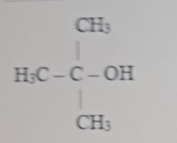
The IUPAC nomenclature of the compound above is
Attached Figure / Diagram
A
propan-1-ol
B
butan-1-ol
C
2-methyl propan-1-ol
D
2-methyl propan-2-ol
medium Difficulty
Verified Correct Answer: Option D
Chemical Principles & Mechanism
The IUPAC nomenclature of the compound above is 2-methylpropan-2-ol.
Source: Myschool Past Questions Archive (Record #70299)
Chemistry
UTME / JAMB 2024
Acids, Bases, and Salts
Solution
What is formed when metal reacts with acid to liberate gas?
A
Salt
B
Base
C
Acid
D
Liquid
medium Difficulty
Verified Correct Answer: Option A
Chemical Principles & Mechanism
When a metal reacts with an acid, hydrogen gas and a metal salt are formed.
Metal + acid → salt + hydrogen
2Na + 2HCl → 2NaCl + H\(_2\)
Source: Myschool Past Questions Archive (Record #70301)
Chemistry
UTME / JAMB 2024
Acids, Bases, and Salts
Solution
Concentrated sodium chloride solution is electrolyzed using mercury cathode and graphite anode. The products at the anode and the cathode respectively are
A
hydrogen and chlorine
B
chlorine and hydrogen
C
chlorine and sodium
D
sodium and chlorine
medium Difficulty
Verified Correct Answer: Option C
Chemical Principles & Mechanism
1:Identify the components involved in the electrolysis: The electrolysis involves a concentrated sodium chloride (NaCl) solution, a mercury cathode, and a graphite anode.
2: Determine the reactions at the electrodes: At the anode (oxidation), chlorine gas is produced because the potential for chlorine evolution is lower than that of oxygen evolution in a concentrated NaCl solution. The reaction is 2Cl^- → Cl2 + 2e^-.
3: Determine the reaction at the cathode: At the mercury cathode (reduction), sodium is produced and forms an amalgam with mercury because the potential for sodium reduction is lower than that of hydrogen evolution due to the high overpotential of hydrogen on mercury. The reaction is Na^+ + e^- → Na.
4: Identify the products: The products are chlorine gas (Cl2) at the anode and sodium (which forms an amalgam with mercury) at the cathode.
This implies Chlorine is produced at the anode and sodium at the cathode.
The correct answer is C.
Source: Myschool Past Questions Archive (Record #70304)
Chemistry
UTME / JAMB 2024
Atomic Structure and Periodic Table
Solution
When n = 3, the quantum number of an element is
A
3
B
9
C
18
D
21
medium Difficulty
Verified Correct Answer: Option A
Chemical Principles & Mechanism
Quantum numbers are a set of numbers that describe the position and energy of an electron in an atom.
When the quantum number is equal to 3, the possible values for the azimuthal quantum number are 0, 1, and 2:
l=0, The resulting subshell is an "s" subshell.
l =1, The resulting subshell is a "p" subshell.
l =2: The resulting subshell is a "d" subshell.
The three possible sub-shells when n=3 are 3s, 3p, and 3d.
Source: Myschool Past Questions Archive (Record #70310)