Question Library

Browse, filter, and study verified past examination questions with step-by-step mathematical reasoning.

Launch Interactive Practice
Searching 18,000+ Questions... Sifting topics, KaTeX formulas & verified solutions
Showing 22426–22440 of 29811 verified questions
Sort by:
Biology WAEC / WASSCE 1995 Variation & Genetics (Heredity)
Which of the following is an example of discontinuous variation?
A
Height
B
Size of head
C
Blood group
D
Skin colour
E
Length of foot
medium Difficulty
Biology WAEC / WASSCE 1995 Variety of Organisms & Classification of Living Things
Hereditary variation is best described as
A
characters transmitted from generation to generation
B
traits acquired from diseases
C
characters that show up due to social conditions
D
traits acquired from habits and environmental conditions
E
characters that result from physical injuries.
medium Difficulty
Biology WAEC / WASSCE 1995 Variation & Genetics (Heredity)
An individual with blood group AB can receive blood from those in blood group(s)
A
AB only B
B
A and B only
C
B only
D
AB and O only
E
A, B, AB and O
medium Difficulty
Biology WAEC / WASSCE 1995 Adaptation & Evolution
The statement that the environment determines which organisms survives to reproduce
A
explains the theory of acquired characters
B
supports Jean Lamarck’s theory of use and disuse
C
supports the idea of survival of the fittest
D
is refuted by fossil records
E
implies that organisms modify their environment in order to survive.
medium Difficulty
Biology WAEC / WASSCE 1995 Variation & Genetics (Heredity)
Which of the following is a definition of heredity? It is the
A
non-resemblance of closely related organisms
B
total absence of parental traits in offspring
C
absence of variation in organisms
D
transfer of characteristics from parents to offspring
E
cause of infant mortality.
medium Difficulty
Biology WAEC / WASSCE 1995 Variation & Genetics (Heredity)
Which of the following is not a reason why an offspring looks different from its parents?
A
Random reorganisation of chromosome during gamete formation
B
Existence of multiple alleles in organisms
C
Formation of chasmata in chromatids during meiosis
D
Mutation which gives rise to new combination of gene
E
Mitosis of the zygote produces new combination of chromosomes
medium Difficulty
Biology WAEC / WASSCE 1995 Variation & Genetics (Heredity)
The pair of genes expressed in a heterozygous individual is described as
A
allele
B
chromatid
C
dominant gene
D
centrosome
E
chromomere
medium Difficulty
Biology WAEC / WASSCE 1995 Respiration & Gaseous Exchange
The following structures are adaptation for water conservation except
A
sunken stomata
B
scales in animals
C
lenticels in stems
D
spines in plants
E
thick leaves
medium Difficulty
Biology WAEC / WASSCE 1995 Population Ecology, Habitats & Conservation
Which of the following ecological factors causes food shortage?
A
Low rate of reproduction
B
Emigration
C
Drought
D
Topography
E
wind direction
medium Difficulty
Biology WAEC / WASSCE 1995 Basic Ecological Concepts, Ecosystems & Biomes
Density, mortality rate, birth rate are the factors that affect
A
population
B
dominance
C
cover
D
habitat
E
abiotic community
medium Difficulty
Biology WAEC / WASSCE 1995 Excretion & Homeostasis
Ultra-filtration process at the Bowman’s capsule is facilitated by
A
the volume of water in the blood
B
the high concentration of urea in the blood of the Bowman’s capsule
C
the differential blood pressure between the glomerulus and the Bowman’s capsule
D
the differential blood volume between the glomerulus and the Bowman’s capsule
E
heavy weight of the urea, water, glucose and amino acids in the Bowman’s capsule.
medium Difficulty
Biology UTME / JAMB 1995 Nervous, Hormonal Coordination & Sense Organs
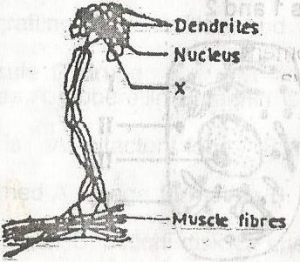
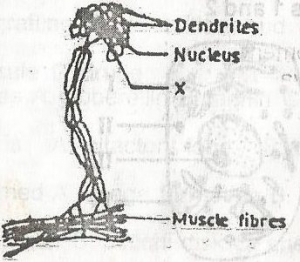
The part labelled X is the
A
axon
B
cell body
C
terminal dendrites
D
synapse
medium Difficulty
Biology UTME / JAMB 1995 Nervous, Hormonal Coordination & Sense Organs
The diagram represents
Attached Figure / Diagram
Question diagram
A
sensory neurone
B
relay neurone
C
afferent neurone
D
motor neurone
medium Difficulty
Biology UTME / JAMB 1995 Nervous, Hormonal Coordination & Sense Organs
The part labelled X is the
Attached Figure / Diagram
Question diagram
A
axon
B
cell body
C
terminal dendrites
D
synapse
medium Difficulty
Biology WAEC / WASSCE 1995 Supporting Tissues & Skeletal System
1. Name the blood vessel which carries blood away from the kidney. 2.What part of the brain controls temperature regulation in the body? 3.Name the process in mammal during which Urea is formed. 4. In the test for starch why is the green leaf boiled in (a) water; (b) alcohol? 5. Name four parts of the mammalian alimentary canal. 6 State two features which are peculiar to the atlas vertebra 7. Name three diseases which can affect the kidney of man 8 Use the diagram below to answer questions (a) to (c) (a) (i)Name the structure illustrated above (ii) State the organ in which it is food (b) Name the parts labeled HV (c) Name the fluid that is found within the parts of the structure labeled I - V 10. List the media of transportation of nutrients in: (a) Paramecium (c) invertebrates, (d) mammals 11. State two features which classify the rhizome as an underground stem. SECTION B Answer all the questions 12. You are provided with 10cm\(^3\) of water and a few crystals of potassium permanganate. Take two crystals with a spatula, bring the spatula close to the surface of tho water and gently drop that crystals into the water Do not stir the water or shake the test tube. (a) Carefully observe the set- up and record your observations as follows () Immediately after dropping the crystals into the water (i) after 5 minutes (ii) after 10 minutes (iv) after 15 minutes. Copy the table below into your answer booklet and use it in recording your observations. Time Observation Immediately after dropping the crystals After 5 minutes After 1O minutes After 15 minutes (b) What physical process must have given rise to the observations made? (c) State three physiological processes in organisms in which this phenomenon occurs (ii) Why is it not advisable to stir the water or shake the beaker in this experiment? 13. (a) identify specimen. A and B (b) What type of skeleton has specimen A? (c) What is this skeleton made of? (d) From what group of animals can specimen B be collected? (e) From what part of the animal is it found? (f)(i) Make a labeled drawing 8 to 12 cm long of the anterior view of specimen B (ii) Give one function each of any three of the labeled parts. 14. Specimen C is a plant immersed in ink solution. Cut a thin cross section of the stem from at least 1 cm away from the ink mark upwards. Place the cut section in a Petri dish or transparent piece of glass or watch glass. Observe the cut section with a hand lens (a) Make a labeled drawing 8-10 cm in diameter of the cut surface to show with a distribution of tissues in the specimen (b), Shade all the stained tissues with horizontal strokes (c) Name two materials that are transported by the shaded tissues (d) Name three physical processes which help the transportation of materials from the soil to the leaf of the plant.
medium Difficulty
Page 1496 of 1988