Question Library
Browse, filter, and study verified past examination questions with step-by-step mathematical reasoning.
Searching 18,000+ Questions...
Sifting topics, KaTeX formulas & verified solutions
Showing 21481–21495 of 29811 verified questions
Sort by:
Biology
UTME / JAMB 1997
Variety of Organisms & Classification of Living Things
Water loss is regulated in plants and animals by both the
A
scales and the skin
B
scales and the hair
C
thick leaves and the feathers
D
leathery cuticle and the feathers
medium Difficulty
Verified Correct Answer: Option D
Biological Concept & Syllabus Guide
No expanded working has been attached for this question yet. The verified answer is Option D.
Source: Myschool Past Questions Archive (Record #41391)
Biology
WAEC / WASSCE 1997
Nervous, Hormonal Coordination & Sense Organs
Solution
1.Define the following terms: (i) Accommodation (ii) Metamorphosis
2. Why is the wall of the left ventricle of the heart thicker than that of the right ventricle?
3. Why is sugar contained in the urine of a person with diabetes mellitus?
4.Which hormone controls water reabsorption in the kidney?
5. Explain the significance of hemoglobin in respiration
Study the diagram below and use it to answer Question 6
6. (a) What is the aim of the experiment illustrated in the diagram above?
(b) Name the liquid labeled I. (c) Name two materials that can be used as living tissue (d) (i) What would happen to the level of solution inside the living tissue in both A and B if the set-up is allowed to stand for about three hours? (ii) Give a reason for your.answer (c) What is the function of set-up B?
7. (a) What is pest? (b) List three plant pests and name the plant attacked by each
Use the diagram below to answer Question 8
8 (a) identify the organism represented in the diagram
(b) List three features that adapt the organism to its environment.
9. (a) (i) identify specimens A and B without giving reasons. (ii) What are the possible habitats of specimens A and B? (b) Remove the wings of specimen A and make a large labeled drawing 12cm to 15 long of it. (C) In a tabular form, give three differences between specimens A and B (d) Give two economic importance of specimen A and one of specimen B
10. (a) What types of leaves are specimens C,D and E?
(b) () identity the leaf arrangement in specimen D. (ii) What type of venation is exhibited in specimen C?
(c) Observe specimens C and E with a hand-lens. Which one has more stomata? (d) (i) State the likely habitat of the plants from which specimen C was obtained.
(ii) Of what importance are specimens C, D and E to the plant? [1mark] (e) Making use of the hand lens, identify specimens F, G and H
(f) State their modes of nutrition? (g) State two Observable differences between specimens F andG|.
11. (a) identify specimens I,J and K stating organism from which each has been obtained.
(b) List two functions of each of the specimens. (C) Arrange tne specimens in order of evolutionary advancement.
medium Difficulty
Verified Correct Answer: Option
Biological Concept & Syllabus Guide
1.(i) Accommodation is the ability of the eye to focus (both near and distant) objects on the retina or the ability to see clearly (far and near) objects. It is also the adjustments of tne focal length of the eye to see clearly. (i) Metamorphosis is a process by which organisms change or develop from egg to adult.
2. The wall of the left ventricle is thicker because the left ventricle pumps (oxygenated) blood to more parts of the body than the right ventricles. Right ventricle pumps Blood only to the lungs while the left ventricle pumps blood to the other parts of the body.
3. In a diabetic person, there is either insufficient or inadequate or no insulin at all to convert the excess sugar to glycogen for storage in tne Liver. This causes excess sugar to be contained in the urine.
4. Vasopressin or Anti-diuretic Hormones (ADH) controls the reabsorption of water in the kidney.
5. Hemoglobin has an affinity for oxygen with which it combines loosely to form oxyhaemoglobin. In the tissues, the oxyhaemoglobin dissociates to release oxygen in the cells for tissue respiration or internal respiration.
6(a) The aim of the experiment is to demonstrate osmosis in a living tissue or to demonstrate that water moves from the region of higher concentration through a semi-permeable or selective permeable membrane. (b) The liquid labeled I is water Yam potato. pawpaw, pig's bladder or cocoyam can be used as a living tissue.
(d)(i) The level of the solution in A will rise while the level of B will remain the same. (ii) In the soup A, the trough has a higher concentration of water molecules than the sugar solution, so there is a movement of water molecules rough through the living tissues into the sugar solution. OR there is a higher osmotic pressure in the sugar solution than in the trough, so water molecules move from the trough through the cells of the living tissues into the sugar solution. In set-up B, the concentration of water molecules are the same in the trough and in the yam cup.
(e) Set up B serves as a control.
7.(a) A pest is an organism (living organism) which harms or causes damage to man, his animals, crops or possession (b) Aphid attacks orange, citrus, cocoa, banana. cowpea. beans. beetles attacks banana, yam, bean, coconut, cocoa, palms. Weevils cereal crops. attack grains, beans, rice, corn, millet. Grasshopper/ Locust attacks cassava, all crops. Stem borer attacks maize, cocoa plant, Cocoa, Cotton cereal Crops. Mealy bug attacks cassava, mango bitter leaf. (African) armyworm attacks rice, sorghum, guinea crops. Rodents attacks tubers, maize, groundnut, sugarcane stem. Termites attacks any named plant. Cotton stainners attack cotton. Caterpiller attacks vegetables.
8. Hydrophyte or with air water lettuce or Pistia (b) Light body (ii) poorly developed strengthening tissue (iii) presence of alir spaces, spongy tissue and presence of parenchvma, (iv) presence of poorly developed conducting tissue (V) presence of thin cuticle or absence of cuticle (vi) presence of stomata only on the upper of the leaf (vii) presence of stolon (viii) presence of fibrous roots for water absorption.
9.(a) Specimen A is Cockroach while Specimen B is Earthworm (i) Specimen A is found in dark corners, Crevices, shelves, Cupboards, cartons containing food stuff or books, dirty toilet. Specimen B is found in damp or humid soil, mud and moist soil.
(c) Differences between specimen A and B are: Cockroach (Specimen A)
(i)Body is divided into head, thorax and abdomen,(ii) Antenna present (iii) Legs present iv) Wings present (v) Eyes present (vi) Clitellum absent (vi) Chaetae/setae absent (vii) Distinct head present.
Earthworm
(Specimen Body not divided into head, thorax and abdomen (not divided into three (three regions.) regions), Legs absent, Wings absent, Eye absent, Clitellum present, Chaetae/setae present, Distinct head absent.
(d) Specimen A is a disease vector. It: (i) destroys books, clothes, food etc (ii) deposits feces on clothes/ books to stain them (iii) causes discomfort by biting human body and introducing germs into it. (iv) loosens soil, making it well aerated.
Specimen B: (i) burrows the soil to make it easy for growth of roots (ii) is used as a bait for fishing (iii) dead worms and earthworm casts enrich the soil. (iv) drags leaves into the soil thereby improving soil fertility (iv) burrows to enhance water drainage.
10(a)Specimen C is a simple leaf. Specimen D is bipinnate or compound leaf. Specimen Eis pinnate or compound leaf (b)(i)Opposite (ii) Net (venation) or Reticulate (venation) (c) Specimen C and Specimen E. (d)(i)Terrestrial, land or Savannah (ii) (1) Photosynthesis for manufacture of food (2) respiration (3) excretion (4) transpiration or loss of water. (e) F = Mould, fungus, Rhozopus mucor, G= Spirogyra, Filamentous alga or green alga. H = Tick, F= Saprophytic or saprobic; G = Photosynthetic, autotrophic or holopytiC; H= Parasitic
Observable differences between specimens Fand G are:
Specimen F
Specimen G
grey/brown/black in colour
Green in colour
Sporangia is present
Sporangia is absent
Specimen F is fiuffy/powdery
Specimen G is slimy.
Spiral) chloroplast absent spiral)
chloroplast present
branched
unbranched/filamentous
11(a) Specimen I= Scale(s) from fish; J = Feather(s) from Fowl or Bird; K= Hair(s) from mammal
(b) Specimen I (i) Protection or camouflage (ii) Water proofing. - Specimen J (i) Insulation or temperature regulation. (ii) adaptation for flight or aerial life (il) protection and camoutlage (iv) courtship,beautification and gender differentiation (v) maintenance of body shape (vi) water proofing or prevents water loss.
Specimen K (i) protection and camouflage (ii) insulation and temperature regulation (ili) courtship, for attraction of mating partners, beautification, gender differentiation (c) Scale - Feather -Hairs/ I,J,K/K J I. Or Scale from fish, feather from bird, (Hair from mammal (e.g rat) )
Source: Official Exam / Past Question Archive
Biology
WAEC / WASSCE 1997
Basic Ecological Concepts, Ecosystems & Biomes
Solution
(a) Describe an experiment to compare the water-holding capacity of sandy, loamy and clayey soils.
(b) List three factors that may affect the water-holding capacity of soils.
(c) (i) State the characteristics of sandy and loamy soils.
(ii) What type of vegetation does each support?
medium Difficulty
Verified Correct Answer: Option
Biological Concept & Syllabus Guide
(a) To perform an experiment to compare water holding capacity of sandy, loamy and clayey soil, one will need to obtain samples of sandy, loamy and clayey soils, dry soils samples or air dry samples to constant weight, insert funnels in the neck of the three measuring cylinders and place a folded filter paper or cotton wool in each of the funnels, put a known or equal weight of each of the air-dried soils in each of the funnels respectively and label them as sandy, loamy and clayey, pour equal amount of water into each soil and leave the set up till no more drops of water pass through it to the cylinder. Find the differences between the volume of water retained by each soil.
Observation: Sandy soil has more volume of water, followed by loamy soil and clayey soil in the cylinder.
Conclusion: Clayey soil has the greatest water retention capacity followed by loamy soil and sandy soil.
(b) Factors that may affect water holding capacity of a soil are:
(i) Humus content/organic matter/living organisms
(ii) Clay content
(iii) Soil texture.
(iv) size of soil particles
(v) mineral salt and pH
(c)(i) Sandy soil contains silica, large particles, low nutrients and low capillary power, retains little water, is porous / well drained, possesses coarse, gritty or rough texture and large air spaces and its mineral nutrients are easily leached. Loamy soil contains humus, organic matter, a mixture of sand clay and silt in about equal proportion and possesses moderate aeration, capillary power and water holding or retaining capacity.
(ii) Sandy soil supports scanty vegetation, grass or grassland and shrubs while loamy soil supports heavy or luxuriant vegetation (forest).
Source: Myschool Past Questions Archive (Record #52973)
Biology
WAEC / WASSCE 1997
Variety of Organisms & Classification of Living Things
Solution
(a) Explain the following terms:
(i) first aid
(ii) artificial respiration
(iii) dislocation
(iv) haemorrhage
(b) (i) State three objectives of first aid.
(ii) Explain the procedure for administering the mouth-to-mouth method of artificial respiration.
(c) (i) State three signs of dislocation.
(ii) Name two ways of stopping bleeding from an open wound.
medium Difficulty
Verified Correct Answer: Option
Biological Concept & Syllabus Guide
(a)(i) First aid is referred to as the assistance given to a victim of accidents or sudden illness in order to prevent worsening of condition before employing the services of a qualified doctor or physician.
(ii) Artificial respiration involves the supply of air or oxygen to the lungs of a suffocating person to restore normal breathing or a method of resuscitating a person who suffers from asphyxia or lack of oxygen.
(iii) Dislocation is the shifting or displacement of bones from joints or can be referred to as when bones forming a joint are displaced from their original positions.
(iv) Haemorrhage is the escape or loss of blood or bleeding from a cut or punctured blood vessel.
(b) (i) The objectives of first aid are: .
(1) To sustain life
(2) To save life or regain consciousness
(3) To reassure the victim of life
(4) To prevent the worsening of a condition of infection
(5) To reduce pain.
(ii) The procedures for administering mouth-to mouth artificial respiration are:
(1) Lie victim on the back and loosen all tight wears.
(2) Tilt the head back as far as possible and pull jaw forward to open the mouth.
(3) Ensure that you examine the mouth and pharynx well to remove any obstacles.
(4) Then open your mouth wide and place over the mouth of victim.
(5) Close victim's nostrils by pinching his nose with one of your hands.
(6) Take deep breath and blow in air gently (10 to 12 times a minute) into the victim's lungs until there is chest movement.
(c) (i) Signs of dislocation are:
(1) Pain at the affected joint
(2) Swelling or tenderness around the affected joint
(3) Loss of function of the affected limb or loss of normal movement
(4) Deformity or abnormal appearance at the affected joint.
(ii) Ways of stopping bleeding from an open wound include
direct pressure on the wound
pressure at the pressure point
use of iodine solution or methylated spirit
use of bandage, use of tourniquet.
Source: Myschool Past Questions Archive (Record #52975)
Biology
WAEC / WASSCE 1997
Reproduction in Plants & Animals
Solution
(a) Make a labelled diagram of the female reproductive organ of a
(i) flowering plan
(ii) mammal (man) .
(b) State the functions of any two of the labelled parts in (a) (i) and (ii).
(c) Compare reproduction in mammals, amphibians and birds with respect to
(i) number of eggs produced
(ii) method of fertilization
(iii) parental care.
medium Difficulty
Verified Correct Answer: Option
Biological Concept & Syllabus Guide
(i)
(b)(i)Functions of Stigma in (a)(i) above is that it receives pollen grains and nourishes the pollen grains to germination while the Ovary houses the ovule or develops embryo or develops to fruit. The style serves as the passage way for germinating pollen grain to reach the ovule. The Ovule develops to seed after fertilization and Placenta connects ovule or seed to the ovary for nourishment.
(b)(ii) The ovary produces ovum/egg/hormones. The Funnel receives the ovum or egg. Fallopian tube or oviduct serves as a passage way for ovum or site of fertilization. The Uterus or womb houses the embryo till birth. The Vagina is the passage way for the baby during birth and it receives male organs (penis) and sperm during coition or intercourse. The Vulva is the entrance to the vagina. It receives male organ or penis and serves as a passage way for baby.
Mammals
Amphibians
Birds
No of eggs
Fertilization
Parental care
One or few
Internal
Present and fora Iona time
Many
External
Absent
Many or few
Internal
Present but for a short time
Source: Myschool Past Questions Archive (Record #52976)
Biology
WAEC / WASSCE 1997
Population Ecology, Habitats & Conservation
Solution
(a) Define the term " Conservation".
(b) State three reasons for conservation.
(c) List four methods of conserving each of the following: (i) water (ii) wildlife (iii) forest.
(d) Mention three forest or game reserves in Nigeria.
medium Difficulty
Verified Correct Answer: Option
Biological Concept & Syllabus Guide
(a) Conservation- can be referred to as the intelligent use or selection of what can be changed or replaced in the community without harmfully disturbing the balance in nature. In other words, it is the preservation of natural I resources from loss or waste, harm and exploitation through wise, rational or sensible use to ensure their availability and to preserve the quality or original nature of the natural resources.
(b) Reasons for conservation are:
(i) To prevent destruction of natural ecosystems
(ii) For medicinal purposes .
(iii) To preserve naturally beautiful scenarios for their aesthetic values.
(iv) For research purposes
(v) To promote the recycling of some scarce mineral resources/ water
(vi) To prevent destruction of natural environment
(vii) To allow for continued use of natural resources for man's benefit
(viii) Preservation of rare and valuable species of plant and animals for future generation or to save them from extinction.
(c) (i) Methods of conserving water are:
(1) Trapping or storage in tanks or wells
(2) Treatment and recycling of used water
(3) Damming of rivers to allow more effective management of water
(4) Planting of trees to provide vegetation cover which reduces evaporation and promotes water retention in soil /rainfall.
(5) Saving of water by prompt repairs of burst pipes and turning off taps immediately after use.
(ii) Methods of conserving wild life are:
(1) Establishment of zoological gardens
(2) Establishment of game /forest reserves
(3) Hunting should be controlled
(4) Prohibiting bush burning
(5) Prohibiting killing or poaching of animals in game reserves
(6) Educating the public on the values of wildlife
(7) Discouraging deforestation and encouraging afforestation.
(iii) Methods of conserving Forest are:
(1) Ensure cutting of trees without destroying undergrowth.
(2) Reafforestation or tree planting should be encouraged.
(3) Discourage bush burning.
(4) Pests /diseases of plants should be controlled.
(5) Establishment of forest reserve
(6) Educating the public on the value of forest and importance of conservation and cutting of matured trees only.
(d) Some forest or game reserves in Nigeria include:
(1) Yankari game reserve in Bauchi State
(2) Borgu game reserve in Niger State
(3) Omo forest reserve in Ogun State
(4) Sakpoba forest reserve in Edo State
(5) Mamu River in Anambra State
(6) Anara in Kaduna State
(7) Zamfara in Zamfara State
(8) Sanga River Plateau State
(9) Olomu forest reserve - Kwara State
(10) ljero forest reserve in Ekiti.
Source: Myschool Past Questions Archive (Record #52978)
Mathematics
WAEC / WASSCE 1996
Plane Geometry, Polygons & Circle Theorems
Solution
If the hypotenuse of a right-angle isosceles triangle is 2, what is the length of each of the other side?
A
1/√2
B
√2 - 1
C
1
D
√2
E
√3
medium Difficulty
Verified Correct Answer: Option D
Step-by-Step Mathematical Solution
An Isosceles Right Triangle is a right triangle that consists of two equal length legs.
i.e opp = adj
hyp\(^2\) = adj\(^2\) + opp\(^2\)
2\(^2\) = x\(^2\) + x\(^2\)
4 = 2x\(^2\)
2 = x\(^2\)
\sqrt2 = x
Source: WAEC / JAMB / NECO Classroom Archive (Record #23810)
Mathematics
WAEC / WASSCE 1996
Plane Geometry, Polygons & Circle Theorems
Diagram
Solution
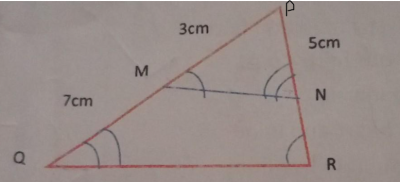
In the diagram, ∠PMN = ∠PRQ and ∠PNM = ∠PQR. If /Pm/ = 3cm, /MQ/ = 7cm and /PN/ = 5cm, find /NR/
Attached Figure / Diagram
A
1cm
B
3cm
C
31/2
D
5cm
E
6cm
medium Difficulty
Verified Correct Answer: Option A
Step-by-Step Mathematical Solution
△PQR is similar to △PNM
\(\frac{PQ}{PN}\) = \(\frac{PR}{PM}\)
\(\frac{7 + 3 }{5}\) \(\frac{5 + NR}{3}\)
cross multiply
10 x 3 = (5 x 5) + 5 x NR
5NR = 30 - 25 = 5
NR = \(\frac{5}{5}\) = 1 cm.
Source: WAEC / JAMB / NECO Classroom Archive (Record #23822)
Mathematics
WAEC / WASSCE 1996
Mensuration (Areas, Perimeters & Volumes)
Diagram
Solution
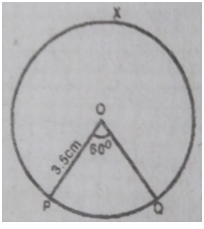
In the diagram above, O is the center of the circle of radius 3.5cm, ∠POQ = 60°. What is the area of the minor sector POQ?
[Take π = 22/7].
Attached Figure / Diagram
A
1481/2cm2
B
77cm2
C
321/12cm2
D
65/12cm2
E
15/6cm2
medium Difficulty
Verified Correct Answer: Option D
Step-by-Step Mathematical Solution
Area of sector = \(\frac{\theta}{360^\circ} \times \pi r^2\)
= \(\frac{60}{360} \times \frac{22}{7} \times 3.5 \times 3.5\)
= \(\frac{77}{12}\)
= \(6\frac{5}{12}\) cm\(^2\)
Source: WAEC / JAMB / NECO Classroom Archive (Record #23809)
Physics
WAEC / WASSCE 1996
Circular Motion, Gravitation & Simple Harmonic Motion
Solution
Two simple pendula x and y make 400 and 500 oscillations respectively in equal time. If the period of oscillation of x is 1.5 seconds, what is the period of oscillation of y?
A
0.53s
B
0.83s
C
1.20s
D
1.50s
E
1.88s.
medium Difficulty
Verified Correct Answer: Option C
Physical Principles & Numerical Solution
where f = \(\frac{oscillations}{time}\)
period = 1/ f or \(\frac{time}{oscillations}\)
For pendulum x:
where period = 1.5 and oscillation = 400
time = oscillations X 1.5 = 600s
For pendulum y:
\(\frac{time}{oscillations}\) → 600/500
period for y = 1.2s
period =
Source: WAEC / JAMB / NECO Classroom Archive (Record #25209)
Physics
WAEC / WASSCE 1996
Magnetism, Electromagnetism & AC Circuits
Solution
Calculate the amount of heat generated in an external load of resistance 8Ω if an alternating current of peak value 5A is passed through for 100s.
A
20,000J
B
10,000J
C
5,000J
D
4,000J
E
200J
medium Difficulty
Verified Correct Answer: Option B
Physical Principles & Numerical Solution
E = I\(_{rms}\)\(^2\)Rt
I\(_{rms}\) = \(\frac{I_o}{\sqrt{2}}\) = \(\frac{5}{\sqrt{2}}\) = 3.5355
E = 12.5 x 8 x 100 = 10,000J
Source: WAEC / JAMB / NECO Classroom Archive (Record #25249)
Mathematics
WAEC / WASSCE 1996
Sequences & Series (AP & GP)
Solution
The 6th term of a G.P is \(\frac{-2}{27}\) and its first term is 18. What is the common ratio?
A
-1/2
B
-1/3
C
1/4
D
2
E
3
medium Difficulty
Verified Correct Answer: Option B
Step-by-Step Mathematical Solution
a, ar, ar\(^2\), ar\(^3\), ar\(^4\), ar\(^5\)
6th term = ar\(^5\) = \(\frac{-2}{27}\)
1st term = a = 18
=> ar\(^5\)
= 18r\(^5\) =\(\frac{-2}{27}\)
r\(^5\) = \(\frac{-2}{27 * 18}\)
→ \(\frac{-1}{27 * 9}\)
r\(^5\) = \(\frac{-1}{243}\)
r = \(^5\)\sqrt[\(\frac{-1}{243}\)]
r = \(\frac{-1}{3}\)
Source: Myschool Past Questions Archive (Record #23791)
Mathematics
WAEC / WASSCE 1996
Number Bases & Modular Arithmetic
Solution
Convert the decimal number 89 to a binary number
A
101101
B
111001
C
1001001
D
1001101
E
1011001
medium Difficulty
Verified Correct Answer: Option E
Step-by-Step Mathematical Solution
2
89
2
44 r 1
2
22 r 0
2
11 r 0
2
5 r 1
2
2 r 1
2
1 r 0
0 r 1
89\(_{10}\) = 101100\(1_2\)
Source: Myschool Past Questions Archive (Record #23792)
Mathematics
WAEC / WASSCE 1996
Plane Geometry, Polygons & Circle Theorems
Solution
Simplify: \((2\frac{1}{6} - 1\frac{2}{3}) \div 2\frac{2}{3}\).
A
3/16
B
7/16
C
1 13/24
D
2 11/24
E
10 2/5
medium Difficulty
Verified Correct Answer: Option A
Step-by-Step Mathematical Solution
\((2\frac{1}{6} - 1\frac{2}{3}) \div 2\frac{2}{3}\)
= \((\frac{13}{6} - \frac{5}{3}) \div \frac{8}{3}\)
= \(\frac{3}{6} \times \frac{3}{8}\)
= \(\frac{3}{16}\)
Source: Myschool Past Questions Archive (Record #23793)
Mathematics
WAEC / WASSCE 1996
Plane Geometry, Polygons & Circle Theorems
Solution
Simplify 56x\(^{-4}\) \(\div\) 14x\(^{-8}\)
A
2x-12
B
3x-3
C
4x-4
D
4x-3
E
4x4
medium Difficulty
Verified Correct Answer: Option E
Step-by-Step Mathematical Solution
\(56x^{-4} \div 14x^{-8}\)
= \(4x^{- 4 - (-8)}\)
= \(4x^{4}\)
Source: Myschool Past Questions Archive (Record #23794)