Question Library
Browse, filter, and study verified past examination questions with step-by-step mathematical reasoning.
Searching 18,000+ Questions...
Sifting topics, KaTeX formulas & verified solutions
Showing 21286–21300 of 29811 verified questions
Sort by:
Chemistry
UTME / JAMB 1997
Organic Chemistry I: Hydrocarbons & Crude Oil
Solution
The final product of the reaction of ethyne with hydrogen iodide is?
A
CH3—CHI2
B
CH2l—CH2I
C
CH3—CI3
D
CH2 = CHI
medium Difficulty
Verified Correct Answer: Option A
Chemical Principles & Mechanism
Unsaturated compounds like ethyne readily undergo addition reactions where a molecule adds across the double or triple bond.
Ethyne reacts with HI in a two-step process, with the first step forming an intermediate with a carbon-carbon double bond, and the second step forming the final product, 1,1-diiodoethane.
First step : H-C≡C-H + HI → H\(_2\)C=CHI
Second step: H\(_2\)C=CHI + HI → H\(_3\)C-CHI\(_2\)
Source: Myschool Past Questions Archive (Record #13847)
Chemistry
UTME / JAMB 1997
Organic Chemistry II: Functional Groups, Polymers & Biomolecules
Solution
Synthetic rubber obtained by the polymerization of chlorobutadiene in the presence of sodium is called?
A
teflon
B
isoprene
C
polythene
D
neoprene
medium Difficulty
Verified Correct Answer: Option D
Chemical Principles & Mechanism
Synthetic rubber produced by the polymerization of chlorobutadiene (specifically 2-chloro-1,3-butadiene, also known as chloroprene) is called neoprene. This polymer, also known as polychloroprene, is valued for its chemical stability and flexibility across a wide temperature range. While modern commercial production often uses emulsion polymerization, historical and theoretical contexts (like those found in certain chemistry examinations) link this specific monomer to the formation of neoprene.
Source: Myschool Past Questions Archive (Record #13848)
Chemistry
UTME / JAMB 1997
Organic Chemistry II: Functional Groups, Polymers & Biomolecules
Solution
The synthetic detergents are preferred to soap for laundry using hard water because?
A
detergents are water soluble while soap is not
B
the calcium salts of detergents are water soluble
C
the magnesium salt of soap is soluble in hard water
D
soap does not have a hydrocarbon terminal chain
medium Difficulty
Verified Correct Answer: Option B
Chemical Principles & Mechanism
Synthetic detergents are preferred over soap for laundry in hard water because they don't form insoluble precipitates (scum) like soap does, remaining effective in the presence of calcium and magnesium ions. Hard water contains high levels of dissolved minerals, primarily calcium and magnesium ions. When soap (which is a sodium or potassium salt of a fatty acid) reacts with these ions in hard water, it forms insoluble precipitates, which appear as a scum or curd on clothes and in the washbasin. This scum reduces the cleaning power of the soap and can leave a residue on clothes.
Source: Myschool Past Questions Archive (Record #13851)
Chemistry
UTME / JAMB 1997
Stoichiometry, Mole Concept & Volumetric Analysis
Solution
25 cm\(^3\) of 0.02 M KOH neutralized 0.03 g of a monobasic organic acid having the general formula C\(_n\)H\(_{2n + 1}\)COOH. The molecular formula of the acid is?
(C = 12, H = 1, O = 16)
A
HCOOH
B
C2H5COOH
C
CH3COOH
D
C3H7COOH
medium Difficulty
Verified Correct Answer: Option C
Chemical Principles & Mechanism
Concentration of KOH = 39 x 0.02 = 0.78 g/dm\(^3\)
25cm\(^3\) required 0.03 g of C\(_n\)H\(_{2n + 1}\)COOH
1000cm\(^3\) will require X
\(\frac{{1000}\times{0.03}}{25}\) = 1.2g
C\(_n\)H\(_{2n + 1}\)COOH + KOH → C\(_n\)H\(_{2n + 1}\)COOK + H\(_2\)O
Recall that \(\frac{M_A V_A}{M_B V_B}\) = \(\frac{1}{1}\)
\(\frac{{M_A}\times{1.2}}{{0.02}\times{0.78}}\) = \(\frac{1}{1}\)
M\(_A\) = 0.013
Con. = Molarity x Molecular Mass
Molecular Mass = (0.78) / (0.013) x 60
C\(_n\)H\(_{2n + 1}\)COOH = 60
12n + 1 (2n + 1) + 12 + 32 + 1 = 60
14n = 60 - 46
n =\(\frac{14}{14}\) = 1
Substituting n = 1 into C\(_n\)H\(_{2n + 1}\)COOH
We'll have CH\(_3\)COOH
∴ CH\(_3\)COOH
Source: Myschool Past Questions Archive (Record #13855)
Chemistry
UTME / JAMB 1997
Chemical Energetics & Thermochemistry
Solution
\(\frac{1}{2}\)N\(_2\)(g) + \(\frac{1}{2}\)O\(_2\)(g) → NO(g) ∆H^\circ = 89 KJ mol\(^{-1}\). If the entropy change for the reaction above at 25^\circC is 11.8 J mol\(^{-1}\), calculate the change in free energy. ∆G^\circ, for the reaction at 25^\circC?
A
88.71 KJ
B
85.48 KJ
C
-204.00 KJ
D
-3427.40 KJ
medium Difficulty
Verified Correct Answer: Option B
Chemical Principles & Mechanism
\(\frac{1}{2}\)N\(_2\)(g) + \(\frac{1}{2}\)O\(_2\)(g) → NO(g) ∆H^\circ = 89 KJ mol\(^{-1}\)
First, ensure the right conversion is made.
T\(^0\)C = 25 + 273 = 298K
∆S = 11.8 = \(\frac{11.8}{1000}\) = 0.0118 kJmol\(^{-1}\) (Conversion from J/mol to kJ/mol)
∆H = 89 kJmol\(^{-1}\)
Applying the formula; ∆G\(^0\) = ∆H - T∆S
= 89 - (298 x 0.0118)
= 89 - 3.5164
= 85.4836
= 85.48 kJmol\(^{-1}\)
Source: Myschool Past Questions Archive (Record #13860)
Chemistry
UTME / JAMB 1997
Stoichiometry, Mole Concept & Volumetric Analysis
Diagram
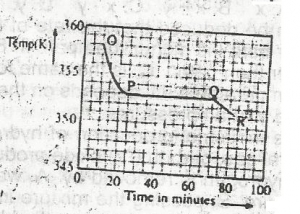
Use the graph above to answer this question. A sample, X, solid at room temperature, was melted, heated to a temperature of 358 K and allowed to cool as shown in OPQR. The section PQ indicates that X is
Attached Figure / Diagram
A
a mixture of salts
B
a hydrated salt
C
an ionic salt
D
a pure compound
medium Difficulty
Verified Correct Answer: Option D
Chemical Principles & Mechanism
No expanded working has been attached for this question yet. The verified answer is Option D.
Source: Myschool Past Questions Archive (Record #31533)
Chemistry
UTME / JAMB 1997
Stoichiometry, Mole Concept & Volumetric Analysis
Diagram
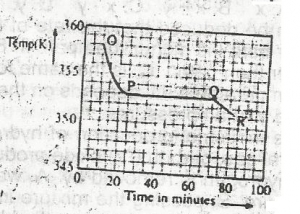
Use the graph above to answer this question. A sample, X, solid at room temperature, was melted, heated to a temperature of 358 K and allowed to cool as shown in OPQR.The section OP suggests that X is in the
Attached Figure / Diagram
A
liquid sate
B
solid/liquid state
C
solid state
D
gaseous state
medium Difficulty
Verified Correct Answer: Option A
Chemical Principles & Mechanism
No expanded working has been attached for this question yet. The verified answer is Option A.
Source: Myschool Past Questions Archive (Record #31534)
Chemistry
UTME / JAMB 1997
Non-Metals & Their Compounds
Diagram
Solution
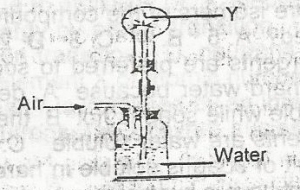
In the diagram above the gas Y could be
Attached Figure / Diagram
A
hydrogen chloride
B
oxygen
C
carbon (IV) oxide
D
chlorine
medium Difficulty
Verified Correct Answer: Option A
Chemical Principles & Mechanism
- Two gases that can be used in the study of fountain experiment is ammonia gas and hydrogen chloride gas.
- Ammonia dissolves into the water and the pressure in the container drops. As a result, more water is forced into the container from another inlet creating a fountain effect.
- All the hydrogen chloride in the flask dissolves in the water drops from the pipette, creating a vacuum in the flask. Water is then sucked up at great speed from the bowl, creating a spectacular 'fountain' in the flask.
Source: Myschool Past Questions Archive (Record #31536)
Chemistry
UTME / JAMB 1997
Stoichiometry, Mole Concept & Volumetric Analysis
Diagram
Solution
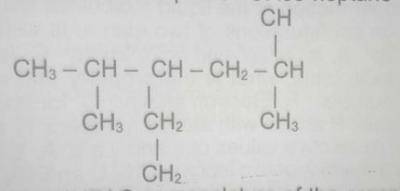
The IUPAC nomenclature of the organic compound with the above structural formula is
Attached Figure / Diagram
A
3-ethyl-2,5-dimethylhexane
B
4-ethyl-2,5-dimethylhexane
C
3-ethyl-2,5,5 - trimethylpentane
D
3-ethyl, 1,1,4-trimethylpentane
medium Difficulty
Verified Correct Answer: Option A
Chemical Principles & Mechanism
The name of the compound is 3 - ethyl - 2,5 - dimethylhexane.
Source: Myschool Past Questions Archive (Record #31539)
Chemistry
UTME / JAMB 1997
Organic Chemistry I: Hydrocarbons & Crude Oil
Diagram
How many more isomers of the compound above can be obtained ?
Attached Figure / Diagram
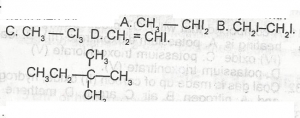
A
5
B
4
C
3
D
2
medium Difficulty
Verified Correct Answer: Option B
Chemical Principles & Mechanism
No expanded working has been attached for this question yet. The verified answer is Option B.
Source: Myschool Past Questions Archive (Record #31542)
Chemistry
UTME / JAMB 1997
Stoichiometry, Mole Concept & Volumetric Analysis
Diagram
Choose the correct answer from the options above. When Fehling is solution is added to two isomeric carbonyl compounds X and Y with the molecular formula C 5H 10O, compound X gives a red precipitate while Y does not react. It can be inferred that X is
Attached Figure / Diagram
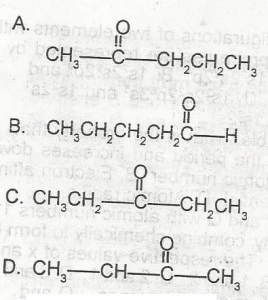
A
A
B
B
C
C
D
D
medium Difficulty
Verified Correct Answer: Option B
Chemical Principles & Mechanism
No expanded working has been attached for this question yet. The verified answer is Option B.
Source: Myschool Past Questions Archive (Record #31544)
Chemistry
UTME / JAMB 1997
Chemical Bonding & Intermolecular Forces
Diagram
Solution
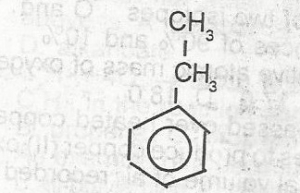
The compound above contains
Attached Figure / Diagram
A
Sp 3 hybridized carbon atoms only
B
Sp 2 hybridized carbon atoms only
C
Sp 3 and Sp hybirdized carbon atoms
D
Sp 3 and Sp 2
medium Difficulty
Verified Correct Answer: Option D
Chemical Principles & Mechanism
The structure comprises a benzene ring ( C\(_6\)H\(_5\) ) with a CH\(_2\)-CH\(_3\) substituent attached to it.
Recall that benzene is aromatic compound, as well as conjugated compound having three double bonds and three single bonds.
If we re-write the molecular formular of the compound,trying to represent on a straight chain just for better understanding, we'll have -CH=CH-CH=CH-CH=CH-CH\(_2\)-CH\(_3\)
Whenever you are solving questions on Hybridization of Hydrocarbons, always use this key:
If the compound contains a Carbon atom + single bonded to 4 atoms - SP\(^3\)
If the compound contains a Carbon atom + one double bond + two single bonds - SP\(^2\)
If the compound contains a Carbon atom + a triple bond + one single bond - SP
SP\(^2\) SP\(^2\) SP\(^3\)
-CH=CH-CH=CH-CH=CH-CH\(_2\)-CH\(_3\)
There's no triple bond, hence there will be no SP hybridization but we only have SP\(^3\) an SP\(^2\) because of the criteria stated above.
Source: Myschool Past Questions Archive (Record #31545)
Chemistry
UTME / JAMB 1997
Stoichiometry, Mole Concept & Volumetric Analysis
Diagram
The compound above is the product of the oxidation of
Attached Figure / Diagram
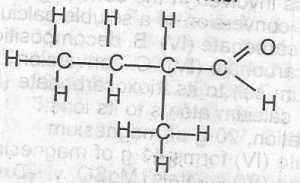
A
2-methlbutan-2-ol
B
2-methylbutan -1- ol
C
2, 3-dimethylprop 1-ol
D
Pentan -2- ol
medium Difficulty
Verified Correct Answer: Option B
Chemical Principles & Mechanism
No expanded working has been attached for this question yet. The verified answer is Option B.
Source: Myschool Past Questions Archive (Record #31546)
Chemistry
UTME / JAMB 1997
Stoichiometry, Mole Concept & Volumetric Analysis
The compound above is the product of the oxidation of
A
2-methlbutan-2-ol
B
2-methylbutan -1- ol
C
2, 3-dimethylprop 1-ol
D
Pentan -2- ol
medium Difficulty
Verified Correct Answer: Option B
Chemical Principles & Mechanism
No expanded working has been attached for this question yet. The verified answer is Option B.
Source: Official Exam / Past Question Archive
Chemistry
WAEC / WASSCE 1997
Water, Solutions & Solubility
Solution
The phenomenon observed when dust particles collide randomly in a beam of sunlight is known as?
A
Tyndal effect
B
diffusion
C
osmosis
D
brownian movement
E
dialysis
medium Difficulty
Verified Correct Answer: Option A
Chemical Principles & Mechanism
The correct answer is: Tyndall effect.
The Tyndall effect is the scattering of light by particles in a colloid or in a very fine suspension. When a beam of sunlight passes through a colloidal solution, the particles scatter the light, making it visible. This is why we see a beam of light when dust particles are present in the air.
Brownian movement, on the other hand, refers to the random motion of particles suspended in a fluid (such as a gas or liquid) due to collisions with the surrounding fluid molecules.
So, while Brownian movement is related to the motion of particles, the Tyndall effect is specifically about the scattering of light by particles!
Source: Myschool Past Questions Archive (Record #36532)