Question Library
Browse, filter, and study verified past examination questions with step-by-step mathematical reasoning.
Searching 18,000+ Questions...
Sifting topics, KaTeX formulas & verified solutions
Showing 196–210 of 334 verified questions
Sort by:
Physics
WAEC / WASSCE 2000
Thermal Physics
Diagram
Solution
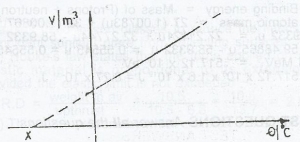
The diagram shows the variation of volume V of a glass with temperature at the point X is
Attached Figure / Diagram
A
-32oC
B
-100oC
C
-273oC
D
-373oC
medium Difficulty
Verified Correct Answer: Option C
Physical Principles & Numerical Solution
The point X is the Absolute zero temperature( the lowest possible temperature). Absolute zero is at -273.15 Celsius or -459.67 Fahrenheit or 0 k.
Source: Myschool Past Questions Archive (Record #33776)
Physics
WAEC / WASSCE 2000
Thermal Physics
Solution
A piece of metal of mass 50g is cooled from 80oC to 20oC. Calculate the amount of heat lost. (specific heat capacity of the material of metal = 450Jkg-1K-1)
A
4.50 x 10³J
B
2.25 x 10³J
C
1.80 x 10³J
D
1.35 x 10³J
medium Difficulty
Verified Correct Answer: Option D
Physical Principles & Numerical Solution
mass of metal = 50g = 0.05kg, c = 45Jkg\(^{-1}\)k\(^{-1}\), \DeltaT = 80 - 20 = 60ºC
Quantity of heat lost(Q) = mass of metal x specific capacity of mass x change in temperature
Q = m x c x \DeltaT
Q = 0.05 x 45 x 60 = 1350J = 1.35 x 10\(^3\)J
Source: Myschool Past Questions Archive (Record #33795)
Physics
WAEC / WASSCE 2000
Thermal Physics
Solution
The mass of water vapour in a given volume of air is 0.05g at 20oC, while the mass of water vapour required to saturate it at the same temperature is 0.15g. Calculate the relative humidity of the air
A
3.33%
B
5.55%
C
33.33%
D
55.55%
medium Difficulty
Verified Correct Answer: Option C
Physical Principles & Numerical Solution
Relative humidity = \(\frac{\text{mass of water vapour in a given volume of air(m)}}{\text{mass of water vapour needed to saturate same volume of air at same temp(M)}}\) x 100%
R.H = \(\frac{\text{m}}{\text{M}}\) = \(\frac{0.05}{0.15}\) x 100%
Therefore, relative humidity of the air = 33.33%
Source: Myschool Past Questions Archive (Record #33801)
Physics
WAEC / WASSCE 2000
Thermal Physics
Solution
An immersion heater is rated 120W. How long does it take the heater to raise the temperature of 1.2kg of water by 15oC. (Assuming heat lost to the surrounding is negligible. Specific heat capacity of water = 4200 Jkg-1K-1C)
A
65.0 minutes
B
60.0 minutes
C
52.5 minutes
D
10.5 minutes
medium Difficulty
Verified Correct Answer: Option D
Physical Principles & Numerical Solution
Given:
P = 120W, t = ?, m of water = 1.2kg, c of water = 4200Jkg\(^{-1}\)K\(^{-1}\), \DeltaT = 15ºC
Q = pt = m c \DeltaT
120 x t = 1.2 x 4200 x 15 = 75600J
t = \(\frac{75600}{120}\) = 630secs → 10.50minutes.
Source: Myschool Past Questions Archive (Record #33838)
Physics
NECO SSCE 2000
Thermal Physics
The specific heat of a substance in the solid state is C1; its specific beat in the liquid state is C2 and its latent heat of fusion is L. If a mass M of the substance is changed from the solid state at temperature T, to the liquid state, also at temperature T, the amount of heat required will be
A
M(C1 ÷ C2) x T
B
ML
C
L
D
M(C1 + C2) × T ÷ ML
E
ML(C1 + C2 ÷ 2) × T
medium Difficulty
Verified Correct Answer: Option B
Physical Principles & Numerical Solution
No expanded working has been attached for this question yet. The verified answer is Option B.
Source: Myschool Past Questions Archive (Record #42701)
Physics
NECO SSCE 2000
Thermal Physics
Solution
400g of cold water is added to 200g of water at 70^\circC. If they are properly mixed and the temperature of the mixture is 30^\circC. calculate the initial temperature of the cold water. (Neglect the heat absorbed by the container)
A
10°C
B
15°C
C
20°C
D
30°C
E
40°C
medium Difficulty
Verified Correct Answer: Option A
Physical Principles & Numerical Solution
Heat lost by the warm water = heat gained by cold water
m\(_w\) X c X ( Tw - Tm) = m\(_c\) X c X (Tm - Tc)
200 X ( 70 - 30) = 400 X ( 30 - Tc)
2 x 40 = 120 - 4Tc
4Tc = 120 - 80 = 40
Tc = \(\frac{40}{4}\) = 10ºC
Source: Myschool Past Questions Archive (Record #42717)
Physics
NECO SSCE 2000
Thermal Physics
Solution
The clinical thermometer differs from other mercury-in-glass thermometers because it has
I. a constriction
II. a wide range
III. a short range
IV. a narrow bore.
Which of the above are correct?
A
I and II only
B
I and III only
C
III and IV only
D
I,II and III only
E
I, III and IV only
medium Difficulty
Verified Correct Answer: Option B
Physical Principles & Numerical Solution
Correct features of a clinical thermometer (that differ from ordinary mercury-in-glass thermometers):
- I. A constriction — Yes (the kink just above the bulb prevents mercury from falling back on its own after removal from the body).
- III. A short range — Yes (typically 35^\circC to 42^\circC or 43^\circC, suitable only for human body temperature).
Thus, only I and III are correct for what makes the clinical thermometer different.
Source: Myschool Past Questions Archive (Record #42733)
Physics
UTME / JAMB 1999
Thermal Physics
Solution
The temperature gradient across a copper rod of thickness 0.02m, maintained at two temperature junctions of 20°C and 80°C respectively is
A
3.0 x 10²Km-1
B
3.0 x 10³Km-1
C
5.0 x 10³Km-1
D
3.0 x 10⁴Km-1
medium Difficulty
Verified Correct Answer: Option B
Physical Principles & Numerical Solution
Temperature Gradient = \(\frac{\Delta {\text{temp.}}}{\text{thickness}}\)
= \(\frac{80 - 20}{0.02}\)
= \(\frac{60}{0.02}\)
= 3000Km-1
= 3.0 x 10³Km-1
Source: Myschool Past Questions Archive (Record #553)
Physics
UTME / JAMB 1999
Thermal Physics
Solution
Calculate the mass of ice that would melt when 2kg of copper is quickly transferred from boiling water to a block of ice without heat loss.
Specific heat capacity of copper = 400JKg-1K-1
Latent heat of fusion of ice = 3.3 x 10\(^5\)JKg-1
A
8/33kg
B
33/80kg
C
80/33kg
D
33/8kg
medium Difficulty
Verified Correct Answer: Option A
Physical Principles & Numerical Solution
Heat given off by the copper = MCt
= 2 x 400 x (100 - 0)
Heat absorbed by the ice = ML
= M x 3.3 x 10\(^5\)
Heat lost = Heat gained
∴ M x 3.3 x 10\(^5\) = 2 x 400 x 100
∴ M =\(\frac{(2 \times 400 \times 100)}{3.3 \times 10^5}\)
= \(\frac{8}{33}\)Kg
Source: Myschool Past Questions Archive (Record #557)
Physics
WAEC / WASSCE 1999
Thermal Physics
The ice point of an ungraduated mercury-in-glass thermometer is X, while its steam point is 90o. This thermometer reads 60o when the true temperature is 40oC Calculate the value of X.
A
60o
B
48o
C
40o
D
30o
medium Difficulty
Verified Correct Answer: Option C
Physical Principles & Numerical Solution
No expanded working has been attached for this question yet. The verified answer is Option C.
Source: Myschool Past Questions Archive (Record #25478)
Physics
WAEC / WASSCE 1999
Thermal Physics
An iron rod of length 50m and at a temperature of 60oC is heated to 70oC. Calculate its new length. (Linear expansivity of iron = 1.2 x 10⁻⁵K-1)
A
50.006m
B
50.060m
C
51.600m
D
51.200m
medium Difficulty
Verified Correct Answer: Option A
Physical Principles & Numerical Solution
No expanded working has been attached for this question yet. The verified answer is Option A.
Source: Myschool Past Questions Archive (Record #25480)
Physics
WAEC / WASSCE 1999
Thermal Physics
Solution
A 10 \Omega coil takes 21 s to melt 10g of ice at 0ºC. Assuming no heat losses, determine the current in the coil. (Specific latent heat of fusion of ice = 336 Jg\(^{-1}\))
A
16A
B
5A
C
4A
D
3A
medium Difficulty
Verified Correct Answer: Option C
Physical Principles & Numerical Solution
Heat lost = Heat used to melt ice
I\(^2\)R t = mL
I\(^2\) x 10 x 21 = 10 x 336
I\(^2\) = \(\frac{3360}{210}\) = 16
I = \(\sqrt{16}\) = 4A.
Source: Myschool Past Questions Archive (Record #25505)
Physics
WAEC / WASSCE 1999
Thermal Physics
A sheet of paper is placed in the path of the following radiations: I. Alpha particles II. Beta particles III. Gamma rays. Which of the radiations will pass through the sheet of paper?
A
I only
B
II only
C
I and II only
D
II and III only
medium Difficulty
Verified Correct Answer: Option D
Physical Principles & Numerical Solution
No expanded working has been attached for this question yet. The verified answer is Option D.
Source: Myschool Past Questions Archive (Record #25514)
Physics
UTME / JAMB 1998
Thermal Physics
Solution
A platinum resistance thermometer records 3.0\(\Omega\) at 0oC and 8.0\(\Omega\) at 100oC. If it records 6.0\(\Omega\) in a certain environment, The temperature of the medium is
A
80oC
B
60oC
C
50oC
D
30oC
medium Difficulty
Verified Correct Answer: Option B
Physical Principles & Numerical Solution
8\(\Omega\).....100oC
6\(\Omega\).....\(\theta\)oC
3\(\Omega\).....0oC
\(\frac{6 - 3}{8 - 3}\) = \(\frac{\theta - 0}{100 - 0}\)
therefore, \(\theta\) = 60oC
Source: Myschool Past Questions Archive (Record #27619)
Physics
UTME / JAMB 1998
Thermal Physics
Solution
A gas has a volume of 100cm3 at 27oC. If it is heated to temperature T until a final volume of 120cm3 is attained, calculate T
A
33oC
B
60oC
C
87oC
D
114oC
medium Difficulty
Verified Correct Answer: Option C
Physical Principles & Numerical Solution
\(\frac {V_1}{T_1}\) = \(\frac {V_2}{T_2}\)
\(\frac {100}{27 + 273}\) = \(\frac {120}{T + 273}\)
T = 87oC
Source: Myschool Past Questions Archive (Record #27624)