Question Library
Browse, filter, and study verified past examination questions with step-by-step mathematical reasoning.
Searching 18,000+ Questions...
Sifting topics, KaTeX formulas & verified solutions
Showing 196–210 of 1709 verified questions
Sort by:
Physics
WAEC / WASSCE 2019
Mechanics and Properties of Matter
Diagram
Solution
The diagram above illustrates an object moving in a circular path at a constant speed. Which of the arrows indicates the direction of linear velocity?
Attached Figure / Diagram
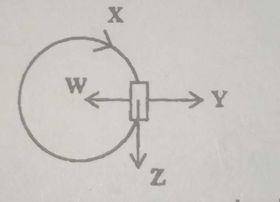
A
z
B
X
C
Y
D
W
medium Difficulty
Verified Correct Answer: Option A
Physical Principles & Numerical Solution
for an object moving along a circular path, it speed is constant but its linear velocity changes with time at every point on the circle.
Source: Myschool Past Questions Archive (Record #59022)
Physics
WAEC / WASSCE 2019
Mechanics and Properties of Matter
Diagram
Solution
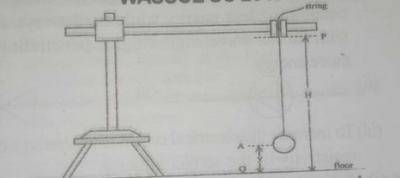
You are provided with a stopwatch, a meter rule, a split cork, retort stand and clamp, a pendulum bob, a piece of thread, and other necessary apparatus.
i. Place the retort stand on a laboratory stool. Clamp the split cork.
ii. Suspend the pendulum bob from the split cork such that the point of support P of the bob is at height H = 100cm above the floor Q. The bob should not touch the floor and H should be kept constant throughout the experiment.
iii. Adjust the length of the thread such that the center A of the bob is at a height y= AQ= 20cm from the floor.
iv. Displace the bob such that it oscillates in a horizontal plane.
v. Take the time t for 20 complete oscillations.
vi. Determine the period T of oscillation and evaluate T
vii. Repeat the procedure for four other values of y = 30cm, 40cm, 50cm, and 60cm. In each case, determine T and T.
viii. Tabulate the results.
ix. Plot a graph of T on the vertical axis and y on the horizontal axis, starting both axes from the origin (0,0).
x. Determine the slope, s, of the graph and the intercept c on the vertical axis.
xi. If in this experiment SR= c, calculate R.
x. State two precautions taken to ensure accurate results.
(b) i. The bob of a simple pendulum is displaced a small distance from the equilibrium position and then released to perform simple harmonic motion Identify where its:
(\(\propto\)) kinetic energy is maximum
(\(\beta\)) acceleration is maximum
ii. An object of weight 120N vibrates with a period of 4.0s when hung from a spring. Calculate the force per unit length of the spring. [g= 10ms\(^{-2}\), \(\pi\)=3.142]
Attached Figure / Diagram
medium Difficulty
Verified Correct Answer: Option
Physical Principles & Numerical Solution
H = 100cm
Table of value
SN
y(cm)
t(sec)
T
T\(^{2}\)
1
2
3
4
5
20
30
40
50
60
50.50
47.50
43.50
40.00
35.80
2.525
2.375
2.175
2.000
1.790
6.376
5.641
4.731
4.000
3.204
Slope (s) = \(\frac{\bigtriangleup T^{2}}{\bigtriangleup \text{y}}\) = \(\frac{604 - 2.0}{76 - 20}\)
= \(\frac{4.4}{56}\) = 0.079 = 0.08
Intercept on vertical axis = 8
Evaluate R = \(\frac{s}{c}\) = \(\frac{8.00}{0.08}\) = 100
Scale: Let 2cm represent 1 unit on the vertical axis and 1.5cm represent 10 units on the horizontal axis.
Precautions
- Avoided parallax error in reading stopwatch/clock/ meter rule.
- Noted/corrected/avoided zero error on stopwatch/ clock/meter rule.
- Avoided draught/switch off fans.
- Avoided conical oscillation Ensured that support was rigid/firm.
- Ensured bob of the pendulum was free from table/did not touch table
- Repeated reading shown on the table.
- Small angular displacement
(b) (\(\propto\)) The kinetic energy is maximum at the equilibrium position
(\(\beta\)) The acceleration is maximum at the point of maximum displacement.
ii. The period T is given by
T = 2\(\pi\)\(\sqrt\frac{M}{K}\)
T\(^{2}\) = 4\(\pi^2\)\(\frac{M}{K}\)
K = 4\(\pi^2\)\(\frac{M}{T^{2}}\)
= \(\frac{4x(3.14)^2(\frac{120}{10})}{4}^2\)
29.62NM\(^{-1}\)
OR
T = 2\(\pi\)\(\sqrt\frac{e}{g}\)
T\(^{2}\) = 4\(\pi^2\)\(\frac{e}{g}\)
e = \(\frac{T^{2}}g{4\pi^2}\) = 4.05
k = \(\frac{f}{e}\) = \(\frac{120}{4.05}\)
= 29.62NM\(^{-1}\)
Source: Myschool Past Questions Archive (Record #59765)
Physics
UTME / JAMB 2018
Mechanics and Properties of Matter
Solution
The density of 400cm\(^3\) of palm oil was 0.9gcm-3 before frying. If the density of the oil was 0.6gcm-3 after frying, assuming no loss of oil due to spilling, its new volume was?
A
1360cm\(^3\)
B
600cm\(^3\)
C
240cm\(^3\)
D
8000m\(^3\)
medium Difficulty
Verified Correct Answer: Option B
Physical Principles & Numerical Solution
\(Density= \frac{mass}{volume}\)
⇒ \(0.9gcm^{-3} = \frac{mass}{400cm^{3}} = 360g\)
without any loss in the frying process, we have
\(0.6gcm^{-3} = \frac{360g}{v}\)
\(v = \frac{360g}{0.6gcm^{-3}} = 600cm^{3}\)
Source: Myschool Past Questions Archive (Record #47376)
Physics
UTME / JAMB 2018
Mechanics and Properties of Matter
What type of reaction is represented by the following scheme?
\(_{1} ^{2} X\) + \(_{1} ^{2} Y\) -----> \(_{2} ^{3} Z\) + \(_{0} ^{1} n\) + energy
A
fusion reaction
B
fission reaction
C
Chain reaction
D
radioactive decay
medium Difficulty
Verified Correct Answer: Option A
Physical Principles & Numerical Solution
No expanded working has been attached for this question yet. The verified answer is Option A.
Source: Myschool Past Questions Archive (Record #47387)
Physics
UTME / JAMB 2018
Mechanics and Properties of Matter
Solution
A lead bullet of mass 0.05 kg is fired with a velocity of 200 m/s into a lead block of mass 0.95 kg. Given that the lead block can move freely, the final kinetic energy after impact is
A
100J
B
150J
C
50J
D
200J
medium Difficulty
Verified Correct Answer: Option C
Physical Principles & Numerical Solution
From the law of conservation of linear momentum,
\(m_1 u_1 + m_2 u_2 = m_1 v_1 + m_2 v_2\)
Since the collision is inelastic, we have
\((0.05 \times 200) - (0.95 \times 0) = (0.05 + 0.95)V\)
\(10 = V\)
\(V = 10ms^{-1}\)
Hence the Kinetic energy = \(\frac{1}{2} (0.05 + 0.95) \times 10^2\)
= \(\frac{1}{2} \times 100\)
= 50J
Source: Myschool Past Questions Archive (Record #47400)
Physics
UTME / JAMB 2018
Mechanics and Properties of Matter
Diagram
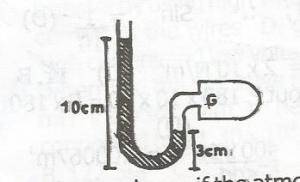
In the diagram given if the atmospheric pressure is 760mm, the pressure in the chamber G Is
Attached Figure / Diagram
A
660mm
B
830mm
C
690mm
D
860mm
medium Difficulty
Verified Correct Answer: Option B
Physical Principles & Numerical Solution
No expanded working has been attached for this question yet. The verified answer is Option B.
Source: Myschool Past Questions Archive (Record #47395)
Physics
UTME / JAMB 2018
Mechanics and Properties of Matter
Solution
A ball of mass 800g moving horizontally with a speed of 5m/s hits a vertical wall and rebounds with the same speed. The impulse experienced by the ball is?
A
0kgm
B
2kgm/s
C
4kgm/s
D
8kgm/s
medium Difficulty
Verified Correct Answer: Option D
Physical Principles & Numerical Solution
Initial momentum = (0.8) \times (5)
= 4.0kgms\(^{-1}\)
Final momentum
= (0.8) \times (– 5)
= – 4.0kgms\(^{-1}\)
Impulse on ball
= Change in momentum
= 4.0 – (– 4.0)
= 8.0.0kgms\(^{-1}\)
Source: Myschool Past Questions Archive (Record #47681)
Physics
UTME / JAMB 2018
Mechanics and Properties of Matter
Solution
The force between the molecules of a liquid in contact with that of a solid is?
A
Adhesive
B
Cohesive
C
Magnetic
D
Repulsive
medium Difficulty
Verified Correct Answer: Option A
Physical Principles & Numerical Solution
The term Adhesive forces refers to the attractive forces between unlike substance
Source: Myschool Past Questions Archive (Record #47682)
Physics
UTME / JAMB 2018
Mechanics and Properties of Matter
Solution
A body of mass 100g moving with a velocity of 10ms-1 collides with a wall. If after collision it moves with a velocity of 2.0ms−1 in the opposite direction, calculate the change in momentum.
A
0.8Ns
B
1.2Ns
C
12.0Ns
D
80.0Ns
medium Difficulty
Verified Correct Answer: Option B
Physical Principles & Numerical Solution
Momentum = Mass x Velocity
Change in Momentum = Mass x (change in velocity)
Change in Momentum = Mass x (v - u)
Mass = 100g = 0.1kg
U = 2ms\(^{-1}\)
V = 10ms\(^{-1}\)
Change in momentum = m (v − u)
= 0.1 (2 -(- 10))
= 0.1 (12)
= 1.2Ns
Source: Myschool Past Questions Archive (Record #47683)
Physics
UTME / JAMB 2018
Mechanics and Properties of Matter
Solution
A 20kg mass is to be pulled up a slope inclined at 30^\circ to the horizontal. If efficiency of the plane is 75%. The force required to pull the load up the plane is J [g=10ms\(^{− 2}\)]
A
87N
B
73.5N
C
133.3N
D
533.2N
medium Difficulty
Verified Correct Answer: Option C
Physical Principles & Numerical Solution
V. R = \(\frac{1}{Sin\theta}\)
m = 20kg
V.R = \(\frac{1}{Sin 30}\)
= 2
Efficiency = 75%
Load = mg
= 20 x 10 = 200N
Efficiency = \(\frac{M.A}{V.R} \times 100\)
75/100 = \(\frac{M.A}{2}\)
M .A = \(\frac{75 \times 2}{100}\)
M. A = 1.5
Since M. A. = \(\frac{\text{Load}}{\text{Force}}\)
Force = \(\frac{200}{1.5}\)
= 133.3N
Source: Myschool Past Questions Archive (Record #47684)
Physics
UTME / JAMB 2018
Mechanics and Properties of Matter
Solution
The tendency of a body to remain at rest when a force is applied to it is called.
A
Impulse
B
Momentum
C
Inertia
D
Friction
medium Difficulty
Verified Correct Answer: Option C
Physical Principles & Numerical Solution
Inertia, property of a body by virtue of which it opposes any agency that attempts to put it in motion or, if it is moving, to change the magnitude or direction of its velocity. Inertia is a passive property and does not enable a body to do anything except oppose such active agents as forces and torques. A moving body keeps moving not because of its inertia but only because of the absence of a force to slow it down, change its course, or speed it up.
There are two numerical measures of the inertia of a body: its mass, which governs its resistance to the action of a force, and its moment of inertia about a specified axis, which measures its resistance to the action of a torque about the same axis.
Source: Myschool Past Questions Archive (Record #47685)
Physics
UTME / JAMB 2018
Mechanics and Properties of Matter
Solution
The energy needed to move a unit positive charge around a complete electric circuit is called the
A
electromotive force
B
electric potential difference
C
electric energy
D
kinetic energy
medium Difficulty
Verified Correct Answer: Option A
Physical Principles & Numerical Solution
The energy needed to move a unit positive charge around a complete electric circuit is indeed referred to as Electromotive Force (EMF).
Source: Myschool Past Questions Archive (Record #47693)
Physics
UTME / JAMB 2018
Mechanics and Properties of Matter
An object moves in a circular path of radius 0.5m with a speed of 1ms\(^{-1}\). What is its angular velocity?
A
8rads\(^{-1}\)
B
4rads\(^{-1}\)
C
1rads\(^{-1}\)
D
2rads\(^{-1}\)
medium Difficulty
Verified Correct Answer: Option D
Physical Principles & Numerical Solution
No expanded working has been attached for this question yet. The verified answer is Option D.
Source: Myschool Past Questions Archive (Record #47433)
Physics
UTME / JAMB 2018
Mechanics and Properties of Matter
Solution
What effort will a machine of efficiency 90% apply to a load of 180N if its efforts arm is twice as long as its load arm?
A
100N
B
90N
C
80N
D
120N
medium Difficulty
Verified Correct Answer: Option A
Physical Principles & Numerical Solution
Given:
- Load \( W = 180 \, \text{N} \)
- Efficiency \( \eta = 90\% = 0.9 \)
- Let the effort \( E \) be applied.
The efficiency of a machine is given by the formula:
\(\eta = \frac{\text{Mechanical Advantage (MA)}}{\text{Velocity Ratio (VR)}}\)
Mechanical Advantage (MA) is defined as the ratio of load to effort:
\(\text{MA} = \frac{W}{E}\)
Determine the Velocity Ratio (VR)
Given that the effort arm is twice the load arm, we can express the Velocity Ratio (VR) as:
\(\text{VR} = \frac{\text{Length of effort arm}}{\text{Length of load arm}} = \frac{2L}{L} = 2\)
Substitute into the efficiency formula
Substituting the expressions for MA and VR into the efficiency formula gives:
\(0.9 = \frac{\frac{W}{E}}{2}\)
Rearrange to find the effort \( E \)
Multiplying both sides by \( 2E \):
\(1.8E = W\)
Substituting \( W = 180 \, \text{N} \):
\(
1.8E = 180\)
Solve for \( E \)
Now, dividing by 1.8:
\(E = \frac{180}{1.8} = 100 \, \text{N}\)
Therefore, the effort applied by the machine is: \(\boxed{100 \, \text{N}}\).
Source: Myschool Past Questions Archive (Record #47434)
Physics
UTME / JAMB 2018
Mechanics and Properties of Matter
Solution
Temperature is the property of a body which is proportional to the ____.
A
total kinetic energy of its molecules
B
average kinetic energy of its molecules
C
average speed of its molecules
D
maximum speed of its molecules
medium Difficulty
Verified Correct Answer: Option B
Physical Principles & Numerical Solution
The last postulate of the kinetic molecular theory states that the average kinetic energy of a gas particle depends only on the temperature of the gas. Thus, the average kinetic energy of the gas particles increases as the gas becomes warmer.
Source: Myschool Past Questions Archive (Record #47719)