Question Library
Browse, filter, and study verified past examination questions with step-by-step mathematical reasoning.
Searching 18,000+ Questions...
Sifting topics, KaTeX formulas & verified solutions
Showing 196–210 of 557 verified questions
Sort by:
Physics
WAEC / WASSCE 2009
Electricity and Magnetism
Solution
(a) State Faraday’s second law of electrolysis.
(b) An electric charge of 9.6 x 10\(^4\) C liberates 1 mole of substance containing 6.0 x 10\(^{23}\) atoms. Determine the value of the electronic charge
medium Difficulty
Verified Correct Answer: Option
Physical Principles & Numerical Solution
(a) If the same quantity of electricity is passed through different voltameters/electrolytes connected in series the masses of the substances liberated/deposited during electrolysis is (directly) proportional to their chemical equivalents.
OR The mass of an element deposited/liberated during electrolysis is (directly) proportional to the chemical equivalent of the element.
(b) Let e represent the electronic charge.
e = Faraday’s constant
Avogadro’s number
= 9.6 x 10\(^4\)
6. 0. x 10\(^{23}\)
= 1.60 x 10\(^{-19}\)C
Source: Myschool Past Questions Archive (Record #53489)
Physics
UTME / JAMB 2008
Electricity and Magnetism
Solution
The d.c generator has essentially the same components as the a.c generator except the presence of?
A
slip-ring
B
carbon brushes
C
split ring
D
armature
medium Difficulty
Verified Correct Answer: Option C
Physical Principles & Numerical Solution
A d.c. generator uses a split ring (commutator) to convert alternating current (a.c.) to direct current (d.c.), while an a.c. generator uses slip rings.
Source: Myschool Past Questions Archive (Record #14074)
Physics
UTME / JAMB 2008
Electricity and Magnetism
Solution
\(^{14}_7\)N + \(^4_2\)He → \(^{17}_8\)O + X
In the equation above, the particles X is?
A
a proton
B
a neutron
C
an α - particle
D
a β - particle
medium Difficulty
Verified Correct Answer: Option A
Physical Principles & Numerical Solution
for the conversion of mass 14 + 4 = 17 + x
∴ X = 18 - 17 = 1
for conservation pf charge:7 + 2 = 8 + y
y = 9 - 8 = 1
Thus, the element is 11X which is equal to hydrogen nucleus ( proton)
Source: Myschool Past Questions Archive (Record #14494)
Physics
WAEC / WASSCE 2008
Electricity and Magnetism
The design of the thermostat of an electric iron is based on the
A
emmision of electrons from metals when heated
B
increase in size of metals when heated
C
increase in the density of metals when heated
D
change in the mass of metals when heated
medium Difficulty
Verified Correct Answer: Option B
Physical Principles & Numerical Solution
No expanded working has been attached for this question yet. The verified answer is Option B.
Source: Myschool Past Questions Archive (Record #35035)
Physics
WAEC / WASSCE 2008
Electricity and Magnetism
Diagram
Solution
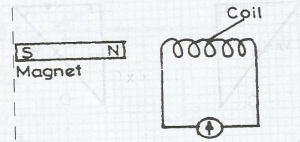
The diagram above illustrates a bar magnet near a coil connected to a galvanometer, When the magnet is rapidly moves towards the coil i. e.m.f. is induced in the coil ii. the galvanometer needle deflects iii. the magnet is attracted by the coil. Which of the statements above is/are correct?
Attached Figure / Diagram
A
i only
B
ii only
C
iii only
D
i and iii only
medium Difficulty
Verified Correct Answer: Option D
Physical Principles & Numerical Solution
Moving the magnet changes flux, inducing emf (i) and current that deflects the galvanometer (ii). By Lenz’s law the induced current repels the approaching magnet, so (iii) is false.
Source: Myschool Past Questions Archive (Record #34986)
Physics
WAEC / WASSCE 2008
Electricity and Magnetism
A negatively charged rod is held close to an uncharged metal ball on an insulating stand. The ball will
A
be negatively chargeed
B
be positively charged
C
have an excess negatively charges on the side nearest the rod
D
have an excess positively charges on the side nearest the rod
medium Difficulty
Verified Correct Answer: Option D
Physical Principles & Numerical Solution
No expanded working has been attached for this question yet. The verified answer is Option D.
Source: Myschool Past Questions Archive (Record #35071)
Physics
WAEC / WASSCE 2008
Electricity and Magnetism
Solution
If the charge on an object is measured as 4.0 x 10⁻¹⁸C, how many excess electrons does the object possess, given that the charge of an electron is 1.6 x 10⁻¹⁸C
A
18
B
19
C
25
D
37
medium Difficulty
Verified Correct Answer: Option C
Physical Principles & Numerical Solution
\(\frac{4 \times 10^{-18}}{1.6 \times 10^{-19}} = 25\)
Source: Myschool Past Questions Archive (Record #35085)
Physics
WAEC / WASSCE 2008
Electricity and Magnetism
Solution
A transformer is required to supply 12 Vrms to operate a toy train set from a 240 Vrms. If the number of turns in the in the secondary coil is 100, calculate the number of turns required in the primary coil
A
5
B
12
C
2000
D
2400
medium Difficulty
Verified Correct Answer: Option A
Physical Principles & Numerical Solution
\(\frac{E_s}{E_p} = \frac{N_s}{N_p} = \frac{240}{12} \frac{100}{N_p}\)
Np = 5
Source: Myschool Past Questions Archive (Record #35106)
Physics
WAEC / WASSCE 2008
Electricity and Magnetism
Which of the following is a unit of the time rate of flow of electric charges?
A
coulomb
B
ampere
C
volt
D
watt
medium Difficulty
Verified Correct Answer: Option B
Physical Principles & Numerical Solution
No expanded working has been attached for this question yet. The verified answer is Option B.
Source: Myschool Past Questions Archive (Record #35087)
Physics
WAEC / WASSCE 2008
Electricity and Magnetism
Solution
A wire 1.0m long and with cross-sectional area 2.0 x 10⁻⁷ m2 has a resistance of 0.1\(\Omega\). Calculate the electrical conductivity of the wire
A
2.0 x 10⁷\(\Omega^{-1} m^{-1}\)
B
5.0 x 10⁷\(\Omega^{-1} m^{-1}\)
C
2.0 x 10⁸\(\Omega^{-1} m^{-1}\)
D
5.0 x 10⁸\(\Omega^{-1} m^{-1}\)
medium Difficulty
Verified Correct Answer: Option B
Physical Principles & Numerical Solution
K = \(\frac{L}{RA} = \frac{1}{0.1 \times 2 \times 10^{-7}} = 5 \times 10^7\)
Source: Myschool Past Questions Archive (Record #35092)
Physics
WAEC / WASSCE 2008
Electricity and Magnetism
Solution
A voltmeter is a device that
A
draws high current
B
has a very low resistance
C
has a very high resistance
D
is able to measure both voltage and current
medium Difficulty
Verified Correct Answer: Option C
Physical Principles & Numerical Solution
A voltmeter is a device used to measure the voltage across two points in an electrical circuit. To achieve accurate measurements without interfering with the circuit's operation, a voltmeter is constructed with:
Very High Resistance
This high resistance limits the current drawn from the circuit, allowing the voltage measurement to be taken without altering the conditions of the circuit.
Source: Myschool Past Questions Archive (Record #35098)
Physics
WAEC / WASSCE 2008
Electricity and Magnetism
Solution
In an electrolysis experiment, the ammeter records a steady current of 1 A. The mass of copper deposited in 30 minutes is 0.66 g. Calculate the error in the ammeter reading. [ Electrochemical equivalent of copper = 0.00033 g C\(^{-1}\)]
medium Difficulty
Verified Correct Answer: Option
Physical Principles & Numerical Solution
I = \(\frac{M}{zt} = \frac{0.66}{33 \times 10^{-5} \times 30 \times 60}\)
= 1.11A
Error = 1.11 - 1 = 0.11A
Source: Myschool Past Questions Archive (Record #53536)
Physics
WAEC / WASSCE 2008
Electricity and Magnetism
Solution
(a) Define electrolysis.
(b) Classify each of the following substances as an electrolyte or a non-electrolyte
(i) sugar solution;
(ii) kerosene;
(iii) alkaline solution
(iv) lemon fruit juice.
medium Difficulty
Verified Correct Answer: Option
Physical Principles & Numerical Solution
(a) Electrolysis is the process through which solutions or molten substance is broken down into their component parts by the passage of electric current.
(b)
Electrolytes
Non-electrolytes
- alkaline
- lemon fruit juice
- sugar solution
- kerosene
Source: Myschool Past Questions Archive (Record #53552)
Physics
WAEC / WASSCE 2008
Electricity and Magnetism
Diagram
Solution
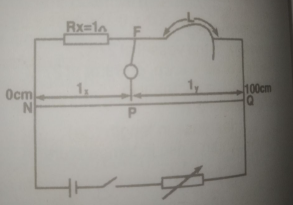
You are provided with two resistance wires labeled A and B, a1\(\Omega\) standard resistor Rx, and other necessary apparatus.
Connect \(R_x\) in the left-hand gap of the metre bridge, a length L= 100cm of wire A in the right-hand gap, and the other apparatus as shown in the diagram above.
Determine and record the balance point P on the bridge wire NQ.
Measure and record \(l_x\) = NP and \(l_y\) = PQ.
Evaluate \(R_1\) = \(\frac{I_{y}}{L_{x}}\) = \(R_x\)
Repeat the procedure for four other values of L= 95, 85, 75 and 65cm. In each case, determine and record the balance point P and the length \(l_x\) and \(l_y\). Also, evaluate \(R_1\).
Repeat the experiment with the second wire B. Obtain the balance points P and the values of and \(l_x\) and \(l_y\).
Evaluate \(R_1\) = \(\frac{I_{y}}{L_{x}}\) = \(R_x\) in each case. Tabulate your readings.
Plot a graph of \(R_2\) on the vertical axis against \(R_1\) on the horizontal axis.
Determine the slope, s, of the graph.
Evaluate k = \(\sqrt s \).
State two precautions taken to obtain accurate results.
(b)i. State two advantages of using a potentiometer over a voltmeter for measuring the potential difference.
ii. Define the internal resistance of a cell.
Attached Figure / Diagram
medium Difficulty
Verified Correct Answer: Option
Physical Principles & Numerical Solution
L(cm)
Lx(cm)
Ly(cm)
\(R_1\)=Ly. L x R
L\(x_1\)
L\(y_1\)
\(R_2\),(Ly/Lx)Rx
100
5.2
95.0
18.3
21.5
78.3
3.64
95
6.0
94.0
15.7
22.6
77.8
3.44
85
6.5
94.0
14.5
22.8
76.4
3.35
75
7.8
93.1
12.0
23.4
75.6
3.23
65
8.5
95.5
11.2
24.3
75.2
3.10
k = s
s = 0.0903
k = 0.0903 = 0.3005
Precautions: I
ensured keys were removed when not taking readings.
ensured tight connections/clean terminals.
avoided parallax errors in reading meter rule.
ensured jockey did not scratch the resistance wire.
avoided zero error of meter rule noted and corrected.
(b)i. Advantages of the potentiometer over the voltmeter
- High accuracy
- Null deflection (does not draw current at balance point).
- Range can be increased as required.
- No friction in moving parts.
ii. The internal resistance of a cell is the opposition to the current flow through (the electrolyte of) the cell.
Source: Myschool Past Questions Archive (Record #60036)
Physics
UTME / JAMB 2007
Electricity and Magnetism
Solution
A charge 50 µc has electric field strength of 360 NC-1 at a certain point. The electric field strength due to another charge 120 µc kept at the same distance apart and in the same medium is?
A
864 NC-1
B
150 NC-1
C
144 NC-1
D
18 NC-1
medium Difficulty
Verified Correct Answer: Option A
Physical Principles & Numerical Solution
In general, electric field strength E = \(\frac{(F)}{q}\)
E = \(\frac{q}{4\pi\varepsilon_0d^2}\)
⇒ 360 = \(\frac{9\times10^9\times50\times10^-6}{d^2}\)
solving, we have \(d^2\) = 1250
putting \(d^2\) = 1250 into the second equation,
E = \(\frac{9\times10^9\times120\times10^-6}{1250}\)
we have E = \(864NC^-1\)
Source: Myschool Past Questions Archive (Record #13970)