Question Library
Browse, filter, and study verified past examination questions with step-by-step mathematical reasoning.
Searching 18,000+ Questions...
Sifting topics, KaTeX formulas & verified solutions
Showing 196–210 of 345 verified questions
Sort by:
Mathematics
NECO SSCE 2001
Statistics and Probability
Diagram
Solution
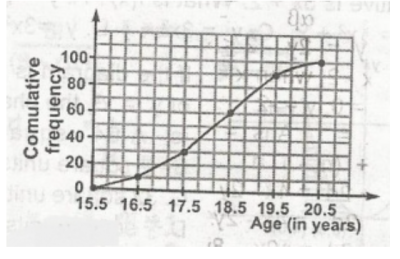
51 women wore coloured shoes to a party, out of which 21 wore purple and 9 wore white. if a woman is selected at Random. What is the probability that she is wearing neither a purple shoe nor a white shoe?
Attached Figure / Diagram
A
\(\frac{10}{17}\)
B
\(\frac{7}{17}\)
C
\(\frac{20}{51}\)
D
\(\frac{3}{17}\)
E
\(\frac{1}{51}\)
medium Difficulty
Verified Correct Answer: Option B
Step-by-Step Mathematical Solution
No of women wearing both purple and white shoes = 21 + 9
= 30 women.
No of women wearing neither purple nor white shoes = 51 - 30
= 21 women
\(\therefore\) Probability of picking a woman wearing neither purple nor white shoes
= \(\frac{21}{51}\)
= \(\frac{7}{17}\).
Source: WAEC / JAMB / NECO Classroom Archive (Record #41883)
Mathematics
WAEC / WASSCE 2001
Statistics and Probability
Solution
A box contains 5 red, 3 green and 4 blue balls. A boy is allowed to take away two balls from the box. What is the probability that the two balls are red?
A
\(\frac{5}{33}\)
B
\(\frac{5}{36}\)
C
\(\frac{103}{132}\)
D
\(\frac{31}{36}\)
medium Difficulty
Verified Correct Answer: Option A
Step-by-Step Mathematical Solution
Total number of balls = 5 + 3 + 4
= 12 balls
P(first ball is red) = \(\frac{5}{12}\)
P(second ball is red) = \(\frac{4}{11}\)
\(\therefore\) P(both balls are red) = \(\frac{5}{12} \times \frac{4}{11}\)
= \(\frac{5}{33}\)
Source: Myschool Past Questions Archive (Record #26501)
Mathematics
WAEC / WASSCE 2001
Statistics and Probability
Solution
A box contains 5 red, 3 green and 4 blue balls. A boy is allowed to take away two balls from the box. What is the probability that one is green and the other is blue?
A
\(\frac{2}{11}\)
B
\(\frac{5}{12}\)
C
\(\frac{8}{12}\)
D
\(\frac{7}{11}\)
medium Difficulty
Verified Correct Answer: Option A
Step-by-Step Mathematical Solution
Total number of balls = 5 + 3 + 4 = 12 balls
P(one ball is green and the other is blue) = P(first ball is green and second blue) + P(first ball is blue and the second green)
= \(\frac{3}{12} \times \frac{4}{11} + \frac{4}{12} \times \frac{3}{11}\)
= \(\frac{2}{11}\)
Source: Myschool Past Questions Archive (Record #26502)
Mathematics
WAEC / WASSCE 2001
Statistics and Probability
Solution
If the probability that an event will occur is p and the probability that it will not occur is q, which of the following is true?
A
p-q=1
B
q-p=0
C
p+q=1
D
p+q=0
medium Difficulty
Verified Correct Answer: Option C
Step-by-Step Mathematical Solution
The probability that an event will certainly occur + the probability that an event will certainly not occur =
The probability that an event will certainly occur = 1 - the probability that an event will certainly not occur
The probability that an event will certainly not occur = 1 + The probability that an event will certainly occur
Option C is true.
Source: Myschool Past Questions Archive (Record #26503)
Mathematics
WAEC / WASSCE 2001
Statistics and Probability
Diagram
Solution
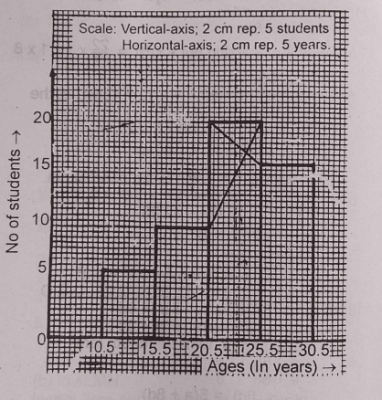
What is the mode?
Attached Figure / Diagram
A
22.5 years
B
23.0 years
C
24.0 years
D
27.5 years
medium Difficulty
Verified Correct Answer: Option C
Step-by-Step Mathematical Solution
MODE \(\approx\) 20.5 + 3.5 = 24years
Source: Myschool Past Questions Archive (Record #26505)
Mathematics
UTME / JAMB 2001
Statistics and Probability
Diagram
Solution
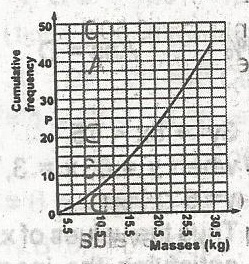
The graph shows the cumulative frequency of the distribution of masses of fertilizer for 48 workers in one institution. Which of the following gives the inter-quartile range?
Attached Figure / Diagram
A
\(\frac{1}{2}(Q_3 - Q_1)\)
B
Q3 - Q2
C
Q3 - Q2
D
Q3 - Q1
medium Difficulty
Verified Correct Answer: Option D
Step-by-Step Mathematical Solution
The interquartile range formula is the first quartile subtracted from the third quartile:
IQR = Q3 – Q1.
Source: Myschool Past Questions Archive (Record #33099)
Mathematics
NECO SSCE 2001
Statistics and Probability
Solution
If the mean of 3, 5, 8, k, 14 and 17 is 11, what is the value of k
A
58
B
38
C
19
D
11
E
967
medium Difficulty
Verified Correct Answer: Option C
Step-by-Step Mathematical Solution
To calculate Mean:
add up all the numbers ⇒ 3+5+8+k+14+17 = 47 + k
then divide by how many numbers there are ⇒ 6
The Mean is already given as 11
11 = (47 + k) / 6
Cross multiply to solve for k
: k = (6 X 11) - 47
k = 19
Source: Myschool Past Questions Archive (Record #41789)
Mathematics
NECO SSCE 2001
Statistics and Probability
The mean age of 12 boys involved survey is 19 years, 3 months. lf the-age of one of the boys is 22 years, what is the mean age of the other-boys?
A
10.5 years
B
19.0 years
C
35.4 years
D
264.0 years
E
423.5 years
medium Difficulty
Verified Correct Answer: Option B
Step-by-Step Mathematical Solution
No expanded working has been attached for this question yet. The verified answer is Option B.
Source: Myschool Past Questions Archive (Record #41795)
Mathematics
NECO SSCE 2001
Statistics and Probability
Solution
Two beads are drawn at random, one after the other, with replacement, from a box containing 5 red and 7 white identical beads. What is the probability that the beads are the same colour
A
\(\frac{119}{144}\)
B
\(\frac{95}{144}\)
C
\(\frac{37}{72}\)
D
\(\frac{49}{144}\)
E
\(\frac{1}{6}\)
medium Difficulty
Verified Correct Answer: Option C
Step-by-Step Mathematical Solution
To find the probability that two beads drawn (with replacement) are of the same color, we consider two cases: both red and both white.
Beads = 5, White beads = 7, Total beads = 12
Both Red:
\(P(\text{Red}) = \frac{5}{12}, \quad P(\text{Both Red}) = \frac{5}{12} \times \frac{5}{12} = \frac{25}{144}\)
Both White:
\(P(\text{White}) = \frac{7}{12}, \quad P(\text{Both White}) = \frac{7}{12} \times \frac{7}{12} = \frac{49}{144}\)
Total Probability of Same Color:
\(P(\text{Same Color}) = \frac{25}{144} + \frac{49}{144} = \frac{74}{144} = \frac{37}{72}\)
The probability that the two beads are the same color is \( \frac{37}{72}\).
Source: Myschool Past Questions Archive (Record #41861)
Mathematics
NECO SSCE 2001
Statistics and Probability
Solution
Two fair coins are tossed at the same time. what is the probability of getting a head?
A
1
B
\(\frac{3}{4}\)
C
\(\frac{1}{2}\)
D
\(\frac{1}{3}\)
E
\(\frac{1}{4}\)
medium Difficulty
Verified Correct Answer: Option B
Step-by-Step Mathematical Solution
T
H
T
T, T
T, H
H
H , T
H ,H
Pro(one head) = \(\frac{3}{4}\) = \(\frac{3}{4}\)
Source: Myschool Past Questions Archive (Record #41970)
Mathematics
UTME / JAMB 2000
Statistics and Probability
Solution
In a youth club with 94 members, 60 like modern music, and 50 like traditional music. The number of members who like both traditional and modern music is three times those who do not like any type of music. How many members like only one type of music?
A
8
B
24
C
62
D
86
medium Difficulty
Verified Correct Answer: Option C
Step-by-Step Mathematical Solution
x = no. of ppl that like none.
no. of ppl that like both Traditional and Modern music, which is equal to 3x
Modern Music = 60 - 3x
Traditional Music = 50 - 3x
60-3x + 50 - 3x + 3x + x = 94
110 - 3x + x = 94
-2x = 94 - 110
=>-2x = -16,
this x = 8.
Members that like only one music:
= 60 - 3x + 50 - 3x
= 60 - 3[8] + 50 - 3[8]
= 60 - 24 + 50 - 24
= 36 + 26 = 62
Members that like only one type of music = 62
Source: Myschool Past Questions Archive (Record #556)
Mathematics
UTME / JAMB 2000
Statistics and Probability
Solution
if P and Q are fixed points and X is a point which moves so that XP = XQ, the locus of X is
A
A straight line
B
a circle
C
the bisector of angle PXQ
D
the perpendicular bisector of PQ
medium Difficulty
Verified Correct Answer: Option D
Step-by-Step Mathematical Solution
A perpendicular bisector always divides a line segment through its midpoint. The term bisect itself means dividing equally or uniformly.
Source: Myschool Past Questions Archive (Record #793)
Mathematics
UTME / JAMB 2000
Statistics and Probability
Solution
X and Y are two events. The probability of X or Y is 0.7 and that of X is 0.4. If X and Y are independent, find the probability of Y.
A
0.30
B
0.50
C
0.57
D
1.80
medium Difficulty
Verified Correct Answer: Option A
Step-by-Step Mathematical Solution
P (X or Y) = P(X) + P(Y), when they are independent as given.
0.7 = 0.4 + P(Y)
P(Y) = 0.7 - 0.4 = 0.30
Source: Myschool Past Questions Archive (Record #926)
Mathematics
UTME / JAMB 2000
Statistics and Probability
Solution
If the mean of the numbers 0, (x+2), (3x+6), and (4x+8) is 4, find their mean deviation.
A
0
B
2
C
3
D
4
medium Difficulty
Verified Correct Answer: Option C
Step-by-Step Mathematical Solution
Mean = \(\frac{{0 + (x+2) + (3x+6) + (4x+8)}}{4}\) = 4
=> 0 + (x+2) + (3x+6) + (4x+8) = 16
8x + 16 = 16
x = 0
Now prepare a table showing the deviation of each of 0, (x+2), (3x+6), and (4x+8). Adding the deviations will give 12.
Thus M.D = \(\frac{12}{4}\) = 3
Source: Myschool Past Questions Archive (Record #1047)
Mathematics
UTME / JAMB 2000
Statistics and Probability
Solution
If U = {x : x is an integer and 1 \(\leq\) x \(\leq\) 20}
E\(_1\) = {x : x is a multiple of 3}
E\(_2\) = {x : x is a multiple of 4}
and an integer is picked at random from U, find the probability that it is not in E\(_2\)
A
3/4
B
3/10
C
1/4
D
1/20
medium Difficulty
Verified Correct Answer: Option A
Step-by-Step Mathematical Solution
U = {1, 2, 3, 4, 5,..., 20}
E1 = {3, 6, 9, 12, 15, 18}
E2 = {4, 8, 12, 16, 20}
P(E\(_2\)) = \(\frac{5}{20}\)
P(not E\(_2\)) = 1 - (\(\frac{5}{20}\)) = \(\frac{15}{20} = \frac{3}{4}\)
Source: Myschool Past Questions Archive (Record #1077)