Question Library
Browse, filter, and study verified past examination questions with step-by-step mathematical reasoning.
Searching 18,000+ Questions...
Sifting topics, KaTeX formulas & verified solutions
Showing 20866–20880 of 29811 verified questions
Sort by:
Biology
WAEC / WASSCE 1998
Reproduction in Plants & Animals
Solution
Which of the following examples best describes camouflagic colouration in organisms?
A
A butterfly which has a real colouration on the wing
B
A green snake in a green grass
C
zebra with vertical stripes on the body
D
Certain tree frogs with bright colour patterns
E
A flower whose petals and sepals are of the same colou
medium Difficulty
Verified Correct Answer: Option C
Biological Concept & Syllabus Guide
Camouflage is a method of cryptic or concealing coloration that allows an otherwise visible organism or object to remain indiscernible from the surrounding environment through deception. Examples include a tiger's stripes
Source: Myschool Past Questions Archive (Record #19474)
Biology
UTME / JAMB 1998
Adaptation & Evolution
In the whistling pine, leaves are reduced to brown scales and young stems are green. This is an adaptation for
A
obtaining food
B
conserving nutrients
C
storing water
D
reducing transpiration
medium Difficulty
Verified Correct Answer: Option D
Biological Concept & Syllabus Guide
No expanded working has been attached for this question yet. The verified answer is Option D.
Source: Official Exam / Past Question Archive
Biology
WAEC / WASSCE 1998
Reproduction in Plants & Animals
Solution
1.State two Structural differences between the nymph of cockroach and an adult cockroach.
2. List three characteristic features of cross-pollinated flowers.
3. Give a reason why the testes in most mammals are located outside the body cavity
4. State the structure used by each of the following organism for movement: (a) Ameba (b) Euglena (c) Paramecium.
5. List three types of stimuli detected by the sensory nerve endings on the skin.
6. Explain the function of the ciliary muscles of the eye.
7. How many "daughter" cells are produced in (a) meiosis (b) mitosis?
8. The graphs show the limit of tolerance of some species of fish I, Il and lll to water temperature. (a) From the graphs, what can you deduce about the geographical range of species i and ili? (b) What is the optimal temperature for growth of species I, Il and IIl?
9. Name three abiotic factors which plants growing close to each other may compete for?
10. Name four excretory products of plants.
11. (a) (i) identify specimens A, B,C and D without reasons. (ii) To which class of animals do specimens B and C belong? (ii) State the excretory structures possessed by each of specimens B and D. (b) State two external features used by specimen C for gaseous exchange. (c) Mention (i) three structural similarities (i) two structural differences between specimens B and C (d) Make a labeled drawing 8-10 cm long of the ventral view of specimen A.
12. (a) identify specimen E without reasons. (b) Make a labeled drawing 8-10cm long of the cut surface of specimen E.
13.(a) identity specimens F, GH, I, J and K without reasons. (b) Copy and complete the table below into your answer booklet
Put a tick ( ✓ ) where appropriate
SPECIMEN
ANNUAL
PERENNIAL
CASH CROP
FOOD CROP
F
G
H
I
J
K
medium Difficulty
Verified Correct Answer: Option
Biological Concept & Syllabus Guide
1. The structural differences between the nymph of cockroach and an adult cockroach are:
Adult Cockroach
Nymph
Winged/Wings present
Wingless/presence of wind buds
More prominent anal styles
Less prominent anal style
Prominent egg pouch
Less prominent egg pouch
Bigger /named body part
Smaller /Corresponding named body part.
More prominent cerci
Less prominent cerci
Long antenna
short antennae
2. Characteristic features of cross- pollinated flowers are: Protandry/stamen/androecium ripening before the gynoecium/pistil, Protogyny /pistil/ gynoecium ripening before the stamen/ androecium, Unisexual flower, Self sterility, brightly colored, Scented, presence of nectar - sticky/rough/spiny pollen grains
sticky stigma - light pollen grains
3. Testes in most mammals are located outside the body cavity to ensure that the testes can remain at a temperature lower than the normal body temperature as the body temperature is too high for sperm formation. The temperature of the scrotal sac is more conducive for sperm production.
4 (a) Ameba uses pseudopodium /pseudopodia/false foot/ false feet for movement. (b) Euglena uses flagellum- flagella for movement, (c) Paramecium uses cilia /cilium for movement.
5. The types of stimuli detected by the sensory nerve endings on the skin are: touch/tactile,pressure, temperature, pain.
6. Functions of the ciliary muscles of the eye are to alter the shape of the lens, so as to control its focussing power accommodation
7. (a) Four "daughter cells" are produced in meiosis and (b) Two daughter cells for mitosis.
8. (a) Species is adapted to cold conditions/ temperate /cold regions with a temperature of O^\circC 11^\circC and therefore, its distribution will not be wide geographically, Species lll is adapted to 10^\circC- 40^\circC, hence a wide range of distribution. It is likely to be found in warm temperature of hot tropical regions (b) Optimal temperature for growth of Species I is 4/5^\circ/6^\circ C. (4^\circ-6^\circC); Optimal temperature for growth of Species ll is 14^\circ/ 15^\circ/ 16^\circC. (14^\circ- 16^\circC), Optimal temperature for growth of Species lll is 22^\circ/ 23^\circ/24/ 25^\circ C (22^\circ-25^\circC)
9. Abiotic factors which plants growing close to each other may compete for are: nutrients, mineral salts, light, sunlight, sunshine, solar energy, water, moisture, space. 10. Four excretory products of plants are: CO2/carbon IV oxide /carbon dioxide O\(_2\) / oxygen, Alkaloids (e.g. cocaine/ morphine/quinine/etc), Resins: e.g - gums, latex, mucilage, tannins, ammonia, water/water vapor.
11. (a) (i) Specimen A= Pelvic girdle, osinnomination, half pelvic girdle; Specimen B = small mammal, e.g. rat, rabbit, guinea pig, mice, squirrel etc. Specimen C= Toad, frog. Specimen D =Leaf of a dicotyledonous plant, e.g.mango, orange leaf.
Specimen B
Mammal /mammalia
Specimen C
Ampibia /amphibian
Specimen B
Kidney/skin/lung
Specimen D
Stoma/Stomata /stomates
(Some of the external features used by specimen C for gaseous exchange are: skin, (external), nostril/nares- buccal cavity/mouth
(C) Similarities between specimen B and C: (1) 2 pairs of limbs (2) a pair of eyes (3) a pair of hearing organs/ears (4) nostrils/nares for external respiration/ gaseous exchange (5) both have anterior opening (mouth) and posterior opening (anus) (6) Limbs end up in digits
(ii) Structural differences between Specimens B and C
Mammal (B)
Toad (c)
Pinna present
Pinna absent
Hair present
Hair absent
Tail present
Tail absent
Body not watery
Body watery
Digits end in claws
Digits without claws
Toes not webbed
Webbed toes
Nictitating membrane absent in the eye
Nictitating, membrane present in the eye
Whiskers present
Whiskers absent
No bulging eyes
Bulging eyes present
Neck present
Neck absent or no distinct neck
Limbs with five digits
Limbs with four digits
Poison gland absent
Poison gland present.
12. a . Specimen E = Vertical section of ( bird's ) egg or longitudinal section of ( bird's ) egg
13. (a) F = Maize/Corn (grain); G = Onion /onion bulb/bulb; H Ginger/rhizome; I = Cowpea / bean/ bean seed Cocoyam /corm/potato (stem) tuber: K= Oil palm seed/kernel or coconut seed/endosperm.
(b)
Specimen
Annuals
Perennial
Cash Crop
Food Crop
F = Maize
✓
✓
G = Onion
✓
✓
H = Ginger
✓
✓
✓
I = Cowpea
✓
✓
J = Cocoyam
✓
✓
K = Oilpalm / Coconut
✓
✓
✓
(d) Difference between specimens F and l
F(Maize grain)
I (Cowpea)
- Remains of style present/two scars
present
Pericarp present
Pericarp absent
Testa and pericarp fused
Only testa present
Only one cotyledon present
Two cotyledons present
Endosperm present
Endosperm absent
Source: Official Exam / Past Question Archive
Biology
WAEC / WASSCE 1998
Nutrition in Plants & Animals (Photosynthesis & Food Substances)
Solution
(a) (i) Name the two stages involved in photosynthesis.
(ii) Write an equation to represent the first stage of photosynthesis.
(b) (i) List six modes of nutrition in organisms.
(ii) Name one feature that makes feeding possible in the following organisms: I. Paramecium; II Spirogyra; Ill Rhizopus; IV Tape worm.
(c) Define the term balanced diet.
(d) (i) State three characteristics of enzymes.
(ii) in a tabular form, indicate the source, substrate acted upon and the product of the following enzymes: ptyalin and pepsin.
medium Difficulty
Verified Correct Answer: Option
Biological Concept & Syllabus Guide
(a)(i) The two stages involved in photosynthesis are: Light reaction stage or photolysis or Hill's reaction and Dark reaction stage or Carbon assimilation or Calvin reaction.
(ii) Equation to represent Photolysis 4H\(_2\)O Light 4H\(^{+}/) + 4OH\(^{-}/) → chloropyll
(b)(i) Modes of nutrition in organisms are:
(1) Holozoic nutrition
(2) Parasitic nutrition
(3) Symbiotic nutrition
(4) Carnivorous /Insectivorous/Piscevorous nutrition
(5) Herbivorous nutrition
(6) Chemosynthetic nutrition
(7) Photosynthetic/Autotrophic /Holophytic nutrition
(8) Ominivorous nutrition
(9) Heterotrophic nutrition
(b)(ii) Features that made feeding possible in:
(1) Paramecium are: Food vacuole/cilia/ oralgroove/gullet/cytostome
(II) Spirogyra are: Chloroplast/chlorophyll
(III) Rhizopus are: Mycelia/Rhizoids / Hyphae
(IV) Tape worm are: Body surface/flat body/body.
(c) A balanced diet; is a diet containing the correct proportion or right amount of all the six food substances or names of the six food substances or essential food subtances required by the organism/man. OR A balanced diet contains 15% protein, 15% fats and oils, Vitamins, 10%Minerals water and 60% carbohydrates.
(d)(i)Characteristics of enzymes are:
Enzymes
(i) speed up chemical reactions or act as catalysts
(ii) are specific in action
(iii) are not used up or changed during reaction
(iv) Actions of enzymes are reversible.
(v) are affected by temperature or denatured at high temperature
(vi) are affected by pH of their surrounding
(vii) Some enzymes act best in the presence of co-enzymes.
(vii) Enzymes can function outside organisms producing them.
(ix) are protein in nature
(x) Enzymes have active sites.
(xi) Small amount of enzymes catalyze large amounts of substrate.
(d)(ii)
Enzyme
Source
Substrate
Product
Ptyalin
Pepsin
Mouth/salivary Gland/ saliva
Stomach/Gastric
Starch/ Cooked starch
Proteins gland/ Gastric juice
Maltose/ Malt Sugar/dextrin/ dextrose
Peptones/ Polypeptides/peptides
Source: Myschool Past Questions Archive (Record #52959)
Biology
WAEC / WASSCE 1998
Nervous, Hormonal Coordination & Sense Organs
Solution
(a) List four floral parts of a flower.
(b) (i) In a tabular form, state five differences between wind and insect pollinated flowers.
(ii) Give one example of each.
(c) (i) State three agents of fruit and seed dispersal.
(ii) Give an example of fruits or seeds dispersed by each agent
(d) (i) Define the term "hormones.
(ii) Name one plant hormone.
(iii) State two effects of plant hormones.
medium Difficulty
Verified Correct Answer: Option
Biological Concept & Syllabus Guide
a(i) Four Floral parts of a flower are:
(1) calyx/sepals
(2) corollapetals
(3) androecium/stamen, filament, anther, pollen grains
(4) gynoecium/pistil/carpel
(5) stigma, style, ovary, pedicle, receptacle, ovules.
(b)(i) Differences between wind and insect pollinated flowers are:
Wind pollinated flowers
Insect pollinated flowers
- Flowers are small or inconspicuous
- No scent, odour or smell
- No nectar
- Have no particular shape
- Flowers not brightly coloured
- Produce large quantity of pollen grains
- Smooth pollen grains
- Pollen grains not sticky /powdery - Light pollen grains
- Stigmas are large, feathery providing large surface area
-Flowers are large and conspicuous.
-Scented/possess scent/odour
-Nectar present
-Flowers are specially shaped to facilitate pollination by particular types of insects.
-Flowers are usually brightly coloured.
-Produce relatively small quantity of pollen grains
-Rough pollen grains /Spiky pollen grains
-Pollen grain are not light/heavy
-Stigmas are flat/have small surface area
(b)(ii)Examples of wind pollinated flowers are Maize, Millet, Rice, Oat, Grass while examples of insect pollinated flowers are Delonix, Tridax, Eurena, Sunflower, Basam, Mango, Pride of Barbados, Thumbergia, Hibiscus.
(c) Agents of fruit and seed dispersal are:
(i) Wind - tecons,cotton, tridax, aspilia, emilia etc.
(ii) Animal-mango, pawpaw, oranges etc.
(iii) Explosive mechanism - flamboyant, pride of barbados, okra, oil bean, castor oil seed, balsam etc.
(iv) Man - Cocoa, rubber, oil palm, cassava, coconut, etc (v) Water coconut, mangrove, water-lily, etc.
(d)(i) Hormones are organic/chemical susbtances/bio chemical substances produced in minute quantities in one part of an organism and transported to the site of action where they exact specific effect to control body metabolism.
(ii) Examples of plant hormones are Indole -3- acetic acid/Indole acetic acid (I AA), Gibberellin, Florigen, Cytokinins, Put Abscussin/abscissic acid, Traumatin 2,4, dicholorphencxy ethanoic acid ( 2- 4 -d) auxin.
(iii) Examples of effects of plant hormones are;
(1) Promotes abscission of leaves.
(2) Induces dormancy in buds/seeds.
(3) Promotes ripening of fruits/maturity/flowering.
(4) Encourages parthenocarpy
(5) Promotes apical dominance
(6) Promotes growth
(7) Excess inhibits growth in root/ it retards growth in roots when in excess/high concentration
(8) delays abscission in young leaves
Source: Myschool Past Questions Archive (Record #52962)
Biology
WAEC / WASSCE 1998
Reproduction in Plants & Animals
Solution
(a) mention four caste found among termite nests
(b)(i) state one role of each caste to the colony.
(ii) mention two ways by which termites are of economic importance to man
(c)(i) mention two types of courtship behaviour in lower animals
(ii) state two importance of courtship behaviour in the reproduction of lower animals
(d) Describe briefly the courtship behaviour exhibited by Agama lizard
medium Difficulty
Verified Correct Answer: Option
Biological Concept & Syllabus Guide
(a) Castes found in termites are Queen, King, Soldiers, Workers, Winged reproductive
(b) (I) Role of each caste:
(1) Queen produces eggs/ egg laying/reproduction
(2) King fertilizes the eggs through mating with the queen
(3) Workers build/repair the termitarium/ the colony, search for/ store/collect /digest food, collect eggs, feed the nymphs/queen when too aged/necessary; clean the colony
(4) Soldiers protect the colony from enemies / defend the colony.
(5) Winged reproductive can become the future queen/future king or initiates a colony.
(ii) The economic importance of termites to man include:
(1) Destruction of crops, wood, furniture etc.
(2) Improves aeration of soil
(3) Edible/source of protein and revenue earning
(4) Helps to speed up decay processes and add manure to increase soil fertility.
(c)(i) Types of courtship behaviour in lower animals are: Dancing, Display, Singing/ croaking, Pairing, Nest-making, Seasonal migration, Territoriality, Production of odour by female to attract the male, Symbolic feeding of the female to attract the male.
(c) (ii) The importance of courtship behaviour in lower animals are:
(1) Prepares male and female for possible mating/pairing
(ii) Stimulates egg-laying and sperm release in the partners
(3) Enhances fertilization/reproduction.
(d) During courtship, the male Agama lizard establishes a territory and guards it from other males. The male displays its full colour which the female is attracted to and responds by assuming a soliciting posture by arching her back or bending down while lifting her tail up vertically.The male chases the female into the territory and grips her by the neck.
Source: Myschool Past Questions Archive (Record #52967)
Biology
WAEC / WASSCE 1998
Adaptation & Evolution
Solution
(a) Define the term organic evolution
(b) Outline the contribution of
(i) Larmack
(ii) Darwin to organic evolution
(c) List three evidences of organic evolution
(d) Explain the role of
(i) Mutation
(ii) Isolation in the form of new species
medium Difficulty
Verified Correct Answer: Option
Biological Concept & Syllabus Guide
(a)Organic evolution is a sum total of adaptive changes from pre-existing or old forms which have taken place over a long time and which result in diversity of form, structure, and functions among organisms.
(b) (i) Larmack contributed greatly to organic evolution as he brought great changes in environment resulting 'in a corresponding changes in the species. These changes cause the organism to form new structures or habits to adjust to the new or prevailing environment. The organism then develop specialised characters by use and dis-use of organs which when frequently used become well developed while the ones not used degenerate and become atrophied/useless/vestigial. The well developed or dominant acquired characters are inheritable.
(ii) Darwin in his contribution to organic evolution postulated that species have abilities to produce large number of offspring into the environment with limited resources, thus leading to competition by these offspring. The survivors which must have inherited the useful traits then reproduce and pass on these good traits to their offspring. Those that could not survive the struggle die off or are eliminated. This phenomenon is often referred to as the survival of the fittest/natural selection. There is great variability with population as this process continues through many generations while the population gradually becomes better adapted to the environment. This gives rise to the origin of new species.
(c) Evidences of organic evolution are:
(i) Geological /fossil records/palaeontology/archeological/ historical records,
(ii) Geographical distribution
(iii) Comparative anatomy/ structure
(iv) Embryology
(v) Vestigial organs
(vi) mesticated organism.
(d) (I) Mutation brings about sudden appearance of distinct trait or character in large population of organism due to minor change or alteration in the gene or chromosome. Mutation can only be inherited when it occurs in the gene or gametes leading to production and perpetuation of new species. Mutation elsewhere in the body can not be passed on or inherited.
(ii) The role of isolation in the formation of new species is that if members of a specie are separated into two or more populations by natural barriers like desert, mountains, oceans, rivers, continental drift, etc for a long period, their genes may change to the extent that they cannot interbreed again to produce viable offspring; and the population thereby may have produced new species.
Source: Myschool Past Questions Archive (Record #52969)
Mathematics
UTME / JAMB 1997
Indices, Logarithms & Surds
Solution
Evaluate 64.764\(^2\) - 35.236\(^2\) correct to 3 significant figures
A
2960
B
2950
C
2860
D
2850
medium Difficulty
Verified Correct Answer: Option B
Step-by-Step Mathematical Solution
(64.764 - 35.236)(64.764 + 35.236)
= 29.528 x 100
= 2950 to 3 sig. fig.
Source: WAEC / JAMB / NECO Classroom Archive (Record #30783)
Mathematics
UTME / JAMB 1997
Linear, Simultaneous & Quadratic Equations
Solution
Solve the simultaneous equations \(\frac{2}{x} - {\frac{3}{y}}\) = 2, \(\frac{4}{x} + {\frac{3}{y}}\) = 10
A
x = \(\frac{3}{2}\), y = \(\frac{3}{2}\)
B
x = \(\frac{1}{2}\), y = \(\frac{3}{2}\)
C
x = \(\frac{-1}{2}\), y = \(\frac{-3}{2}\)
D
x = \(\frac{1}{3}\), y = \(\frac{3}{2}\)
medium Difficulty
Verified Correct Answer: Option B
Step-by-Step Mathematical Solution
\(\frac{2}{x} - {\frac{3}{y}}\) = 2.....(1)
\(\frac{4}{x} + {\frac{3}{y}}\) = 10 ... (2)
(1) + (2):
\(\frac{6}{x}\) = 12 \(\to\) x = \(\frac{6}{12}\)
x = \(\frac{1}{2}\)
put x = \(\frac{1}{2}\) in equation (i)
= 4 - \(\frac{3}{y}\) = 2
= 4 - 2
= \(\frac{3}{y}\)
therefore y = \(\frac{3}{2}\)
Source: WAEC / JAMB / NECO Classroom Archive (Record #30801)
Mathematics
WAEC / WASSCE 1997
Algebraic Expressions, Polynomials & Factorisation
Solution
Make q the subject of the relation t = √(pq/r - r\(^2\)q)
A
q = \(\frac{rt^2}{(p - r^3)}\)
B
q = \(\frac{t^2}{(p - r^2)}\)
C
q = \(\frac{rt}{(p - r^3)}\)
D
q = \(\frac{(p - r^3)}{rt^2}\)
E
q = rt\(^2\)(p - r\(^3\))
medium Difficulty
Verified Correct Answer: Option A
Step-by-Step Mathematical Solution
t = \sqrtpq/r - r\(^2\)q
multiply both sides by the L.C.M, r
r\(^2\) = pq - qr\(^3\)
collect like terms on the RHS
q(p - r3) = rt\(^2\)
q = \(\frac{rt^2}{(p - r^3)}\)
Source: WAEC / JAMB / NECO Classroom Archive (Record #23862)
Physics
WAEC / WASSCE 1997
Calorimetry, Latent Heat & Change of State
Solution
Steel bars each of length 3m at 28°C are to be used for constructing a rail line. If the linear expansitivity of the steel is 1 x \(10^{-5}K^{-1}\),what is the safety gap that must be left between the successive bars if the highest temperature expected is 40°C?
A
1.2x \(10^{-1}cm\)
B
7.2x\(10^{-1}cm\)
C
6x\(10^{-1}cm\)
D
3.6x\(10^{-2}cm\)
E
1.8x\(10^{-1}cm\)
medium Difficulty
Verified Correct Answer: Option D
Physical Principles & Numerical Solution
\(\alpha= \frac{\Delta{L}}{L_1\Delta\theta}; \Delta{L}=\alpha{L_1}\Delta\theta\Rightarrow 1.0\times 10^{-5}\times 300\times (40-28)= 0.036 or 3.6\times 10^{-2}\)
Source: WAEC / JAMB / NECO Classroom Archive (Record #26296)
Physics
WAEC / WASSCE 1997
Circular Motion, Gravitation & Simple Harmonic Motion
Solution
Two blocks of the same dimension, one steel and the other wooden are dropped simultaneously from the same height. If they fall freely neglecting air resistance the?
A
Two blocks hit the ground simultaneously because they have the same acceleration
B
Two blocks reach the ground at the same time because their dimensions are the same
C
Wooden block being lighter than the steel block reaches the ground first
D
Steel block reaches the ground first because it is denser than the wooden block
E
Steel block takes half as much time as the wooden block to reach the ground because it is more massive than the wooden block
medium Difficulty
Verified Correct Answer: Option A
Physical Principles & Numerical Solution
An object falling without air resistance or friction is defined to be in free-fall.
The acceleration of free-falling objects is therefore called the acceleration due to gravity.
It is because the acceleration due to gravity is constant for all objects regardless of the mass, neglecting air resistance.
Source: WAEC / JAMB / NECO Classroom Archive (Record #26291)
Physics
UTME / JAMB 1997
Reflection, Refraction & Dispersion of Light
Diagram
Solution
In the diagram above, which of the angles \( \theta _1 \) , \( \theta _2 \) , \( \theta _3 \) and \( \theta _4 \) is the angle of deviation of the ray of light passing through the glass prism XYZ?
Attached Figure / Diagram
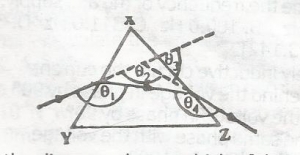
A
\( \theta _3 \)
B
\( \theta _2 \)
C
\( \theta _1 \)
D
\( \theta _4 \)
medium Difficulty
Verified Correct Answer: Option A
Physical Principles & Numerical Solution
\( \theta _3 \) shows the angle of deviation
Source: WAEC / JAMB / NECO Classroom Archive (Record #41741)
Physics
UTME / JAMB 1997
Waves, Sound & Vibrations
Solution
Ripples on water and light waves are similar because both?
A
have the same frequency
B
can be refracted and diffracted
C
are longitudinal waves
D
have the same velocity
medium Difficulty
Verified Correct Answer: Option B
Physical Principles & Numerical Solution
Examples of transverse waves include:
ripples on the surface of water.
vibrations in a guitar string.
a Mexican wave in a sports stadium.
electromagnetic waves – eg light waves, microwaves, radio waves.
Some basic properties of light :
Reflection of light.
Refraction of light.
Diffraction of light.
All kinds of waves have the same fundamental properties of reflection, refraction, diffraction and interference,
and all waves have a wavelength, frequency, speed and amplitude.
Source: WAEC / JAMB / NECO Classroom Archive (Record #27699)
Chemistry
WAEC / WASSCE 1997
Kinetic Theory of Matter & Gas Laws
Solution
Boyle's law can be expressed mathematically as
A
V \(\alpha\) T (P constant)
B
P \(\alpha\) V (T constant)
C
P \(\alpha\) T
D
V \(\alpha\) 1 / p(T constant)
E
V1/T1 = / T2
medium Difficulty
Verified Correct Answer: Option D
Chemical Principles & Mechanism
The absolute pressure exerted by a given mass of an ideal gas is inversely proportional to the volume it occupies if the temperature and amount of gas remain
Source: WAEC / JAMB / NECO Classroom Archive (Record #36593)