Question Library

Browse, filter, and study verified past examination questions with step-by-step mathematical reasoning.

Launch Interactive Practice
Searching 18,000+ Questions... Sifting topics, KaTeX formulas & verified solutions
Showing 20821–20835 of 29811 verified questions
Sort by:
Biology WAEC / WASSCE 1998 Excretion & Homeostasis
In which part of the kidney does ultrafiltration take place?
A
Bowman’s capsule
B
Distal convoluted tubule
C
Proximal convoluted tubule
D
Collecting duct
E
Afferent arteriole
medium Difficulty
Biology WAEC / WASSCE 1998 Digestive System & Feeding Mechanisms
Which of the following organs is concerned with detoxication of harmful compounds?
A
Kidney
B
Lungs
C
Gall bladder
D
Liver
E
Pancreas
medium Difficulty
Biology WAEC / WASSCE 1998 Nervous, Hormonal Coordination & Sense Organs
The hormone that promotes secondary sexual characteristics in females is
A
insulin
B
thyroxin
C
testosterone
D
oxytocin
E
oestrogen
medium Difficulty
Biology WAEC / WASSCE 1998 Reproduction in Plants & Animals
Which of the following is a method of artificial vegetative propagation?
A
Creeping stem
B
Layering
C
Corm
D
Rhizome
E
Bulbil
medium Difficulty
Biology WAEC / WASSCE 1998 Variety of Organisms & Classification of Living Things
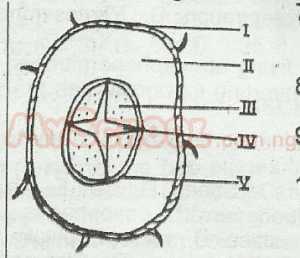
The above diagram represents a
Attached Figure / Diagram
Question diagram
A
longitudinal section of a stem
B
longitudinal section of a root
C
cross section of a root
D
transverse section of stem
E
longitudinal section of a leaf
medium Difficulty
Biology WAEC / WASSCE 1998 Reproduction in Plants & Animals
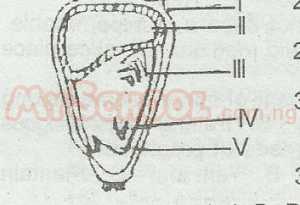
The part labelled II in the diagram is the
Attached Figure / Diagram
Question diagram
A
plumule
B
endosperm
C
radicle
D
coleorhiza
E
pericarp
medium Difficulty
Biology WAEC / WASSCE 1998 Reproduction in Plants & Animals
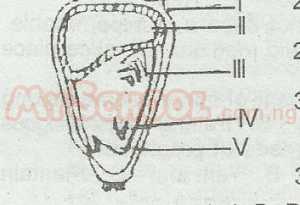
The part labelled IV in the diagram is the
Attached Figure / Diagram
Question diagram
A
plumule
B
endosperm
C
radicle
D
coleoptile
E
pericarp
medium Difficulty
Biology WAEC / WASSCE 1998 Digestive System & Feeding Mechanisms
Which of the following is not a function of the blood?
A
Maintenance of body temperature
B
Formation of clot
C
Distribution of bile
D
Transportation of excretory materials.
E
Distribution of hormones
medium Difficulty
Biology WAEC / WASSCE 1998 Reproduction in Plants & Animals
Which of the following is a feature of wind pollinated flowers?
A
Large and brightly coloured petals
B
Possession of sweet scent
C
Presence of nectar
D
Presence of pollen guides
E
Smooth, light and numerous pollen grains
medium Difficulty
Biology WAEC / WASSCE 1998 Nutrition in Plants & Animals (Photosynthesis & Food Substances)
In testing for starch in a leaf the function of alcohol is to
A
kill the cells of the leaf
B
soften the veins of the leaf
C
aid iodine to penetrate the cells
D
be a component of the heating bath
E
extract the chlorophyll from the leaf
medium Difficulty
Biology WAEC / WASSCE 1998 Basic Ecological Concepts, Ecosystems & Biomes
Which of the following processes removes CO2 from the atmosphere?
A
Respiration
B
Photosynthesis
C
Transpiration
D
Excretion
E
Combustion
medium Difficulty
Biology WAEC / WASSCE 1998 Basic Ecological Concepts, Ecosystems & Biomes
The role of bacteria in the nitrogen cycle includes the following except
A
fixing atmospheric nitrogen
B
converting ammonia to nitrites
C
converting nitrites to nitrates
D
converting carbohydrates to carbondioxide
E
causing the decay of dead organisms
medium Difficulty
Biology WAEC / WASSCE 1998 Nutrition in Plants & Animals (Photosynthesis & Food Substances)
The mode of nutrition which describes feeding habit in animals is
A
autotrophic
B
holozoic
C
holophytic
D
saprophytic
E
photosynthetic
medium Difficulty
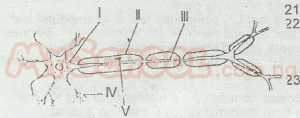
Biology WAEC / WASSCE 1998 Variety of Organisms & Classification of Living Things
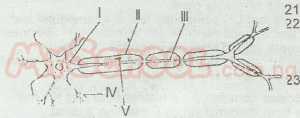
The cell body in the diagram labelled
Attached Figure / Diagram
Question diagram
A
I
B
II
C
III
D
IV
E
V
medium Difficulty
Biology WAEC / WASSCE 1998 Nervous, Hormonal Coordination & Sense Organs
The function of the part labelled II in the diagram is to
Attached Figure / Diagram
Question diagram
A
transmit impulse from one end of the cell to the other
B
manufacture food for the cell
C
protect the axon
D
produce energy for the cell
E
detect electrical impulses
medium Difficulty
Page 1389 of 1988