Question Library

Browse, filter, and study verified past examination questions with step-by-step mathematical reasoning.

Launch Interactive Practice
Searching 18,000+ Questions... Sifting topics, KaTeX formulas & verified solutions
Showing 20776–20790 of 29811 verified questions
Sort by:
Biology UTME / JAMB 1998 Transport System in Plants & Animals
In adult mammalian blood, the cells which lack nuclei are the
A
erythrocytes
B
lymphocytes
C
leucocytes
D
phagocytes
medium Difficulty
Biology UTME / JAMB 1998 Basic Ecological Concepts, Ecosystems & Biomes
Which of the following is the direct consequence of transferring energy from one trophic level to another?
A
An increase in biomass
B
A decrease in the efficiency
C
An increase in the total numbers of resulting individuals
D
A decrease in the resulting biomass
medium Difficulty
Biology UTME / JAMB 1998 Growth, Micro-organisms & Public Health
The condition that encourages denitrification is
A
low soil oxygen
B
high soil nitrogen
C
absence of soil bacteria
D
lightening and thunderstrom
medium Difficulty
Biology UTME / JAMB 1998 Variety of Organisms & Classification of Living Things
A fresh water plant such as water lily can solve the problem of buoyancy by the possession of
A
aerenchymarous tissues
B
dissected leaves
C
thin cell walls of the epidermis
D
water-repelling epidermis
medium Difficulty
Biology UTME / JAMB 1998 Basic Ecological Concepts, Ecosystems & Biomes
The sequence of the biomes in Nigeria from port Harcourt to Damaturu is
A
estuarine → rain forest → Guinea Savannah → Sahel Savannah
B
rain forest → Guinea savannah → estuarine → desert
C
estuarine → Guinea savannah → rain forest → Sahel savannah
D
rain forest → estuarine → Guinea savannah → desert
medium Difficulty
Biology UTME / JAMB 1998 Nutrition in Plants & Animals (Photosynthesis & Food Substances)
Soil micro-organisms are beneficial because of their involvement in
A
photosynthesis
B
translocation
C
cycling of nutrients
D
respiration using soil air
medium Difficulty
Biology UTME / JAMB 1998 Respiration & Gaseous Exchange
Which of following movements occur during exhalation?
A
The diaphragm and intercostal muscles relax
B
The thoracic cavity increases in volume
C
The diaphragm and intercostal muscles contract
D
The diaphragm contracts and the intercostal muscle relax
medium Difficulty
Biology UTME / JAMB 1998 Excretion & Homeostasis
In which of the following groups of animals is the malpighian tubule found?
A
Lizards, snakes and frogs
B
Crickets, houseflies and grasshoppers
C
Millipedes, centipedes and scorpions
D
earthworms, roundworms and flatworms
medium Difficulty
Biology UTME / JAMB 1998 Transport System in Plants & Animals
Which of the following is not a function of the mammalian skeleton?
A
Protection
B
respiration
C
Transportation
D
Support
medium Difficulty
Biology UTME / JAMB 1998 Reproduction in Plants & Animals
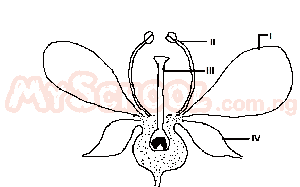
The ovary represented is
Attached Figure / Diagram
Question diagram
A
half-superior
B
inferior
C
superior
D
half-inferior
medium Difficulty
Biology UTME / JAMB 1998 Variety of Organisms & Classification of Living Things
The most reliable estimate of growth is by measuring changes in
A
length
B
volume
C
surface area
D
dry weight
medium Difficulty
Biology UTME / JAMB 1998 Reproduction in Plants & Animals
A dry fruit formed from two or more carpels containing several seeds is a
A
follicle
B
legume
C
capsule
D
schizocarp
medium Difficulty
Biology UTME / JAMB 1998 Reproduction in Plants & Animals
The outermost embryonic membrane in the mammal is the
A
amnion
B
chorion
C
allantois
D
yolk sac
medium Difficulty
Biology UTME / JAMB 1998 Nervous, Hormonal Coordination & Sense Organs
The small masses of nervous tissues in which many neurones have their nuclei are called
A
dorsal roots
B
ventral roots
C
ganglia
D
synapses
medium Difficulty
Biology UTME / JAMB 1998 Reproduction in Plants & Animals
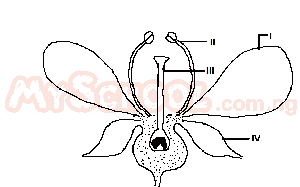
The corolla is partly represented by
Attached Figure / Diagram
Question diagram
A
I
B
II
C
III
D
Iv
medium Difficulty
Page 1386 of 1988