Question Library

Browse, filter, and study verified past examination questions with step-by-step mathematical reasoning.

Launch Interactive Practice
Searching 18,000+ Questions... Sifting topics, KaTeX formulas & verified solutions
Showing 20761–20775 of 29811 verified questions
Sort by:
Biology UTME / JAMB 1998 Variety of Organisms & Classification of Living Things
The natural tendency of organisms as they evolve is to
A
decrease in size
B
increase in number
C
develop specialize structure
D
feed indiscriminately
medium Difficulty
Biology UTME / JAMB 1998 Respiration & Gaseous Exchange
The structure that prevents food particle from escaping through the fish gills are called gill
A
arches
B
filaments
C
rakers
D
lamellae
medium Difficulty
Biology UTME / JAMB 1998 Variety of Organisms & Classification of Living Things
A distinguished feature of mammals is the possession of
A
skin
B
scale
C
nail
D
hair
medium Difficulty
Biology UTME / JAMB 1998 Supporting Tissues & Skeletal System
Which of the following structures is capable of producing more tissues in the stem of a herbaceous flowering plant?
A
Epidermis
B
Pericycle
C
Xylem
D
Cambium
medium Difficulty
Biology UTME / JAMB 1998 Nutrition in Plants & Animals (Photosynthesis & Food Substances)
The manufacture of carbohydrates by plants takes place only in
A
the leaves
B
the green stems
C
chlorophyllous parts
D
flowering plants
medium Difficulty
Biology UTME / JAMB 1998 Variety of Organisms & Classification of Living Things
In a water culture experiment, a plant showed poor growth and yellowing of the leaves. These may be due to deficiency in
A
copper
B
iron
C
magnesium
D
calcium
medium Difficulty
Biology UTME / JAMB 1998 Variety of Organisms & Classification of Living Things
In snails, the hard calcareous shells are secreted by the
A
radula
B
ctenidium
C
pneumostome
D
mantle
medium Difficulty
Biology UTME / JAMB 1998 Variety of Organisms & Classification of Living Things
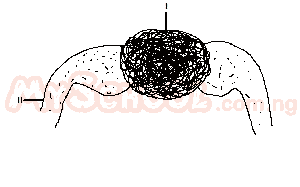
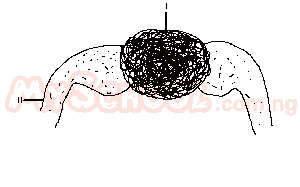
The structure labelled I is formed as a result of the fusion of
Attached Figure / Diagram
Question diagram
A
two pairs of nuclei
B
several pairs of nuclei
C
a pair of nuclei
D
two pairs of nucleoli
medium Difficulty
Biology UTME / JAMB 1998 Variety of Organisms & Classification of Living Things
The special name of the part labelled II is
Attached Figure / Diagram
Question diagram
A
gametangium
B
hypha
C
suspensor
D
zygospore
medium Difficulty
Biology UTME / JAMB 1998 Variety of Organisms & Classification of Living Things
The ability of the cockroach to live in cracks and crevices is enhanced by the possession of
A
wings and segmented body
B
compound eyes
C
claws on the leg
D
dorso-ventrally flattened body
medium Difficulty
Biology UTME / JAMB 1998 Adaptation & Evolution
The caste of termites that lacks pigmentation is the
A
King
B
worker
C
soldier
D
queen
medium Difficulty
Biology UTME / JAMB 1998 Nutrition in Plants & Animals (Photosynthesis & Food Substances)
In million's test, when the reagent is added to a protein food item, a white precipitate is produced which turns
A
blue on heating
B
yellow on heating
C
green on heating
D
red on heating
medium Difficulty
Biology UTME / JAMB 1998 Nervous, Hormonal Coordination & Sense Organs
Regulation of blood sugar level takes place in the
A
pancreas
B
iluem
C
liver
D
kidney
medium Difficulty
Biology UTME / JAMB 1998 Cell & Its Environment (Diffusion, Osmosis & Transport)
Unicellular organisms transport essential nutrients directly to all parts of their bodies by the process of diffusion because, they have
A
a large volume of surface area ratio
B
a large surface area to volume ratio
C
their bodies immersed in the nutrients
D
their outer membrane made of cellulose
medium Difficulty
Biology UTME / JAMB 1998 Transport System in Plants & Animals
The heart of the adult frog consist of
A
two auricles and two ventricles
B
one auricle and one ventricle
C
two ventricle and one auricle
D
one ventricle and two auricles
medium Difficulty
Page 1385 of 1988