
Question Library

Browse, filter, and study verified past examination questions with step-by-step mathematical reasoning.
Launch Interactive Practice
Searching 18,000+ Questions... Sifting topics, KaTeX formulas & verified solutions
Showing 20701–20715 of 29811 verified questions
Sort by:
Chemistry UTME / JAMB 1998 Reaction Rates & Chemical Equilibrium
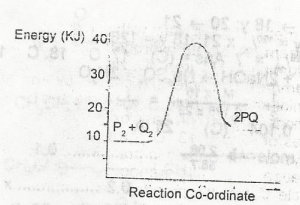
In the diagram above , the activation energy for the backward reaction is
Attached Figure / Diagram
Question diagram
A
+5kJ
B
+15KJ
C
+25KJ
D
+30KJ
medium Difficulty
Chemistry UTME / JAMB 1998 Acids, Bases, pH & Salts
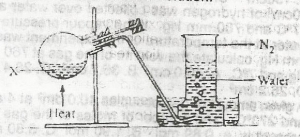
In the experiment above, X could be a solution of
Attached Figure / Diagram
Question diagram
A
sodium trioxonitrate (V) and ammonium chloride
B
sodium trioxonitrate (lll) and ammonium chloride
C
lead (ll) trioxonitrate (V) and copper turnings
D
potassium trioxonitrate (V) and copper turnings
medium Difficulty
Chemistry UTME / JAMB 1998 Acids, Bases, pH & Salts
In the experiment above, X could be a solution of
A
sodium trioxonitrate (V) and ammonium chloride
B
sodium trioxonitrate (lll) and ammonium chloride
C
lead (ll) trioxonitrate (V) and copper turnings
D
potassium trioxonitrate (V) and copper turnings
medium Difficulty
Chemistry WAEC / WASSCE 1998 Acids, Bases, pH & Salts
AN AQUEOUS SOLUTION IS ACIDIC IF
A
its pH value is high
B
it s corrosive
C
it changes the colour of litmus
D
it has a bitter taste
E
it contains more H3O- than OH-
medium Difficulty
Chemistry WAEC / WASSCE 1998 Stoichiometry, Mole Concept & Volumetric Analysis
The following oxides react with water except
A
Na2O
B
SO3
C
NO2
D
CO2
E
CuO
medium Difficulty
Chemistry WAEC / WASSCE 1998 Stoichiometry, Mole Concept & Volumetric Analysis
Which of the following is not a property of trioxonitrate (V) salts?
A
Positive reaction to the brown ring test
B
Ability to dissolve in cold water
C
Decomposition on being strongly heated
D
Production of effervescence with saturated Na2CO3 solution
E
Evolution of gas with concentrated H2SO4 and copper turnings
medium Difficulty
Chemistry WAEC / WASSCE 1998 Acids, Bases, pH & Salts
Which of the following methods is suitable for the preparation of an insoluble salt?
A
Action of an acid on a metal
B
Double decomposition
C
Neutralisation
D
Action of an acid on a trioxocarbonate (IV)
E
Action of an acid on an oxide
medium Difficulty
Chemistry WAEC / WASSCE 1998 Stoichiometry, Mole Concept & Volumetric Analysis
What is the function of sulphur (IV) oxide in the reaction represented by the following equation? SO 2(aq) + 2H2S(g) → 3S (s) + 2H 2O (l)
A
Dehydrating agent
B
Oxidising agent
C
Bleaching agent
D
Acid
E
Precipitant
medium Difficulty
Chemistry WAEC / WASSCE 1998 Electrolysis & Electrochemical Cells
Which of the following will produce oxygen and hydrogen during its electrolysis using platinum electrode?
A
Glucose solution
B
Aqueous copper (ll) tetraoxosulphate (IV)
C
Dilute sodium chloride solution
D
Concentrated hydrochloric acid
E
Dilute copper (ll) chloride solution
medium Difficulty
Chemistry WAEC / WASSCE 1998 Electrolysis & Electrochemical Cells
What mass of copper would be deposited by a current of 1. 0 ampere passing for 965 seconds through copper (ll) tetraoxosulphate (IV) solution? [Cu = 63.5; 1F = 96500C]
A
0.318g
B
0.635g
C
18g
D
6.35g
E
9.65g
medium Difficulty
Chemistry WAEC / WASSCE 1998 Water, Solutions & Solubility
Substances which absorb water from the atmosphere without dissolving in it are sid to be
A
anhydrous
B
hygroscopic
C
insolube
D
hydrated
E
efflorescent
medium Difficulty
Chemistry WAEC / WASSCE 1998 Stoichiometry, Mole Concept & Volumetric Analysis
Pipe-borne water is usually chlorinated in order to
A
improve the teste of the water
B
remove the hardness in the water clear
C
coagulate sediments in the water
D
kill harmful bacteria in the water
E
make the water clear and colourless
medium Difficulty
Chemistry WAEC / WASSCE 1998 Reaction Rates & Chemical Equilibrium
Which of the following can be added to dissolve the precipitate formed in the reaction represented by the following equation? CaCl2(aq) + H2C2O 4(s) ⇌ CaC 2O2
A
Calcium chloride solution
B
Concentrated hydrochloric acid
C
Ethanol
D
Ethanedioc acid
E
Aqueous ammonia
medium Difficulty
Chemistry WAEC / WASSCE 1998 Chemical Energetics & Thermochemistry
The spontaneity of a chemical reaction is determined by the change in the
A
concentration of the reactants
B
temperature of the system
C
free energy of the system
D
pressure applied to the system
E
volume of the reactants
medium Difficulty
Chemistry WAEC / WASSCE 1998 Water, Solutions & Solubility
Two metallic ions commonly present in hard water are
A
Ca2+ and Zn2+
B
Cu2+ and Na+
C
Mg2+ and Ca2+
D
Fe2+ and Na+
E
Zn2+ and Cu2+
medium Difficulty
Page 1381 of 1988