Question Library
Browse, filter, and study verified past examination questions with step-by-step mathematical reasoning.
Searching 18,000+ Questions...
Sifting topics, KaTeX formulas & verified solutions
Showing 20251–20265 of 29811 verified questions
Sort by:
Biology
WAEC / WASSCE 1999
Basic Ecological Concepts, Ecosystems & Biomes
Solution
(a) (i) Define the term hydrosphere.
(ii) Give three examples of hydrosphere.
(b) (i) State the two laws of thermodynamics levels.
(c) (i) Name two local biotic communities in Nigeria and associate each type with a particular State in Nigeria.
(ii) List three factors that affect organisms in the marine habitat.
(iii) State three adaptive features of sea weeds.
medium Difficulty
Verified Correct Answer: Option
Biological Concept & Syllabus Guide
(a)(i) Hydrosphere is the aquatic portion of the biosphere or life supporting living world or earth.
(ii) Examples of hydrosphere are: Lake, Pools, Spring, Oceans, Ponds, Oasis, Rivers, Streams, Manny.
(b)(i) The first law of thermodynamics states that energy can neither be created nor destroyed. The second law of thermodynamics states that in any conversion of energy from one state to another, there is always a decrease in the amount of useful energy.
(ii) Using the second law of thermodynamics, the energy flow across trophic levels can be explained as follows:
The transfer of energy between trophic levels is not 100%. That means it is not completely transferred.
Successive levels have less of useful energy and support fewer organisms.
Primary producers/plants have the highest amount of energy and when herbivores feed on plants, the energy level is reduced.
When carnivores consume the herbivores the energy level is further reduced.
(c) (i) Local biotic communities and the state each is found in Nigeria are:
Local biotic community
State
Tropical rainforest .
Southern Guinea Savanna
Northern Guinea Savanna
Sahel Savanna
Mangrove/Swamp/Estuarine
Edo/Delta/Ondo/Imo/Abia/Lagos/Anam bra/Rivers/Bayelsa/Akwa-Ibom
Enugu/Kogi/Benue/Kwara/Oyo/Ebonyi/Osun/Ekiti.
Plateau/Kaduna/Bauchi/Niger/Taraba/Adarnawa/Kano.
Borno/Kastina/Sokoto/Yobe/Kebbi/Zamfara/Kano/Jigawa.
Delta/Cross River/Rivers/Akwalbom/Bayelsa/Ogun/Lagos/Ondo.
(ii) Factors affecting marine organisms are: Temperature, Salinity, Pressure, Turbidity/light penetration, Dissolved oxygen, Density of sea water, PH/hydrogen ion concentration, Waves /up-welling of water, Current and Tides.
(iii) Adaptive features of sea weeds are;
(1) Possession of chloroplast/photosynthesis
(2) Absence of lignified tissue which makes them flexible and able to withstand wave actions
(3) Possession of hold fast for firm attachment to substratum or rocky surface
(4) Body covered with mucilage to reduce desiccation during low tide or on exposure
(5) Possession of air bladders for buoyancy.
Source: Myschool Past Questions Archive (Record #52934)
Biology
WAEC / WASSCE 1999
Variation & Genetics (Heredity)
Solution
(a) (i) Define the law of independent assortment.
(ii) State the findings from Mendel's experiment involving white-flowered and red-flowered pea plants.
(iii) Illustrate these findings by means of simple diagrams.
(b) Explain why blood groups A and B in man can exist both in heterozygous and homozygous conditions while blood group 0 can only exist in homozygous state. .
medium Difficulty
Verified Correct Answer: Option
Biological Concept & Syllabus Guide
(a) (i) The law of independent assortment states that each member of alleles or contracting character may combine randomly with either member of another pair.
(ii) Findings of Mendel's experiment involving white and red flowered pea plants:- On crossing white and red flowered pea plants, he obtained all red - flowered offspring, but on self-.crossing each of these red- flowered plants he obtained mixtures of red flowered and white flowered plants in the ratio of 3:1 (¾ red / ¼ white flowered).
(iii) Illustrations: Key for parental genotype e.g R for red, r for white
(b) Blood grouping in man is determined by three alternative genes (alleles) A, B, and 0. A person can only possess two (alleles) of the genes on a pair of homologous chromosomes. 0 is recessive to both A and B, hence it is possible to have blood group A and AA (homozygous) and AO (heterozygous) and group B as BB or BO. However, group 0 can only exist genotypically as 00 in the homozygous recessive state.
Source: Myschool Past Questions Archive (Record #52939)
Biology
WAEC / WASSCE 1999
Population Ecology, Habitats & Conservation
Solution
(a) (i) What is Pollution?
(ii) Name two pollutants each of air and water.
(b) (i) State four effects of water pollution.
(ii)Mention four ways of preventing water pollution in an environment.
(c) (i) Name three sources of noise pollution.
(ii) State three effects of noise pollution on man.
medium Difficulty
Verified Correct Answer: Option
Biological Concept & Syllabus Guide
(a) (i) Pollution; is the release of toxic or harmful substances into the environment by their natural forces or man and other animals to an extent that causes biological damage to man and his resources.
(1) Pollutants of air are: Smoke, fumes, dust, harmful gases e.g sulphurdioxide, hydrogen sulphide, ammonia, chlorine/nitrogen oxides, carbon monoxide, pollen grains and soot.
(2) Pollutants of water are: sewage, excreta/faeces, pesticides, chemical wastes/chemicals from factories, fertilizers, slurry/waste from farms, petroleum/ crude oil, heated water, oil spillage.
(b)(i) Effects of water pollution on organisms are:
(1) Destruction or death of valuable aquatic species such as sea birds, fishes e.t.c.
(2) Food chain is affected, or disrupted.
(3) Pollutants encourage bacterial growth leading to reduced amounts of dissolved oxygen/biological oxygen demand in water. This leads to death of fishes and other organisms.
(4) Causes algae blood or putrification while water is rendered unsafe for domestic, drinking, industrial use or recreation.
(5) It also leads to migration of water animals.
(ii) Ways of preventing water pollution:
(1) There should be efficient and proper sewage disposal system.
(2) Dumping of refuse or petro-chemical by-products into rivers/streams/ponds or seas should be avoided.
(3) The use of efficient techniques to deal with or prevent oil spillage should be adopted.
(4) Industries should be sited away from residential areas and water bodies.
(5) Government /local authorities should strictly monitor all industrial wastes and carry out public enlightenment.
(6) Industrial effluents and hot water should be re-cycled.
(c)(i) Sources of noise pollution are:
(1) Factory or industrial noise.
(2) Aeroplane/aviation noise (taking off and landing of aeroplanes).
(3) Railway engine/locomotive noise.
(4) Automobile/ car horns/sirens.
(5) High pitched musical sounds from loud speakers/drumming.
(6) Noise from mills/sawmills/ grinding mills/electronic gadgets and generators.
(7) Artillary shots /shelling/canon shots.
(8) Thunder noise.
(ii) Effects of noise pollution on man:
(1) Loss of hearing /deafening /hard hearing/hearing difficulty.
(2) Emotional disorder/anxiety / fright and lack of concentration.
(3) High blood pressure/hypertension.
(4) General irritation/short temper.
(5) Changes in behaviour.
Source: Myschool Past Questions Archive (Record #52940)
Biology
WAEC / WASSCE 1999
Reproduction in Plants & Animals
Solution
(a) (i) Define the term metamorphosis.
(ii) Name the two types of metamorphosis that organisms undergo and mention two organisms that undergo each type.
(b) (i) State four economic importance of insects and name an example of each of the insects involved.
(ii) List four peculiar features of social insects.
medium Difficulty
Verified Correct Answer: Option
Biological Concept & Syllabus Guide
(a) (i) Metamorphosis; refers to series of changes of forms or shapes from the fertilized egg (immature stage) to adult (mature stage or adulthood).
(ii) Two types of metamorphosis are: Complete metamorphosis, e.g, Butterfly, Housefly, Bees, Wasp, Beetles, Mosquito and Incomplete metamorphosis, e.g, Grasshoppers, Cockroach, Dragonfly , Locust, Aphids, Termites, Praying mantis
(b) (i) Economic importance of insects are:
(1) Act as carriers, vectors or transmitters of diseases ( e.g anopheles mosquito, tsetsefly etc
(2) Act as pests and are destructive to life plants or stored food (e.g locust; grasshoppers weevil, crickets)
(3) As food or source of protein (e.g termites, honey, larval forms of some beetles, cricket, grasshopper)
(4) Life processes involved in meiosis used in biological control (e.g lady bird - used in control of aphids on plantations, praying mantis:- control of some insects)
(5) Serve as pollinating agents of flowering plants (e.g bees, butterflies, ants, moths, wasps, beetles).
(6) Soil insects for aeration or loosening of soil (e.g termites, crickets, dung - beetles).
(7) Insects as industrial material, (bee wax for candles, silk worms).
(8) Termitarium used in building lawn tennis courts
(9) Revenue yielding - e.g termites, larva of beetles e.t.c.
(10) Destroy furniture, books, clothes, wood e.t.c, e.g cockroaches and termites.
(ii) Peculiar features of social insects are:
(1) They live together or form colonies
(2) They live in nests.
(3) Show or display division of labour.
(4) Show distinct castes.
(5) Members communicate with one another within the colonies.
Source: Myschool Past Questions Archive (Record #52942)
Biology
WAEC / WASSCE 1999
Cell Structure, Organization & Cell Division
Solution
(a) (i) Name four similarities found in plant and animal cells
(ii) In a tabular form list four different cells found in man and give a function for each of the cells.
(b) (i) Name the two types of cell divisions.
(ii) Give two examples each of life processes involved in each type of the cell division.
(c) Name the two types of reproduction usually associated with organisms.
medium Difficulty
Verified Correct Answer: Option
Biological Concept & Syllabus Guide
(a) (i) Similarities found in plant and animal cells are: Cytoplasm, Nucleus, nucleolus, DNA, RNA, chromosomes, Cell membrane, Mitochondria, Golgi bodies, Endoplasmic reticulum, Nuclear membrane, Ribosomes.
Types of human cells
Functions
Red blood cells/ corpuscles/ erythrocytes
perform circulatory, excretory, respiratory or transport functions; carry O\(_2\) to or round the body and remove CO\(_2\) from cells.
White blood cells/ leucocytes
Defend, protect the body and provide immunity.
Epidermal cells
protect the body against disease germs, infection or dehydration
Nerve cells/ spermatozoa
for reproduction/ fertilization
Nerve cells/ neurons
Transmit impulses or messages from nerve fibres
Ova/ eggs
for reproduction
muscle cells
from muscles for movement or locomotion and attachment of bones and give shape to the body
Bone cells / oesteoblast / oesteocytes
Form bones, give support to or aid movement and give shape to the body
Chondroblast/ cartilage
Attachment of bones (support)
Rods
Photo receptor in dim light
Cone
Photo receptor in bright light
(b) (i) The two types of cell divisions are Mitosis and Meiosis (ii)(a) Examples of life processes involved in mitosis are: Formation of new cells in the maiphigian layer of skin, Production of red blood cells and white blood cells in the bone marrow, Cell division in liver, Growth Spermatogenesis, Repair or healing of wound, Binary fission.
(b) Examples of life processes involved in meiosis are: Formation of sperms (male gametes), Formation of oval eggs (female gametes), Formation of pollen grains in anther of flowering plants, Formation of ovules (in ovary) of flowering plants.
(c) Two reproductive methods in organisms are: Sexual and Asexual
Source: Myschool Past Questions Archive (Record #52945)
Biology
UTME / JAMB 1999
Basic Ecological Concepts, Ecosystems & Biomes
Solution
Primary consumers are found in
A
1, 2 and 3
B
1, 3 and 7
C
2, 3 and 7
D
2, 4 and 5
medium Difficulty
Verified Correct Answer: Option C
Biological Concept & Syllabus Guide
Primary consumers are organisms that eat plants or algae, and are the first step in a food chain. They are also known as herbivores or plant-eaters. In the Food web given in the question, immediately after the plants (Primary producers, because they are autotrophs), the organisms that feed on the plants in the different food chains are called primary consumers, and they are found in numbers 2,3 and 7( moth, grasshopper and herbivorous bug respectively).
Source: Myschool Past Questions Archive (Record #56106)
Mathematics
WAEC / WASSCE 1998
Linear, Simultaneous & Quadratic Equations
Solution
Find the root of the equation 2x\(^2\) - 3x - 2 = 0
A
x = -2 or 1/2
B
x = -2 or1
C
x = -2 or 2
D
x = -1 or 2
E
x = -1/2 or 2
medium Difficulty
Verified Correct Answer: Option E
Step-by-Step Mathematical Solution
2x\(^2\) - 3x - 2 = 0
2x\(^2\) - 4x + x - 2 = 0
2x(x - 2) + 1(x - 2) = 0
(2x + 1)(x - 2) = 0
x = \(\frac{-1}{2}\) or x = 2
Source: Myschool Past Questions Archive (Record #22093)
Mathematics
WAEC / WASSCE 1998
Linear, Simultaneous & Quadratic Equations
Solution
What value of k makes the given expression a perfect square ? m\(^2\) - 8m + k = 0
A
2
B
4
C
8
D
16
E
64
medium Difficulty
Verified Correct Answer: Option D
Step-by-Step Mathematical Solution
Take half the coefficient of m and square it
=> (-8/2)2 = k = 16
Source: Myschool Past Questions Archive (Record #22094)
Mathematics
WAEC / WASSCE 1998
Indices, Logarithms & Surds
Solution
If log\(_{10}\) q = 2.7078, what is q?
A
5102
B
849.9
C
510.2
D
84.99
E
51.02
medium Difficulty
Verified Correct Answer: Option C
Step-by-Step Mathematical Solution
q = 10\(^{2.7078}\)
Antilog of 2.7078 = 510.2
Source: Myschool Past Questions Archive (Record #22095)
Mathematics
WAEC / WASSCE 1998
Trigonometry, Elevation & Bearings
Solution
Cos x is negative and sin x is negative.Which of the following is true of x?
A
0o o
B
90o o
C
180o o
D
270o o
E
-90o o
medium Difficulty
Verified Correct Answer: Option C
Step-by-Step Mathematical Solution
In the 3rd quadrant, only the tan of angles are positive.
The 3rd quadrant = 180^\circ < x < 270^\circ
Source: Myschool Past Questions Archive (Record #22096)
Mathematics
WAEC / WASSCE 1998
Fractions, Decimals, Percentages & Approximations
Solution
Simplify 0.63954 \div 0.003 giving your answer correct to two significant figures
A
213.18
B
213.00
C
213
D
210
E
21
medium Difficulty
Verified Correct Answer: Option D
Step-by-Step Mathematical Solution
= \(\frac{0.63954}{0.003}\)
moving the decimal places, we have
= \(\frac{639.54}{3}\)
= 213.18
\(\approxeq\) 210 (to 2 s.f.)
Source: Myschool Past Questions Archive (Record #22097)
Mathematics
WAEC / WASSCE 1998
Indices, Logarithms & Surds
Solution
If log\(_{10}\) a = 4; what is a?
A
0.4
B
40
C
400
D
1000
E
10000
medium Difficulty
Verified Correct Answer: Option E
Step-by-Step Mathematical Solution
log\(_{10}\) a = 4
a = 10\(^4\)
= 10000
Source: Myschool Past Questions Archive (Record #22098)
Mathematics
WAEC / WASSCE 1998
Fractions, Decimals, Percentages & Approximations
Solution
A student measured the length of a room and obtained the measurement of 3.99m. If the percentage error of is measurement was 5% and his own measurement was smaller than the length , what is the length of the room?
A
3.78m
B
3.80m
C
4.18m
D
4.20m
E
4.788m
medium Difficulty
Verified Correct Answer: Option D
Step-by-Step Mathematical Solution
Let the actual length of the room = y m
\(\therefore \frac{y - 3.99}{y} \times 100 = 5%\)
\(100(y - 3.99) = 5y \implies 100y - 399 = 5y\)
\(100y - 5y = 399 \implies y = \frac{399}{95}\)
y = 4.2 m
Source: Myschool Past Questions Archive (Record #22099)
Mathematics
WAEC / WASSCE 1998
Trigonometry, Elevation & Bearings
Solution
When an aeroplane is 800m above the ground, its angle of elevation from a point P on the ground is 30o. How far is the plane from P by line of sight?
A
400m
B
800m
C
1500m
D
1600m
E
1700m
medium Difficulty
Verified Correct Answer: Option D
Step-by-Step Mathematical Solution
From the diagram, \(\sin 30 = \frac{800}{x}\)
\(x = \frac{800}{\sin 30} \)
= \(\frac{800}{0.5} \)
= 1600 m
Source: Myschool Past Questions Archive (Record #22100)
Mathematics
UTME / JAMB 1998
Plane Geometry, Polygons & Circle Theorems
Diagram
Solution
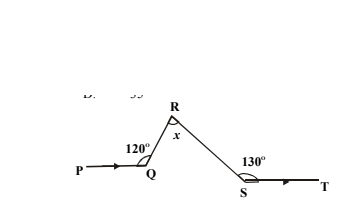
In diagram, PQ || ST and < PQR = 120º, < RST = 130º, find the angle marked x
Attached Figure / Diagram
A
50
B
65
C
70
D
80
medium Difficulty
Verified Correct Answer: Option C
Step-by-Step Mathematical Solution
Produce line PQ to meet line RS at U
< RQU = 180º - 120º = 60º (
In angle QRU: < QPT + RQU = < RUV ( 2 interior angles = one exterior angle)
x + 60º = 130º and x = 70º
Source: WAEC / JAMB / NECO Classroom Archive (Record #33077)