Question Library

Browse, filter, and study verified past examination questions with step-by-step mathematical reasoning.

Launch Interactive Practice
Searching 18,000+ Questions... Sifting topics, KaTeX formulas & verified solutions
Showing 20146–20160 of 29811 verified questions
Sort by:
Biology UTME / JAMB 1999 Nutrition in Plants & Animals (Photosynthesis & Food Substances)
The dark reaction of photosynthesis involves
A
fixation of carbon (IV) oxide to give six-carbon sugar
B
fixation of carbon (IV) oxide with the help of oxygen
C
use of carbon (IV) oxide to produce glucose using ATP
D
fixation of carbon (IV) oxide on chlorophyll using hydrogen
medium Difficulty
Biology UTME / JAMB 1999 Transport System in Plants & Animals
Mammals acclimatize to reduced oxygen content at high altitudes by
A
the stimulation of marrow to reduce the amount of erythrocytes produced
B
increasing the rate at which erythrocytes are destroyed
C
the stimulation of marrow to produce more erythrocytes
D
increasing the break down of the protein portion of the erythrocytes
medium Difficulty
Biology UTME / JAMB 1999 Basic Ecological Concepts, Ecosystems & Biomes
The modes of nutrition in Nitrobacter, Ascaris and Homo sapiens respectively are
A
photosynthetic , parasitic and holozoic
B
chemosynthetic, parasitic and holozoic
C
photosynthetic, parasitic and heterophytic
D
chemosynthetic, holophytic and holozoic
medium Difficulty
Biology UTME / JAMB 1999 Nutrition in Plants & Animals (Photosynthesis & Food Substances)
The richest source of vitamin A are
A
palm oil and groundnut oil
B
palm oil and carrot
C
rice and groundnut oil
D
oranges and carrot
medium Difficulty
Biology UTME / JAMB 1999 Cell Structure, Organization & Cell Division
The structure that is most commonly identified in all living cells under the light microscope is the
A
mitochondrion
B
chloroplast
C
nucleus
D
ribosome
medium Difficulty
Biology UTME / JAMB 1999 Respiration & Gaseous Exchange
Which of the following is an organ?
A
Guard cell
B
Liver
C
Xylem bundle
D
Blood
medium Difficulty
Biology UTME / JAMB 1999 Variety of Organisms & Classification of Living Things
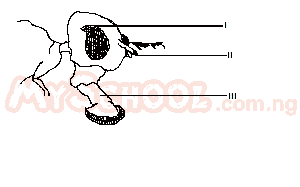
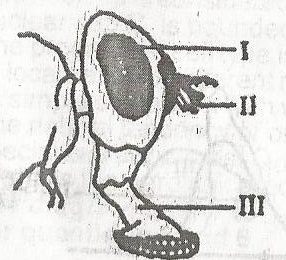
The structure labelled II is used for
Attached Figure / Diagram
Question diagram
A
tasting
B
feeling
C
biting
D
sucking
medium Difficulty
Biology UTME / JAMB 1999 Digestive System & Feeding Mechanisms
The structure labeled III represents the
Attached Figure / Diagram
Question diagram
A
mandible
B
palp
C
proboscis
D
labium
medium Difficulty
Biology UTME / JAMB 1999 Variety of Organisms & Classification of Living Things
The division of a body into two equal halves along a longitudinal plane is called
A
bilateral symmetary
B
transverse section
C
radial symmetry
D
longitudinal section
medium Difficulty
Biology UTME / JAMB 1999 Supporting Tissues & Skeletal System
The force that holds water together in the form of a stream within the xylem tube is the
A
cohesion of water molecules to one another by hydrogen bonds
B
force of gravity attacking the water molecules through the hydrogen bonds
C
attraction between the water and xylem osmotic force
D
normal flow of water from the ground with help of gravitational force
medium Difficulty
Biology UTME / JAMB 1999 Variety of Organisms & Classification of Living Things
Yellowing of leaves is a symptom associated with deficiency of
A
iron, calcium and magnesium
B
nitrogen, sulphur and potassium
C
sulphur, phosphorus and iron
D
magnesium, nitrogen and iron
medium Difficulty
Biology UTME / JAMB 1999 Transport System in Plants & Animals
The lymphatic system of mammals rejoins the blood circulatory system at the
A
hepatic vein
B
subclavian vein
C
renal vein
D
common iliac vein
medium Difficulty
Biology UTME / JAMB 1999 Supporting Tissues & Skeletal System
In dissection, the rib cage of mammal has to be opened in order to expose the
A
diaphragm
B
liver
C
heart
D
sternum
medium Difficulty
Biology UTME / JAMB 1999 Reproduction in Plants & Animals
Fertilization in humans usually takes place in the
A
lower part of the uterus
B
upper part of the uterus
C
lower part of the oviduct
D
upper part of the oviduct
medium Difficulty
Biology UTME / JAMB 1999 Reproduction in Plants & Animals
Insects visit flowers in order to
A
feed on the nectar
B
deposit pollen on the stigma
C
pollinate the flowers
D
transfer pollen from anthers
medium Difficulty
Page 1344 of 1988