Question Library

Browse, filter, and study verified past examination questions with step-by-step mathematical reasoning.
Launch Interactive Practice
Searching 18,000+ Questions... Sifting topics, KaTeX formulas & verified solutions
Showing 20071–20085 of 29811 verified questions
Sort by:
Chemistry UTME / JAMB 1999 Stoichiometry, Mole Concept & Volumetric Analysis
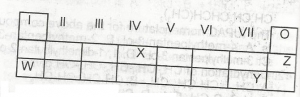
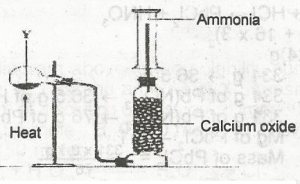
In the diagram above, Y is a mixture of
Attached Figure / Diagram
Question diagram
A
calcium hydroxide and ammonium chloride
B
calcuim hydroxide and sodium chloride
C
sodium chloride and ammonuim trioxonitrate (V)
D
sodium dioxonitrate (lll) and ammouium chloride
medium Difficulty
Chemistry UTME / JAMB 1999 Stoichiometry, Mole Concept & Volumetric Analysis
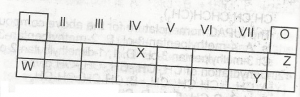
Use the table above to answer this question . The element that is likely to participate in covalent rather than ionic bonding is
Attached Figure / Diagram
Question diagram
A
Z
B
Y
C
X
D
W
medium Difficulty
Chemistry UTME / JAMB 1999 Stoichiometry, Mole Concept & Volumetric Analysis
Use the table above to answer this question .The least reactive element is
Attached Figure / Diagram
Question diagram
A
W
B
X
C
Y
D
Z
medium Difficulty
Chemistry UTME / JAMB 1999 Nature of Matter & Separation Techniques
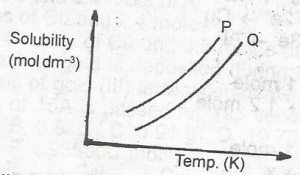
In the diagram above, the mixture of the solids P and Q can be separated by?
Attached Figure / Diagram
Question diagram
A
distillation
B
fractional distillation
C
crystallization
D
fractional crystallization
medium Difficulty
Chemistry UTME / JAMB 1999 Stoichiometry, Mole Concept & Volumetric Analysis
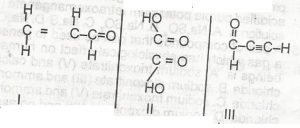
Which of the compounds above would react to take up two molecules of bromine durng bromination?
Attached Figure / Diagram
Question diagram
A
l only
B
lll only
C
l and ll only
D
ll and lll only
medium Difficulty
Chemistry WAEC / WASSCE 1999 Atomic Structure, Orbitals & Nuclear Chemistry
Calcium atom ionizes by
A
gaining two electrons
B
losing two electrons
C
sharing two electrons
D
gaining two protons
medium Difficulty
Chemistry WAEC / WASSCE 1999 Periodic Table & Periodicity
Which of the following properties increases down a group in the Periodic Table?
A
Atomic radius
B
Electronegativity
C
Electon affinity
D
Ionization energy
medium Difficulty
Chemistry WAEC / WASSCE 1999 Periodic Table & Periodicity
In the Periodic Table, the elements that loss electrons most readily belong to
A
Group 1 A
B
Group 11 A
C
Group 111 A
D
Group V11 A
medium Difficulty
Chemistry WAEC / WASSCE 1999 Stoichiometry, Mole Concept & Volumetric Analysis
Which of the following reactions is not feasible?
A
Cl2 + 2Kl → 2KCI + I2
B
Cl2 + 2NaF → 2NaCI + F2
C
Zn + CuCI2 → ZnCl2 + Cu
D
Zn + 2AgNO3 → Zn(NO3)2 + 2Ag
medium Difficulty
Chemistry WAEC / WASSCE 1999 Stoichiometry, Mole Concept & Volumetric Analysis
Which of the following halogens is the most reactive?
A
F2
B
Br2
C
l2
D
Cl
medium Difficulty
Chemistry WAEC / WASSCE 1999 Stoichiometry, Mole Concept & Volumetric Analysis
Which of the following atoms contains the highest number of electrons in the outermost shell?
A
8O
B
10Ne
C
15P
D
19K
medium Difficulty
Chemistry WAEC / WASSCE 1999 Atomic Structure, Orbitals & Nuclear Chemistry
What is the electronic configuration of an element represented as 199X?
A
1s 22s2 2p 5
B
1s22s23s23p3
C
1s2 2s2 2p 33s2
D
1s 22s22p 63s23p64s 1
medium Difficulty
Chemistry WAEC / WASSCE 1999 Atomic Structure, Orbitals & Nuclear Chemistry
Pauli Exclusion Principle is related to
A
quantum numbers of electrons
B
reversiblility of equlibrium reactions
C
electronegativity values of elements
D
collision theory of reaction rates
medium Difficulty
Chemistry WAEC / WASSCE 1999 Stoichiometry, Mole Concept & Volumetric Analysis
Which of the orbitals 4s, 4p, 4d and 4f has the lowest energy?
A
4f
B
4p
C
4d
D
4s
medium Difficulty
Chemistry WAEC / WASSCE 1999 Atomic Structure, Orbitals & Nuclear Chemistry
Two radioactive elements Q and S have half-life periods of 10 hours and 20 hours respectively. Therefore
A
S decays faster than Q
B
Q is twice as stable as S
C
Q emits fewer particles than S
D
S is more stable than Q
medium Difficulty
Page 1339 of 1988