Question Library
Browse, filter, and study verified past examination questions with step-by-step mathematical reasoning.
Searching 18,000+ Questions...
Sifting topics, KaTeX formulas & verified solutions
Showing 19681–19695 of 29811 verified questions
Sort by:
Mathematics
UTME / JAMB 1999
Statistics (Data Representation, Central Tendency & Dispersion)
Solution
A student calculated the mean of 5 numbers as 45.3. While rechecking his working, he discovered that his total was short by 20.5. What is the correct mean of the 5 numbers?
A
49.4
medium Difficulty
Verified Correct Answer: Option A
Step-by-Step Mathematical Solution
The student calculated the mean as 45.3 for 5 numbers.
Therefore, the **wrong total (sum) he used was:
45.3 × 5 = 226.5
He discovered that his total was short by 20.5.
This means the actual (correct) sum is:
226.5 + 20.5 = 247
Correct mean = Correct sum ÷ Number of numbers
247 ÷ 5 = 49.4
Source: WAEC / JAMB / NECO Classroom Archive (Record #77195)
Physics
UTME / JAMB 1999
Work, Energy, Power & Simple Machines
Diagram
Solution
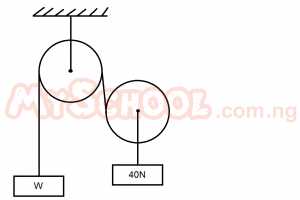
The figure above represents a frictionless pulley system in which a weight W is in equilibrium with a weight of 40N. Find the value of W
Attached Figure / Diagram
A
13.3N
B
20.0N
C
40.0N
D
80.0N
medium Difficulty
Verified Correct Answer: Option D
Physical Principles & Numerical Solution
With P1 and P2 as shown (make a V.R of 2), the weight W = 40N * 2 = 80N
Source: WAEC / JAMB / NECO Classroom Archive (Record #11141)
Physics
WAEC / WASSCE 1999
Current Electricity & Electric Circuits
Diagram
Solution
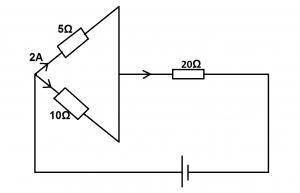
Using the data on the diagram above, calculate the potential difference across the 20- Ω resistor. (Neglect the internal resistance of the cell)
Attached Figure / Diagram
A
5V
B
10V
C
20V
D
60V
medium Difficulty
Verified Correct Answer: Option D
Physical Principles & Numerical Solution
Voltage across 5\Omega resistor = IR = 2 \times 5 = 10V
Since voltage in a parallel connection is the same, voltage across 10\Omega is also 10V
Current flowing across the 10\Omega resistor
I = V/R = 10/10
Current I= 1A
Total current flowing = 2 + 1 = 3A
Voltage across 20\Omega resistor = IR
= 3 \times 20
= 60V
Source: WAEC / JAMB / NECO Classroom Archive (Record #25497)
Physics
WAEC / WASSCE 1999
Reflection, Refraction & Dispersion of Light
Solution
The image of an object is located 6cm behind a convex mirror. If its magnification is 0.6, calculate the focal length of the mirror
A
3.75cm
B
6.60cm
C
10.00cm
D
-15.00cm
medium Difficulty
Verified Correct Answer: Option D
Physical Principles & Numerical Solution
V = -6cm
M = 0.6cm
Recall m = \(\frac{V}{U}\)
U = \(\frac{V}{M}\)
U = \(\frac{6}{0.6}\)
U = 10
\(\frac{1}{U}\) + \(\frac{1}{V}\) = \(\frac{1}{F}\)
\(\frac{1}{10}\) + \(\frac{1}{-6}\) = \(\frac{1}{F}\)
\(\frac{-4}{60}\) = \(\frac{1}{F}\)
F = \(\frac{60}{-4}\)
= -15cm
Source: WAEC / JAMB / NECO Classroom Archive (Record #25489)
Physics
UTME / JAMB 1999
Waves, Sound & Vibrations
Diagram
Solution
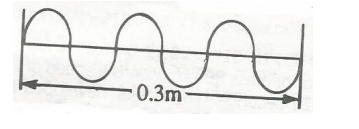
The diagram above represents a transverse electromagnetic wave travelling with speed 3.0 x 10⁸ms-1. What is the frequency of the wave.
Attached Figure / Diagram
A
3.0 x 10⁷Hz
B
9.0 x 10⁷Hz
C
1.0 x 10⁹Hz
D
3.0 x 10⁹Hz
medium Difficulty
Verified Correct Answer: Option D
Physical Principles & Numerical Solution
The frequency f = V/\lambda,
Where \lambda = wavelength
From the above, the distance OA = one wavelength; AB = one wave length and BC = one wavelength.
=> OC = 3 wavelength = 3\lambda
∴3\lambda = 0.3M
\lambda = 0.3/3
= 0.1m
∴ f = V/\lambda = (3.0 x 10⁸) / 0.1
= 3.0 x 10⁹Hz
Source: WAEC / JAMB / NECO Classroom Archive (Record #11180)
Chemistry
UTME / JAMB 1999
Chemical Bonding & Intermolecular Forces
Solution
X + Y → Z. The rate equation for the chemical reaction above is \(\frac{-Δx}{Δt}\) = K[X]\(^2\)[Y].
The overall order of the reaction is?
A
0.0
B
1.0
C
2.0
D
3.0
medium Difficulty
Verified Correct Answer: Option D
Chemical Principles & Mechanism
The overall order of a reaction is the sum of the exponents in the rate law.
The rate equation is \(\frac{-\Deltax}{\Deltat}\) = K[X]\(^2\)[Y].
The exponent for [X] = 2
The exponent for [Y] = 1
The overall order is the sum of the exponents = 2 + 1 = 3
Source: WAEC / JAMB / NECO Classroom Archive (Record #1416)
Chemistry
WAEC / WASSCE 1999
Acids, Bases, pH & Salts
Solution
Which of the following compounds reacts with sodium hydroxide to form a salt?
A
CH 3CH 2COOH
B
(CH3) 3COH
C
CH3CH=CH 2
D
C 6H 12O 6
medium Difficulty
Verified Correct Answer: Option A
Chemical Principles & Mechanism
Like aqueous mineral acids, an alkanoic acid like propanoic acid (CH\(_3\)CH\(_2\)COOH) neutralizes a base like NaOH to produce a salt and water only in a NEUTRALIZATION REACTION.
Source: WAEC / JAMB / NECO Classroom Archive (Record #36728)
Chemistry
UTME / JAMB 1999
Periodic Table & Periodicity
Solution
Chlorine, bromine and iodine resemble one another in that they?
A
dissolve in alkalis
B
react violently with hydrogen without heating
C
are liquids
D
displace one another from solutions of their salts
medium Difficulty
Verified Correct Answer: Option A
Chemical Principles & Mechanism
Chlorine and hydrogen do not react vigorously without heating unless exposed to sunlight or a flame. The reaction is spontaneous and explosive when exposed to these conditions. However, chlorine, bromine, and iodine all dissolve in alkali to form alkali metal halides.
Alkali metals are electropositive elements that bond ionically with halogens, which are electronegative elements.
Source: WAEC / JAMB / NECO Classroom Archive (Record #1463)
Mathematics
UTME / JAMB 1999
Permutations, Combinations & Probability
Solution
Three boys play a game of luck in which their respective chances of winning are \(\frac{1}{2}\), \(\frac{1}{3}\), and \(\frac{1}{4}\). What is the probability that one and only one of the boys wins the game?
A
\(\frac{1}{24}\)
B
\(\frac{1}{12}\)
C
\(\frac{11}{24}\)
D
\(\frac{23}{24}\)
medium Difficulty
Verified Correct Answer: Option C
Step-by-Step Mathematical Solution
The probabilities of the three boys winning are independent and are given as:
- Boy A: \( \frac{1}{2} \), - Boy B: \( \frac{1}{3} \), - Boy C: \( \frac{1}{4} \)
"One and only one wins" means exactly one boy wins (the other two lose).
The three possible cases are:
A wins, B loses, C loses
\( P = \frac{1}{2} \times \left(1 - \frac{1}{3}\right) \times \left(1 - \frac{1}{4}\right) = \frac{1}{2} \times \frac{2}{3} \times \frac{3}{4} = \frac{6}{24} \)
B wins, A loses, C loses
\( P = \left(1 - \frac{1}{2}\right) \times \frac{1}{3} \times \frac{3}{4} = \frac{1}{2} \times \frac{1}{3} \times \frac{3}{4} = \frac{3}{24} \)
C wins, A loses, B loses
\( P = \left(1 - \frac{1}{2}\right) \times \left(1 - \frac{1}{3}\right) \times \frac{1}{4} = \frac{1}{2} \times \frac{2}{3} \times \frac{1}{4} = \frac{2}{24} \)
Add them up:
\( \frac{6}{24} + \frac{3}{24} + \frac{2}{24} = \frac{11}{24} \)
Source: Myschool Past Questions Archive (Record #10415)
Mathematics
UTME / JAMB 1999
Binary Operations, Matrices & Determinants
Solution
Given that Q = \(\begin{pmatrix} 6 & 0 \\ 4 & 5 \end{pmatrix}\) and Q + P = \(\begin{pmatrix} 7 & -2 \\ 6 & 8 \end{pmatrix}\). Evaluate | Q + 2P|.
A
90
B
96
C
102
D
120
medium Difficulty
Verified Correct Answer: Option D
Step-by-Step Mathematical Solution
Q + 2P = Q + 2(Q + P - Q) = 2(Q + P) - Q
Q + P = \(\begin{pmatrix} 7 & -2 \\ 6 & 8 \end{pmatrix}\)
2(Q + P) = \(\begin{pmatrix} 14 & -4 \\ 12 & 16 \end{pmatrix}\)
Q + 2P = 2(Q + P) - Q = \(\begin{pmatrix} 14-6 & -4-0 \\ 12-4 & 16-5 \end{pmatrix} = \begin{pmatrix} 8 & -4 \\ 8 & 11 \end{pmatrix}\)
Determinant: |Q + 2P| = 8 \(\times\) 11 - (-4)\(\times\) 8 = 88 + 32 = 120.
Source: Myschool Past Questions Archive (Record #10416)
Mathematics
UTME / JAMB 1999
Statistics (Data Representation, Central Tendency & Dispersion)
Solution
If the standard deviation of the set of numbers 3, 6, x, 7, 5 is 2, find the least possible value of x.
A
2
B
3
C
4
D
6
medium Difficulty
Verified Correct Answer: Option A
Step-by-Step Mathematical Solution
Numbers: 3, 6, x, 7, 5
Mean = \(\frac{(21 + x)}{5}\)
Standard deviation = 2, so the sum of squared deviations = 20.
Solving:
2x² - 21x + 27 = 0
x = 9 or x = 1.5 ≈ 2
The **least possible value of x is 1.5
Source: Myschool Past Questions Archive (Record #10417)
Mathematics
UTME / JAMB 1999
Indices, Logarithms & Surds
Diagram
Solution
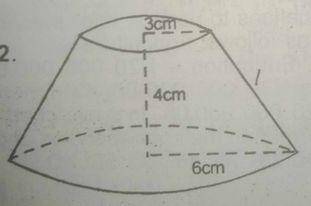
Find the value of l in the frustrum above
Attached Figure / Diagram
A
5cm
B
6cm
C
7cm
D
8cm
medium Difficulty
Verified Correct Answer: Option A
Step-by-Step Mathematical Solution
\DeltaABE and \DeltaACD are similar
therefore \(\frac{ x}{ x + 4} = \frac{3}{6}\)
6x = 3(x+4)
6x = 3x + 12
3x = 12
x = 4
In \DeltaACD; \(L^2\) = \((4+4)^2 + 6^2\)
= \(8^2 + 6^2\)
= 64 + 36
= 100
L = \(\sqrt{100}\)
= 10cm
In ABE, \((AE)^2 = 4^2 + 3^2\)
= 16 + 9
= 25
AE = 5cm
∴L = 10 - 5
= 5cm
Source: Myschool Past Questions Archive (Record #10418)
Mathematics
UTME / JAMB 1999
Fractions, Decimals, Percentages & Approximations
Diagram
Solution
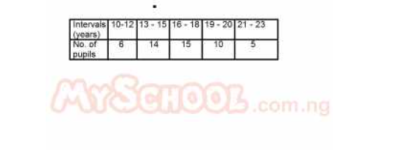
The table above shows the frequency distribution of the ages (in years) of pupils in a certain secondary school. What percentage of the total number of pupils is over 15 years but less than 21 years?
Attached Figure / Diagram
A
35%
B
45%
C
50%
D
60%
medium Difficulty
Verified Correct Answer: Option C
Step-by-Step Mathematical Solution
% of those above 15 but less than 21 years
age = \(\frac{25}{50}\) x \(\frac{100}{1}\)
= 50%
Source: Myschool Past Questions Archive (Record #10420)
Mathematics
WAEC / WASSCE 1999
Inequalities & Linear Programming
Solution
The side of a rhombus is 10cm long, correct to the nearest whole number. Between what limits should the perimeter P lie?
A
39cm ≤ P ≤41cm
B
38cm ≤ P < 42cm
C
38.5 ≤ P ≤ 41.5cm
D
38.5 ≤ P ≤ 40cm
medium Difficulty
Verified Correct Answer: Option B
Step-by-Step Mathematical Solution
If the side = 10 cm, correct to the nearest whole number, then
The side ranges from 9.5 cm to 10.5 cm. (9.5 \(\leq\) s < 10.5)
Perimeter of a rhombus = 4 x side
\(\therefore\) 4 x 9.5 \(\leq\) perimeter < 4 x 10.5
= 38 cm \(\leq\) P < 42 cm
Source: Myschool Past Questions Archive (Record #26380)
Mathematics
WAEC / WASSCE 1999
Indices, Logarithms & Surds
Solution
Simplify log\(_7\) 8 - log\(_7\) 2 + log\(_7\) 4.
A
0
B
\(2log_7 2\)
C
\(3log_7 2\)
D
\(4log_7 2\)
medium Difficulty
Verified Correct Answer: Option D
Step-by-Step Mathematical Solution
log\(_7\) 8 - log\(_7\) 2 + log\(_7\) 4
= log\(_7\) (8/2 x 4)
= log\(_7\) 16
= 4 log\(_7\) 2
Source: Myschool Past Questions Archive (Record #26381)