
Question Library

Browse, filter, and study verified past examination questions with step-by-step mathematical reasoning.
Launch Interactive Practice
Searching 18,000+ Questions... Sifting topics, KaTeX formulas & verified solutions
Showing 19531–19545 of 29811 verified questions
Sort by:
Biology WAEC / WASSCE 2000 Cell & Its Environment (Diffusion, Osmosis & Transport)
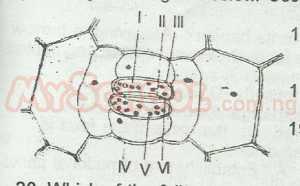
Which of the following solutions will induce the condition shown in the diagram?
Attached Figure / Diagram
Question diagram
A
Hypertonic solution
B
Hypotonic solution
C
isotonic solution
D
Distilled water.
medium Difficulty
Biology WAEC / WASSCE 2000 Nutrition in Plants & Animals (Photosynthesis & Food Substances)
Vitamin C deficiency results in
A
ricket
B
beri-beri
C
scurvy
D
pellagra
medium Difficulty
Biology WAEC / WASSCE 2000 Nutrition in Plants & Animals (Photosynthesis & Food Substances)
Members of the vitamin B complex are
A
water-soluble
B
fat-soluble
C
water insoluble
D
generally insoluble
medium Difficulty
Biology WAEC / WASSCE 2000 Nutrition in Plants & Animals (Photosynthesis & Food Substances)
Which of the following statements about phosphorous is not correct?
A
Helps to regulate the acid-base balance of the body
B
Regulates the metabolism of proteins, fats and carbohydrates
C
Required in many chemical reactions occurring in the body
D
Phosphorous is a major constituent of bones and teeth
medium Difficulty
Biology WAEC / WASSCE 2000 Nutrition in Plants & Animals (Photosynthesis & Food Substances)
Vitamin E is concerned with
A
bone formation
B
reproduction
C
normal growth
D
formation of red blood cells.
medium Difficulty
Biology WAEC / WASSCE 2000 Variety of Organisms & Classification of Living Things
A balanced meal for an adult person may consist of
A
two pieces of chicken, four balls of bean cake, two eggs and two cups of tea with milk
B
four slices of bread, one bowl of pap, two oranges and two bananas
C
four slices of yam and stew, two pieces of beef, one cup of tea with milk and two oranges
D
a plate of beans, two pieces of meat, two eggs, one cup of tea with milk and two oranges
medium Difficulty
Biology WAEC / WASSCE 2000 Nutrition in Plants & Animals (Photosynthesis & Food Substances)
Which of the following food substances turns bright red when warmed with suddan III solution?
A
Starch
B
Reducing sugar
C
Protein
D
Fat
medium Difficulty
Biology WAEC / WASSCE 2000 Nutrition in Plants & Animals (Photosynthesis & Food Substances)
Mammals require a relatively high amount of carbohydrates because
A
they maintain the weight of the body
B
they are required for growth
C
they initiate enzyme production
D
they yield energy for activities.
medium Difficulty
Biology WAEC / WASSCE 2000 Basic Ecological Concepts, Ecosystems & Biomes
All the available places on earth which support life constitute the
A
lithosphere
B
atmosphere
C
biosphere
D
hydrosphere
medium Difficulty
Biology WAEC / WASSCE 2000 Basic Ecological Concepts, Ecosystems & Biomes
The abiotic factor which determines the depth to which light penetrates in a pond is
A
current
B
turbidity
C
wind
D
salinity
medium Difficulty
Biology WAEC / WASSCE 2000 Variety of Organisms & Classification of Living Things
Which of the following organisms is a producer?
A
Spirogyra
B
Mucor
C
Rhizopus
D
Yeast
medium Difficulty
Biology WAEC / WASSCE 2000 Variety of Organisms & Classification of Living Things
Which of the following groups consists of heterotrophs?
A
Mucor, chlamydomonas and Euglena
B
Spirogyra, Mucor and Mushroom
C
Man, Mucor and Mushroom
D
Man, Maize and Cowpea
medium Difficulty
Biology WAEC / WASSCE 2000 Variety of Organisms & Classification of Living Things
Which of the following organisms will not bring about decomposition?
A
Earthworm
B
Bactenum
C
Mould
D
Spirogyra
medium Difficulty
Biology WAEC / WASSCE 2000 Variety of Organisms & Classification of Living Things
Which of the following is not released during decay of living matter?
A
Ammonia
B
Oxygen
C
Carbon dioxide
D
Heat energy
medium Difficulty
Biology WAEC / WASSCE 2000 Nutrition in Plants & Animals (Photosynthesis & Food Substances)
In commensalism
A
one of the organisms gains and the other loses
B
both organisms benefit from the association
C
one of the organisms gains while the other neither gains nor loses
D
one of the organisms produces extra cellular Digestive juices.
medium Difficulty
Page 1303 of 1988