Question Library
Browse, filter, and study verified past examination questions with step-by-step mathematical reasoning.
Searching 18,000+ Questions...
Sifting topics, KaTeX formulas & verified solutions
Showing 181–195 of 1709 verified questions
Sort by:
Physics
WAEC / WASSCE 2019
Mechanics and Properties of Matter
Solution
(a) (i) Define force and state its S.I unit.
(ii) List the two types of solid friction.
(b) A car travelling at a constant speed of 30 ms-1 for 20 s was suddenly decelerated when the driver sighted a pot-hole. It took the driver 6 s to get to the pot-hole with a reduced speed of 18 ms-1. He maintained the steady speed for another 10 s to cross the pot-hole. The brakes were then applied and the car came to rest 5 s later.
(i) Draw the velocity-time graph for the journey.
(ii) Calculate the deceleration during the last 5 s of the journey.
(iii) Calculate the total distance covered.
medium Difficulty
Verified Correct Answer: Option
Physical Principles & Numerical Solution
(a) (i) Definition of force
Action/push/pull that changes/tends to change the state of rest or of uniform motion in straight line. Its unit is newton (N)
(ii) Types of solid friction
- dynamic (friction)
- static (friction)
(b) (i) Velocity-time graph for journey
Source: Myschool Past Questions Archive (Record #56611)
Physics
WAEC / WASSCE 2019
Mechanics and Properties of Matter
Solution
The diagram above illustrates a structure of a typical photocell.
(i) Identify each of the parts labelled A and B.
(ii) State one function each of A and B
(iii) Einstein’s photoelectric equation can be written as E = hf – Wo. State what each of the terms E, hf and Wo represent.
(b) A photon is incident on a metal whose work function is 1.32 eV. An electron is emitted from the surface with a maximum kinetic energy of 1.97 eV. Calculate the frequency of the photon. [1 eV = 1.6 x 10⁻¹⁹ J]
(c)(i) Define half-life of a radioactive element.
(ii) Sketch a graph of the relation N = Noe-\lambdat and indicate the half-life.
medium Difficulty
Verified Correct Answer: Option
Physical Principles & Numerical Solution
The expected answer is:
(a) (i) Identification of labelled parts of photocell
A - Emitter / cathode
B - Collector / anode
(ii) Function of part of photocell
A - emits electrons
B - attracts electrons
(iii) Meaning of terms in Einstein’s photoelectric equation
E - kinetic energy of photoelectrons
hf - energy of incident photon
Wo - work function of metal
Source: Myschool Past Questions Archive (Record #56612)
Physics
WAEC / WASSCE 2019
Mechanics and Properties of Matter
Solution
A body of mass 2 kg is released from a point 100 m above the ground. Calculate its kinetic energy 80m from the point of release.
A
1600 J
B
900 J
C
600 J
D
200 J
medium Difficulty
Verified Correct Answer: Option A
Physical Principles & Numerical Solution
K.E = mgh
but h = 80m, m = 2kg, g = 10m/s^2
K.E = 2 x 10 x 80 = 1600J.
Source: Myschool Past Questions Archive (Record #58793)
Physics
WAEC / WASSCE 2019
Mechanics and Properties of Matter
The time rate of increase in velocity is called
A
force
B
momentum
C
acceleration
D
speed
medium Difficulty
Verified Correct Answer: Option C
Physical Principles & Numerical Solution
No expanded working has been attached for this question yet. The verified answer is Option C.
Source: Myschool Past Questions Archive (Record #58778)
Physics
WAEC / WASSCE 2019
Mechanics and Properties of Matter
Solution
A loaded spring is set in simple harmonic motion. The force that tends to restore the load to its equilibrium position is
A
adhesive
B
elastic
C
frictional
D
gravitational
medium Difficulty
Verified Correct Answer: Option B
Physical Principles & Numerical Solution
Elastic Force: This is the force exerted by the spring when it is compressed or stretched. It is the elastic force that directly acts to restore the spring to its equilibrium position.
Source: Myschool Past Questions Archive (Record #58801)
Physics
WAEC / WASSCE 2019
Mechanics and Properties of Matter
Solution
A transverse pulse of frequency 9 Hz traves 4.5m in 0.6 s. Calculate the wavelength of the pulse.
A
3.33 m
B
0.30 m
C
0.83 m
D
1.20 m
medium Difficulty
Verified Correct Answer: Option C
Physical Principles & Numerical Solution
Wavelength (\(\alpha\)) = \(\frac{Velocity (V)}{Frequency (f)}\)
Velocity = \(\frac{Distance}{Time}\) = \(\frac{4.5}{0.6}\)
= \(\frac{7.5}{9.0}\)
= 0.83m
Source: Myschool Past Questions Archive (Record #58863)
Physics
WAEC / WASSCE 2019
Mechanics and Properties of Matter
Solution
If the efficiency of a transformer is 100%, which of the following equations would be correct?
A
N\(_p\)E\(_p\) = N\(_s\)E\(_s\)
B
N\(_s\)I\(_p\)= N\(_p\)I\(_s\)
C
N\(_s\)I\(_s\) = N\(_p\)I\(_p\)
D
I\(_p\)E\(_s\) = I\(_s\)E\(_p\)
medium Difficulty
Verified Correct Answer: Option D
Physical Principles & Numerical Solution
For a transformer with 100% efficiency, the input power equals the output power:
E\(_p\)I\(_p\) = E\(_s\)I\(_s\)
Source: Myschool Past Questions Archive (Record #58844)
Physics
WAEC / WASSCE 2019
Mechanics and Properties of Matter
Solution
A device consumes 100 W of power when connected to a 120 V source. Calculate its resistance.
A
1.2\(\Omega\)
B
12,000 \(\Omega\)
C
20.0\(\Omega\)
D
144\(\Omega\)
medium Difficulty
Verified Correct Answer: Option D
Physical Principles & Numerical Solution
P = \(\frac{V^2}{R}\)
R = \(\frac{120^2}{100}\)
= 144.0\(\Omega\)
Source: Myschool Past Questions Archive (Record #58985)
Physics
WAEC / WASSCE 2019
Mechanics and Properties of Matter
Diagram
Solution
Which of the following graphs gives the correct relationship between energy and mass when mass is converted to energy.
Attached Figure / Diagram
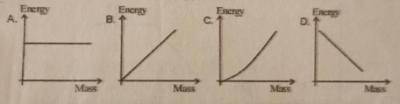
A
A
B
B
C
C
D
D
medium Difficulty
Verified Correct Answer: Option B
Physical Principles & Numerical Solution
Energy is directly proportional to mass when mass is converted to energy. According to Albert Einstein’s mass-energy equivalence formula:
E = mc\(^2\)
Source: Myschool Past Questions Archive (Record #58889)
Physics
WAEC / WASSCE 2019
Mechanics and Properties of Matter
Solution
An 800 kg car moving at 80 km hr\(^{-1}\) collides with a 1200 kg car moving at 40 km hr\(^{-1}\) in the same direction. If the cars stick together, calculate their common velocity.
A
60 km hr\(^{-1}\)
B
8 km hr\(^{-1}\)
C
40 km hr\(^{-1}\)
D
56 km hr\(^{-1}\)
medium Difficulty
Verified Correct Answer: Option D
Physical Principles & Numerical Solution
From momentum conservation
(800 x 80) + (1200 x 40)
= (800 + 1200) V
= 64000 + 48000 = 2000V
112000 = 2000V
V = \(\frac{112000}{2000}\)
= 56kmh\(^-1\)
The common velocity = 56kmhr\(^{-1}\)
Source: Myschool Past Questions Archive (Record #58901)
Physics
WAEC / WASSCE 2019
Mechanics and Properties of Matter
Solution
The mass of a load is doubled while the force acting on it is halved. The resulting acceleration of the load is
A
quadrupled
B
quartered
C
halved
D
doubled
medium Difficulty
Verified Correct Answer: Option B
Physical Principles & Numerical Solution
Force = mass x acceleration
but force was halved = 1/2 and mass doubled = 2 ( assuming that force and mass are 1N and 1kg respectively)
f = ma = \(\frac{1}{2}\) = 2 x a
dividing both sides by 2
a = \(\frac{1}{2} \times\frac{1}{2} = \frac{1}{4}\)
Source: Myschool Past Questions Archive (Record #58904)
Physics
WAEC / WASSCE 2019
Mechanics and Properties of Matter
Solution
An electron of mass 9.1 x 10\(^{-31}\) kg moves with a speed of 2.0 x 10\(^6\) ms\(^{-1}\) round the nucleus of an atom in a Circular path of radius
6.1 x 10\(^{11}\) m. Calculate the centripetal force acting on the electron.
A
7.7 x 10\(^{47}\) N
B
6.0 x 10\(^{-8}\)N
C
3.0 x 10\(^{-14}\)N
D
1.3 x 10\(^{-26}\)N
medium Difficulty
Verified Correct Answer: Option B
Physical Principles & Numerical Solution
Centripetal force (Fr) = \(\frac{MV^2}{r}\)
i.e. Fr = \(\frac{Mv^2}{r}\)
= \(\frac{9.1 \times 10^{-31} \times 2.0 \times 10^6 \times 2.0 \times 10^6}{6.1 \times 10^{-11}}\) N
= (\(\frac{36.4 \times 10^{-19}}{6.1 \times 10^{-11}}\)) N
= 5.967 x 10\(^{-8}\) N
~ 6.0 x 10\(^{-8}\) N
Source: Myschool Past Questions Archive (Record #58977)
Physics
WAEC / WASSCE 2019
Mechanics and Properties of Matter
The area under a velocity-time graph represents
A
speed
B
acceleration
C
moment
D
distance
medium Difficulty
Verified Correct Answer: Option D
Physical Principles & Numerical Solution
No expanded working has been attached for this question yet. The verified answer is Option D.
Source: Myschool Past Questions Archive (Record #59030)
Physics
WAEC / WASSCE 2019
Mechanics and Properties of Matter
Solution
(a) (i) Define atomic spectra.
(ii) Differentiate between emission spectra and absorption spectra.
(b)
The diagram above illustrates an electron transition from energy level n = 3 to n = 1. Calculate the:
(i) energy of the photon
(ii) frequency of the photon
(ii) wavelength of the photon [h = 6.6 x 10\(^{-34}\)J s, c = 3.0 x 10\(^8\) ms\(^{-1}\); 1 ev = 1.6 x 10\(^{-19}\) J]
c)(i)Differentiate between soft x-rays and hard x-rays
(ii) Draw the circuit symbol for a p-n junction diode.
(iiii) Give the reason for doping a semiconductor material
medium Difficulty
Verified Correct Answer: Option
Physical Principles & Numerical Solution
(a) The emission of light from a substance when its excited electrons move to a lower energy level.
OR
Distinct/separate bright lines of light of definite frequency/wavelength (emitted from vapourised atoms)
(ii) Emission spectra is the pattern of light displayed when electrons jump from a higher energy level to a lower energy level, while absorption spectra is the displayed pattern of wavelengths absorbed by the gas.
(b) \(\Delta\)E = E\(_i\) - E\(_f\)
= -1.51 + 13.6
= 12.09 eV
= 12.09 x 1.6 x 10\(^{-19}\) J
= 1.934 x 10\(^{-18}\) J
(ii) \(\Delta\)E- hf
f = \(\frac{\Delta E}{h}\) = \(\frac{1.934 \times 10^{-18}}{6.6 \times 10^{-34}}\)
f = 2.93 x 10\(^{15}\)Hz
(ii) c = f\(\lambda\)
\(\lambda\) = \(\frac{3 \times 10^8}{2.93 x 10^{13}}\)
= 1.023 x 10\(^{-7}\)m
(c) (I) Soft x-rays are those with longer wavelengths/lowNer penetrating/less energy while hard x-rays are those with shorter wavelengths/higher penetrating power more energy.
(iii) To increase the electrical conductivity/reduce electrical resistivity of the semiconductor.
Source: Myschool Past Questions Archive (Record #59307)
Physics
WAEC / WASSCE 2019
Mechanics and Properties of Matter
Solution
Two bodies of masses 3.0 kg and 2.0 kg are separated by a distance of 50 cm. Calculate the force of attraction between them. [G = 6.67 x 10\(^{-11}\) Nm\(^2\) kg\(^2\)]
A
1.6 x 10\(^{-9}\)N
B
1.3 x 10\(^{3}\)N
C
2.3 x 10\(^{3}\)N
D
5.0x 10\(^{3}\)N
medium Difficulty
Verified Correct Answer: Option A
Physical Principles & Numerical Solution
Using the formula
F = \(\frac{Gm_1m_2}{r^2}\)
= \(\frac{6.67 \times 10^{-11} \times 3.0 \times 2.0}{(50)^2}\)
= \(\frac{40.02 \times 10^{-11}}{2500}\)
= 1.6 x 10\(^{-9}\)N
Source: Myschool Past Questions Archive (Record #59019)