Question Library
Browse, filter, and study verified past examination questions with step-by-step mathematical reasoning.
Searching 18,000+ Questions...
Sifting topics, KaTeX formulas & verified solutions
Showing 181–195 of 573 verified questions
Sort by:
Mathematics
UTME / JAMB 2010
Algebra
Solution
If P = \(\begin{pmatrix} 2 & -3 \\ 1 & 1 \end{pmatrix}\) , what is P\(^-1\)
A
\(\begin{pmatrix} -{\frac{1}{5}} & -{\frac{3}{5}} \\ -{\frac{1}{5}} & -{\frac{2}{5}} \end{pmatrix}\)
B
\(\begin{pmatrix} {\frac{1}{5}} & {\frac{3}{5}} \\ {\frac{1}{5}} & {\frac{2}{5}} \end{pmatrix}\)
C
\(\begin{pmatrix} -{\frac{1}{5}} & {\frac{3}{5}} \\ -{\frac{1}{5}} & {\frac{2}{5}} \end{pmatrix}\)
D
\(\begin{pmatrix} {\frac{1}{5}} & {\frac{3}{5}} \\ -{\frac{1}{5}} & {\frac{2}{5}} \end{pmatrix}\)
medium Difficulty
Verified Correct Answer: Option D
Step-by-Step Mathematical Solution
P = \(\begin{pmatrix} 2 & -3 \\ 1 & 1 \end{pmatrix}\)
|P| = 2 - 1 x -3 = 5
P-1 = \(\frac{1}{5}\)\(\begin{pmatrix} 1 & 3 \\ -1 & 2 \end{pmatrix}\)
= \(\begin{pmatrix} {\frac{1}{5}} & {\frac{3}{5}} \\ -{\frac{1}{5}} & {\frac{2}{5}} \end{pmatrix}\)
Source: WAEC / JAMB / NECO Classroom Archive (Record #29576)
Mathematics
UTME / JAMB 2010
Algebra
Solution
Solve the inequalities -6 \(\leq\) 4 - 2x < 5 - x
A
-1 < x < 5
B
-1 < x \(\leq\) 5
C
-1 \(\leq\) x \(\leq\) 6
D
-1 \(\leq\) x < 6
medium Difficulty
Verified Correct Answer: Option B
Step-by-Step Mathematical Solution
-6 \(\leq\) 4 - 2x < 5 - x
split inequalities into two and solve each part as follows:
-6 \(\leq\) 4 - 2x = -6 - 4 \(\leq\) -2x
-10 \(\leq\) -2x
\(\frac{-10}{-2}\) \(\geq\) \(\frac{-2x}{-2}\)
giving 5 \(\geq\) x or x \(\leq\) 5
4 - 2x < 5 - x
-2x + x < 5 - 4
-x < 1
\(\frac{-x}{-1}\) > \(\frac{1}{-1}\)
giving x > -1 or -1 < x
Combining the two results, gives -1 < x \(\leq\) 5
Source: WAEC / JAMB / NECO Classroom Archive (Record #29572)
Mathematics
UTME / JAMB 2010
Algebra
Solution
The 3rd term of an arithmetic progression is -9 and the 7th term is -29. Find the 10th term of the progression
A
-44
B
-165
C
165
D
44
medium Difficulty
Verified Correct Answer: Option A
Step-by-Step Mathematical Solution
3rd term : a + 2d = -9 .......(1)
7th term : a + 6d = -29 ......(2)
(2) - (1): 4d = -20
:. d = -20/4 = -5
From (1) : a + 2(-5) = -9
a - 10 = -9
:. a = -9 + 10 = 1
:. 10th term of A.P is a + 9d = 1 + 9 (-5)
= 1 - 45 = -44
Source: WAEC / JAMB / NECO Classroom Archive (Record #29561)
Mathematics
UTME / JAMB 2010
Algebra
Solution
Find the sum to infinity of the following series. 0.5 + 0.05 + 0.005 + 0.0005 + .....
A
\(\frac{5}{8}\)
B
\(\frac{5}{7}\)
C
\(\frac{5}{11}\)
D
\(\frac{5}{9}\)
medium Difficulty
Verified Correct Answer: Option D
Step-by-Step Mathematical Solution
Using S\(\infty\) = \(\frac{a}{1 - r}\)
r = \(\frac{0.05}{0.5}\) = \(\frac{1}{10}\)
S\(\infty\) = \(\frac{0.5}{{\frac{1}{10}}}\)
= \(\frac{0.5}{({\frac{9}{10}})}\)
= \(\frac{0.5 \times 10}{9}\)
= \(\frac{5}{9}\)
Source: WAEC / JAMB / NECO Classroom Archive (Record #29573)
Mathematics
UTME / JAMB 2010
Algebra
Solution
Find the equation of a line parallel to y = -4x + 2 passing through (2,3)
A
y + 4x + 11 = 0
B
y - 4x - 11 = 0
C
y + 4x - 11 = 0
D
y - 4x + 11 = 0
medium Difficulty
Verified Correct Answer: Option C
Step-by-Step Mathematical Solution
By comparing y = mx + c
with y = -4x + 2,
the gradient of y = -4x + 2 is m1 = -4
let the gradient of the line parallel to the given line be m2,
then, m2 = m1 = -4
(condition for parallelism)
using, y - y1 = m2(x - x1)
Hence the equation of the parallel line is
y - 3 = -4(x-2)
y - 3 = -4 x + 8
y + 4x = 8 + 3
y + 4x = 11
y + 4x - 11 = 0
Source: WAEC / JAMB / NECO Classroom Archive (Record #29564)
Mathematics
WAEC / WASSCE 2010
Algebra
Solution
Solve the inequality: 3(x + 1) \(\leq\) 5(x + 2) + 15
A
x \(\geq\) -14
B
x \(\leq\) - 14
C
x \(\geq\) -11
D
x \(\leq\) - 11
medium Difficulty
Verified Correct Answer: Option C
Step-by-Step Mathematical Solution
3(x + 1) \(\leq\) 5(x + 2) + 15
3x + 3 \(\leq\) 5x + 10 + 15
3x - 5x \(\leq\) 10 + 15 - 3
-2x \(\leq\) 22
x \(\geq\) \(\frac{-22}{2}\)
x \(\geq\) -11
Source: Myschool Past Questions Archive (Record #36526)
Mathematics
WAEC / WASSCE 2010
Algebra
Solution
The nth term of the sequence -2, 4, -8, 16.... is given by
A
Tn = 2n
B
Tn = (-2)n
C
Tn = (-2n)
D
Tn = n
medium Difficulty
Verified Correct Answer: Option B
Step-by-Step Mathematical Solution
sequence: -2, 4, -8, 16........{GP}
a = -2; r = \(\frac{4}{-2}\) = -2
nth term Tn = arn-1
Tn = (-2)(-2)^n-1
Tn = (-2)1 + n - 1
Tn = (-2)n
Source: Myschool Past Questions Archive (Record #36559)
Mathematics
WAEC / WASSCE 2010
Algebra
Solution
\(\begin{array}{c|c} x & 0 & 2 & 4 & 6\\ \hline y & 1 & 2 & 3 & 4\end{array}\).
The table is for the relation y = mx + c where m and c are constants. What is the equation of the line described in the tablet?
A
y = 2x
B
y = x + 1
C
y = x
D
y = \(\frac{1}{2}x + 1\)
medium Difficulty
Verified Correct Answer: Option D
Step-by-Step Mathematical Solution
y = mx + c; when x = 0; y = 1
1 = m(0) + c; 1 = 0 + c; c = 1
when x = 2; y = 2
2 = m(2) + c; 2 = 2m + c; but c = 1
2 = 2m + 1
2 - 1 = 2m
2m = 1
m = \(\frac{1}{2}\)
y = \(\frac{1}{2}\)x + 1
Source: Myschool Past Questions Archive (Record #36565)
Mathematics
WAEC / WASSCE 2010
Algebra
Solution
If the sum of the roots of the equation (x - p)(2x + 1) = 0 is 1, find the value of x
A
1\(\frac{1}{2}\)
B
\(\frac{1}{2}\)
C
-\(\frac{3}{2}\)
D
-1\(\frac{1}{2}\)
medium Difficulty
Verified Correct Answer: Option A
Step-by-Step Mathematical Solution
(x - p)(2x + 1) = 0
2x2 + x - 2px - p = 0
2x2 + x (1 - 2p) - p = 0
2x2 - (2p - 1)x - p = 0
divide through by 2
x2 - \(\frac{(2p - 1)}{2}\)x - \(\frac{p}{2}\) = 0
compare to x2 - (sum of roots)x + product of roots = 0
sum of roots = \(\frac{2p - 1}{2}\)
But sum of roots = 1
Given; \(\frac{2p - 1}{2}\) = 1
2p - 1 = 2 x 1
2p - 1 = 2
2p = 2 + 1 = 3
p = \(\frac{3}{2}\)
p = 1\(\frac{1}{2}\)
Source: Myschool Past Questions Archive (Record #36587)
Mathematics
WAEC / WASSCE 2010
Algebra
Diagram
Solution
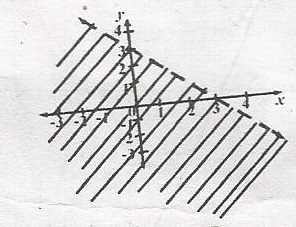
The shaded portion in the diagram is the solution of
Attached Figure / Diagram
A
x + y \(\leq\) 3
B
x + y < 3
C
x + y > 3
D
x + y \(\geq\) 3
medium Difficulty
Verified Correct Answer: Option B
Step-by-Step Mathematical Solution
Using \(\frac{x}{a} + \frac{y}{b}\) < 1for the equation of the time
where a = intercept on x-axis and b = intercept on y - axis
\(\frac{x}{3} + \frac{y}{3} = 1\)
= \(\frac{x + y}{3} = 1\)
= x + y < 3
Source: Myschool Past Questions Archive (Record #36608)
Mathematics
WAEC / WASSCE 2010
Algebra
Solution
(a) Copy and complete the table of values for the relation \(y = -x^{2} + x + 2; -3 \leq x \leq 3\).
x
-3
-2
-1
0
1
2
3
y
-4
2
-4
(b) Using scales of 2 cm to 1 unit on the x- axis and 2 cm to 2 units on the y- axis, draw a graph of the relation \(y = -x^{2} + x + 2\).
(c) From the graph, find the : (i) minimum value of y ; (ii) roots of equation \(x^{2} - x - 2 = 0\) ; (iii) gradient of the curve at x = -0.5.
medium Difficulty
Verified Correct Answer: Option
Step-by-Step Mathematical Solution
(a)
x
-3
-2
-1
0
1
2
3
y
-10
-4
0
2
2
0
-4
(b)
(c) (ii) roots of the equation : \(x^{2} - x - 2 = 0\) are x = -1 or x = 2.
(iii) gradient of the curve at x = -0.5 is 2.1.
Source: Myschool Past Questions Archive (Record #52833)
Mathematics
WAEC / WASSCE 2010
Algebra
Solution
(a) The third term of a Geometric Progression (G.P) is 24 and its seventh term is \(4\frac{20}{27}\). Find its first term.
(b) Given that y varies directly as x and inversely as the square of z. If y = 4, when x = 3 and z = 1, find y when x = 3 and z = 2.
medium Difficulty
Verified Correct Answer: Option
Step-by-Step Mathematical Solution
\(T_{n} = ar^{n - 1}\) (Terms of a G.P)
\(T_{3} = ar^{2} =24 .... (1)\)
\(T_{7} = ar^{6} = 4\frac{20}{27} = \frac{128}{27} .......... (2)\)
Divide (2) by (1),
\(\frac{ar^{6}}{ar^{2}} = \frac{\frac{128}{27}}{24}\)
\(r^{4} = \frac{16}{81}\)
\(r = \sqrt[4]{\frac{16}{81}}\)
= \(\frac{2}{3}\)
Putting r in equation (1),
\(ar^{2} = a(\frac{2}{3})^{2} = 24\)
\(\frac{4}{9} a = 24 \implies a = \frac{24 \times 9}{4}\)
a = 54.
(b) \(y \propto x \propto \frac{1}{z^{2}}\)
\(\implies y = \frac{kx}{z^{2}}\)
\(4 = \frac{3k}{1^{2}} \implies k = \frac{4}{3}\)
\(\therefore y = \frac{4x}{3z^{2}}\)
When x = 3, z = 2, y = ?
\(y = \frac{4(3)}{3(2^{2})}\)
= \(\frac{12}{12} = 1\).
Source: Myschool Past Questions Archive (Record #52838)
Mathematics
UTME / JAMB 2009
Algebra
Solution
A polynomial in x whose roots are 4/3 and -3/5 is?
A
15x2 - 11x – 12
B
15x2 + 11x – 12
C
12x2 - x – 12
D
12x2 + 11x – 15
medium Difficulty
Verified Correct Answer: Option A
Step-by-Step Mathematical Solution
If 4/3 and -3/5 are roots of a polynomial
Imply x = 4/3 and - 3/5
3x = 4 and 5x = -3
∴3x-4 = 0 and 5x+3 = 0 are factors
(3x-4)(5x+3) = 0 product of the factors
15x2 + 9x – 20x – 12 = 0 By expansion
15x2 - 11x – 12 = 0
Source: Myschool Past Questions Archive (Record #9315)
Mathematics
UTME / JAMB 2009
Algebra
Diagram
Solution
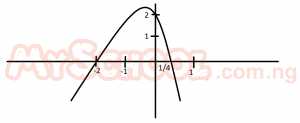
Which of the following equations represent the graph above?
Attached Figure / Diagram
A
y = 2+7x+4x2
B
y = 2-7x+4x2
C
y = 2+7x-4x2
D
y = 2-7x-4x2
medium Difficulty
Verified Correct Answer: Option D
Step-by-Step Mathematical Solution
x = -2 and x = 1/4
x = -2 and 4x = 1
x+2 and 4x-1
(x+2)(4x-1) = 0
4x2 - x + 8x -2 = 0
4x2 + 7x – 2 = 0 but y intercept is positive. Multiply the equation by -1
-4x2 - 7x + 2 = 0
∴y = 2 – 7x – 4x2
Source: Myschool Past Questions Archive (Record #9316)
Mathematics
UTME / JAMB 2009
Algebra
Solution
The sum of the first n terms of the arithmetic progression 5, 11, 17, 23, 29, 35, ... is?
A
n(3n - 0.5)
B
n(3n + 2)
C
n(3n + 2.5)
D
n(3n + 5)
medium Difficulty
Verified Correct Answer: Option B
Step-by-Step Mathematical Solution
a = 5, d = 6, n = n
Sn = n/2(2a + (n-1)d)
= n/2(2(5) + (n-1)6)
= n/2(10 + 6n-6)
= n/2(6n+4)
= 6n2/2 + 4n/2
= 32 + 2n
= n(3n + 2)
Source: Myschool Past Questions Archive (Record #9320)