Question Library
Browse, filter, and study verified past examination questions with step-by-step mathematical reasoning.
Searching 18,000+ Questions...
Sifting topics, KaTeX formulas & verified solutions
Showing 19381–19395 of 29811 verified questions
Sort by:
Chemistry
UTME / JAMB 2000
Water, Solutions & Solubility
Diagram
Solution
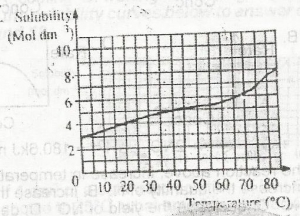
The diagram above is the solubility curve of a solute, X. Find the amount of X deposited when 500cm3 of a solution of X is cooled from 60oC to 20oC.
Attached Figure / Diagram
A
0.750 mole
B
0.950 mole
C
2.375 moles
D
4.750 moles
medium Difficulty
Verified Correct Answer: Option A
Chemical Principles & Mechanism
From the graph, when you extrapolate when the temperature is @ 60 deg, Solubility = 5.5 mol/dm3
Also, when the temperature is @ 20 deg, Solubility = 4.0 mol/dm3.
Difference in solubility = 5.5 - 4.0 = 1.5 mol/dm3
Recall that, solubility = amount x 1000/ volume of solvent
1.5 = n x 1000/500
n = 1.5/2
n = 0.750 mole - Option A
Source: Myschool Past Questions Archive (Record #31580)
Chemistry
UTME / JAMB 2000
Reaction Rates & Chemical Equilibrium
Diagram
Solution
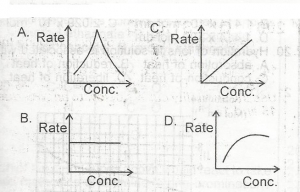
Use the option above to answer this question. The graph that describes a zero order reaction is
Attached Figure / Diagram
A
A
B
B
C
C
D
D
medium Difficulty
Verified Correct Answer: Option B
Chemical Principles & Mechanism
Zero order - A horizontal line indicates that the reaction rate is independent of the reactant concentration.
The rate equation is: rate = k
First order - A straight line passing through the origin signifies that the reaction rate is directly proportional to the reactant concentration.
The rate equation is: rate = k[X]
Second order - A curved plot indicates that the reaction rate is proportional to the square of the reactant concentration.
The rate equation is: rate = k[X]2
Source: Myschool Past Questions Archive (Record #31582)
Chemistry
UTME / JAMB 2000
Organic Chemistry II: Functional Groups, Polymers & Biomolecules
Diagram
Solution
The compound above is an
Attached Figure / Diagram

A
ether
B
ester
C
alkanal
D
alkanol
medium Difficulty
Verified Correct Answer: Option B
Chemical Principles & Mechanism
The Molecular formula of the compound is CH\(_3\)CH\(_2\)COOCH\(_2\)CH\(_3\).
The name of the compound is Ethyl propanoate. i.e it is an alkanoate or esters.
It is actually a product from the reaction of propanoic acid, CH\(_3\)CH\(_2\)COOH and Ethanol, CH\(_3\)CH\(_2\)OH.
Hence, the correct answer is Ester - Option B
Source: Myschool Past Questions Archive (Record #31584)
Chemistry
WAEC / WASSCE 2000
Atomic Structure, Orbitals & Nuclear Chemistry
Solution
The atoms of four elements are represented as 20Q, 16R, 10S and 8T Which of the elements would be unreactive?
A
Q
B
R
C
S
D
T
medium Difficulty
Verified Correct Answer: Option C
Chemical Principles & Mechanism
Element S has an atomic number of 10, which means it belongs to Group O. Recall that elements in group O are inert gases (Unreactive) as they have completely filled electrons in their outermost shell. However, no other element in the option has its outermost shell electrons completely filled. The correct answer is option C
Source: Myschool Past Questions Archive (Record #36739)
Chemistry
WAEC / WASSCE 2000
Chemical Bonding & Intermolecular Forces
Solution
Chlorine atom forms \(Cl^{-}\) by
A
losing one electron
B
Sharing one electron
C
Donating lone pair of electrons
D
Gaining one electron
medium Difficulty
Verified Correct Answer: Option D
Chemical Principles & Mechanism
All non-metals will gain electron(s) to become negatively charge unlike metals which lose electron(s) to become positively charged. Chlorine atom is a non-metal in group VII, once it gains an electron to have its outermost shell completely filled with electrons, thus becoming negatively charged. The correct answer is option D
Source: Myschool Past Questions Archive (Record #36742)
Chemistry
WAEC / WASSCE 2000
Particulate Nature of Matter, Laws & Formulae
Solution
An element Z has a combining power of 3. Which of the following formulae is correct of its compounds?
A
ZSO3
B
Z3CI2
C
Z 2O 3
D
ZS3
medium Difficulty
Verified Correct Answer: Option C
Chemical Principles & Mechanism
When two elements combine with each other to form compounds, they do so by exchanging their valencies or combining powers. From the question, Z has a combining power of 3, therefore any element it will combine with among the options must have its valency swapped with that of Z. Among the options, only option C is correct because Oxygen has a valency of 2 while Z has valency of 3. As they combine, Z takes the valency of Oxygen which is 2 while Oxygen takes the valency of Z which is 3.
Source: Myschool Past Questions Archive (Record #36743)
Chemistry
WAEC / WASSCE 2000
Chemical Bonding & Intermolecular Forces
Solution
Electrovalent compounds are characterized by
A
solubility in ethanol
B
high molar mass
C
high melting point
D
strong oxidizing ability
medium Difficulty
Verified Correct Answer: Option C
Chemical Principles & Mechanism
Electrovalent compounds(ionic) are formed by transfer of electron from metals to non-metals. Thus they are held together by strong electrostatic forces which results to their high melting points. The correct option is C
Source: Myschool Past Questions Archive (Record #36745)
Chemistry
WAEC / WASSCE 2000
Chemical Bonding & Intermolecular Forces
Solution
The type of chemical bond that exists between potassium and oxygen in potassium oxide is
A
ionic
B
metallic
C
covalent
D
dative
medium Difficulty
Verified Correct Answer: Option A
Chemical Principles & Mechanism
Ionic bonding involves transfer of electron(s) from metals (potassium) to non-metals(Oxygen). Two atoms of K will combine with one atom of Oxygen to satisfy the electron transfer, thereby fulfilling the octet rule. Option A is the correct answer.
Source: Myschool Past Questions Archive (Record #36747)
Chemistry
WAEC / WASSCE 2000
Chemical Bonding & Intermolecular Forces
Solution
Which of the following contains co-ordinate covalent bond?
A
HCI
B
CH 4
C
NH4
D
Na+CI
medium Difficulty
Verified Correct Answer: Option C
Chemical Principles & Mechanism
The Nitrogen atom in Ammonia, NH3 has a lone pair of electron which is given out or shared with the Hydrogen ion to form NH4+. Recall that coordinate covalent bond usually involves one of the two participating atoms or molecules donating the lone pair of electrons to be shared by the two atoms or molecules to bond. Therefore option C is the correct answer as ammonium ion is formed by dative bonding or coordinate-covalent bonding.
Source: Myschool Past Questions Archive (Record #36749)
Chemistry
WAEC / WASSCE 2000
Periodic Table & Periodicity
Solution
Electrostatic force of attraction between sodium ion and halide ion is greatest in
A
NaCI
B
NaBr
C
NaF
D
NaI
medium Difficulty
Verified Correct Answer: Option C
Chemical Principles & Mechanism
The electrostatic force of attraction is greatest depending on their strength of electronegativity. In other words, Fluorine atom has the highest electronegativity as it is the most reactive non-metal. The electrostatic force of attraction is greatest between Na and F. The correct answer is option C.
Source: Myschool Past Questions Archive (Record #36750)
Chemistry
WAEC / WASSCE 2000
Periodic Table & Periodicity
Solution
Which of the following non-metals reacts most readily with metals?
A
Nitrogen
B
Chlorine
C
Sulphur
D
Carbon
medium Difficulty
Verified Correct Answer: Option B
Chemical Principles & Mechanism
The most reactive non-metals are the Group VII elements (Halogens). Chlorine is the only group VII element among the option, thus it is the most reactive non-metal. The correct answer is option B.
Source: Myschool Past Questions Archive (Record #36752)
Chemistry
WAEC / WASSCE 2000
Atomic Structure, Orbitals & Nuclear Chemistry
Solution
A radioactive solid is best stored
A
under paraffin oil
B
under ultraviolet light
C
in a cool, dark cupboard
D
in a box lined with lead
medium Difficulty
Verified Correct Answer: Option D
Chemical Principles & Mechanism
The correct answer is option D. This is because alpha particles, beta particles and gamma rays cannot penetrate a lead box to cause further radioactivity.
Source: Myschool Past Questions Archive (Record #36753)
Chemistry
WAEC / WASSCE 2000
Chemical Bonding & Intermolecular Forces
Solution
What is the shape of a molecule of CCI4?
A
Pyramidal
B
Tetrahedral
C
Trigonal planar
D
Linear
medium Difficulty
Verified Correct Answer: Option B
Chemical Principles & Mechanism
CCl4 has no lone pairs on the central carbon atom and is therefore of tetrahedral geometry. Option B is the correct answer.
Source: Myschool Past Questions Archive (Record #36756)
Chemistry
WAEC / WASSCE 2000
Reaction Rates & Chemical Equilibrium
Solution
Which of the following increases as boiling water changes to steam?
A
temperature of the system
B
degree of disorder in the system
C
number of molecules
D
activation energy
medium Difficulty
Verified Correct Answer: Option B
Chemical Principles & Mechanism
As water begins to boil, bubbles are formed, thereby increasing the entropy. i.e the degree of disorderliness in the system increases. The correct answer is option B
Source: Myschool Past Questions Archive (Record #36758)
Chemistry
WAEC / WASSCE 2000
Stoichiometry, Mole Concept & Volumetric Analysis
Solution
9.60 g of a gas X occupies the same volume at 0.30 g of hydrogen under the same conditions. Calculate the molar mass of X [H = 1]
A
8g mol -1
B
16 gmol -1
C
32g mol -1
D
64g mol -1
medium Difficulty
Verified Correct Answer: Option D
Chemical Principles & Mechanism
Using the ideal gas equation,
PV = nRT.
where \(n = \frac{mass}{\text{molar mass}}\).
For Hydrogen, \(\frac{m_H}{M_H} = \frac{PV}{RT}\).
For element X, \(\frac{m_X}{M_X} = \frac{PV}{RT}\)
Under the same conditions implies \(\frac{PV}{RT}\) is the same for both hydrogen and X.
\(\frac{m_H}{M_H} = \frac{m_X}{M_X}\)
Molar mass of X = \(\frac{\text{molar mass of hydrogen} \times \text{mass of X}}{\text{mass of hydrogen}}\)
= \(\frac{2 \times 9.6}{0.3}\)
= 64 g/mol
Source: Myschool Past Questions Archive (Record #36759)