Question Library
Browse, filter, and study verified past examination questions with step-by-step mathematical reasoning.
Searching 18,000+ Questions...
Sifting topics, KaTeX formulas & verified solutions
Showing 19156–19170 of 29811 verified questions
Sort by:
Physics
WAEC / WASSCE 2000
Linear Motion, Projectiles & Kinematics
Solution
An object is situated within the Earth's gravitational field. Which of the following factor does not affect the acceleration of free fall g?
A
the distance of the object from the centre of the earth
B
the latitude of the earth on which the object is situated
C
rotation of the earth
D
the mass of the object
medium Difficulty
Verified Correct Answer: Option D
Physical Principles & Numerical Solution
The acceleration due to gravity (g) is affected by the distance from the center of the Earth, the latitude, and the rotation of the Earth. However, the mass of the object does not affect g; all objects fall at the same rate in a vacuum, regardless of their mass.
Source: Myschool Past Questions Archive (Record #33834)
Physics
WAEC / WASSCE 2000
Electrostatics & Capacitors
Solution
The capacitance of a parallel-plate capacitor is increased by making the area of the plates
A
small and their seperation large
B
large and their seperation small
C
and their seperation small
D
and their seperation equal
medium Difficulty
Verified Correct Answer: Option B
Physical Principles & Numerical Solution
Making the area large and the separation small will increase the capacitance.
Source: Myschool Past Questions Archive (Record #33835)
Physics
WAEC / WASSCE 2000
Current Electricity & Electric Circuits
Diagram
Solution
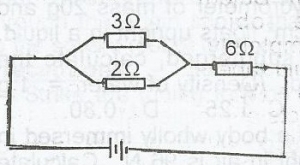
In the diagram above, the current passing through the 6\(\Omega\) resistor is 1.5A. Calculate the current in the 3\(\Omega\) resistor
Attached Figure / Diagram
A
1.20A
B
0.90A
C
0.75A
D
0.60A
medium Difficulty
Verified Correct Answer: Option D
Physical Principles & Numerical Solution
\(\frac{1}{\text{R}}\) = \(\frac{1}{2}\) + \(\frac{1}{3}\) = \(\frac{5}{6}\)
R = \(\frac{6}{5}\) = 1.2\(\Omega\); So p.d through the 3\(\Omega\) and 2\(\Omega\) resistors in parallel = 1.5 x 1.2 =1.8V
So the current through the 3\(\Omega\) resistor(I) = \(\frac{\text{V}}{\text{R}}\) = \(\frac{1.8}{3}\) = 0.6A (recall V = IR)
Source: Myschool Past Questions Archive (Record #33836)
Physics
WAEC / WASSCE 2000
Calorimetry, Latent Heat & Change of State
Solution
An immersion heater is rated 120W. How long does it take the heater to raise the temperature of 1.2kg of water by 15oC. (Assuming heat lost to the surrounding is negligible. Specific heat capacity of water = 4200 Jkg-1K-1C)
A
65.0 minutes
B
60.0 minutes
C
52.5 minutes
D
10.5 minutes
medium Difficulty
Verified Correct Answer: Option D
Physical Principles & Numerical Solution
Given:
P = 120W, t = ?, m of water = 1.2kg, c of water = 4200Jkg\(^{-1}\)K\(^{-1}\), \DeltaT = 15ºC
Q = pt = m c \DeltaT
120 x t = 1.2 x 4200 x 15 = 75600J
t = \(\frac{75600}{120}\) = 630secs → 10.50minutes.
Source: Myschool Past Questions Archive (Record #33838)
Physics
WAEC / WASSCE 2000
Magnetism, Electromagnetism & AC Circuits
Solution
The region around a magnet in which the magnetic influence is experienced is called
A
magnetic flux
B
magnetic field
C
magnetic meridian
D
magnetic declination
medium Difficulty
Verified Correct Answer: Option B
Physical Principles & Numerical Solution
"magnetic field" is the term that describes the region where magnetic effects are felt.
Source: Myschool Past Questions Archive (Record #33839)
Physics
WAEC / WASSCE 2000
Atomic, Quantum, Nuclear Physics & Electronics
Solution
A nuclide \(^{202}_{84} Y\) emits in succession an \(\alpha-particle\) and a \(\beta-particle\). The atomic number of the resulting nuclide is
A
198
B
83
C
82
D
80
medium Difficulty
Verified Correct Answer: Option B
Physical Principles & Numerical Solution
\(^{202}_{84} Y\) → \(^4_2\)He + \(^0_{-1}\)e + \(^{98}_{83}\)X
Therefore, the atomic number of the resulting nuclide = 83.
Source: Myschool Past Questions Archive (Record #33849)
Physics
WAEC / WASSCE 2000
Atomic, Quantum, Nuclear Physics & Electronics
Solution
The half life of a radioactive substance is 14 days. If 48g of this substance is stored, after how many days will 1.5g of the original substance remain?
A
84 days
B
70 days
C
56 days
D
40 days
medium Difficulty
Verified Correct Answer: Option B
Physical Principles & Numerical Solution
Using N = N\(_o\)\((\frac{1}{2})^n\)
N\(_o\) = 48g, N =1.5g and n = number of half-lives
1.5 = 48\((\frac{1}{2})^n\)
\(\frac{1.5}{48}\) = \(\frac{1}{32}\) = (\(\frac{1}{2})^5\) = \((\frac{1}{2})^n\)
n = 5 (same base, equate power)
Total time = n x t\(_{\frac{1}{2}}\) = 5 x 14 = 70 days
Therefore, 1.5g will remain after 70 days.
Source: Myschool Past Questions Archive (Record #33851)
Physics
WAEC / WASSCE 2000
Current Electricity & Electric Circuits
Solution
A material of mass 1.0 x 10\(^{-2}\)kg undergoes a fission process which decreases its mass by 0.02 percent. Calculate the amount of energy released in the process. (c = 3.0 x 10\(^{8}\)ms\(^{-1}\))
A
1.8 x 10²⁰J
B
1.8 x 10¹³J
C
1.8 x 10¹¹J
D
1.8 x 10¹⁰J
medium Difficulty
Verified Correct Answer: Option C
Physical Principles & Numerical Solution
To calculate the energy released during the fission process, we can use Einstein's mass-energy equivalence principle, given by the formula:
E = \Deltamc\(^2\)
m = 1.0 x 10\(^{-2}\)kg
c = 3.0 x 10\(^8\)ms\(^{-1}\)
Mass decrease = 0.02%
\Deltam = 0.02% x 1.0 x 10\(^{-2}\) = 2.0\times10\(^{−6}\)kg
E = \Deltamc\(^2\) = 2.0\times10\(^{−6}\) x (3.0 x 10\(^8\))\(^2\) = 1.8\times10\(^{11}\)J
Source: Myschool Past Questions Archive (Record #33856)
Physics
WAEC / WASSCE 2000
Atomic, Quantum, Nuclear Physics & Electronics
Solution
Absorption line spectra exhibited by atoms is a result of
A
change in the kinetic energy of a movimg atom
B
instability of the nucleons
C
excitation of an electron in the atom
D
transition of an electron from a higher to a lower energy level
medium Difficulty
Verified Correct Answer: Option C
Physical Principles & Numerical Solution
Absorption line spectra are produced when electrons in an atom absorb specific wavelengths of light to move from a lower energy level to a higher energy level (excitation). The absorbed energy corresponds to the difference in energy between the two levels, resulting in dark lines in the spectrum at those specific wavelengths.
Source: Myschool Past Questions Archive (Record #33858)
Physics
WAEC / WASSCE 2000
Current Electricity & Electric Circuits
Solution
In a nuclear reactor, electricity can be generated through the following processes. Arrange the processes in the correct order. i. The steam is used to drive turbines. ii. The heat energy released is removed by passing water through the reactor. iii. The turbines in turn generate electricity. iv. The water then passes through some form of heat exchanger to produce steam
A
ii, iv, i and iii
B
i, ii, iii and iv
C
iii, i, iv and ii
D
iv, i, iii and ii
medium Difficulty
Verified Correct Answer: Option A
Physical Principles & Numerical Solution
To arrange the processes in the correct order for generating electricity in a nuclear reactor, let's break down the steps involved:
1. Heat Generation: The nuclear reaction generates heat.
2. Heat Removal: This heat is removed by passing water through the reactor.
3. Steam Production: The heated water then passes through a heat exchanger to produce steam.
4. Turbine Operation: The steam drives turbines.
5. Electricity Generation: The turbines generate electricity
Therefore, the correct order is:
ii: The heat energy released is removed by passing water through the reactor.
iv: The water then passes through some form of heat exchanger to produce steam.
i: The steam is used to drive turbines.
iii: The turbines in turn generate electricity
Source: Myschool Past Questions Archive (Record #33949)
Physics
WAEC / WASSCE 2000
Atomic, Quantum, Nuclear Physics & Electronics
Solution
The duality of matter implies that matter
A
exists as a particle of dual composition
B
has momentum and energy
C
has both wave and particle properties
D
is made up of dual materials
medium Difficulty
Verified Correct Answer: Option C
Physical Principles & Numerical Solution
The duality of matter refers to the concept in quantum mechanics that matter exhibits both wave-like and particle-like properties.
Source: Myschool Past Questions Archive (Record #33951)
Physics
WAEC / WASSCE 2000
Atomic, Quantum, Nuclear Physics & Electronics
Solution
In which of the following transitions is the largest quantum of energy liberated by an hydrogen atom when the electron changes energy levels? [n is the quantum number]
A
n = 2 to n = 1
B
n = 1 to n = 2
C
n = 2 to n = 3
D
n = 3 to n = 2
medium Difficulty
Verified Correct Answer: Option A
Physical Principles & Numerical Solution
The largest quantum of energy a hydrogen atom liberates occurs during a transition from a higher to a lower energy level. The energy difference between levels can be calculated using the formula:
E = −13.6eV(\(\frac{1}{n_f^2} - \frac{1}{n_i^2}\))
n\(_i\) is the initial quantum number (higher energy level),
n\(_f\) is the final quantum number (lower energy level.
A. n = 2 to n = 1
Source: Myschool Past Questions Archive (Record #33943)
Physics
WAEC / WASSCE 2000
Waves, Sound & Vibrations
Solution
A proton of wavelength \(\lambda_o\) is emitted when an electron in an atom makes a transition from a level of energy 2E. If the electron transits from \(\frac{4}{3}E_k\) to E level, determine the wavelength of the photon that would be emitted
A
3\(\lambda_o\)
B
2\(\lambda_o\)
C
\(\frac{3}{4}\)\(\lambda_o\)
D
\(\frac{1}{3}\)\(\lambda_o\)
medium Difficulty
Verified Correct Answer: Option A
Physical Principles & Numerical Solution
2E - E = \(\frac{hc}{\lambda}\) = E = \(\frac{hc}{\lambda}\)
\(\frac{4}{3}\)E = \(\frac{hc}{\lambda_{new}}\)
E = \(\frac{3hc}{\lambda_2}\)
\(\frac{3hc}{\lambda_2}\) = \(\frac{hc}{\lambda}\)
\(\lambda_{new}\) = 3 \(\lambda_o\)
Source: Myschool Past Questions Archive (Record #33945)
Physics
WAEC / WASSCE 2000
Current Electricity & Electric Circuits
Solution
The nucleon number and the proton number of a neutral atom of an element are 23 and 11 respectively. How many neutrons are present in the atom?
A
11
B
12
C
23
D
34
medium Difficulty
Verified Correct Answer: Option B
Physical Principles & Numerical Solution
Nucleon number = Proton number + Neutron number
Neutron number = Nucleon number − Proton number
Neutron number = 23 - 11 = 12
The number of neutrons present in the atom is 12
Source: Myschool Past Questions Archive (Record #33947)
Physics
WAEC / WASSCE 2000
Current Electricity & Electric Circuits
Solution
Measure and record the e.m.f. of the accumulator provided.
Connect a circuit as shown in the diagram. S is a standard resistor and R is a resistance box.
With R = 0\(\Omega\), close the key K. Read and record the ammeter reading I. Evaluate 1\(^{-1}\).
Repeat the procedure for R=1,2, 3, 4, and 5\(\Omega\). Tabulate your readings.
Plot a graph of R on the vertical axis and 1\(^{-1}\) on the horizontal axis, starting both axis from the origin (0,0).
Determine the slope s of the graph and find the intercept C on the vertical axis.
State two precautions taken to ensure accurate results.
(b)i. State two advantages of a lead-acid accumulator over a Leclanche cell.
ii. A parallel combination of 3\(\Omega\) and 4\(\Omega\) resistors is connected in series with a resistor of 4\(\Omega\) and a battery of negligible internal resistance. Calculate the effective resistance in the circuit.
A
11
B
12
C
23
D
34
E
mutual forces excerted by the balls
medium Difficulty
Verified Correct Answer: Option B
Physical Principles & Numerical Solution
The e.m.f of the accumulator = 1.5v
Table of value/observations
R(\(\Omega\))
1\(_{amp}\)
1\(^{-1}_{amp}\)
0
0.78
1.28
1
0.50
2.00
2
0.38
2.63
3
0.30
3.33
4
0.25
4.00
5
0.22
4.55
Slope (s) = \(\frac{y_{2}-y_{1}}{x_{2}-x_{1}} = \frac{4-1}{4-2} = \frac{3}{2}\)
The intercept on the vertical axis is =-1.85\(\Omega\)
Precautions:
I tightened connections.
I avoided errors due to parallax in reading ammeter or voltmeter.
I noted zero error of ammeter/ voltmeter.
I removed key when readings were not taken.
I took repeated readings from the table, i.e. averaging the reading.
(b)i.
- The lead-acid accumulator can be recharged while the Leclanche cell cannot.
- The lead-acid accumulator has the capacity to supply large currents for a long time while the leclanche cell does not.
ii. The two resistors 3\(\Omega\) and 4\(\Omega\) are connected in parallel.
\(\therefore\) The equivalent resistance (\(\Omega\) = \(\frac{1}{R} = \frac{1}{3} = \frac{1}{4} = \frac{4+3}{12}\)
= \(\frac{7}{12}\) = 1.71
The effective resistance in the circuit = 1.71 + 4 = 5.71\(\Omega\)
Source: Official Exam / Past Question Archive