Question Library
Browse, filter, and study verified past examination questions with step-by-step mathematical reasoning.
Searching 18,000+ Questions...
Sifting topics, KaTeX formulas & verified solutions
Showing 19126–19140 of 29811 verified questions
Sort by:
Physics
WAEC / WASSCE 2000
Elasticity, Density, Pressure & Fluids
Solution
A ball bearing is gently released from rest and allowed to fall through a viscous fluid. Which of the following statements about the motion is correct?
A
its acceleration decreases before terminal velocity is attained
B
when terminal velocity is attained the acceleration of the fluid becomes zero
C
its velocity increases before terminal velocity is attained
D
there is no resultant force on the ball before it attains terminal velocity
medium Difficulty
Verified Correct Answer: Option A
Physical Principles & Numerical Solution
Its acceleration decreases before terminal velocity is attained:
When the ball bearing is released, it accelerates due to gravity. As it falls, the viscous drag force exerted by the fluid increases. This drag force opposes the weight of the ball bearing, resulting in a decrease in acceleration until terminal velocity is reached.
Source: Myschool Past Questions Archive (Record #33762)
Physics
WAEC / WASSCE 2000
Current Electricity & Electric Circuits
Solution
The driver of a car moving with uniform speed of 40ms-1 observes a truck approaching from the opposite direction with a speed of 20ms-1. Calculate the speed of the car relative to that of the truck
A
.5ms-1
B
2.0ms-1
C
20.0ms-1
D
60.0ms-1
medium Difficulty
Verified Correct Answer: Option D
Physical Principles & Numerical Solution
Let V\(_t\) = velocity of truck, = 20m/s V\(_c\) = velocity of car = 40m/s
\(_cV_t\) = V\(_t\) - V\(_c\) = 40 -(-20) = 40 + 20 = 60m/s
Source: Myschool Past Questions Archive (Record #33763)
Physics
WAEC / WASSCE 2000
Linear Motion, Projectiles & Kinematics
Solution
A bus travelling at 15ms\(^{-1}\) accelerates uniformly at 4ms\(^{-2}\), what is the distance covered in 10s?
A
150m
B
170m
C
350m
D
600m
medium Difficulty
Verified Correct Answer: Option C
Physical Principles & Numerical Solution
given: u = 15m/s, a = 4m/s\(^2\), t = 10secs, S = ?
Using:
S = ut + \(\frac{1}{2}\)at\(^2\)
S = 15 x 10 + 0.5 x 4 x 100
S = 350m.
Source: Myschool Past Questions Archive (Record #33764)
Physics
WAEC / WASSCE 2000
Equilibrium of Forces, Moments & Flotation
Solution
A uniform metre rule of mass 90g is provided at the 40cm mark. If the rule is in equilibrium with an unknown mass m placed at the 10cm mark and a 72g mass at the 70cm mark, determine m
A
72g
B
102g
C
298g
D
504g
medium Difficulty
Verified Correct Answer: Option B
Physical Principles & Numerical Solution
Taking moment about the 40cm mark
Total clockwise moments = total anti-clockwise moment
m x 30 = 90 x 10 + 72 x 30
30m = 900 + 2160 = 3060
m = \(\frac{3060}{30}\) = 102g.
Source: Myschool Past Questions Archive (Record #33765)
Physics
WAEC / WASSCE 2000
Circular Motion, Gravitation & Simple Harmonic Motion
Solution
The bob of a simple pendulum takes 0.25s to swing from its equilibrium position to one extreme end. Calculate its period
A
0.25s
B
0.50s
C
0.75s
D
1.00s
medium Difficulty
Verified Correct Answer: Option D
Physical Principles & Numerical Solution
period = 0.25 x 4 = 1.0sec, time taken to make one complete circle.
Source: Myschool Past Questions Archive (Record #33767)
Physics
WAEC / WASSCE 2000
Circular Motion, Gravitation & Simple Harmonic Motion
Solution
The period of oscillation of a particle executing simple harmonic motion is 4\(\pi\) seconds. If the amplitude of oscillation is 3.0m. Calculate the maximum speed of the particle.
A
1.5ms-1
B
3.0ms-1
C
4.5ms-1
D
6.0ms-1
medium Difficulty
Verified Correct Answer: Option A
Physical Principles & Numerical Solution
V\(_{max}\) = \omegar
\omega = 2\(\pi\)f but f = \(\frac{1}{T}\)
\omega = \(\frac{2\pi}{T}\) = \(\frac{2\pi}{4\pi}\) ( since T = 4\(\pi\) given)
\omega = 0.5rads/secs
V\(_{max}\) = \omegar = 0.5 x 3 = 1.5m/s ( r = 3cm given)
Source: Myschool Past Questions Archive (Record #33768)
Physics
WAEC / WASSCE 2000
Newton's Laws, Momentum & Collisions
Solution
An inelastic collision takes place between ball of known masses, just before the collision one of the ball is moving with a known velocity while the other is stationary. Which of the following physical quantities can be determined from the information given?
A
speed of each of the ball after collision
B
kinetic energy of each ball after collision
C
total momentum of the ball after collision
D
total momentum of the two ball after collision
E
mutual forces excerted by the balls
medium Difficulty
Verified Correct Answer: Option D
Physical Principles & Numerical Solution
The total momentum of the two balls after collision:
Can be determined. The total momentum before the collision can be calculated using the mass and velocity of the moving ball, and since momentum is conserved, the total momentum after the collision will be equal to the total momentum before the collision
Source: Myschool Past Questions Archive (Record #33769)
Physics
WAEC / WASSCE 2000
Work, Energy, Power & Simple Machines
Diagram
Solution
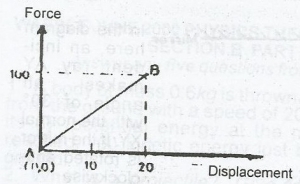
Using the force displacement diagram shown above. Calculate the work done
Attached Figure / Diagram
A
2000J
B
1000J
C
20J
D
5J
medium Difficulty
Verified Correct Answer: Option B
Physical Principles & Numerical Solution
Work done = area under the triangle
Work done = \(\frac{1}{2}\) x base x height = 0.5 x 20 x 100 = 1000J
Therefore, the work done, as calculated from the force-displacement diagram, is 1000J
Source: Myschool Past Questions Archive (Record #33770)
Physics
WAEC / WASSCE 2000
Current Electricity & Electric Circuits
Solution
A machine of efficiency 80% is used to raise a body of mass 75kg through a vertical height of 3m in 30s. Calculate the power input. (g = 10ms-2)
A
9.4W
B
60.0W
C
75.0W
D
93.8W
medium Difficulty
Verified Correct Answer: Option D
Physical Principles & Numerical Solution
Efficiency = \(\frac{ poweroutput}{powerinput}\)
but power output = \(\frac{ f \times s}{ t}\) = \(\frac{75 \times 10 \times 3}{ 30}\) = 75W
Efficiency = 80%, power output = 75w
then 0.8 = \(\frac{ 75}{powerinput}\)
power input = \(\frac{ 75}{0.8}\) = 93.75W.
Source: Myschool Past Questions Archive (Record #33771)
Physics
WAEC / WASSCE 2000
Current Electricity & Electric Circuits
Solution
Two bodies P and Q, are in thermal equilibrium, which of the following statements about the bodies is correct?
A
the temperature of Q is higher than that of P
B
P and Q have the same heat capacty
C
P and Q have the same mass
D
P and Q are at the same temperature
medium Difficulty
Verified Correct Answer: Option D
Physical Principles & Numerical Solution
When two bodies are in thermal equilibrium, it means that they have the same temperature. This is because, in thermal equilibrium, there is no net transfer of heat between the bodies, indicating that they have reached the same temperature.
Source: Myschool Past Questions Archive (Record #33772)
Physics
WAEC / WASSCE 2000
Temperature, Thermometry & Thermal Expansion
Solution
The cubic expansivity of mercury is 1.8 x 10⁻⁴K-1 and the linear expansivity of glass 8.0 x 10⁻⁶K-1, calculate the apparent expansivity of mercury in a glass container
A
1.00 x 10⁻⁴K-1
B
1.56 x 10⁻⁴K-1
C
1.72 x 10⁻⁴K-1
D
2.04 x 10⁻⁴K-1
medium Difficulty
Verified Correct Answer: Option B
Physical Principles & Numerical Solution
γ\(_r\) = γ + γ\(_{app}\)
1.8 x 10\(^{-4}\) = (3 x 8.0 x 10\(^{-6}\)) + γ\(_{app}\)
γ\(_{app}\) = 1.8 x 10\(^{-4}\) - 2.4 x 10\(^{-5}\)
= 1.56 x 10\(^{-4}\)K\(^{-1}\)
Source: Myschool Past Questions Archive (Record #33774)
Physics
WAEC / WASSCE 2000
Temperature, Thermometry & Thermal Expansion
Diagram
Solution
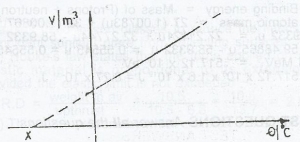
The diagram shows the variation of volume V of a glass with temperature at the point X is
Attached Figure / Diagram
A
-32oC
B
-100oC
C
-273oC
D
-373oC
medium Difficulty
Verified Correct Answer: Option C
Physical Principles & Numerical Solution
The point X is the Absolute zero temperature( the lowest possible temperature). Absolute zero is at -273.15 Celsius or -459.67 Fahrenheit or 0 k.
Source: Myschool Past Questions Archive (Record #33776)
Physics
WAEC / WASSCE 2000
Current Electricity & Electric Circuits
Solution
The volume and pressure of a given mass of gas at 27oC are 76cm3 and 80cm of mercury respectively. Calculate the volume at s.t.p
A
36.2cm3
B
72.8cm3
C
100.0cm3
D
808.9cm3
medium Difficulty
Verified Correct Answer: Option B
Physical Principles & Numerical Solution
Using the general gas equation, \(\frac{ P_1 V_1}{ T_1} = \frac{ P_2 V_2}{ T_2}\)
\(V_1 = 76cm^3\), \(T_1 = 27^0C\) = 27 + 273K = 300K, \(P_1\) = 80cm, at STP \(T_2 = 0^0C\) = 273K, \(P_2\) = 76cm, \(V_2\) = ?
\(V_2 = \frac{ P_1\times V_1\times T_2}{P_2 \times T_1}\)
\(V_2 = \frac{ 80 \times 76 \times 273}{76 \times 300}\)
\(V_2 = 72.8cm^3\)
Source: Myschool Past Questions Archive (Record #33780)
Physics
WAEC / WASSCE 2000
Calorimetry, Latent Heat & Change of State
Solution
A piece of metal of mass 50g is cooled from 80oC to 20oC. Calculate the amount of heat lost. (specific heat capacity of the material of metal = 450Jkg-1K-1)
A
4.50 x 10³J
B
2.25 x 10³J
C
1.80 x 10³J
D
1.35 x 10³J
medium Difficulty
Verified Correct Answer: Option D
Physical Principles & Numerical Solution
mass of metal = 50g = 0.05kg, c = 45Jkg\(^{-1}\)k\(^{-1}\), \DeltaT = 80 - 20 = 60ºC
Quantity of heat lost(Q) = mass of metal x specific capacity of mass x change in temperature
Q = m x c x \DeltaT
Q = 0.05 x 45 x 60 = 1350J = 1.35 x 10\(^3\)J
Source: Myschool Past Questions Archive (Record #33795)
Physics
WAEC / WASSCE 2000
Calorimetry, Latent Heat & Change of State
Solution
The mass of water vapour in a given volume of air is 0.05g at 20oC, while the mass of water vapour required to saturate it at the same temperature is 0.15g. Calculate the relative humidity of the air
A
3.33%
B
5.55%
C
33.33%
D
55.55%
medium Difficulty
Verified Correct Answer: Option C
Physical Principles & Numerical Solution
Relative humidity = \(\frac{\text{mass of water vapour in a given volume of air(m)}}{\text{mass of water vapour needed to saturate same volume of air at same temp(M)}}\) x 100%
R.H = \(\frac{\text{m}}{\text{M}}\) = \(\frac{0.05}{0.15}\) x 100%
Therefore, relative humidity of the air = 33.33%
Source: Myschool Past Questions Archive (Record #33801)