Question Library
Browse, filter, and study verified past examination questions with step-by-step mathematical reasoning.
Searching 18,000+ Questions...
Sifting topics, KaTeX formulas & verified solutions
Showing 18961–18975 of 29811 verified questions
Sort by:
Mathematics
WAEC / WASSCE 2000
Trigonometry, Elevation & Bearings
Solution
A tree is 8km due south of a building. Kofi is standing 8km west of the tree. How far is Kofi from the building?
A
4√2km
B
8km
C
8√2km
D
16km
medium Difficulty
Verified Correct Answer: Option C
Step-by-Step Mathematical Solution
\(x^2 = 8^2 + 8^2\)
\(x^2 = 64 + 64 = 128\)
\(x = \sqrt{128}\)
= \(8\sqrt{2}\) km
Source: WAEC / JAMB / NECO Classroom Archive (Record #26437)
Mathematics
WAEC / WASSCE 2000
Trigonometry, Elevation & Bearings
Solution
A tree is 8km due south of a building. Kofi is standing 8km west of the tree. Find the bearing of Kofi from the building
A
315o
B
270o
C
225o
D
135o
medium Difficulty
Verified Correct Answer: Option C
Step-by-Step Mathematical Solution
The bearing of Kofi from the building = 180^\circ + 45^\circ
= 225^\circ
Source: WAEC / JAMB / NECO Classroom Archive (Record #26438)
Mathematics
WAEC / WASSCE 2000
Trigonometry, Elevation & Bearings
Solution
Which of the following bearings is equivalent to S50°W?
A
040o
B
130o
C
220o
D
230o
medium Difficulty
Verified Correct Answer: Option D
Step-by-Step Mathematical Solution
S50^\circW = 180^\circ + 50^\circ
= 230^\circ
Source: WAEC / JAMB / NECO Classroom Archive (Record #26439)
Mathematics
UTME / JAMB 2000
Trigonometry, Elevation & Bearings
Solution
A ship sails a distance of 50km in the direction S50ºE and then sails in the distance of 50km in the direction N40ºE. Find the bearing of the ship from its original position.
A
S90\(^0\)E
B
N40\(^0\)
C
S95\(^0\)E
D
N85\(^0\)E
medium Difficulty
Verified Correct Answer: Option A
Step-by-Step Mathematical Solution
The bearing of the ship from its original position is S90ºE
Source: WAEC / JAMB / NECO Classroom Archive (Record #69869)
Mathematics
UTME / JAMB 2000
Integration & Applications
Diagram
Solution
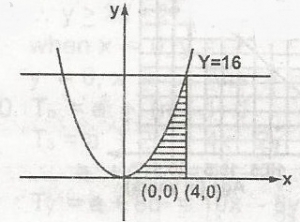
If the diagram is the graph of y = x\(^2\), the shaded area is
Attached Figure / Diagram
A
64 square units
B
\(\frac{128}{3}\) square units
C
32 square units
D
\(\frac{64}{3}\) square units
medium Difficulty
Verified Correct Answer: Option B
Step-by-Step Mathematical Solution
A = \(\int^{x = 4}_{x = 0}\) ydx = \(\int^{4}_{0}\)16 - x\(^2\)dx = [16 - \(\frac{x^3}{3} + c]^{4}_{0}\)
= \(\frac{128}{3}\) square units
Source: WAEC / JAMB / NECO Classroom Archive (Record #33093)
Mathematics
WAEC / WASSCE 2000
Statistics (Data Representation, Central Tendency & Dispersion)
Diagram
Solution
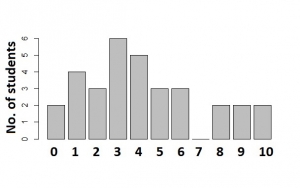
The bar chart shows the distribution of marks scored by a group of students in a test. Use the chart to answer the question below
How many students scored 4 marks and above?
Attached Figure / Diagram
A
15
B
11
C
10
D
17
medium Difficulty
Verified Correct Answer: Option D
Step-by-Step Mathematical Solution
Students that scored 4 and above = 5 + 3 + 3 + 0 + 2 + 2 + 2
= 17
Source: WAEC / JAMB / NECO Classroom Archive (Record #26441)
Mathematics
WAEC / WASSCE 2000
Statistics (Data Representation, Central Tendency & Dispersion)
Diagram
Solution
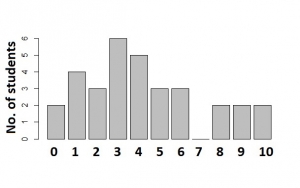
The bar chart shows the distribution of marks scored by a group of students in a test. Use the chart to answer the question below
How many students took the test?
Attached Figure / Diagram
A
38
B
32
C
15
D
11
medium Difficulty
Verified Correct Answer: Option B
Step-by-Step Mathematical Solution
2 + 3 + 4 + 5 + 6 + 3 +3 + 0 + 2 + 2 + 2 = 32
Source: WAEC / JAMB / NECO Classroom Archive (Record #26442)
Mathematics
UTME / JAMB 2000
Statistics (Data Representation, Central Tendency & Dispersion)
Diagram
Solution
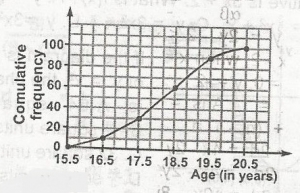
The cumulative frequency curve represents the ages of ages of students in a school. What age group do 70% of the students belongs?
Attached Figure / Diagram
A
17.5 - 20.5
B
16.5 - 19.5
C
15.5 - 19.5
D
15.5 - 18.5
medium Difficulty
Verified Correct Answer: Option A
Step-by-Step Mathematical Solution
If the total number of students represents 100%, then 70% corresponds to the point on the graph where the cumulative frequency reaches 70
From the graph, find where the cumulative frequency line intersects the 70% mark. This typically corresponds to a specific age on the X-axis
Source: WAEC / JAMB / NECO Classroom Archive (Record #33094)
Mathematics
WAEC / WASSCE 2000
Statistics (Data Representation, Central Tendency & Dispersion)
Diagram
Solution
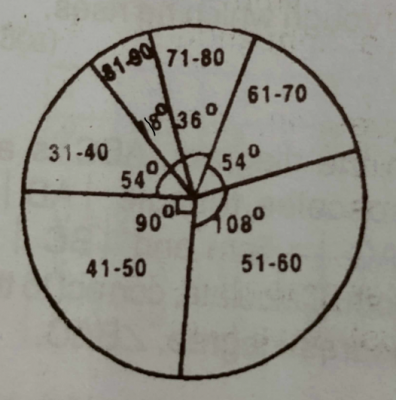
The pie chart above shows the distribution of marks scored by 200 pupils in a test.
(a) How many pupils scored : (i) between 41 and 50 marks? ; (ii) above 80 marks?
(b) What fraction of the pupils scored at most 50 marks?
(c) What is the modal class?
Attached Figure / Diagram
medium Difficulty
Verified Correct Answer: Option
Step-by-Step Mathematical Solution
(a)(i) The number of pupils who scored between 41 and 50 marks = \(\frac{90}{360} \times 200 = 50\)
(ii) The angles for pupils above 60 marks = 54^\circ + 36^\circ + 18^\circ = 108^\circ
\(\frac{108}{360} \times 200 = 60\)
(b) The fraction of the pupils who scored at least 50 marks : \(\frac{54 + 90}{360} = \frac{2}{5}\)
(c) The modal class = 51 - 60; It has the largest angle in the pie- chart.
Source: WAEC / JAMB / NECO Classroom Archive (Record #53466)
Mathematics
WAEC / WASSCE 2000
Statistics (Data Representation, Central Tendency & Dispersion)
Solution
Calculate the standard deviation of the following marks; 2, 3, 6, 2, 5, 0, 4, 2
A
1.5
B
1.7
C
1.8
D
1.9
medium Difficulty
Verified Correct Answer: Option C
Step-by-Step Mathematical Solution
x
2
3
6
2
5
0
4
2
24
x - \(\bar{x}\)
-1
0
3
-1
2
-3
1
-1
\((x - \bar{x})^2\)
1
0
9
1
4
9
1
1
26
Mean = \(\frac{24}{8} = 3\)
Standard deviation = \(\sqrt{\frac{26}{8}}\)
= \(\sqrt{3.25}\)
= 1.802 \(\approx\) 1.8
Source: WAEC / JAMB / NECO Classroom Archive (Record #26443)
Mathematics
WAEC / WASSCE 2000
Permutations, Combinations & Probability
Solution
The probabilities that Kodjo and Adoga pass an examination are \(\frac{3}{4}\) and \(\frac{3}{5}\) respectively. Find the probability of both boys failing the examination
A
\(\frac{1}{10}\)
B
\(\frac{3}{10}\)
C
\(\frac{9}{20}\)
D
\(\frac{2}{3}\)
medium Difficulty
Verified Correct Answer: Option A
Step-by-Step Mathematical Solution
P(Kodjo passing) = \(\frac{3}{4}\); P(Adoga passing) = \(\frac{3}{5}\)
P(Kodjo failing) = \(\frac{1}{4}\); P(Adoga failing) = \(\frac{2}{5}\)
P(both fail) = \(\frac{1}{4} \times \frac{2}{5}\)
= \(\frac{1}{10}\)
Source: WAEC / JAMB / NECO Classroom Archive (Record #26444)
Physics
NECO SSCE 2000
Calorimetry, Latent Heat & Change of State
Solution
A gas occupies a certain volume at 27°C. At what temperature will its volume be twice times the original volume assuming that its pressure remains constant?
A
54°C
B
108°C
C
150°C
D
327°C
E
600°C
medium Difficulty
Verified Correct Answer: Option D
Physical Principles & Numerical Solution
\(\frac{V_{1}}{T_{1}} = \frac{V_{2}}{T_{2}}\)
Given \(V_{2} = 2V_{1}\)
\(T_{1} = 27^\circC + 273 = 300k\)
\(\frac{V_{1}}{300} = \frac{2V_{1}}{T_{2}}\)
\(\frac{1}{300} = \frac{2}{T_{2}} \implies T_{2} = 600k or 327^\circC\)
Source: WAEC / JAMB / NECO Classroom Archive (Record #42690)
Physics
UTME / JAMB 2000
Work, Energy, Power & Simple Machines
Solution
If the force and the velocity on a system are each reduced simultaneously by half, the power of the system is
A
doubled
B
reduced to a quarter
C
reduced by half
D
constant
medium Difficulty
Verified Correct Answer: Option B
Physical Principles & Numerical Solution
The Relation between Power, Force and Velocity is given by the relation:
P = F.V , this power is the product of force and velocity.
Therefore, The power of the system is reduced to one-quarter of its original value when both the force and the velocity are reduced by half.
Source: WAEC / JAMB / NECO Classroom Archive (Record #696)
Physics
WAEC / WASSCE 2000
Scalars, Vectors & Relative Motion
Solution
The resultant of two forces acting on an object is maximum when the angle between them is?
A
180o
B
90o
C
45o
D
0o
medium Difficulty
Verified Correct Answer: Option D
Physical Principles & Numerical Solution
Resultant of two vector will be maximum when they are parallel
That angle between them as zero.
Source: WAEC / JAMB / NECO Classroom Archive (Record #33766)
Physics
UTME / JAMB 2000
Temperature, Thermometry & Thermal Expansion
Solution
At a fixed point below a liquid surface, the pressure downwards is P1 and pressure upwards is P2. It can be deduced that?
A
P1 > P2
B
P1 ≥ P2
C
P1 2
D
P1 = P2
medium Difficulty
Verified Correct Answer: Option D
Physical Principles & Numerical Solution
As the temperature increases, the molecules in the gas move faster, impacting the gas's container more frequently and exerting a greater force. This increases the pressure. And similarly As the pressure goes up, the temperature also goes up. So the temperature and the pressure is directly proportional to each other. At a fixed point, temperature is kept constant. Hence, at this point, it can be deduced that \(P_{1} = P_{2}\)
Source: WAEC / JAMB / NECO Classroom Archive (Record #695)