Question Library
Browse, filter, and study verified past examination questions with step-by-step mathematical reasoning.
Searching 18,000+ Questions...
Sifting topics, KaTeX formulas & verified solutions
Showing 18946–18960 of 29811 verified questions
Sort by:
Mathematics
WAEC / WASSCE 2000
Mensuration (Areas, Perimeters & Volumes)
Solution
The length of the parallel sides of a trapezium are 5cm and 7cm. If its area is 120cm\(^2\), find the perpendicular distance between the parallel sides
A
5.0cm
B
6.9cm
C
10.0cm
D
20.0cm
medium Difficulty
Verified Correct Answer: Option D
Step-by-Step Mathematical Solution
Area of trapezium = \(\frac{1}{2} (a + b)h\)
\(120 = \frac{1}{2} (5 + 7) \times h\)
\(120 = 6h\)
\(h = 20 cm\)
Source: WAEC / JAMB / NECO Classroom Archive (Record #26465)
Mathematics
WAEC / WASSCE 2000
Mensuration (Areas, Perimeters & Volumes)
Diagram
Solution
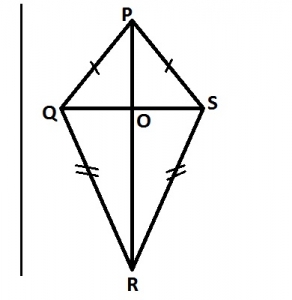
In the diagram, |PQ| = |PS| Which of the following statements is true?
Attached Figure / Diagram
A
∠QPS = QRS
B
|PO| = |RO|
C
QR||PS
D
∠PQR=∠PSR
medium Difficulty
Verified Correct Answer: Option D
Step-by-Step Mathematical Solution
The given figure is a kite.
Here are the properties of a kite:
Two Pairs of Adjacent Sides: A kite has two pairs of adjacent sides that are equal in length.
Diagonals: The diagonals of a kite are perpendicular to each other. One diagonal bisects the other.
Symmetry: A kite has one line of symmetry, which runs along the longer diagonal.
Angles: The angles between the unequal sides are equal. Specifically, the angles opposite the equal sides are also equal.
Therefore, ∠PQR = ∠PSR is correct.
Source: WAEC / JAMB / NECO Classroom Archive (Record #26467)
Mathematics
WAEC / WASSCE 2000
Mensuration (Areas, Perimeters & Volumes)
Diagram
Solution
(a) A cylindrical well of radius 1 metre is dug out to a depth of 8 metres. (i) calculate, in m\(^{3}\), the volume of soil dug out ; (ii) if the soil is used to raise the level of rectangular floor of a room 4m by 12m, calculate, correct to the nearest cm, the thickness of the new layer of soil. [Take \(\pi = \frac{22}{7}\)].
(b) see figure b above.
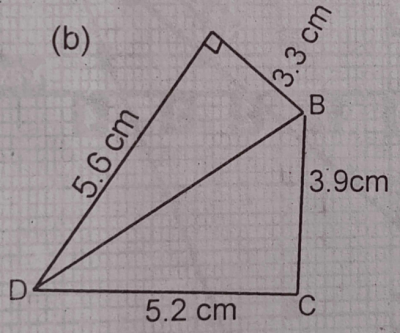
The diagram shows a quadrilateral ABCD in which < DAB is a right-angle. |AB| = 3.3 cm, |BC| = 3.9 cm, |CD| = 5.6 cm. (i) find the length of BD. (ii) show that < BCD = 90°.
Attached Figure / Diagram
medium Difficulty
Verified Correct Answer: Option
Step-by-Step Mathematical Solution
(a) See Figure A above. (i) r = 1m, h = 8m.
\(V = \pi r^{2} h = \frac{22}{7} \times 1^{2} \times 8\)
= \(\frac{176}{7}\)
= \(25.14 m^{3}\)
(ii) \(V = L \times B \times H\)
\(\frac{176}{7} = 4 \times 12 \times h\)
\(h = \frac{176}{7} \div 48\)
\(h = \frac{11}{21}m\)
= \(\frac{1100}{21} cm = 52.38 cm\)
\(\approxeq 52 cm\) (nearest whole number)
(b)(i) see figure B. \(3.3^{2} + 5.6^{2} = BD^{2}\)
\(BD = \sqrt{3.3^{2} + 5.6^{2}}\)
= \(\sqrt{10.89 + 31.36}\)
= \(\sqrt{42.25} = 6.5 cm\)
(ii) See Figure C
If < BCD is right-angled, then Pythagoras rule holds true.
\(BD^{2} = 5.2^{2} + 3.9^{2} = 27.04 + 15.21\)
= \(42.25\)
\(BD = \sqrt{42.25} = 6.5 cm\)
Hence, \(\Delta BCD\) is right-angled.
Source: WAEC / JAMB / NECO Classroom Archive (Record #53498)
Mathematics
WAEC / WASSCE 2000
Mensuration (Areas, Perimeters & Volumes)
Solution
The area of a circle is 38.5cm2. Find its diameter [take \(\pi = \frac{22}{7}\)]
A
22cm
B
14cm
C
7cm
D
6cm
medium Difficulty
Verified Correct Answer: Option C
Step-by-Step Mathematical Solution
\(\pi r^2\) = 38.5
\(\frac{22}{7} r^2\) = 38.5
r\(^2\) = \(\frac{38.5 \times 7}{22}\)
r = \(\sqrt{12.25}\) = 3.5
diameter = 2r = 2 x 3.5 = 7cm
Source: WAEC / JAMB / NECO Classroom Archive (Record #26468)
Mathematics
WAEC / WASSCE 2000
Mensuration (Areas, Perimeters & Volumes)
Diagram
Solution
(a) The mean of 1, 2, x, 11, y, 14, arranged in ascending order, is 8 and the median is 9. Find the values of x and y.
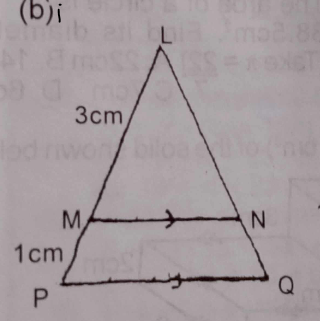
(b) Use the figure above to answer the question(i) below.
(i) In the diagram, MN || PQ, |LM| = 3cm and |LP| = 4cm. If the area of \(\Delta\) LMN is 18\(cm^{2}\), find the area of the quadrilateral MPQN.
Attached Figure / Diagram
medium Difficulty
Verified Correct Answer: Option
Step-by-Step Mathematical Solution
(a) Mean \(\bar{x} = \frac{\sum x}{n} = 8\)
\(\frac{1 + 2 + x + 11 + y + 14}{6} = 8\)
\(28 + x + y = 48 \implies x + y = 20 .... (1) \)
The middle numbers are x and 11 therefore, \(\frac{x + 11}{2} = 9\)
\(x + 11 = 18 \implies x = 18 - 11 = 7\)
Putting x = 7 in (1),
\(7 + y = 20 \implies y = 20 - 7 = 13\)
(x, y) = (7, 13).
(b) \(\frac{LM}{LP} = \frac{3}{4}\)
\(\frac{\text{Area of LMN}}{\text{Area of LPQ}} = \frac{3^{2}}{4^{2}}\)
Area of \(\Delta\) LPQ = \(\frac{16}{9} \times 18 = 32 cm^{2}\)
\(\therefore \text{Area of quadrilateral MPQN} = 32 - 18 = 14 cm^{2}\)
Source: WAEC / JAMB / NECO Classroom Archive (Record #53482)
Mathematics
WAEC / WASSCE 2000
Mensuration (Areas, Perimeters & Volumes)
Solution
The height of a pyramid on square base is 15cm. if the volume is 80cm^3, find the area of the square base.
A
8cm2
B
9.6cm2
C
16cm2
D
25cm2
medium Difficulty
Verified Correct Answer: Option C
Step-by-Step Mathematical Solution
Volume of pyramid with square base = \(\frac{\text{base area} \times height}{3}\)
\(80 = \frac{\text{base area} \times 15}{3}\)
\(80 = 5 \times \text{base area}\)
\(\text{Base area} = 16 cm^2\)
Source: WAEC / JAMB / NECO Classroom Archive (Record #26463)
Mathematics
WAEC / WASSCE 2000
Mensuration (Areas, Perimeters & Volumes)
Diagram
Solution
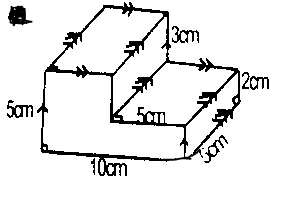
Find the volume (in cm\(^3\)) of the solid shown above
Attached Figure / Diagram
A
100cm3
B
150cm3
C
175cm3
D
250cm3
medium Difficulty
Verified Correct Answer: Option C
Step-by-Step Mathematical Solution
Total volume = (5 x 5) x 5 + (5 x 5) x 2
= 125 + 50
= 175 cm\(^3\)
Source: WAEC / JAMB / NECO Classroom Archive (Record #26469)
Mathematics
WAEC / WASSCE 2000
Plane Geometry, Polygons & Circle Theorems
Diagram
Solution
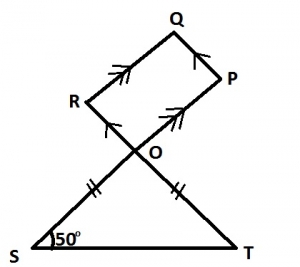
In the diagram, POS and ROT are straight lines, OPQR is a parallelogram. |OS| = |OT| and ∠OST = 50°. Calculate ∠OPQ.
Attached Figure / Diagram
A
160o
B
140o
C
120o
D
100o
medium Difficulty
Verified Correct Answer: Option D
Step-by-Step Mathematical Solution
< T = < S = 50^\circ (OS = OT)
< SOT = 180^\circ - 2(50^\circ) = 80^\circ
< ROP = 80^\circ (vertically opposite angle)
\(\therefore\) < OPQ = 180^\circ - 80^\circ = 100^\circ (adjacent angles)
Source: WAEC / JAMB / NECO Classroom Archive (Record #26449)
Mathematics
WAEC / WASSCE 2000
Plane Geometry, Polygons & Circle Theorems
Solution
If the interior angles of hexagon are 107°, 2x°, 150°, 95°, (2x-15)° and 123°, find x.
A
\(57\frac{1}{2}^{\circ}\)
B
\(65^{\circ}\)
C
\(106^{\circ}\)
D
\(120^{\circ}\)
medium Difficulty
Verified Correct Answer: Option B
Step-by-Step Mathematical Solution
Sum of interior angle in a hexagon = (6 - 2) x 180^\circ
= 720^\circ
\(\therefore\) 107^\circ + 2x^\circ + 150^\circ + 95^\circ + (2x - 15)^\circ + 123^\circ = 720^\circ
460 + 4x = 720 \(\implies\) 4x = 720 - 460
4x = 260^\circ \(\implies\) x = 65^\circ
Source: WAEC / JAMB / NECO Classroom Archive (Record #26448)
Mathematics
WAEC / WASSCE 2000
Plane Geometry, Polygons & Circle Theorems
Solution
(a) Given that cos x = 0.7431, 0° < x < 90°, use tables to find the values of : (i) 2sin x ; (ii) tan\(\frac{x}{2}\).
(b) The interior angles of a pentagon are in ratio 2 : 3: 4: 4: 5. Find the value of the largest angle.
medium Difficulty
Verified Correct Answer: Option
Step-by-Step Mathematical Solution
(a) \(\cos x = 0.7431\)
\(x = \cos^{-1} (0.7431)\)
\(x = 42^\circ\)
(i) \(2 \sin x = 2 \sin 42\)
= \(2 \times 0.6692\)
= \(1.3384\)
(ii) \(\tan \frac{x}{2} = \tan \frac{42}{2}\)
= \(\tan 21^\circ\)
= \(0.3839\)
(b) Sum of the interior angles of a polygon = \((2n - 4) \times 90^\circ\)
For a pentagon, n = 5
\((2(5) - 4) \times 90^\circ = 6 \times 90^\circ\)
= \(540^\circ\)
Ratio of sides = 2:3:4:4:5
Total = 2 + 3 + 4 + 4 + 5 = 18
Largest angle = \(\frac{5}{18} \times 540^\circ = 150^\circ\)
Source: WAEC / JAMB / NECO Classroom Archive (Record #53461)
Mathematics
WAEC / WASSCE 2000
Plane Geometry, Polygons & Circle Theorems
Solution
A bicycle wheel of radius 42cm is rolled over a distance 66 meters. How many revolutions does it make?[Take \(\pi = \frac{22}{7}\)]
A
2.5
B
5
C
25
D
50
medium Difficulty
Verified Correct Answer: Option C
Step-by-Step Mathematical Solution
circumference of the bicycle wheel
\(= 2\pi r = 2 \times \frac{22}{7} \times 42 = 264cm = 2.64m\\\)
Number of revolution
\(=\frac{66}{2.64} = 25\)
Source: WAEC / JAMB / NECO Classroom Archive (Record #26462)
Mathematics
WAEC / WASSCE 2000
Plane Geometry, Polygons & Circle Theorems
Solution
The arc of a circle 50 cm long, subtends angle of 75° at the center of the circle. Find correct to 3 significant figures, the radius of the circle. Take \(\pi = \frac{22}{7}\)
A
8.74cm
B
38.2cm
C
61.2cm
D
76.4cm
medium Difficulty
Verified Correct Answer: Option B
Step-by-Step Mathematical Solution
Length of arc = \(\frac{\theta}{360} \times 2\pi r\)
\(50 = \frac{75}{360} \times 2 \times \frac{22}{7} \times r\)
\(r = \frac{50 \times 360 \times 7}{75 \times 2 \times 22}\)
\(r = \frac{420}{11}\)
= 38.18 cm \(\approxeq\) 38.2 cm (3 sig. figs)
Source: WAEC / JAMB / NECO Classroom Archive (Record #26466)
Mathematics
WAEC / WASSCE 2000
Plane Geometry, Polygons & Circle Theorems
Solution
Using ruler and a pair of compasses only,
(a) construct \(\Delta PQR\) such that |PQ| = 7 cm, |PR| = 6 cm and < PQR = 60°.
(b) locate point M, the mid-point of PQ.
(c) Measure < RMQ.
medium Difficulty
Verified Correct Answer: Option
Step-by-Step Mathematical Solution
From the figure above, and by measurement
< RMQ = 60^\circ.
Source: WAEC / JAMB / NECO Classroom Archive (Record #53464)
Mathematics
WAEC / WASSCE 2000
Trigonometry, Elevation & Bearings
Diagram
Solution
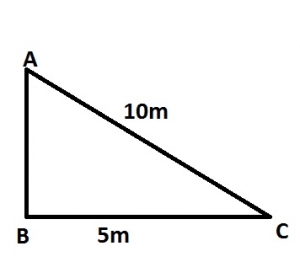
In the diagram, AB is a vertical pole and BC is horizontal. If |AC| = 10m and |BC| = 5m, calculate the angle of depression of C from A
Attached Figure / Diagram
A
63o
B
60o
C
45o
D
27o
medium Difficulty
Verified Correct Answer: Option B
Step-by-Step Mathematical Solution
In triangle ABC, \(\frac{BC}{AC} = \cos \theta\)
\(\implies \cos \theta = \frac{5}{10} = 0.5\)
\(\theta = \cos^{-1} (0.5) = 60^\circ\)
Source: WAEC / JAMB / NECO Classroom Archive (Record #26440)
Mathematics
WAEC / WASSCE 2000
Trigonometry, Elevation & Bearings
Diagram
Solution
(a) A surveyor walks 100m up a hill which slopes at an angle of 24° to the horizontal. Calculate, correct to the nearest metre, the height through which he rises.
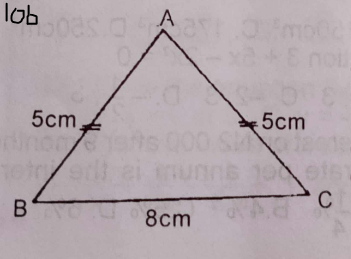
(b) Use Figure 10b above to answer the question below.
In the diagram, ABC is an isosceles triangle. |AB| = |AC| = 5 cm, and |BC| = 8 cm. Calculate, correct to the nearest degree, < BAC.
(c) Two boats, 70 metres apart and on opposite sides of a light-house, are in a straight line with the light-house. The angles of elevation of the top of the light-house from the two boats are 71.6° and 45°. Find the height of the light-house. [Take tan 71.6° = 3].
Attached Figure / Diagram
medium Difficulty
Verified Correct Answer: Option
Step-by-Step Mathematical Solution
(a) see figure a above \(\frac{h}{100} = \sin 24\)
\(h = 100 \sin 24\)
= \(100 \times 0.4067\)
= \(40.67m\)
(b) see figure b above \(\sin \alpha = \frac{4}{5} = 0.8\)
\(\alpha = \sin^{-1} (0.8) = 53.13^\circ\)
\(< BAC = 2 \theta = 2(53.13^\circ)\)
= \(106.26^\circ\)
\(\approxeq 106^\circ\) (to the nearest degree).
(c) See Figure C above
In \(\Delta PSQ\),
\(\frac{h}{PQ} = \tan 71.6\)
\(PQ = \frac{h}{\tan 71.6}\)
In \(\Delta QSR\),
\(\frac{h}{QR} = \tan 45\)
\(QR = \frac{h}{\tan 45}\)
\(PR = PQ + QR\)
\(\frac{h}{3} + h = 70 \implies \frac{4}{3}h = 70\)
\(h = \frac{70 \times 3}{4} = 52.5m\)
Source: WAEC / JAMB / NECO Classroom Archive (Record #53487)