Question Library
Browse, filter, and study verified past examination questions with step-by-step mathematical reasoning.
Searching 18,000+ Questions...
Sifting topics, KaTeX formulas & verified solutions
Showing 18931–18945 of 29811 verified questions
Sort by:
Mathematics
WAEC / WASSCE 2000
Variations
Solution
Given that p varies directly as q while q varies inversely as r, which of the following statements is true?
A
r varies directly as p
B
p varies inversely as r
C
p varies directly as r
D
q varies inversely as p
medium Difficulty
Verified Correct Answer: Option B
Step-by-Step Mathematical Solution
P varies directly as q means p = kq some constant k
q varies inversely as r means q = \(\frac{\text{m}}{\text{r}}\) for some constant m
Substituting the expression for q into the equation for p:
p =\(\frac{\text{km}}{\text{r}}\)
This shows that p varies inversely as r.
Source: WAEC / JAMB / NECO Classroom Archive (Record #26460)
Mathematics
WAEC / WASSCE 2000
Algebraic Expressions, Polynomials & Factorisation
Solution
Given that x = -\(\frac{1}{2}\) and y = 4 evaluate 3x\(^2y+xy^2\)
A
-5
B
-1
C
4
D
11
medium Difficulty
Verified Correct Answer: Option A
Step-by-Step Mathematical Solution
\(x = -\frac{1}{2}\), y = 4
3x\(^2\)y + xy\(^2\)
3\(\left[-\frac{1}{2}\right]^2 \times 4 + \left(\frac{-1}{2}\right)(4)^2\)
3\(\times \frac{1}{4} \times 4 -\frac{1}{2} \times 16\)
3 - 8 = -5
Source: WAEC / JAMB / NECO Classroom Archive (Record #26450)
Mathematics
WAEC / WASSCE 2000
Algebraic Expressions, Polynomials & Factorisation
Solution
Make t the subject of formula \(k = m\sqrt{\frac{t-p}{r}}\)
A
\(\frac{rk^2 + p}{m^2}\)
B
\(\frac{rk^2+pm^2}{m^2}\)
C
\(\frac{rk^2-p}{m^2}\)
D
\(\frac{rk^2-p^2}{m^2}\)
medium Difficulty
Verified Correct Answer: Option B
Step-by-Step Mathematical Solution
\(k = m\sqrt{\frac{t - p}{r}}\)
\(\frac{k}{m} = \sqrt{\frac{t - p}{r}}\)
\((\frac{k}{m})^2 = \frac{t - p}{r}\)
\(rk^2 = m^2 (t - p)\)
\(\therefore m^2 t = rk^2 + m^2 p\)
\(t = \frac{rk^2 + m^2 p}{m^2}\)
Source: WAEC / JAMB / NECO Classroom Archive (Record #26457)
Mathematics
WAEC / WASSCE 2000
Linear, Simultaneous & Quadratic Equations
Solution
Find the equation whose roots are -8 and 5
A
\(x^2 + 13x + 40=0\)
B
\(x^2 - 13x - 40=0\)
C
\(x^2 - 3x +40=0\)
D
\(x^2 + 3x - 40=0\)
medium Difficulty
Verified Correct Answer: Option D
Step-by-Step Mathematical Solution
Equation with roots -8 and 5: (x + 8)(x - 5) = 0
\(x^2 - 5x + 8x - 40 = 0\)
\(x^2 + 3x - 40 = 0\)
Source: WAEC / JAMB / NECO Classroom Archive (Record #26456)
Mathematics
WAEC / WASSCE 2000
Linear, Simultaneous & Quadratic Equations
Solution
Solve the equation 3 + 5x - 2x\(^2\) = 0
A
\(-\frac{1}{2},-3\)
B
2, 3
C
-2, 3
D
\(-\frac{1}{2},3\)
medium Difficulty
Verified Correct Answer: Option D
Step-by-Step Mathematical Solution
3 + 5x - 2x\(^2\) = 0
3 + 6x - x - 2x\(^2\) = 0
3(1 + 2x) - x(1 + 2x) = 0
(3 - x)(1+2x) = 0
3 - x = 0 or 1 + 2x = 0
x = 3 or x = \(\frac{-1}{2}\)
Source: WAEC / JAMB / NECO Classroom Archive (Record #26470)
Mathematics
WAEC / WASSCE 2000
Linear, Simultaneous & Quadratic Equations
Solution
(a) Given the expression \(y = ax^{2} - bx - 12\) , find the values of x when a = 1, b = 2 and y = 3.
(b) If \(\sqrt{x^{2} + 1} = \frac{5}{4}\), find the positive value of x.
medium Difficulty
Verified Correct Answer: Option
Step-by-Step Mathematical Solution
(a) \(y = ax^{2} - bx - 12\)
When a = 1, b = 2 and y = 3.
\(3 = x^{2} - 2x - 12\)
\(x^{2} - 2x - 12 - 3 = 0 \implies x^{2} - 2x - 15 = 0\)
\(x^{2} - 5x + 3x - 15 = 0\)
\((x - 5)(x + 3) = 0\)
\(\text{x = 5 or -3}\)
(b) \(\sqrt{x^{2} + 1} = \frac{5}{4}\)
Squaring both sides,
\(x^{2} + 1 = \frac{25}{16}\)
\(x^{2} = \frac{25}{16} - 1 = \frac{9}{16}\)
\(x = \sqrt{\frac{9}{16}} = \pm \frac{3}{4}\)
The positive value of x = \(\frac{3}{4}\).
Source: WAEC / JAMB / NECO Classroom Archive (Record #53462)
Mathematics
WAEC / WASSCE 2000
Linear, Simultaneous & Quadratic Equations
Solution
(a) Copy and complete the following table of values for the relation \(y = x^{2} - 2x - 5\)
x
-3
-2
-1
0
1
2
3
4
5
y
-2
-6
-2
3
10
(b) Draw the graph of the relation \(y = x^{2} - 2x - 5\); using a scale of 2 cm to 1 unit on the x- axis, and 2 cm to 2 units on the y- axis.
(c) Using the same axes, draw the graph of \(y = 2x + 3\).
(d) Obtain in the form \(ax^{2} + bx + c = 0\) where a, b and c are integers, the equation which is satisfied by the x- coordinate of the points of intersection of the two graphs.
(e) From your graphs, determine the roots of the equation obtained in (d) above.
medium Difficulty
Verified Correct Answer: Option
Step-by-Step Mathematical Solution
(a)
x
-3
-2
-1
0
1
2
3
4
5
\(x^{2}\)
9
4
1
0
1
4
9
16
25
\(-2x\)
6
4
2
0
-2
-4
-6
-8
-10
-5
-5
-5
-5
-5
-5
-5
-5
-5
-5
y
10
3
-2
-5
-6
-5
-2
3
10
(b) see graph above
(c)
x
-3
-2
-1
0
1
2
3
4
5
\(2x\)
-6
-4
-2
0
2
4
6
8
10
-3
-3
-3
-3
-3
-3
-3
-3
-3
-3
y
-9
-7
-5
-3
-1
1
3
5
7
(d) \(x^{2} - 2x - 5 = 2x - 3\)
\(x^{2} - 2x - 2x - 5 + 3 = 0\)
\(x^{2} - 4x - 2 = 0\)
(e) x = -0.8 or 4.3
Source: WAEC / JAMB / NECO Classroom Archive (Record #53477)
Mathematics
WAEC / WASSCE 2000
Inequalities & Linear Programming
Solution
Form an inequality for a distance d meters which is more than 18m, but not more than 23m
A
18 ≤ d ≤ 23
B
18 < d ≤ 23
C
18 ≤ d < 23
D
d 23
medium Difficulty
Verified Correct Answer: Option B
Step-by-Step Mathematical Solution
more than means greater than WHILE not more than means less than or equal to
therefore the answer is 18 < d \le 23 meaning d is more than 8 but can be equal to or less than 23
Source: WAEC / JAMB / NECO Classroom Archive (Record #26455)
Mathematics
UTME / JAMB 2000
Inequalities & Linear Programming
Diagram
Solution
The solution of the simultaneous inequalities \(2x - 2 \leq\) y and \( 2y - 2 \leq\) x is represented by
Use the diagrams above as the OPTIONS
Attached Figure / Diagram
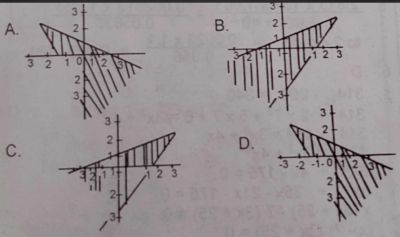
A
A
B
B
C
C
D
D
medium Difficulty
Verified Correct Answer: Option B
Step-by-Step Mathematical Solution
\(2x - 2 \leq\) y = \( y \geq\) 2x - 2
when x = 0 , y = -2 and when y = 0, x = 1
\(2y - 2 \leq\) x
when x = 0, y = 1 and when y = 0, x = 1
Use the diagram above for the OPTIONS
Source: WAEC / JAMB / NECO Classroom Archive (Record #69880)
Mathematics
WAEC / WASSCE 2000
Algebraic Expressions, Polynomials & Factorisation
Solution
Simplify \(\frac{1}{x-3}-\frac{3(x-1)}{x^2 - 9}\)
A
\(\frac{x-1}{x-3}\)
B
\(\frac{-2}{x+3}\)
C
\(\frac{x-1}{x+3}\)
D
\(\frac{4x}{x^2-9}\)
medium Difficulty
Verified Correct Answer: Option B
Step-by-Step Mathematical Solution
\(\frac{1}{x-3}-\frac{3(x-1)}{x^2 - 9}\)
\(\frac{1}{x-3}-\frac{3(x-1)}{(x-3)(x+3)}\)
\(\frac{x+3-3x+3}{(x-3)(x+3)};\frac{-2x+6}{(x-3)(x+3)}\)
\(\frac{-2(x-3)}{(x-3)(x+3)}=\frac{-2}{x+3}\)
Source: WAEC / JAMB / NECO Classroom Archive (Record #26454)
Mathematics
WAEC / WASSCE 2000
Algebraic Expressions, Polynomials & Factorisation
Solution
Find the value of x such that the expression \(\frac{1}{x}+\frac{4}{3x}-\frac{5}{6x}+1\) equals zero
A
\(\frac{1}{6}\)
B
\(\frac{1}{4}\)
C
\(\frac{-3}{2}\)
D
\(\frac{-7}{6}\)
medium Difficulty
Verified Correct Answer: Option C
Step-by-Step Mathematical Solution
\(\frac{1}{x} + \frac{4}{3x} - \frac{5}{6x} + 1 = 0\)
\(\frac{6 + 8 - 5 + 6x}{6x} = 0\)
\(\frac{9 + 6x}{6x} = 0 \implies 9 + 6x = 0\)
\(6x = -9 \implies x = \frac{-3}{2}\)
Source: WAEC / JAMB / NECO Classroom Archive (Record #26459)
Mathematics
WAEC / WASSCE 2000
Sequences & Series (AP & GP)
Solution
(a) The first term of an Arithmetic Progression (A.P) is 8. The ratio of the 7th term to the 9th term is 5 : 8. Calculate the common difference of the progression.
(b) A sphere of radius 2 cm is of mass 11.2g. Find (i) the volume of the sphere ; (ii) the density of the sphere ; (iii) the mass of a sphere of the same material but with radius 3cm. [Take \(\pi = \frac{22}{7}\)].
medium Difficulty
Verified Correct Answer: Option
Step-by-Step Mathematical Solution
(a) \(T_{n} = a + (n - 1)d\) (terms of an AP)
Given a = -8;
\(T_{7} = a + 6d = -8 + 6d\)
\(T_{9} = a + 8d = -8 + 8d\)
\(\frac{-8 + 6d}{-8 + 8d} = \frac{5}{8}\)
\(5(-8 + 8d) = 8(-8 + 6d)\)
\(-40 + 40d = -64 + 48d\)
\(-40 + 64 = 48d - 40d \times 24 = 8d\)
\( d = 3\)
(b) Given r = 2 cm, m = 11.2g
(i) \(V = \frac{4}{3} \pi r^{3}\)
= \(\frac{4}{3} \times \frac{22}{7} \times 2^{3}\)
= \(\frac{704}{21}\)
= \(33.52 cm^{3} = 33.52 \times 10^{-6} m^{3}\)
= \(3.352 \times 10^{-5} m^{3}\)
(ii) \(Density = \frac{mass}{volume}\)
= \(\frac{11.2}{33.52}\)
= \(0.334 g/cm^{3}\)
(iii) \(V = \frac{4}{3} \pi r^{3}\)
= \(\frac{4}{3} \times \frac{22}{7} \times 3^{3}\)
= \(\frac{2376}{21}\)
= \(113.14 cm^{3}\)
\(mass = density \times volume\)
\(0.334 \times 113.14 = 37.789g\)
Source: WAEC / JAMB / NECO Classroom Archive (Record #53503)
Mathematics
WAEC / WASSCE 2000
Mensuration (Areas, Perimeters & Volumes)
Solution
Which of the following statement is not true about a rectangle? I.Each diagonal cuts the rectangle into two congruent triangles. II. A rectangle has four lines of symmetry III. The diagonals intersect at right angles
A
I and II only
B
III only
C
II only
D
II and III only
medium Difficulty
Verified Correct Answer: Option D
Step-by-Step Mathematical Solution
The statement that is not true about a rectangle is: II and III only
The diagonals of a rectangle do not intersect at right angles. and does not have four lines of symmetry but two.
Source: WAEC / JAMB / NECO Classroom Archive (Record #26445)
Mathematics
UTME / JAMB 2000
Mensuration (Areas, Perimeters & Volumes)
Diagram
Solution
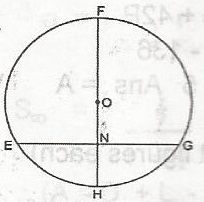
In the diagram, EFGH is a circle centre O. FH is a diameter and GE is a chord which meets FH at right angle at the point N. If NH = 8cm and EG = 24cm, calculate FH
Attached Figure / Diagram
A
32cm
B
26cm
C
20cm
D
16cm
medium Difficulty
Verified Correct Answer: Option B
Step-by-Step Mathematical Solution
\(\bigtriangleup\)OEN = \(\bigtriangleup\)OGN
OE = OG = r(radii)
(r - 8)\(^2\) + 12\(^2\) = r\(^2\)
r\(^2\) - 16r + 64 + 144 = r\(^2\)
16r = 64 + 144
16r = 64 + 144 = 208
\(\frac{208}{16}\) = 13cm
FH = 2FO = 2OH = 2R
= 2 x 13cm
= 26cm
Source: WAEC / JAMB / NECO Classroom Archive (Record #33092)
Mathematics
WAEC / WASSCE 2000
Mensuration (Areas, Perimeters & Volumes)
Diagram
Solution
(a) Two places X and Y on the equator are on longitudes 67°E and 123°E respectively. (i) What is the distance between them along the equator? (ii) How far from the North pole is X? [Take \(\pi = \frac{22}{7}\) and radius of earth = 6400km].
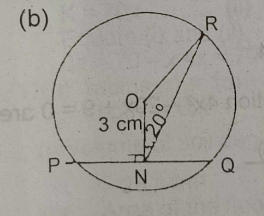
(b) SEE FIGURE B above, In the diagram, PQR is a circle centre O. N is the mid-point of chord PQ. |PQ| = 8cm, |ON| = 3cm and < ONR = 20°. Calculate the size of < ORN to the nearest degree.
Attached Figure / Diagram
medium Difficulty
Verified Correct Answer: Option
Step-by-Step Mathematical Solution
(a) SEE FIGURE A above., Longitude difference = 123^\circ - 67^\circ = 56^\circ
(i) Distance between X and Y along the equator = \(\frac{56}{360} \times 2 \times \frac{22}{7} \times 6400 \cos 0\)
= \(\frac{56}{360} \times 2 \times \frac{22}{7} \times 6400\)
= \(6257.78km \approxeq 6258km\)
(ii) Latitude difference = 90^\circ
Distance from the North pole = \(\frac{90}{360} \times 2 \times \frac{22}{7} \times 6400\)
= \(10057.14km \approxeq 10057km\)
(b) SEE FIGURE B above,.,
\(OP^{2} = PN^{2} + ON^{2}\)
\(4^{2} + 3^{2} = 25\)
\(OP = \sqrt{25} = 5cm\)
\(OP = OR = 5cm\)
\(\Delta NOR = scalene\)
\(\frac{OR}{\sin 20} = \frac{3}{\sin < ORN}\)
\(\frac{5}{\sin 20} = \frac{3}{\sin < ORN}\)
\(\sin < ORN = \frac{3 \times \sin 20}{5}\)
\(\sin < ORN = 0.2052\)
\(< ORN = \sin^{-1} (0.2052)\)
\(< ORN = 11.84^\circ \approxeq 12^\circ\)
Source: WAEC / JAMB / NECO Classroom Archive (Record #53507)