Question Library
Browse, filter, and study verified past examination questions with step-by-step mathematical reasoning.
Searching 18,000+ Questions...
Sifting topics, KaTeX formulas & verified solutions
Showing 18901–18915 of 29811 verified questions
Sort by:
Mathematics
UTME / JAMB 2000
Permutations, Combinations & Probability
Solution
In how many ways can a delegation of 3 be chosen from among 5 men and 3 women, if at least one man and at least one woman must be included?
A
15
B
28
C
30
D
45
medium Difficulty
Verified Correct Answer: Option D
Step-by-Step Mathematical Solution
No of ways of choosing 1 man, 2 women = 5C1 x 3C2
No of ways of choosing 2 men, 1 woman = 5C2 x 3C1
Summing, => (5C1 x 3C2) + (5C2 x 3C1) = 15 + 30 = 45
Source: Myschool Past Questions Archive (Record #1107)
Mathematics
UTME / JAMB 2000
Differentiation & Applications
Solution
A function f(x) passes through the origin and its first derivative is 3x + 2. What is f(x)?
A
y = \(\frac{3x^2}{2}\) + 2x
B
y = (3x2)/2 + x
C
y = 3x2 + (x/2)
D
y = 3x2 +2x
medium Difficulty
Verified Correct Answer: Option A
Step-by-Step Mathematical Solution
Hints:
1. Integrate the given first derivative of f(x) at the boundaries, (0,0)
Then solve accordingly to get f(x) = y = \(\frac{3x^2}{2}\) + 2x
Source: Myschool Past Questions Archive (Record #1110)
Mathematics
UTME / JAMB 2000
Differentiation & Applications
Solution
The expression ax\(^2\) + bx + c equals 5 at x = 1. If its derivative is 2x + 1, what are the values of a, b, and c, respectively?
A
1, 3, 1
B
1, 2, 1
C
2, 1, 1
D
1, 1, 3
medium Difficulty
Verified Correct Answer: Option D
Step-by-Step Mathematical Solution
At x = 1, substituting x = 1 in the equation: ax2 + bx + c = 5;
f(1) => a + b + c = 5 .....(1)
Taking the first derivative of f(x) in the original equation gives dy/dx = 2ax + b = 2x + 1 (given)....(2)
From (2),=> b = 1, and 2ax = 2x, => a = 1. ( comparing coefficients)
substituting into (1) 1 + 1 + c = 5, => c = 5 - 2 = 3
Thus a = 1, b = 1 and c = 3
Source: Myschool Past Questions Archive (Record #1112)
Mathematics
UTME / JAMB 2000
Plane Geometry, Polygons & Circle Theorems
Diagram
Solution
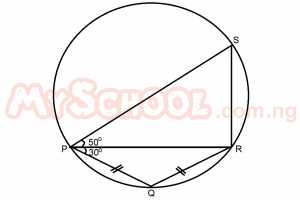
In the diagram above, if ∠RPS = 50o, ∠RPQ = 30o and PQ = QR, find the value of ∠PRS.
Attached Figure / Diagram
A
80o
B
70o
C
60o
D
50o
medium Difficulty
Verified Correct Answer: Option B
Step-by-Step Mathematical Solution
\Delta PQR is isosceles
∴∠PRQ = 30o
Also in \Delta PQR
^Q = 180 -(30 + 30)
= 120o
PQRS is a cyclic quad
∴^S + ^Q = 180(opp ∠s of a cyclic quad)
S + 120 = 180
S = 60o
In \DeltaPSR
x + 50 + 60
= 180(sum of ∠s of a \Delta)
x + 110 = 180
x = 180 - 110
x = 70o
Source: WAEC / JAMB / NECO Classroom Archive (Record #10411)
Mathematics
WAEC / WASSCE 2000
Plane Geometry, Polygons & Circle Theorems
Diagram
Solution
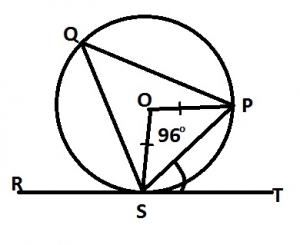
In the diagram, PQS is a circle with center O. RST is a tangent at S and ∠SOP = 96o. Find ∠PST
Attached Figure / Diagram
A
42o
B
48o
C
60o
D
66o
medium Difficulty
Verified Correct Answer: Option B
Step-by-Step Mathematical Solution
In the given diagram,
< PQS = \(\frac{1}{2}\) x 96º = 48º (
Therefore, < PST = 48º ( alternate segment).
Source: WAEC / JAMB / NECO Classroom Archive (Record #26461)
Mathematics
WAEC / WASSCE 2000
Number Bases & Modular Arithmetic
Solution
If \(104_x = 68\), find the value of x
A
5
B
7
C
8
D
9
medium Difficulty
Verified Correct Answer: Option C
Step-by-Step Mathematical Solution
104\(_x\) = 68
1 \(\times x^2 + 0 \times x + 4 \times x^0\) = 68
x\(^2\) = 68 - 4; x\(^2\) = 64
x = \(\sqrt{64}\) = 8
(104\(_x\) change to base 10)
Source: WAEC / JAMB / NECO Classroom Archive (Record #26431)
Mathematics
UTME / JAMB 2000
Number Bases & Modular Arithmetic
Solution
Change 71\(_{10}\) to base 8
A
10\(7_8\)
B
10\(6_8\)
C
71\(_8\)
D
17\(_8\)
medium Difficulty
Verified Correct Answer: Option A
Step-by-Step Mathematical Solution
8
71
8
8 rem 7
8
1 rem 0
0 rem 1
71\(_8\) = 107\(_8\)
Source: WAEC / JAMB / NECO Classroom Archive (Record #69937)
Mathematics
UTME / JAMB 2000
Indices, Logarithms & Surds
Solution
Evaluate 5-\(^{3log_52}\) x 2\(^{2log_23}\)
A
8
B
11/8
C
2/5
D
1/8
medium Difficulty
Verified Correct Answer: Option B
Step-by-Step Mathematical Solution
5-3log52 x 22log23
i Let -3log52 = p => log52-3 = p
∴2-3 = 5p
∴5-3log52 = 5log52-3 = 5p
ii 22log23 = q => log532 = q
∴32 = 2q
∴222log23 = 2q
= 32 = 9
i x ii = 2-3 x 9 = 1/23 x 9
= 1/8 x 9
= 9/8 = 11/8
Source: Myschool Past Questions Archive (Record #10410)
Mathematics
WAEC / WASSCE 2000
Indices, Logarithms & Surds
Solution
Simplify \(\left(\frac{16}{81}\right)^{-\frac{3}{4}}\times \sqrt{\frac{100}{81}}\)
A
\(\frac{80}{243}\)
B
\(\frac{1}{64}\)
C
\(\frac{25}{6}\)
D
\(\frac{15}{4}\)
medium Difficulty
Verified Correct Answer: Option D
Step-by-Step Mathematical Solution
\(\left(\frac{16}{81}\right)^{-\frac{3}{4}}\times \sqrt{\frac{100}{81}}\)
= \(\frac{1}{\left(\sqrt[4]{\frac{16}{81}}\right)^3}\times \frac{10}{9}\)
= \(\frac{1}{\left(\frac{2}{3}\right)^3}\times\frac{10}{9}\)
= \(\frac{27}{8}\times \frac{10}{9} = \frac{15}{4}\) OR
We start with the expression:
\(\left(\frac{16}{81}\right)^{-\frac{3}{4}} \times \sqrt{\frac{100}{81}}\)
First, simplify \(\left(\frac{16}{81}\right)^{-\frac{3}{4}}\):
\(\left(\frac{16}{81}\right)^{-\frac{3}{4}} = \left(\frac{81}{16}\right)^{\frac{3}{4}} = \frac{81^{\frac{3}{4}}}{16^{\frac{3}{4}}}\)
Calculating \(81^{\frac{3}{4}}\) and \(16^{\frac{3}{4}}\):
\(81 = 3^4 \implies 81^{\frac{3}{4}} = 3^3\) = 27
\(16 = 4^2 \implies 16^{\frac{3}{4}} = 4^{\frac{3}{2}} = 2^3\) = 8
Thus,
\(\left(\frac{16}{81}\right)^{-\frac{3}{4}} = \frac{27}{8}\)
Next, simplify \(\sqrt{\frac{100}{81}}\):
\(\sqrt{\frac{100}{81}} = \frac{\sqrt{100}}{\sqrt{81}} = \frac{10}{9}\)
Now, multiply the two results:
\(\frac{27}{8} \times \frac{10}{9} = \frac{27 \times 10}{8 \times 9} = \frac{270}{72}\)
Finding the GCD of 270 and 72 gives:
\(\frac{270 \div 18}{72 \div 18} = \frac{15}{4}\)
The final result is:
\(\left(\frac{16}{81}\right)^{-\frac{3}{4}} \times \sqrt{\frac{100}{81}} = \frac{15}{4}\)
Source: WAEC / JAMB / NECO Classroom Archive (Record #26429)
Mathematics
WAEC / WASSCE 2000
Indices, Logarithms & Surds
Solution
Solve the equation \(3y^2\) = 27y
A
y = o or 3
B
y = 0 or 9
C
y = -3 or 3
D
y = 3 or 9
medium Difficulty
Verified Correct Answer: Option B
Step-by-Step Mathematical Solution
3y\(^2\) = 27y
3y\(^2\) - 27y = 0
3y(y - 9) = 0
3y = 0 or y - 9 = 0
y = 0 or y = 9
y = 0 or 9
Source: WAEC / JAMB / NECO Classroom Archive (Record #26458)
Mathematics
WAEC / WASSCE 2000
Indices, Logarithms & Surds
Solution
Given that \(log_4 x = -3\), find x.
A
\(\frac{1}{81}\)
B
\(\frac{1}{64}\)
C
64
D
81
medium Difficulty
Verified Correct Answer: Option B
Step-by-Step Mathematical Solution
\(\log_4 x = -3\)
\(x = 4^{-3}\)
= \(\frac{1}{64}\)
Source: WAEC / JAMB / NECO Classroom Archive (Record #26433)
Mathematics
WAEC / WASSCE 2000
Indices, Logarithms & Surds
Solution
Given that the logarithm of a number is \(\bar{1}.8732\), find, correct to 2 significant figures the square root of the number.
A
0.29
B
0.75
C
0.86
D
0.93
medium Difficulty
Verified Correct Answer: Option C
Step-by-Step Mathematical Solution
Let the number = d.
\(\log d = \bar{1}.8732\)
\(\log \sqrt{d} = \frac{\bar{1}.8732}{2}\)
= \(\frac{\bar{2} + 1.8732}{2}\)
= \(\bar{1}.9366\)
\(\therefore \sqrt{d} = Antilog (\bar{1}.9366)\)
= 0.86
Source: WAEC / JAMB / NECO Classroom Archive (Record #26434)
Mathematics
WAEC / WASSCE 2000
Indices, Logarithms & Surds
Solution
(a)
Limes
Apples
Good
10
8
Bad
6
6
The table shows the number of limes and apples of the same size in a bag. If two of the fruits are picked at random, one at a time, without replacement, find the probability that : (i) both are good limes ; (ii) both are bad fruits ; (iii) one is a good apple and the other a bad lime.
(b) Solve the equation \(\log_{3} (4x + 1) - \log_{3} (3x - 5) = 2\).
medium Difficulty
Verified Correct Answer: Option
Step-by-Step Mathematical Solution
(a) Total number of fruits = 16 limes + 14 apples = 30
(i) P(both are good limes) = \(\frac{10}{30} \times \frac{9}{29} = \frac{3}{29}\)
(ii) P(both are bad fruits) = \(\frac{12}{30} \times \frac{11}{29} = \frac{22}{145}\)
(iii) P(one is a good apple and the other a bad lime) = \((\frac{8}{30} \times \frac{6}{29}) + (\frac{6}{30} \times \frac{8}{29})\)
= \(\frac{8}{145} + \frac{8}{145}\)
= \(\frac{16}{145}\)
Note : The arrangement is not specific. Hence, it can be a good apple first and then a bad lime or a bad lime first and then a good apple.
(b) \(\log_{3} (4x + 1) - \log_{3} (3x - 5) = 2\)
\(\log_{3} (\frac{4x + 1}{3x - 5}) = 2\)
\((\frac{4x + 1}{3x - 5}) = 3^{2}\)
\(\frac{4x + 1}{3x - 5} = 9 \implies 4x + 1 = 9(3x - 5)\)
\(4x + 1 = 27x - 45 \implies 23x = 46\)
\(x = 2\)
Source: WAEC / JAMB / NECO Classroom Archive (Record #53471)
Mathematics
WAEC / WASSCE 2000
Indices, Logarithms & Surds
Solution
simplify \(\frac{10}{\sqrt{32}}\)
A
\(\frac{5}{4}\sqrt{2}\)
B
\(\frac{4}{5}\sqrt{2}\)
C
\(\frac{5}{16}\sqrt{2}\)
D
\(\frac{16}{5}\sqrt{2}\)
medium Difficulty
Verified Correct Answer: Option A
Step-by-Step Mathematical Solution
\(\frac{10}{\sqrt{32}}\) = \(\frac{10}{\sqrt{16\times 2}}\) = \(\frac{10}{4\sqrt{2}}\)
\(\frac{10\times \sqrt{2}}{4\sqrt{2}\times\sqrt{2}}\) = \(\frac{10\sqrt{2}}{4\times 2}\) = \(\frac{5}{4}\sqrt{2}\)
Source: WAEC / JAMB / NECO Classroom Archive (Record #26426)
Mathematics
WAEC / WASSCE 2000
Mensuration (Areas, Perimeters & Volumes)
Solution
Which of the following numbers is perfect cube?
A
350
B
504
C
950
D
1728
medium Difficulty
Verified Correct Answer: Option D
Step-by-Step Mathematical Solution
By trial and error method
1728 is a perfect cube
or try multiplying 3 same numbers based on the given options, or use the long division method, and group the divisors(same) in 3s.
i.e., 12 x 12 x 12 = 1728, making 1728 a perfect cube.
Source: WAEC / JAMB / NECO Classroom Archive (Record #26430)