Question Library
Browse, filter, and study verified past examination questions with step-by-step mathematical reasoning.
Searching 18,000+ Questions...
Sifting topics, KaTeX formulas & verified solutions
Showing 18856–18870 of 29811 verified questions
Sort by:
Mathematics
WAEC / WASSCE 2001
Plane Geometry, Polygons & Circle Theorems
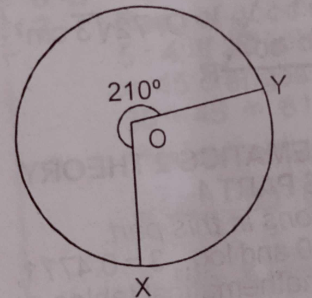
Diagram
Solution
In the diagram above, O is the centre of the circle. Reflex angle XOY = 210º and the length of the minor arc is 5.5m. Find, correct to the nearest metre the length of major arc.
Attached Figure / Diagram
A
8m
B
9m
C
10m
D
13m
medium Difficulty
Verified Correct Answer: Option A
Step-by-Step Mathematical Solution
Length of arc = \(\frac{Ø}{360} \times 2\pi\)
5.5 = \(\frac{360 - 210}{360}\) x 2 x \(\frac{22}{7}\)
\(\frac{ 5.5 \times 360\times7}{150\times2\times22}\) = 2.1
length of major arc = \(\frac{210}{360}\) x 2 x \(\frac{22}{7}\) x 2.1
7.7m ≈ 8m
Source: Myschool Past Questions Archive (Record #70133)
Biology
WAEC / WASSCE 2001
Transport System in Plants & Animals
Solution
(a)(i) Draw and label.the mammalian heart.
(ii) Explain briefly pulmonary circulation in mammals.
(b) State five processes by which the mammalian body reduces its temperature.
medium Difficulty
Verified Correct Answer: Option
Biological Concept & Syllabus Guide
a(i) Diagram of the mammalian heart
(a)(ii) Pulmonary circulation in mammals takes the following process: The heart muscles contract, allowing de-oxygenated blood from the right ventricle to pass through the pulmonary valve into the pulmonary artery to the lung capillaries for exchange of oxygen and carbon dioxide. Oxygenated blood from the lungs then return by the pulmonary vein to the left auricle.
(b) The processes by which mammalian body reduces its temperature are:
(i) relaxation of hair erector muscles
(ii) increased sweat production
(iii) vasodilation
(iv) reduction in heat generated by muscles
(v) reduction of metabolic activities by the body
(vi) conversion of energy into ATP instead of heat
(vii) panting/yawning also reduces temperatures.
Source: Official Exam / Past Question Archive
Biology
NECO SSCE 2001
Adaptation & Evolution
Solution
Which is NOT a social animal?
A
Ant
B
Bee
C
Butterfly
D
Termite
E
Wolf
medium Difficulty
Verified Correct Answer: Option C
Biological Concept & Syllabus Guide
Social insects work together to find food and other resources and to communicate their findings to others in the community. They are capable of providing defense to their home and resources when under attack. Social insects also can displace other insects, and even larger animals, for territory and food.
-Social insects are the ants, bees, wasps, and termites that have organized societies.
-Butterflies are mostly solitary creatures, though some species migrate in massive numbers.
-Wolves are very social animals. They live and hunt together in groups called packs. A wolf pack is really just another name for a family of wolves
Source: Official Exam / Past Question Archive
Biology
WAEC / WASSCE 2001
Reproduction in Plants & Animals
Solution
(i) Draw and label the human sperm cell.
(ii) State where the sperm cell is produced and where it is stored.
(b) Explain how the structure of the sperm cell enables it to function
(c) Mention four advantages of sexual reproduction.
medium Difficulty
Verified Correct Answer: Option
Biological Concept & Syllabus Guide
(a)(i) Diagram of human sperm cell
(ii) Sperm cell are produced in the testis(es) seminiferous, tubules and stored temporarily in the epididymis.
(b) The structure of the sperm cell enables it to function effectively in fertilization in the following ways:
(i) Acrosome: This is located at the anterior end of the head which contains lytic enzymes (agents) used to dissolve the egg membrane. it enhances the penetration of the egg during fertilization.
(ii) Middle piece: it contains numerous mitochondria which generate the energy used by the sperm cell to swim towards the egg.
(iii) Long whip-like tail or flagellum: This is found at the posterior end of the sperm cell. It propels or moves the sperm cell.
(iv)The Nucleus: The nucleus in found the head of the sperm cell contains genetic material which fuses with the nucleus of the egg/ovum.
(c) Advantages of sexual reproduction are:
(i) It permits variability of individuals, i.e., new varieties are produced.
(ii) It enhances survival in new or changing environment.
(iii) It allows for the production of hybrids for some desirable traits.
(iv) It provides the means for the maintenance of chromosome number from generation to generation.
(v) It enhances speciation or formation of new species and allows for the continuity of the species.
Source: Myschool Past Questions Archive (Record #52906)
Biology
WAEC / WASSCE 2001
Nutrition in Plants & Animals (Photosynthesis & Food Substances)
Solution
(a) State eight human activities that may pollute water bodies
(b) Explain the measures that may be used to prevent pollution of water bodies.
(c) Mention four methods of purifying water.
medium Difficulty
Verified Correct Answer: Option
Biological Concept & Syllabus Guide
(a) Activities of man that pollute water bodies are:
(1) dumping of household refuse or organic wastes into water bodies
(ii) oil spillage from drilling or tankers
(iii) thermal pollution, hot water from industrial plants and atomic reactors
(iv) dumping of agro chemicals, e.g. fertilizers, pesticides, fungicides etc
(v) dumping of dye from textile factories into water
(vi) pouring detergents from homes and factories into water bodies
(vii) pouring tannins from leather factories into water bodies
(viii) radiations or radioactive fall-outs from nuclear plants washed into water bodies
(ix) untreated sewage dumped into water bodies
(x) use of dynamites/explosives for fishing
(xi) use of chemicals (Gamalin/DDT) in fishing.
(b) Measures for preventing pollution of water bodies are:
(1)Treatment of raw sewage before discharging into water and prohibition of disposal of human waste into water bodies
(2)Refuse must be burnt or buried and must not be deposited into water bodies
(3)Recycling of industrial waste before discharging them into water.
(4) Wastes should be discharged in controlled amounts.
(5) Cooling of water from industrial plants before discharging
(6) Proper sewage treatment
(7) Using biodegradable detergents in controlled amounts
(8) Limiting the use of pesticides and fertilizers
(9) Spraying oil with detergents to spread it or cover oil with chalk powder to cause it to sink and speed up bacteria decomposition/efficient method of preventing oil spillage
(10) Proper education of farmers on correct usage of fertilizers to limit run-off into water bodies
(11) Enactment/enforcement of laws to prevent the use of explosives and chemicals in fishing. The methods of purifying water are: boiling, addition of chemicals, e.g. alum, and chlorination; filtering; distillation; sedimentation and boiling; sterilization, e.g. by using u. v. light
Source: Myschool Past Questions Archive (Record #52913)
Biology
WAEC / WASSCE 2001
Nervous, Hormonal Coordination & Sense Organs
Solution
(a)(i) Define tropic and nastic movements.
(ii) List four differences between tropic and nastic movements.
(b) Describe an experiment to show that auxins are produced in the apical cells of a shoot.
(c)(i) Name two plant hormones, other than auxins.
(ii) Give two examples of tropism.
medium Difficulty
Verified Correct Answer: Option
Biological Concept & Syllabus Guide
(a) Definition of tropic and nastic movements:
(i) Tropic movement is growth movement of plant organs in response to external unilateral or directional stimulus. Nastic movement is the movement of certain parts of plants in response to diffuse or non-directional stimulus.
(ii)
Tropic movement
Nastic movement
Movement is not easily reversible.
Response leads to growth.
Movements are not due to change in cell turgor.
Response is towards the direction of the stimulus.
Response is slow.
Responses are not due to pressure.
Movement is reversible.
Response does not lead to growth.
Movements are due to changes in cell turgor.
Response is not Directed to the stimulus.
Response is rapid.
Responses are due to pressure.
Experiment to show that auxins are produced in the apical cells of a shoot:
Aim: To show that auxins are produced in the apical cells of a shoot.
Material: 3 potted seedlings of maize labelled A, B and C; agar block, sharp knife/cutting instruments, mica sheet / aluminium foil/cover slip.
Methods:
(i) Cut tip of coleoptile/shoot in Ato serve as control
(ii) Leave decapitated shoot for about 48 hours
(iii) Select another potted seedling, B,.and cut off tip of coleoptile/shoot
(iv) Place the cut tip on an agar block for about 2 — 6 hours
(v) Place agar block on stump of the decapitated shoot and leave for about 48 hours
(vi) Select a third seedling, C, and cut off tip of the coleoptile
(vii) Place tip of the cut coleoptile on mica sheet for 2 — 6 hours
(viii)Place mica sheet on cut surface of decapitated shoot and leave for about 48 hours.
Observation: Growth ceased in decapitated shoot A, but when agar block was placed on stump of shoot B in which growth had stopped, growth resumed. When mica sheet was placed on stump of shoot C in which growth had stopped, growth did not take place (resume).
Conclusion: This shows that a chemical substance (auxin) produced at the tip, i.e., apical cell of the shoot is responsible for the growth of the shoot.
(c)(i) Names of plant hormones other than auxins are
Gibberellic acid / Gibberellin
2, 4 - D 2, 4 - Dichlorophenozy acid
cytokinis/kinins/kinetin
abscisic acid/abscisin
ethylene/ethene
traumatin
florigen
dormin
formin, etc.
(ii) Examples of tropisms are:
geotropism
hydrotropism
thigmotropism/Haptrodropism
photoropism
stereotropism
chemotropism
thermotropism.
Source: Myschool Past Questions Archive (Record #52922)
Biology
WAEC / WASSCE 2001
Basic Ecological Concepts, Ecosystems & Biomes
Solution
(a) what is an ecosystem?
(b) Name twi abiotic factors each which affect plants and animals in a terrestrial habitat
(c) Describe the effect of three abiotic factors pn a named plants and an animal in the habitat mentioned in (b) above
medium Difficulty
Verified Correct Answer: Option
Biological Concept & Syllabus Guide
(a) An ecosystem; is a natural unit in which there is an interaction between all living organisms (biotic factors) and non-living organisms (abiotic factors) within an environment or habitat.
(b) Abiotic factors that affect plants and animals are: inorganic compounds or elements, e.g. O\(_2\), N\(_2\), salts, CO\(_2\) , H\(_2\)O etc; water/rainfall; temperature; light/ sunlight; wind; altitude; pressure; moisture/humidity; pH; wildfire/thunder and lightning
(c) Effects of abiotic factors include:
(i) Temperature:
(1) high temperature leads to high transpiration rate in plants/ aestivation and hibernation in animals
(2) High rate of metabolism in organisms
(3) a high rate of decay of organic matter
(4) a higher rate of growth and shorter length of life cycle in some organisms, e.g. housefly and toad
(5) at very low temperature plant roots absorb water at slower rates leading to reduction in the rate of transpiration and metabolism of organisms
(6) at low temperature, animals, e.g. snails may hibernate., birds migrate.
(ii) Rainfall:
(1) makes water available to organisms (plants and animals)
(2) quantity of rainfall determines type of vegetation in a habitat
(3) vegetation in turn influences types of animals that will live there
(4) rainfall, splash or floods may dislodge organisms
(5) rainfall increases relative humidity which may affect the rate of transpiration and perspiration in plants and animals respectively
(6) rainfall causes soil erosion which deprives plants of soil nutrients
(7) may form puddles or ponds thereby creating habitats or breeding ground for certain terrestrial organisms
(iii) Wind:
(1) steady wind increases rate of evaporation, transpiration and desiccation for animals
(2) strong wind causes soil erosion which affects living organisms
(3) strong wind breaks off branches of trees, fell trees or bend them, and force animals out of cover
(4) aids dispersal of organisms
(5) aids pollination
(iv) Light:
(1) intensity of sunlight affects plants by affecting rate of photosynthesis
(2) affects the rate of transpiration and stomata opening
(3) adequate sunlight promotes growth of many plant species
(4) low light leads to growth of shade tolerant species
(5) light affects the vision/movement of animals
(6) light affects the distribution of organisms in habitat.
(v) Pressure/Altitude:
(1) at high altitude, pressure decreases and animals have problems with respiration and blood pressure
(2) at high altitude, temperatures decrease while wind action increases, and this affects the distribution of organisms
(3) at high altitudes, only animals with special hemoglobin are found in the environment
(4) altitude may affect speciation
(5) altitude may affect the behavioral pattern of animals.
(vi) Inorganic Compounds:
(1) used by organisms (plants and animals) to maintain growth and sustain life
(2) 02 for respiration
(3) CO2 for photosynthesis
(4) N2/Nitrates promote plant growth
(5) H2O for growth and maintenance of body temperature
(6) PO for protein synthesis
(7) SO4\(_2\) for plant growth.
(vii) Humidity:
(1) affects rate of transpiration and perspiration
(2) affects the vision of animals through the formation of fog or mist
(3) affects the activities of poikilothermic animals
(4) affects the distribution of organisms, e.g. earthworms; bryophytes, e.g. liverworts etc.
(viii)Wildfire/Thunder and Lightning:
(1) destroys organisms, vegetation and animals
(2) displaces organisms (animals) from their habitat
Source: Myschool Past Questions Archive (Record #52925)
Mathematics
UTME / JAMB 2000
Sets, Logic & Venn Diagrams
Solution
Let P = {1, 2, u, v, w, x}; Q = {2, 3, u, v, w, 5, 6, y} and R = {2, 3, 4, v, x, y}.
Determine (P-Q) ∩ R
A
{1, x}
B
{x y}
C
{x}
D
ɸ
medium Difficulty
Verified Correct Answer: Option C
Step-by-Step Mathematical Solution
P = {1,2,u,v,w,x}
Q = {2,3,u,v,w,5,6,y}
R = {2,3,4,v,x,y}
P - Q = {1,x}
(P - Q) ∩ R = {1,x} ∩ {2,3,4,v,x,y} = {x}
NB: The set P−Q consists of elements that are in P but not in Q.
Source: Myschool Past Questions Archive (Record #552)
Mathematics
UTME / JAMB 2000
Fractions, Decimals, Percentages & Approximations
Solution
If the population of a town was 240,000 in January 1998 and it increased by 2% each year, what would be the population of the town in January, 2000?
A
480,000
B
249,696
C
249,600
D
244,800
medium Difficulty
Verified Correct Answer: Option B
Step-by-Step Mathematical Solution
1st year, Population = 240,000 x (\(\frac{2}{100}\)) = 4800.
Being the 2nd year population = 240,000 + 4800 = 244800.
Increase in Pop. in 2nd year = 244800 x (\(\frac{2}{100}\)) = 4896
Jan 2000, Pop. = 244800 + 4896 = 249,696
Source: Myschool Past Questions Archive (Record #554)
Mathematics
UTME / JAMB 2000
Indices, Logarithms & Surds
Solution
If \(\frac{(2\sqrt{3}-\sqrt{2})}{(\sqrt{3}+2\sqrt{2})} = m +n\sqrt{6}\), find the values of m and n respectively.
A
1, -2
B
-2, 1
C
\(\frac{-2}{5}\), 1
D
2, 3/5
medium Difficulty
Verified Correct Answer: Option B
Step-by-Step Mathematical Solution
Rationalize \(\frac{(2\sqrt{3}-\sqrt{2})}{(\sqrt{3}+2\sqrt{2})}\) and equate to \(m +n\sqrt{6}\). Such that m = -2, and n = 1.
Use \(\sqrt{3}-2\sqrt{2}\) as the conjugate for Rationalization
\(\frac{(2\sqrt{3}-\sqrt{2})}{(\sqrt{3}+2\sqrt{2})}\) X \(\frac{(\sqrt{3}-2\sqrt{2})}{(\sqrt{3}-2\sqrt{2})}\)
\(\frac{6 - 4\sqrt{6} - \sqrt{6} + 4}{3 - 2\sqrt{6} + 2\sqrt{6} - 8}\)
=\(\frac{10 - 5\sqrt{6}}{-5}\)
= -2 + \(\sqrt{6}\) = \(m +n\sqrt{6}\)
∴ m = -2 and n = 1
Source: Myschool Past Questions Archive (Record #555)
Mathematics
UTME / JAMB 2000
Plane Geometry, Polygons & Circle Theorems
Solution
In a youth club with 94 members, 60 like modern music, and 50 like traditional music. The number of members who like both traditional and modern music is three times those who do not like any type of music. How many members like only one type of music?
A
8
B
24
C
62
D
86
medium Difficulty
Verified Correct Answer: Option C
Step-by-Step Mathematical Solution
x = no. of ppl that like none.
no. of ppl that like both Traditional and Modern music, which is equal to 3x
Modern Music = 60 - 3x
Traditional Music = 50 - 3x
60-3x + 50 - 3x + 3x + x = 94
110 - 3x + x = 94
-2x = 94 - 110
=>-2x = -16,
this x = 8.
Members that like only one music:
= 60 - 3x + 50 - 3x
= 60 - 3[8] + 50 - 3[8]
= 60 - 24 + 50 - 24
= 36 + 26 = 62
Members that like only one type of music = 62
Source: Myschool Past Questions Archive (Record #556)
Mathematics
UTME / JAMB 2000
Indices, Logarithms & Surds
Solution
Evaluate \(\frac{(2.813 \times 10^{-3} \times 1.063)}{(5.637 \times 10^{-2})}\) reducing each number to two significant figures and leaving your answer in two significant figures.
A
0.056
B
0.055
C
0.054
D
0.54
medium Difficulty
Verified Correct Answer: Option B
Step-by-Step Mathematical Solution
\(\frac{2.813 \times 10^{-3} \times 1.063}{5.637 \times 10^{-2}}\)
= \(\frac{0.002813 \times 1.063}{0.05637}\)
\(\approxeq \frac{0.0028 \times 1.1}{0.056}\)
= \(0.055\)
Source: Myschool Past Questions Archive (Record #562)
Mathematics
UTME / JAMB 2000
Fractions, Decimals, Percentages & Approximations
Solution
A man wishes to keep his money in a savings deposit at 25% compound interest so that after three years he can buy a car for N150,000. How much does he need to deposit?
A
N112,000.50
B
N96,000.00
C
N85,714.28
D
N76,800.00
medium Difficulty
Verified Correct Answer: Option D
Step-by-Step Mathematical Solution
Amount A = P(1+r)n;
A = N150,000, r = 25%, n = 3.
150,000 = P(1+0.25)3 = P(1.25)3
P = 150,000/1.253 =N76,800.00
Source: Myschool Past Questions Archive (Record #564)
Mathematics
UTME / JAMB 2000
Number Bases & Modular Arithmetic
Solution
If 314\(_{10}\) - 256\(_7\) = 340\(_x\), find x.
A
7
B
8
C
9
D
10
medium Difficulty
Verified Correct Answer: Option A
Step-by-Step Mathematical Solution
\(314_{10} - 256_7 = 340_x\)
Convert 2567 and 340x to base 10, such that:
314 - 139 = 3x\(^2\) + 4x
=> \(3x^2\) + 4x - 175 = 0 (quadratic)
Factorising, (x - 7) (3x + 25) = 0,
either x = 7 or x = -25/3 ( but x cannot be negative)
Therefore, x = 7.
Source: Myschool Past Questions Archive (Record #567)
Mathematics
UTME / JAMB 2000
Indices, Logarithms & Surds
Solution
Simplify \(\frac{3(2^{n+1}) - 4(2^{n-1})}{2^{n+1} - 2^n}\)
A
2n+1
B
2n-1
C
4
D
1/4
medium Difficulty
Verified Correct Answer: Option C
Step-by-Step Mathematical Solution
Start by expanding \(\frac{3(2^{n+1}) - 4(2^{n-1})}{2^{n+1} - 2^n}\):
\(\frac{3 \times 2^n \times 2^1 - 2^2 \times 2^n \times 2^{-1}}{2^n \times 2 - 2^n}\)
NUMERATOR : 2\(^n\) ( 3\(^1\) X 2\(^1\) - 2\(^2\) X 2\(^{-1}\) )
--> 2\(^n\) ( 3 X 2 — 4 X \(\frac{1}{2}\) )
--> 2\(^n\) ( 6 - 2 )
--> 2\(^n\) (4)
DENOMINATOR : 2\(^n\) ( 2\(^1\) - 1 )
--> 2\(^n\) ( 2 - 1)
--> 2\(^n\)
=> \(\frac{2^n ( 4)}{2^n}\)
= 4
Source: Myschool Past Questions Archive (Record #573)