Question Library
Browse, filter, and study verified past examination questions with step-by-step mathematical reasoning.
Searching 18,000+ Questions...
Sifting topics, KaTeX formulas & verified solutions
Showing 18541–18555 of 29811 verified questions
Sort by:
English Language
WAEC / WASSCE 2001
Lexis, Structure & Register (Cloze & Vocabulary)
Solution
In question numbered 98 above, choose the best option from letters A - D that best completes the gap.
A
transporters
B
voyagers
C
conductors
D
passengers
medium Difficulty
Verified Correct Answer: Option D
Grammar & Contextual Explanation
This choice fits the context, as it refers to those who should not blame the drivers for the increased fares due to fuel scarcity.
Source: Myschool Past Questions Archive (Record #24899)
English Language
WAEC / WASSCE 2001
Lexis, Structure & Register (Cloze & Vocabulary)
Solution
In question numbered 99 above, choose the best option from letters A - D that best completes the gap.
A
exorbitant
B
moderate
C
exquisite
D
fair
medium Difficulty
Verified Correct Answer: Option A
Grammar & Contextual Explanation
"Exorbitant" is appropriate here, as it means excessively high rates.
Source: Myschool Past Questions Archive (Record #24900)
English Language
WAEC / WASSCE 2001
Lexis, Structure & Register (Cloze & Vocabulary)
Solution
In question numbered 100 above, choose the best option from letters A - D that best completes the gap.
A
back door
B
black market
C
fuel depot
D
open market
medium Difficulty
Verified Correct Answer: Option B
Grammar & Contextual Explanation
"Black market" is appropriate as it indicates an illegal or unofficial market where goods, such as fuel, are often sold at inflated prices.
Source: Myschool Past Questions Archive (Record #24901)
Chemistry
UTME / JAMB 2001
Stoichiometry, Mole Concept & Volumetric Analysis
Diagram
Solution
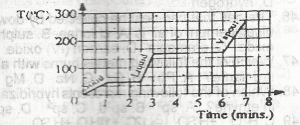
Use the graph above to answer this question.If the gas is cooled, at what temperature will it start to condense?
Attached Figure / Diagram
A
125 oC
B
150oC
C
175oC
D
250oC
medium Difficulty
Verified Correct Answer: Option B
Chemical Principles & Mechanism
If the gas is cooled, the temperature at which it will start to condense will be the distance between the liquid and vapour from the graph. Extrapolate to the y-axis(Temperature axis), you'll discover it's around 150\(^0\)C.
The temperature at which water vapour in the air starts to condense is referred to as the dew point.However,condensation will occur when the water vapour in the air is cooled, changing from gas to liquid.
Source: Myschool Past Questions Archive (Record #31586)
Chemistry
UTME / JAMB 2001
Stoichiometry, Mole Concept & Volumetric Analysis
Diagram
Solution
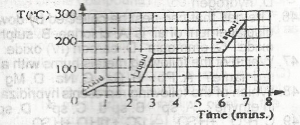
Use the graph above to answer this question.How long does it take all the solid to melt?`
Attached Figure / Diagram
A
2.5 mins
B
6.0 mins
C
1.0 min
D
3.0 mins
medium Difficulty
Verified Correct Answer: Option A
Chemical Principles & Mechanism
Melting involves change of state from solid to liquid. From the graph, check the interval from solid to liquid, it begins from 0 and ends at 2.5mins. Option A is the answer
Source: Myschool Past Questions Archive (Record #31588)
Chemistry
UTME / JAMB 2001
Chemical Bonding & Intermolecular Forces
Diagram
Solution
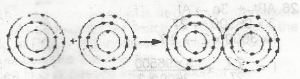
The diagram above represents the formation of
Attached Figure / Diagram
A
a metallic bond
B
an electrovalent bond
C
a covalent bond
D
a coordinate covalent bond
medium Difficulty
Verified Correct Answer: Option C
Chemical Principles & Mechanism
Covalent bonds involve the sharing of electrons between two atoms
Source: Myschool Past Questions Archive (Record #31590)
Chemistry
UTME / JAMB 2001
Water, Solutions & Solubility
Diagram
Solution
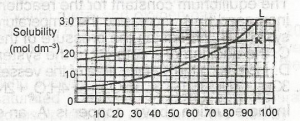
Use the solubility curves below to answer the question. If 1 dm\(^3\) of a saturated solution of L at 60\(^0\)C is cooled to 25\(^0\)C, what amount in mole will separate out?
Attached Figure / Diagram
A
0.75
B
0.25
C
1.00
D
0.50
medium Difficulty
Verified Correct Answer: Option A
Chemical Principles & Mechanism
From the solubility curve given, if you extrapolate for solution L at 60\(^0\)C and 25\(^0\)C, the solubility values will be 1.5 moldm\(^{-3}\) and 0.75 moldm\(^{-3}\) respectively.
To determine the amount in mole that will separate out, subtract the solubility of the initial temperature 25\(^0\)C from that of the final temperature 60\(^0\)C.
i.e 1.5 - 0.75 = 0.75 - Option A
Source: Myschool Past Questions Archive (Record #31592)
Chemistry
WAEC / WASSCE 2001
Periodic Table & Periodicity
Solution
Elements which belong to the same group in the Periodic Table are characterized by
A
difference of +1 in the oxidation numbers of successive members
B
presence of the same number of outermost electrons in the respective atoms
C
difference of 14 atomic mass units between successive members
D
presence of the same number of electron shells in the respective atoms
medium Difficulty
Verified Correct Answer: Option B
Chemical Principles & Mechanism
Elements in the same group have the same number of valence electron in their outermost shell while elements in the same period have the same number of shells.
Source: Myschool Past Questions Archive (Record #36829)
Chemistry
WAEC / WASSCE 2001
Particulate Nature of Matter, Laws & Formulae
Solution
The atom of an element X combines with aluminium (\(_{13}\)AI). What is the formula of the compound formed?
A
AIX 2
B
AI 2X
C
AI2X 2
D
AI 2X 3
medium Difficulty
Verified Correct Answer: Option D
Chemical Principles & Mechanism
Even though we were not told if the element X were a monoatomic or diatomic, inasmuch as Aluminium has a valency of +3, and there is going to be an exchange of valency between the two atoms of elements combining, X will definitely take the 3 from Al, and from the options, only option D has X having 3. Consequently, the correct option is D.
Source: Myschool Past Questions Archive (Record #36830)
Chemistry
WAEC / WASSCE 2001
Metals, Transition Elements & Extraction
Solution
The presence of unpaired electrons in an atom of a transition metal gives rise to
A
paramagnetism
B
malleability
C
malleability
D
ductility
E
shiny appearance
medium Difficulty
Verified Correct Answer: Option A
Chemical Principles & Mechanism
Paramagnetism occurs when an atom or material has unpaired electrons, which act like tiny magnets due to their spin. The magnetic moment of an electron is a result of its spin and orbital motion. Paramagnetism in transition metals is caused by the presence of unpaired electrons in their atomic and ionic species.
Source: Myschool Past Questions Archive (Record #36831)
Chemistry
WAEC / WASSCE 2001
Chemical Bonding & Intermolecular Forces
Solution
What is responsible for metallic bonding?
A
Sharing of electrons between the metal atoms
B
Attraction between the atomic unclei and cloud of electrons
C
transfer of electrons from one atom to another
D
Attraction between positive and negative ions
medium Difficulty
Verified Correct Answer: Option B
Chemical Principles & Mechanism
The positive ions and delocalized electrons are strongly attracted to each other, forming a metallic bond. Metallic bonding occurs when positively charged metal ions are attracted to delocalized electrons.
Source: Myschool Past Questions Archive (Record #36832)
Chemistry
WAEC / WASSCE 2001
Chemical Bonding & Intermolecular Forces
Solution
Which of the following compounds is covalent?
A
CaCI2
B
MgO
C
NaN
D
CH4
medium Difficulty
Verified Correct Answer: Option D
Chemical Principles & Mechanism
A covalent compound is a molecule that is formed when two or more different atoms are connected with a covalent bond. Covalent compounds are basically the molecules that form when two different atoms form a covalent bond. They typically have similar electronegativity and are non-metals. Only Option D has two non-metals.
Source: Myschool Past Questions Archive (Record #36833)
Chemistry
WAEC / WASSCE 2001
Atomic Structure, Orbitals & Nuclear Chemistry
Solution
A sheet of paper is placed in the path of a beam from a radioactive source. The emissions that pass through the paper consist of
A
alpha particles and gamma rays
B
alpha and beta particles
C
beta particles and gamma rays
D
alpha particles only
medium Difficulty
Verified Correct Answer: Option C
Chemical Principles & Mechanism
Among the three types of radiations, alpha, beta and Gamma rays, it is only alpha rays that cannot penetrate a piece of paper or human hand, as it has the lowest penetrating power though the highest ionizing power. However, Beta particles and Gamma rays can pass through or penetrate a piece of paper. Option C is the correct answer.
Source: Myschool Past Questions Archive (Record #36834)
Chemistry
WAEC / WASSCE 2001
Atomic Structure, Orbitals & Nuclear Chemistry
Solution
Which of the following features of a human skeleton can be determined by carbon-dating?
A
Height
B
Mass
C
Age
D
Race
medium Difficulty
Verified Correct Answer: Option C
Chemical Principles & Mechanism
Radiocarbon dating is often used in forensics to determine the age and year of death of unidentified human remains. It can also be used to identify a person's year of birth by measuring carbon-14 levels in tooth enamel. Carbon-dating, also known as carbon-14 dating, can be used to determine the age of a human skeleton.
Source: Myschool Past Questions Archive (Record #36836)
Chemistry
WAEC / WASSCE 2001
Kinetic Theory of Matter & Gas Laws
Solution
Which of the following statements about ideal gases is/are correct? 1. The cohesive forces between their particles are negligible ll. They have no definite volume but occupy the volume of their containers III. They are not compressible IV. Their particles collide with loss of energy
A
l only
B
l and ll only
C
l, ll and lll only
D
l, ll, lll, and IV
medium Difficulty
Verified Correct Answer: Option B
Chemical Principles & Mechanism
Here are some properties of ideal gases:
Inert: Ideal gases are assumed to not react with each other.
Elastic collisions: Ideal gases collide with the container's walls elastically, meaning they don't lose energy after collisions.
Take the shape of their container: Ideal gases take the shape of their container, so the volume of the container is the same as the volume of the gas.
Follow the ideal gas law: The ideal gas law is PV= nRT
Compressibility factor of 1: The compressibility factor of an ideal gas is exactly 1.
Source: Myschool Past Questions Archive (Record #36839)