Question Library
Browse, filter, and study verified past examination questions with step-by-step mathematical reasoning.
Searching 18,000+ Questions...
Sifting topics, KaTeX formulas & verified solutions
Showing 18331–18345 of 29811 verified questions
Sort by:
Physics
WAEC / WASSCE 2001
Magnetism, Electromagnetism & AC Circuits
Diagram
Solution
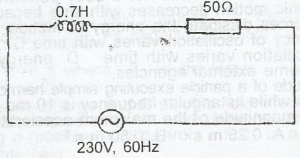
Calculate the reactance of the inductor in the circuit diagram shown above [\(\pi = \frac{22}{7}\)]
Attached Figure / Diagram
A
132\(\Omega\)
B
214\(\Omega\)
C
264\(\Omega\)
D
269\(\Omega\)
medium Difficulty
Verified Correct Answer: Option C
Physical Principles & Numerical Solution
\(X_L = 2 \pi fL = 2 \times \pi \times 60 \times 0.7 = 264\Omega \)
Source: Myschool Past Questions Archive (Record #33944)
Physics
WAEC / WASSCE 2001
Atomic, Quantum, Nuclear Physics & Electronics
Solution
Production of x-ray tube begins with
A
photo electric emission
B
collision of electrons
C
thermionic emission
D
field emission of electrons
medium Difficulty
Verified Correct Answer: Option C
Physical Principles & Numerical Solution
The production of X-rays in an X-ray tube begins with thermionic emission from the hot cathode.
Source: Myschool Past Questions Archive (Record #33946)
Physics
WAEC / WASSCE 2001
Current Electricity & Electric Circuits
Solution
You are provided with two wires marked P and C. a resistor \(R_s\) = 1\(\Omega\) and other necessary apparatus.
Connect \(R_s\) in the left-hand gap of the metre bridge, a length L= 100cm of wire P in the right-hand gap and the other apparatus as shown in the diagram: above
Determine the balance point B on the bridge wire AC
Measure and record AB =/s, and BC = /
Evaluate \(R_1\) = (\(\frac{|_{p}}{|_{s}}\))Rs
Repeat the procedure for four other values of L = 90, 80, 70 and 60cm. In each case obtain and record the value of |\(_{s}\) and |\(_{p}\) and evaluate \(R_1\) = (\(\frac{|_{p}}{|_{s}}\))Rs
Repeat the experiment with the second wire, Q. Obtain the value of |\(_{s}\) and |\(_{Q}\) for equal lengths of wire as used in wire P.
Evaluate \(R_1\) = (\(\frac{|_{p}}{|_{s}}\))Rs. In each case, tabulate your readings.
Plot a graph of \(R_2\) on the Vertical axis against \(R_1\) on the horizontal axis.
Determine the slope S, of the graph.
Evaluate the k = \(\sqrt s\).
State two precautions taken to ensure accurate results.
(b)i. Define the resistivity of the material of a wire.
ii. A galvanometer with a full-scale-deflection of 1.5 x10\(^{3}\). A has a resistance of 50\(\Omega\). Determine the resistance required to convert it into a voltmeter reading up to 1.5V.
A
photo electric emission
B
collision of electrons
C
thermionic emission
D
field emission of electrons
medium Difficulty
Verified Correct Answer: Option C
Physical Principles & Numerical Solution
Table of values
L(cm)\(^{3}\)
Ls(cm)
Lp(cm)
\(R_1\)
100
5.3
94.7
17.90
90
6.5
93.5
14.40
80
7.0
93.0
13.30
70
8.5
91.5
10.80
60
9.5
90.5
9.50
L(cm)
Is\(^{1}\)
Lg
\(R_2\)
100
21.60
78.4
3.60
90
22.1
77.9
3.50
80
23.4
76.6
3.30
70
24.3
75.7
3.10
60
25.3
74.7
2.95
L(cm)
Ls(cm)
Lp(cm)
\(R_1\)
Ls\(^{1}\)cm\(^{3}\)
Lq
R\(^{2}\)
100
5.3
94.7
17.90
21.6
78.4
3.60
90
6.5
93.5
14.40
22.1
77.9
3.50
80
7.0
93.0
13.30
23.4
76.6
3.30
70
8.5
91.5
10.80
24.3
75.7
3.10
60
9.5
90.5
9.50
25.3
74.7
2.95
Slope (s) = of the graph = \(\frac{DR_{2}}{DR_{1}} = \frac{1.4}{8.0}\) = 0.175
K = \(\sqrt 5\) = 0.17555 = 0.42
Precautions:
Key was opened where readings were not being taken.
Tight connections were ensured
ParallaX errors were avoided in reading the metre rule.
Zero error was noted in reading the metre rule.
The jockey was not rolled on or allowed to scratch the wire.
(b) The resistivity of a material is defined as the resistance of a unit length of the material/wire of a uni cross-sectional area.
OR
P = \(\frac{AR}{L}\) where
A = cross-sectional area
R = eletrical resistance
L = length of the wire
V = Vg + \(V_R\) = IRg + IR = I (Rg + R) \(\therefore\) \(\frac{V}{I}\) = Rg+ R
= \(\frac{1.5}{1.5 \times 10^{-3}}\) = 50 + R = 10\(^{3}\) = 50 + R \(\therefore\) R = 950\(\Omega\)
Source: Official Exam / Past Question Archive
Physics
UTME / JAMB 2001
Waves, Sound & Vibrations
Solution
Find the frequencies of the first three harmonics of a piano string of length 1.5m, if the velocity of the wave on the string is 120ms-1
A
40Hz, 80Hz, 120Hz
B
80Hz, 160Hz, 240Hz
C
180Hz, 360Hz, 540Hz
D
369Hz, 180Hz, 90Hz
medium Difficulty
Verified Correct Answer: Option A
Physical Principles & Numerical Solution
in vibrations in string, the fundamental frequency happens to be the first harmonic, and is given as
f\(_0\) = \(\frac{V}{2l}\)
Where V = Velocity of the sound wave, I = Length of the string.
The second harmonic is the first overtone given by
f1 = \(\frac{V}{l}\) = 2f0 ;
and the third harmonic happens to be the second overtone, given by
f2 = \(\frac{3V}{2l}\) = 2f0.
Thus if V = 120m/s and l = 1.5m
Thus f1 = 2f0 = 2 x 40 = 80Hz
Thus f2 = 3f0 = 3 x 40 = 120Hz
Thus we have in order, 40Hz, 80Hz, 120Hz
Source: Myschool Past Questions Archive (Record #41482)
Physics
UTME / JAMB 2001
Current Electricity & Electric Circuits
Solution
A bread toaster uses a current of 4A when plugged in a 240V line. it takes 1 minute to toast slices of bread. what is the energy consumed by the toaster
A
5.76 x 10⁴J
B
1.60 x 10⁴J
C
3.60 x 10³J
D
1.60 x 10²J
medium Difficulty
Verified Correct Answer: Option A
Physical Principles & Numerical Solution
Electrical Energy = IVt
= 4 x 240 x (1 x 60)
= 57600J
= 5.76 x 10⁴J
Source: Myschool Past Questions Archive (Record #41483)
Physics
UTME / JAMB 2001
Magnetism, Electromagnetism & AC Circuits
Solution
What is the angle of dip at the magnetic equator
A
\( 45^{\circ} \)
B
\( 0^{\circ} \)
C
\( 90^{\circ} \)
D
\( 180^{\circ} \)
medium Difficulty
Verified Correct Answer: Option B
Physical Principles & Numerical Solution
The angle of dip is the angle which the resultant earth's magnetic field makes with the horizontal.
At the magnetic equator, which is entirely along the horizontal this angle is zero
Source: Myschool Past Questions Archive (Record #41484)
Physics
NECO SSCE 2001
Current Electricity & Electric Circuits
The invisible part of the spectrum of white light consists of
A
Infra-red and ultra-violet only
B
Infra-red, ultra-violet and blue only
C
red, orange and green only
D
red and violet only
E
yellow and indigo only
medium Difficulty
Verified Correct Answer: Option A
Physical Principles & Numerical Solution
No expanded working has been attached for this question yet. The verified answer is Option A.
Source: Myschool Past Questions Archive (Record #42811)
Physics
NECO SSCE 2001
Gas Laws & Heat Transfer
Solution
50cm\(^3\) of air at a pressure of 5Nm\(^{-2}\) is enclosed in a metal tube by a piston. If the piston is pushed in a distance of 10cm, what will the pressure of the air become, if the cross-sectional area of the tube is 2cm\(^{-2}\)? (Assume that the temperature remains constant throughout)
A
12.5 Nm-2
B
8.7 Nm-2
C
8.3 Nm-2
D
3.8Nm-2
E
3.0Nm-2
medium Difficulty
Verified Correct Answer: Option C
Physical Principles & Numerical Solution
This is an application of Boyle’s Law (since temperature is constant):
P\(_1\)V\(_1\) = P\(_2\)V\(_2\)
Given:
- Initial volume, V\(_1\) = 50 cm\(^3\)
- Initial pressure, P\(_1\) = 5 N m\(^{-2}\)
- Distance piston is pushed in = 10 cm
- Cross-sectional area of tube, A = 2 cm\(^2\)
Decrease in volume = Area \times Distance moved
= 2 cm\(^2\) \times 10 cm
= 20 cm\(^3\)
Calculate the new volume V\(_2\)
V\(_2\) = V\(_1\) − decrease in volume
= 50 cm\(^3\) − 20 cm\(^3\)
= 30 cm\(^3\)
Apply Boyle’s Law
P\(_1\)V\(_1\) = P\(_2\)V\(_2\)
5 \times 50 = P\(_2\) \times 30
P\(_2\) = \(\frac{(5 \times 50)}{ 30}\)
P\(_2\) = \(\frac{250}{30}\)
P\(_2\) = \(\frac{25}{3}\) N m\(^{-2}\)
(The pressure increases because the volume decreases at constant temperature.)
Source: Myschool Past Questions Archive (Record #42812)
Physics
NECO SSCE 2001
Atomic, Quantum, Nuclear Physics & Electronics
Which scientist discovered natural radioactivity?
A
Enrico Fermi
B
Henri Becquerel
C
Marie Curie
D
Micheal Faraday
E
Niels Bohr
medium Difficulty
Verified Correct Answer: Option B
Physical Principles & Numerical Solution
No expanded working has been attached for this question yet. The verified answer is Option B.
Source: Myschool Past Questions Archive (Record #42813)
Physics
NECO SSCE 2001
Reflection, Refraction & Dispersion of Light
Solution
Totally reflecting prisms are preferred to mirrors in periscopes because
I. mirror gives multiple images
II. silvering on mirrors is easily damaged
III. mirrors reflect less light than totally reflecting prisms
A
I only
B
I and II only
C
I and III only
D
II and III only
E
I,II and III
medium Difficulty
Verified Correct Answer: Option E
Physical Principles & Numerical Solution
Total internal reflection in prisms occurs without loss of light, while mirrors can have some absorption and scattering. Thus, totally reflecting prisms generally reflect more light, and the silvering (reflective coating) on mirrors can be easily scratched or damaged, which makes them less durable than totally reflecting prisms.
An ordinary mirror is that it reflects from both surfaces. giving multiple reflections.
Source: Myschool Past Questions Archive (Record #42814)
Physics
NECO SSCE 2001
Electrostatics & Capacitors
What is the energy stored in a 10μ F capacitor if the potential difference between the plates is 40 V?
A
2.0 × 10⁻⁴J
B
8.0 ×10⁻⁴J
C
4.0 × 10⁻³J
D
8.0 × 10⁻³J
E
1.6 × 10⁻²J
medium Difficulty
Verified Correct Answer: Option D
Physical Principles & Numerical Solution
No expanded working has been attached for this question yet. The verified answer is Option D.
Source: Myschool Past Questions Archive (Record #42815)
Physics
NECO SSCE 2001
Current Electricity & Electric Circuits
Solution
Notes of the same frequency sounded on a piano and on a flute may differ in
I. pitch
II. quality
III. Loudness
A
I only
B
II only
C
I and III only
D
II and III only
E
I, II and III
medium Difficulty
Verified Correct Answer: Option B
Physical Principles & Numerical Solution
Quality is that characteristic note which distinguishes the two sounds of the same loudness and same pitch but emitted by two different instruments.
Source: Myschool Past Questions Archive (Record #42816)
Physics
NECO SSCE 2001
Current Electricity & Electric Circuits
What is X in the equation given below? 42He + 94Be → 126C + X
A
electron
B
hydrogen
C
lithium
D
neutron
E
proton
medium Difficulty
Verified Correct Answer: Option D
Physical Principles & Numerical Solution
No expanded working has been attached for this question yet. The verified answer is Option D.
Source: Myschool Past Questions Archive (Record #42817)
Physics
NECO SSCE 2001
Calorimetry, Latent Heat & Change of State
Solution
A waterfall is 630m high. What is the change in temperature of a quantity of water that falls from the top to the bottom of the waterfall? (Neglect heat losses to the surroundings, take g as 10 ms-2 and specific heat capacity of weather as 4200J kg-1K-1
A
0.015°C
B
1.50°C
C
15.00°C
D
21.00 °C
E
50.00°C
medium Difficulty
Verified Correct Answer: Option B
Physical Principles & Numerical Solution
water height as 630m, gravity = 10m/s\(^2\), specific heat capacity of weather as 4200J
Temperature change = \(\frac{gh}{c}\) = \(\frac{630 \times 10}{4200}\)
= 1.5ºC
Source: Myschool Past Questions Archive (Record #42818)
Physics
NECO SSCE 2001
Current Electricity & Electric Circuits
N.N.P.C. gas cylinder containing 15kg of cooking gas was left open, and the gas emptied in 3.8 minutes, at an average speed of 20 ms-1. What force was exerted on the gas in the cylinder?
A
132N
B
13.2N
C
1.32N
D
0.132N
E
0.013N
medium Difficulty
Verified Correct Answer: Option C
Physical Principles & Numerical Solution
No expanded working has been attached for this question yet. The verified answer is Option C.
Source: Myschool Past Questions Archive (Record #42819)