Question Library
Browse, filter, and study verified past examination questions with step-by-step mathematical reasoning.
Searching 18,000+ Questions...
Sifting topics, KaTeX formulas & verified solutions
Showing 18301–18315 of 29811 verified questions
Sort by:
Physics
WAEC / WASSCE 2001
Work, Energy, Power & Simple Machines
Solution
A simple machine with an efficiency of 75% lifts a load of 5000N when a force of 500N is applied to it. Calculate the velocity ratio of the machine
A
10.0
B
13.3
C
17.5
D
25.0
medium Difficulty
Verified Correct Answer: Option B
Physical Principles & Numerical Solution
M.A = \(\frac{load}{effort} \frac{5000N}{500N} = 10\)
V.R = \(\frac{M.A \times 100}{V} = \frac{10 \times 100}{75} = 13.3\)
Source: Myschool Past Questions Archive (Record #33876)
Physics
WAEC / WASSCE 2001
Work, Energy, Power & Simple Machines
Solution
A screw jack with a Tommy bar of length 12cm is used to raise a car through a vertical height of 25cm by turning the Tommy bar through 50 revolutions. Calculate the approximate velocity ratio of the jack [\(\pi = 3.142\)]
A
21
B
38
C
48
D
151
medium Difficulty
Verified Correct Answer: Option D
Physical Principles & Numerical Solution
P = \(\frac{25}{50} = 0.5\)
V.R = \(\frac{2\pi D}{p} = \frac{2 \times 3.142 \times 12}{0.5}\)
= 151
Source: Myschool Past Questions Archive (Record #33880)
Physics
WAEC / WASSCE 2001
Equilibrium of Forces, Moments & Flotation
Diagram
Solution
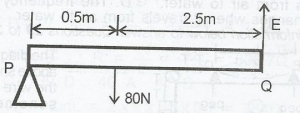
a beam PQ pivoted at P carries a load of 80N as shown above. Calculate the effort E, required to keep it horizontal. [neglect the weight of the beam]
Attached Figure / Diagram
A
32.0N
B
26.7N
C
16.0N
D
13.3N
medium Difficulty
Verified Correct Answer: Option D
Physical Principles & Numerical Solution
E x 3 = 80 x 0.5
E3 = 40
E = \(\frac{40}{3} = 13.3N\)
Source: Myschool Past Questions Archive (Record #33883)
Physics
WAEC / WASSCE 2001
Temperature, Thermometry & Thermal Expansion
Solution
A resistance thermometer has a resistance of 20\(\Omega\) at 0oC and 85\(\Omega\) at 100oC. If its resistance is 52\(\Omega\)in a medium, calculate the corresponding temperature
A
49.2oC
B
60.6oC
C
80.0oC
D
84.7oC
medium Difficulty
Verified Correct Answer: Option A
Physical Principles & Numerical Solution
85\(\Omega\) ........100oC
52\(\Omega\) ........\(\theta\)oC
20\(\Omega\) ........0oC
\(\frac{52 - 20}{85 - 20} = \frac{\theta - 0}{100 - 0}\)
\(\theta = \frac{32 \times 100}{65} = 49.2^oC\)
Source: Myschool Past Questions Archive (Record #33890)
Physics
WAEC / WASSCE 2001
Gas Laws & Heat Transfer
Solution
A given mass of an ideal gas has a pressure of 500Nm-2 at -13ºC. If its volume remains constant. Calculate its pressure at 247ºC.
A
25Nm-2
B
50Nm-2
C
500Nm-2
D
1000Nm-2
medium Difficulty
Verified Correct Answer: Option D
Physical Principles & Numerical Solution
\(P_2 = \frac{p_1 \times T_2}{T_1} = \frac{500 \times 520}{260}\)
= 1000N\(m^{-2}\)
Source: Myschool Past Questions Archive (Record #33893)
Physics
WAEC / WASSCE 2001
Gas Laws & Heat Transfer
Solution
The volume of an ideal gas at a pressure of 77 cmHg and a temperature of 60 ^\circC is 240 cm\(^3\). If the temperature and pressure are increased to 98oC
and 81cmHg respectively, calculate the new volume of the gas
A
411.5cm3
B
267.1cm3
C
254.2cm3
D
112.7cm3
medium Difficulty
Verified Correct Answer: Option C
Physical Principles & Numerical Solution
V2 = \(\frac{P_1V_1T_2}{P_2T_1} = \frac{77 \times 240 \times 371}{81 \times 333}\)
= 254.2cm3
Source: Myschool Past Questions Archive (Record #33897)
Physics
WAEC / WASSCE 2001
Calorimetry, Latent Heat & Change of State
Solution
The amount of heat given out or absorbed when a substance changes its state at a constant temperature is known as
A
latent heat
B
heat capacity
C
specific latent heat
D
specific heat capacity
medium Difficulty
Verified Correct Answer: Option A
Physical Principles & Numerical Solution
The amount of heat given out or absorbed when a substance changes its state at a constant temperature is known as latent heat.
Source: Myschool Past Questions Archive (Record #33899)
Physics
WAEC / WASSCE 2001
Calorimetry, Latent Heat & Change of State
Solution
Which of the following physical qualities affects the saturated vapour pressure of a liquid ?
A
temperature
B
volume
C
mass
D
density
medium Difficulty
Verified Correct Answer: Option A
Physical Principles & Numerical Solution
The saturated vapor pressure of a liquid is primarily affected by temperature. As the temperature increases, the vapor pressure also increases.
Source: Myschool Past Questions Archive (Record #33901)
Physics
WAEC / WASSCE 2001
Current Electricity & Electric Circuits
Solution
Humidity is used to describe the amount of
A
air in water vapour
B
cloud available in the atmosphere
C
air in equal volume of cloud
D
water vapour in the amosphere
medium Difficulty
Verified Correct Answer: Option D
Physical Principles & Numerical Solution
Humidity is used to describe the amount of water vapor in the atmosphere. So OPTION D is correct.
Source: Myschool Past Questions Archive (Record #33903)
Physics
WAEC / WASSCE 2001
Reflection, Refraction & Dispersion of Light
Solution
Surface waves travelling in deep water at 15ms-1 are incident at a shallow water boundary. If the angles of incidence and refraction are 45o and 30o respectively. Calculate the speed of the waves in shallow water
A
8.1ms-1
B
10.0ms-1
C
10.6ms-1
D
22.5ms-1
medium Difficulty
Verified Correct Answer: Option C
Physical Principles & Numerical Solution
n = \(\frac{\sin 45}{\sin 30} = 1.4142\)
n = \(\frac{15m/s}{x}\)
x = \(\frac{15}{1.4142}\) = 10.6m/s
Source: Myschool Past Questions Archive (Record #33907)
Physics
WAEC / WASSCE 2001
Reflection, Refraction & Dispersion of Light
Solution
An incident ray is reflected normally by a plane mirror onto a screen where it forms a bright spot. The mirror and screen are parallel and 1m apart. If the mirror is rotated through 5º, calculate the displacement of the spot
A
8.7cm
B
10.0cm
C
15.4cm
D
17.6cm
medium Difficulty
Verified Correct Answer: Option D
Physical Principles & Numerical Solution
From the diagram above,
Tan\(\theta\) = \(\frac{\text{d}}{100}\)
Tan10º = \(\frac{\text{d}}{100}\)
d = 100 x Tan 10º = 100 x 0.1763 ≈ 17.6cm.
Source: Myschool Past Questions Archive (Record #33909)
Physics
WAEC / WASSCE 2001
Reflection, Refraction & Dispersion of Light
Solution
Convex spherical mirrors are preferred to plane mirrors as driving mirrors because
A
the image produce is upright and clearly visible
B
it provides a wider field of view
C
the image produce is errect and diminished
D
the image produced is not laterally inverted
medium Difficulty
Verified Correct Answer: Option B
Physical Principles & Numerical Solution
Convex spherical mirrors are preferred as driving mirrors mainly because they provide a wider field of view.
Source: Myschool Past Questions Archive (Record #33910)
Physics
WAEC / WASSCE 2001
Current Electricity & Electric Circuits
Solution
An object is placed 20cm from a lens. If an image is formed on a screen 260cm away from the lens, calculate the magnification of the image
A
28
B
26
C
24
D
13
medium Difficulty
Verified Correct Answer: Option D
Physical Principles & Numerical Solution
M = \(\frac{v}{u} = \frac{260}{20} = 13\)
Source: Myschool Past Questions Archive (Record #33911)
Physics
WAEC / WASSCE 2001
Current Electricity & Electric Circuits
Solution
A piece of cloth appears green in sunlight. When held in red light, it will appear
A
green
B
blue
C
red
D
black
medium Difficulty
Verified Correct Answer: Option D
Physical Principles & Numerical Solution
A piece of cloth that appears green in sunlight reflects green light and absorbs other colors. When held in red light, it will not reflect any red light because it does not contain red pigments to reflect that color.
Source: Myschool Past Questions Archive (Record #33912)
Physics
WAEC / WASSCE 2001
Reflection, Refraction & Dispersion of Light
Solution
Dispersion of white light by a glass prism occurs because
A
white light consist of a mixture of seven different colour
B
the refractive index of glass is different from each constituent colour of white light
C
the speed of each colour of light in the glass is proportional to the refractive index of glass for each colour
D
the speed of each colour of light in the glass is proportional to the angle of refraction in he prism
medium Difficulty
Verified Correct Answer: Option B
Physical Principles & Numerical Solution
Dispersion of white light by a glass prism occurs because the refractive index of glass varies for each color. This difference causes each color to bend at a different angle, resulting in a spectrum of colors.
Source: Myschool Past Questions Archive (Record #33913)