Question Library
Browse, filter, and study verified past examination questions with step-by-step mathematical reasoning.
Searching 18,000+ Questions...
Sifting topics, KaTeX formulas & verified solutions
Showing 18031–18045 of 29811 verified questions
Sort by:
Mathematics
UTME / JAMB 2001
Plane Geometry, Polygons & Circle Theorems
Solution
If 6Pr = 6, find the value of 6Pr+1
A
30
B
33
C
35
D
15
medium Difficulty
Verified Correct Answer: Option A
Step-by-Step Mathematical Solution
6Pr = 6 Thus r = 1
N.B 6P1 = \(\frac{\text{6!}}{\text{(6 - 1)!}}\)
= \(\frac{\text{6!}}{\text{5!}}\)
= \(\frac{6 \times \text{5!}}{\text{5!}}\) = 6
6Pr + 1 = 6P2 = \(\frac{\text{6!}}{(6 - 2)\text{!}} = \frac{6\text{!}}{\text{4!}}\)
= \(\frac{6 \times 5 \times \text{4!}}{\text{4!}}\)
= 30
Source: Myschool Past Questions Archive (Record #2869)
Mathematics
UTME / JAMB 2001
Statistics (Data Representation, Central Tendency & Dispersion)
Solution
Find the variance of 2, 6, 8, 6, 2 and 6
A
6
B
5
C
√6
D
√5
medium Difficulty
Verified Correct Answer: Option B
Step-by-Step Mathematical Solution
mean of X = x = (2+6+8+6+2+6)/6 = 30/6 = 5
X → 2,6,8,6,2,6
X - x = -3, 1, 3, 1, 3, 1
(X - x)2 = 9, 1, 9, 1, 9, 1
∑(X-x) = 9+1+9+1+9+1 = 30
Variance = ∑(X-x)2/n = 30/6 = 5
Source: Myschool Past Questions Archive (Record #7713)
Mathematics
UTME / JAMB 2001
Plane Geometry, Polygons & Circle Theorems
Solution
Find the number of ways of selecting 8 subjects from 12 subjects for an examination
A
490
B
495
C
496
D
498
medium Difficulty
Verified Correct Answer: Option B
Step-by-Step Mathematical Solution
To calculate the binomial coefficient \(^{12}C_{8}\):
\(^{12}C_{8} = \frac{12!}{8!4!} = \frac{12 \times 11 \times 10 \times 9}{4!}\)
Calculating \(4!\):
\(4! = 24\)
Thus, \(^{12}C_{8} = \frac{12 \times 11 \times 10 \times 9}{24} = \frac{11880}{24}\) = 495
= \(^{12}C_{8}\) = 495
Source: Myschool Past Questions Archive (Record #7715)
Mathematics
UTME / JAMB 2001
Plane Geometry, Polygons & Circle Theorems
Solution
Find the range of \(\frac{1}{6}\), \(\frac{1}{3}\), \(\frac{3}{2}\), \(\frac{2}{3}\), \(\frac{8}{9}\), and \(\frac{4}{3}\)
A
3/4
B
5/6
C
7/6
D
4/3
medium Difficulty
Verified Correct Answer: Option D
Step-by-Step Mathematical Solution
\(\frac{1}{6}\), \(\frac{1}{3}\), \(\frac{3}{2}\), \(\frac{2}{3}\), \(\frac{8}{9}\) and \(\frac{4}{3}\).
L.C.M of the denominators = 36
The fraction now becomes
\(\frac{6}{36}\), \(\frac{12}{36}\), \(\frac{54}{36}\), \(\frac{24}{36}\), \(\frac{32}{36}\), and \(\frac{48}{36}\).
Highest fraction = \(\frac{54}{36}\)
Lowest fraction = \(\frac{6}{36}\)
Range = Highest - Lowest
( \(\frac{54}{36}\)) - ( \(\frac{6}{36}\))
= \(\frac{48}{36}\)
= \(\frac{4}{3}\).
Source: Myschool Past Questions Archive (Record #7718)
Mathematics
WAEC / WASSCE 2001
Plane Geometry, Polygons & Circle Theorems
Solution
PQRS is a rhombus of side 16cm. The diagonal |QS| = 20cm. Calculate, correct to the nearest degree, ∠PQR
A
51o
B
64o
C
77o
D
103o
medium Difficulty
Verified Correct Answer: Option D
Step-by-Step Mathematical Solution
cos\(\alpha\) = \(\frac{10}{16}\) = 0.625
\(\alpha\) = cos-1(0.625)
= 51.3º
∠PQR = 2\(\alpha\)
= 2(51.3º)
= 102.6
= 103º
Source: WAEC / JAMB / NECO Classroom Archive (Record #26509)
Mathematics
NECO SSCE 2001
Trigonometry, Elevation & Bearings
Solution
If cos x = - \(\frac{5}{13}\) where 180° < X < 270°, what is the value of tan x -sin x ?
A
\(\frac{111}{13}\)
B
\(\frac{321}{65}\)
C
\(\frac{216}{65}\)
D
\(\frac{112}{13}\)
E
\(\frac{131}{65}\)
medium Difficulty
Verified Correct Answer: Option C
Step-by-Step Mathematical Solution
Given \(\cos x = -\frac{5}{13}\) where \(180^\circ < x < 270^\circ\):
Using: \(\sin^2 x + \cos^2 x = 1\)
\(\sin^2 x = 1 - \left(-\frac{5}{13}\right)^2 = \frac{144}{169} \implies \sin x = -\frac{12}{13}\)
\(\tan x = \frac{\sin x}{\cos x} = \frac{-\frac{12}{13}}{-\frac{5}{13}} = \frac{12}{5}\)
Calculating \(\tan x - \sin x\):
\(\tan x - \sin x = \frac{12}{5} - \left(-\frac{12}{13}\right) = \frac{12}{5} + \frac{12}{13}\)
Finding a common denominator (65):
\(\tan x - \sin x = \frac{12 \times 13}{65} + \frac{12 \times 5}{65} = \frac{156}{65} + \frac{60}{65} = \frac{216}{65}\)
Thus, the value is:
\(\tan x - \sin x = \frac{216}{65}\)
Source: WAEC / JAMB / NECO Classroom Archive (Record #41798)
Mathematics
NECO SSCE 2001
Fractions, Decimals, Percentages & Approximations
Solution
Evaluate (\(\frac{1}{343}\))\(^{\frac{1}{3}}\) + (64)\(^{-\frac{1}{3}}\) - \(\frac{4}{9}\)\(^{-\frac{1}{2}}\)
A
-\(\frac{17}{36}\)
B
-\(\frac{3}{28}\)
C
-\(\frac{31}{28}\)
D
\(\frac{17}{36}\)
E
\(\frac{1}{4}\)
medium Difficulty
Verified Correct Answer: Option C
Step-by-Step Mathematical Solution
(\(\frac{1}{343}\))\(^{\frac{1}{3}}\) + (64)\(^{-\frac{1}{3}}\) - \(\frac{4}{9}\)\(^{-\frac{1}{2}}\)
where \(343 = 7^3, 64 = 2^6, 4 = 2^2, 9 = 3^2\)
\(7^{-3}\) \(^{\frac{1}{3}}\) + \(2^6\) \(^{\frac{-1}{3}}\) - \(\frac{2^2}{3^2}\) \(^{\frac{-1}{2}}\)
\(7^{-1} + 2^{-2} - (\frac{2}{3})^{-1}\)
\(\frac{1}{7} + \frac{1}{4} - \frac{3}{2}\)
\(\frac{4+7-42}{28}\)
-\(\frac{31}{28}\)
Source: WAEC / JAMB / NECO Classroom Archive (Record #41952)
Mathematics
NECO SSCE 2001
Inequalities & Linear Programming
Solution
Given that \(\frac{(3 - y)}{2x}\) = \(\frac{(6y + 7)}{(4x - 5)}\), find the value of x when y = 2
A
\(\frac{64}{5}\)
B
6
C
\(\frac{5}{34}\)
D
\(\frac{-5}{34}\)
E
\(\frac{-64}{5}\)
medium Difficulty
Verified Correct Answer: Option D
Step-by-Step Mathematical Solution
Given:
\(\frac{3 - y}{2x} = \frac{6y + 7}{4x - 5}\)
Substitute y = 2
\(\frac{3 - 2}{2x} = \frac{6(2) + 7}{4x - 5} \implies \frac{1}{2x} = \frac{19}{4x - 5}\)
Cross-multiply: 1 \(\cdot\) (4x - 5) = 19 \(\cdot\) 2x
4x - 5 = 38x
-5 = 38x - 4x
-5 = 34x
x = -\(\frac{5}{34}\)
Source: WAEC / JAMB / NECO Classroom Archive (Record #41801)
Mathematics
NECO SSCE 2001
Sequences & Series (AP & GP)
Solution
Find the 19th term of the A.P. \(\frac{5}{6}\), \(\frac{8}{6}\), \(\frac{11}{6}\).................
A
7\(\frac{1}{2}\)
B
9
C
9\(\frac{1}{2}\)
D
9\(\frac{5}{6}\)
E
10
medium Difficulty
Verified Correct Answer: Option D
Step-by-Step Mathematical Solution
first term (a) = \(\frac{5}{6}\)
common difference = \(\frac{8}{6}\) - \(\frac{5}{6}\) → \(\frac{3}{6}\) or \(\frac{1}{2}\)
A.P formula → T\(_n\) = a + (n - 1)d
T\(_n\) = \(\frac{5}{6}\) + (19 - 1)\(\frac{1}{2}\)
T\(_n\) = \(\frac{5}{6}\) + 9
→ 9\(\frac{5}{6}\)
Source: WAEC / JAMB / NECO Classroom Archive (Record #41776)
Mathematics
WAEC / WASSCE 2001
Statistics (Data Representation, Central Tendency & Dispersion)
Diagram
Solution
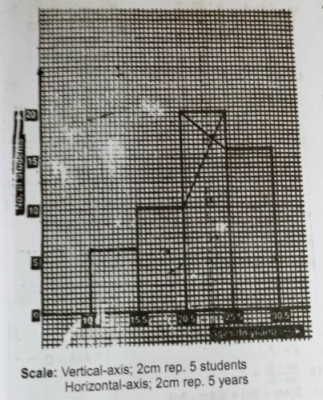
How many students are there in the group?
Attached Figure / Diagram
A
25
B
30
C
52
D
55
medium Difficulty
Verified Correct Answer: Option C
Step-by-Step Mathematical Solution
Total number of students = 20 + 16 + 10 + 6
= 52 students
Source: WAEC / JAMB / NECO Classroom Archive (Record #26506)
Mathematics
NECO SSCE 2001
Permutations, Combinations & Probability
Diagram
Solution
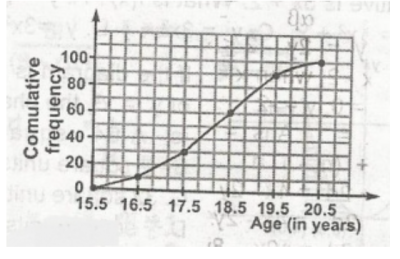
51 women wore coloured shoes to a party, out of which 21 wore purple and 9 wore white. if a woman is selected at Random. What is the probability that she is wearing neither a purple shoe nor a white shoe?
Attached Figure / Diagram
A
\(\frac{10}{17}\)
B
\(\frac{7}{17}\)
C
\(\frac{20}{51}\)
D
\(\frac{3}{17}\)
E
\(\frac{1}{51}\)
medium Difficulty
Verified Correct Answer: Option B
Step-by-Step Mathematical Solution
No of women wearing both purple and white shoes = 21 + 9
= 30 women.
No of women wearing neither purple nor white shoes = 51 - 30
= 21 women
\(\therefore\) Probability of picking a woman wearing neither purple nor white shoes
= \(\frac{21}{51}\)
= \(\frac{7}{17}\).
Source: WAEC / JAMB / NECO Classroom Archive (Record #41883)
Physics
UTME / JAMB 2001
Circular Motion, Gravitation & Simple Harmonic Motion
Solution
I. The earth is not spherical but elliptical in shape
II. Variation in latitude and longitude
III. Rotation of the earth on its axis
IV. Variation in the density of the earth
On which combination of the above does the weight of an object vary on the earth's surface?
A
I, II, III and IV
B
III and IV only
C
I, II and III only
D
I and II only
medium Difficulty
Verified Correct Answer: Option C
Physical Principles & Numerical Solution
The three main reasons why the weight of an object varies on the earth's surface is
- The shape of the earth
- Variation in Longitude and latitude
-Rotation of the earth
Source: WAEC / JAMB / NECO Classroom Archive (Record #1508)
Physics
UTME / JAMB 2001
Work, Energy, Power & Simple Machines
Solution
A gas with initial volume of 2 X 10\(^{-6}m^3\) is allowed to expand to six times its initial value at constant pressure of 2 x 10\(^5Nm^{-2}\). The work done is?
A
2.0J
B
4. 0 J
C
12.0 J
D
2.4 J
medium Difficulty
Verified Correct Answer: Option A
Physical Principles & Numerical Solution
W = P\DeltaV = 2 x 10\(^5\) * (12 x 10\(^{-6}\) - 2 x 10\(^{-6}\))
= 2 x 10\(^5\) 10 x 10\(^{-6}\)
= 2.0J
Source: WAEC / JAMB / NECO Classroom Archive (Record #7255)
Physics
NECO SSCE 2001
Magnetism, Electromagnetism & AC Circuits
Solution
Which material is best for making a permanent magnet?
A
aluminium
B
cobalt
C
copper
D
soft iron
E
steel
medium Difficulty
Verified Correct Answer: Option E
Physical Principles & Numerical Solution
Permanent magnets are made from "hard" ferromagnetic materials such as alnico and ferrite
Permanent magnets are made from special alloys (ferromagnetic materials) such as iron, nickel and cobalt, several alloys of rare-earth metals and minerals such as lodestone.
When a nonmagnetic piece of steel is applied to a magnet, the atoms within it rearrange themselves in a manner that creates a permanent magnet.
Source: WAEC / JAMB / NECO Classroom Archive (Record #42830)
Physics
UTME / JAMB 2001
Current Electricity & Electric Circuits
Diagram
Solution
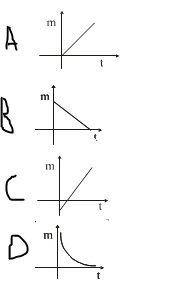
Which of the following graphs correctly represents the variation of mass of a given material deposited with time for constant current in Faraday's Law of Electrolysis?
Attached Figure / Diagram
A
A
B
B
C
C
D
D
medium Difficulty
Verified Correct Answer: Option A
Physical Principles & Numerical Solution
According to Faraday's Law, the mass of the substance deposited is directly proportional to the time for which the current flows, assuming a constant current. Therefore, the graph should show a linear increase in mass over time, which corresponds to option A
Source: WAEC / JAMB / NECO Classroom Archive (Record #70698)