Question Library
Browse, filter, and study verified past examination questions with step-by-step mathematical reasoning.
Searching 18,000+ Questions...
Sifting topics, KaTeX formulas & verified solutions
Showing 166–180 of 784 verified questions
Sort by:
Physics
UTME / JAMB 2013
Waves and Optics
Solution
The angle of deviation of light of various colours passing through a triangular prism increases in the order
A
red → green → blue
B
green → violet → blue
C
blue → red → green
D
blue → green → red
medium Difficulty
Verified Correct Answer: Option A
Physical Principles & Numerical Solution
In a triangular prism, light of different colors is refracted at different angles, with red light deviating the least and blue light deviating the most.
Source: Myschool Past Questions Archive (Record #27358)
Physics
UTME / JAMB 2013
Waves and Optics
The particle nature of light is demonstrated by the
A
photoelectric effect
B
speed of light
C
colours of light
D
diffraction of light
medium Difficulty
Verified Correct Answer: Option A
Physical Principles & Numerical Solution
No expanded working has been attached for this question yet. The verified answer is Option A.
Source: Myschool Past Questions Archive (Record #27371)
Physics
WAEC / WASSCE 2013
Waves and Optics
Solution
The equation of a certain progressive transverse wave is y = 2 sin 2 \(\pi ( \frac{t}{0.01} - \frac{x}{30})\), where x and y are in cm and t in seconds. Calculate the period of the wave.
A
0.001s
B
0.010s
C
10.000s
D
100.000s
medium Difficulty
Verified Correct Answer: Option B
Physical Principles & Numerical Solution
Compare: Y = 2 sin 2 \(\pi (\frac{t}{0.01} - \frac{x}{30})\)
with the wave equation,
y = A sin 2 \(\pi (\frac{t}{T} - \frac{x}{\lambda}\))
⇒ \(\frac{t}{T} = \frac{t}{0.01}\)
T = 0.010s
Source: Myschool Past Questions Archive (Record #35672)
Physics
WAEC / WASSCE 2013
Waves and Optics
At which position should an object be placed in front of a concave mirror in order to obtain an image which is of the same size as the object?
A
at the centre of curvature
B
at the principal focus
C
between the pole and principal focus
D
between the centre of curvature and principal focus
medium Difficulty
Verified Correct Answer: Option A
Physical Principles & Numerical Solution
No expanded working has been attached for this question yet. The verified answer is Option A.
Source: Myschool Past Questions Archive (Record #35673)
Physics
WAEC / WASSCE 2013
Waves and Optics
Solution
Images formed by a convex mirror are always
A
magnified
B
behind the mirror
C
real
D
inverted
medium Difficulty
Verified Correct Answer: Option B
Physical Principles & Numerical Solution
Convex mirrors always form virtual images, which appear behind the mirror.
Source: Myschool Past Questions Archive (Record #35674)
Physics
WAEC / WASSCE 2013
Waves and Optics
Solution
A string under tension produces a note of frequency 14Hz. Determine the frequency when the tension is quadrupled.
A
14Hz
B
18Hz
C
28Hz
D
56Hz
medium Difficulty
Verified Correct Answer: Option C
Physical Principles & Numerical Solution
The formula for the frequency in a stringed instrument : \(f = \frac{1}{2} \sqrt{\frac{T}{m}}\)
f = frequency; T = tension in the string; m = mass per unit lenth of the string.
f\(_1\) = 14 = \(\frac{1}{2} \sqrt{\frac{T}{m}}\).
When T is quadrupled, we have
f\(_2\) = new frequency = \(\frac{1}{2} \sqrt{\frac{4T}{m}}\)
= 2(\(\frac{1}{2} \sqrt{\frac{T}{m}}\))
= 2 f\(_1\)
= 2 x 14
= 28 Hz
Source: Myschool Past Questions Archive (Record #35682)
Physics
WAEC / WASSCE 2013
Waves and Optics
Which of the following statements about waves in pipes is correct?
A
for open pipes, there is only one end correction to be accounted for
B
for closed pipes, there are two end corrections to be accounted for
C
only odd harmonics are possible in closed pipes
D
all harmonics are possible in closed pipes
medium Difficulty
Verified Correct Answer: Option C
Physical Principles & Numerical Solution
No expanded working has been attached for this question yet. The verified answer is Option C.
Source: Myschool Past Questions Archive (Record #35685)
Physics
WAEC / WASSCE 2013
Waves and Optics
Diagram
The diagram above illustrates a waveform. Which of the point on the waveform are in phase?
Attached Figure / Diagram
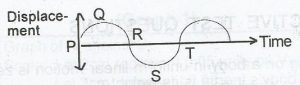
A
P and R
B
R and T
C
P and T
D
Q and S
medium Difficulty
Verified Correct Answer: Option D
Physical Principles & Numerical Solution
No expanded working has been attached for this question yet. The verified answer is Option D.
Source: Myschool Past Questions Archive (Record #35732)
Physics
WAEC / WASSCE 2013
Waves and Optics
Solution
(a) What is a polarizer?
(b) With the aid of a diagram, explain how a polarizer can be used to polarize a beam of unpolarized light.
medium Difficulty
Verified Correct Answer: Option
Physical Principles & Numerical Solution
Polarizer is an optical device which allows vibrations of light to pass throagh in only one phone perpendicular to the direalioniof propagation
(b)
Unpolarized Polarizer Polarized l light ight Unpolarized light vibrates in all directions and a polarized is used to block all vibrations, and transmits only light vibrations polarized in one plane perpendicular to the direction of propagation.
Source: Myschool Past Questions Archive (Record #53128)
Physics
WAEC / WASSCE 2013
Waves and Optics
Solution
Write down the name of:
(a) two particles used in explaining the wave nature of matter;
(b) one device whose invention is based on the wave nature of matter.
medium Difficulty
Verified Correct Answer: Option
Physical Principles & Numerical Solution
(a) Particles used in explaining the wave nature of matter are: hydrogen atom or proton, helium atom, electrons, neutron and helium nuclei or apha particles.
(b) Inventions based on the wave nature of water devices are:
- Electron microscope and scanning tunneling microscope (STM).
Source: Myschool Past Questions Archive (Record #53131)
Physics
WAEC / WASSCE 2013
Waves and Optics
Solution
Using the diagram above as a guide, carry out the following instructions:
Fix a plain sheet of paper on the Celotex board.
Place the rectangular glass prism on the paper and trace its outline, ABCD. Remove the prism.
Draw a normal NMP to meet AB and DC at M and P respectively such that |AM|=DP=2.0cm.
Trace the ray PQ with two pins, \(P_1\) and \(P_2\) at P and Q respectively such that angle MPQ = i =50º
Replace the prism on its outline. Trace the emergent ray with two other pins \(P_3\) and \(P_4\) such that they lie in a straight line with \(P_2\) and the image of \(P_1\) viewed through the glass prism.
Measure and record \(\theta\), the angle between the emergent ray and face AB of the glass prism.
Evaluate cos \(\theta\) and sin i.
Repeat the procedure for four other values of i = 10^\circ, 15^\circ,20^\circ and25^\circ.
Tabulate your readings.
Plot a graph with cos \(\theta\) on the vertical axis and sin i on the horizontal axis.
Determine the slope, s, of the graph
State two precautions taken to ensure accurate results. Attach your traces to your answer booklet
(b)i. State the laws of refraction of light
ii. Explain what is meant by the statement the refractive index of a material is 1.65
medium Difficulty
Verified Correct Answer: Option
Physical Principles & Numerical Solution
i/o
\(\theta\)/0
cos\(\theta\)
sini
5.0
83.0
0.137
0.087
10.0
74.0
0.276
0.174
15.0
65.0
0.423
0.259
20.0
56.0
0.559
0.342
25.0
48.0
0.669
0.423
Slope = \(\frac{\bigtriangleup \text{cos}\theta}{\bigtriangleup \text{sin i}}\) = \(\frac{0.720-0.250}{0.450-0.150}\) = \(\frac{0.47}{0.30}\) = 1.567
PRECAUTIONS; i
Ensured pins were erect/upright/metre rule
Avoided parallax error on the protractor/metre rule
Neat traces or sharp pencils shown on traces
Pins reasonably spaced i.e about 4cm
Noted and corrected/avoided zero error on metre rule.
(b)i. The incident ray, refracted ray was normal at the point of incidence. i.e in the same plane. The ratio of the sine of the angle of incidence to the sine of the angle of refraction is a constant for a given pair of media.
OR nisini = \(n_2\) sinr where the symbols are defined.
OR \(\frac{\text{sini}}{\text{sinr}}\) = N
for a given pair of media, where symbols are defined.
ii. The ratio of the speed of light in vacuum (air) to the speed of light in the material is 1.65
OR
The ratio of the angle of incidence in air/vacuum to the sine of the angle of refraction in the material is 1.65.
Source: Myschool Past Questions Archive (Record #59986)
Physics
UTME / JAMB 2012
Waves and Optics
Solution
The equation of a wave traveling in a horizontal direction is expressed as y = 15 sin \(\frac{2\pi}{5}\) (60t - x). What is its wavelength?
A
60m
B
15m
C
5m
D
2m
medium Difficulty
Verified Correct Answer: Option C
Physical Principles & Numerical Solution
Given: y = 15 sin \(\frac{2\pi}{5}\) (60t - x).
comparing y = 15 sin \(\frac{2\pi}{5}\) (60t - x) with the equation of wave motion Asin\(\frac{2\pi}{\lambda}\)(x - vt)
\(\frac{2\pi}{5}\) = \(\frac{2\pi}{\lambda}\)
Therefore, \(\lambda\) = 5m.
Source: Myschool Past Questions Archive (Record #27401)
Physics
UTME / JAMB 2012
Waves and Optics
Solution
The characteristic of a vibration that determines its intensity is the
A
Frequency
B
Overtone
C
Wavelength
D
Amplitude
medium Difficulty
Verified Correct Answer: Option D
Physical Principles & Numerical Solution
The higher the amplitude of sound the larger the loudness of sound and the lower the amplitude of sound waves the softer the loudness of sound by this we get to know that the amplitude of a sound wave decides the loudness of sound or we can call it the intensity of sound.
Source: Myschool Past Questions Archive (Record #27403)
Physics
UTME / JAMB 2012
Waves and Optics
Where can a man place his face to get an enlarged image when using a concave mirror to shave?
A
Between the centre of curvature and the principal focus
B
At the principal focus
C
Between the principal focus and the pole
D
At the centre of curvature
medium Difficulty
Verified Correct Answer: Option C
Physical Principles & Numerical Solution
No expanded working has been attached for this question yet. The verified answer is Option C.
Source: Myschool Past Questions Archive (Record #27404)
Physics
UTME / JAMB 2012
Waves and Optics
Solution
The magnification of an object 2cm tall when placed 10cm in front of a plane mirror is
A
6.0
B
1.0
C
0.7
D
0.6
medium Difficulty
Verified Correct Answer: Option B
Physical Principles & Numerical Solution
Magnification of an object in front of a plane mirror 2cm tall will be = \(\frac{2}{2}\) = 1 This is because the image will be equal distance behind the mirror.
Source: Myschool Past Questions Archive (Record #27406)