Question Library
Browse, filter, and study verified past examination questions with step-by-step mathematical reasoning.
Searching 18,000+ Questions...
Sifting topics, KaTeX formulas & verified solutions
Showing 166–180 of 1709 verified questions
Sort by:
Physics
UTME / JAMB 2019
Mechanics and Properties of Matter
Solution
An object is acted upon by a system of parallel forces causing the object to be in state equilibrium. Which of the following statement is not correct
A
the resultant of the parallel forces is zero
B
the algebraic sum of all the moments of the forces is zero
C
all the parallel forces must not be equal in magnitude and direction
D
the sum of forces in one direction must be equal to the sum of forces in the opposite direction
medium Difficulty
Verified Correct Answer: Option C
Physical Principles & Numerical Solution
all the parallel forces must be equal in magnitude and direction
Source: Myschool Past Questions Archive (Record #55767)
Physics
UTME / JAMB 2019
Mechanics and Properties of Matter
Solution
Which of the following statements is/are correct for a freely falling body?
I. the total is entirely kinetic
II. the ratio of potential energy to kinetic energy is constant
III. the sum of potential and kinetic energy is constant
A
I only
B
II only
C
III only
D
I & III only
medium Difficulty
Verified Correct Answer: Option C
Physical Principles & Numerical Solution
- the total energy at any point is a combination of the P.E and K.E
- the sum of PE and KE at any point is always constant not the ratio of P.E to K.E
Source: Myschool Past Questions Archive (Record #55768)
Physics
UTME / JAMB 2019
Mechanics and Properties of Matter
Solution
A well 1km deep is filled with a liquid of density 950kg/m\(^3\) and g = 10m/s\(^2\), the pressure at the bottom of the well is
A
9.6 × 10\(^6\)N/m\(^2\)
B
9.5 x 10\(^5\)N/m\(^2\)
C
9.4 x 10\(^6\)N/m\(^2\)
D
9.5 x 10\(^6\)N/m\(^2\)
medium Difficulty
Verified Correct Answer: Option A
Physical Principles & Numerical Solution
P = Pa + ρgh = (1.00 \times 10\(^5\)) + (950 \times 10 \times 1000)
P = 10\(^5\) + (95 \times 10\(^5\)) = 10\(^5\)(1 + 95) = 96 \times 10\(^5\)
P = 9.6 \times 10\(^6\) N/m\(^2\)
Source: Myschool Past Questions Archive (Record #55772)
Physics
UTME / JAMB 2019
Mechanics and Properties of Matter
Solution
"Sum of all forces acting on a body is zero." This condition represents equilibrium'
A
First condition
B
Second condition
C
Third condition
D
Fourth condition
medium Difficulty
Verified Correct Answer: Option A
Physical Principles & Numerical Solution
First condition
Source: Myschool Past Questions Archive (Record #55778)
Physics
UTME / JAMB 2019
Mechanics and Properties of Matter
Diagram
Solution
Which of the following bodies, each with centre of gravity G, lying on a horizontal table, is/are in unstable equilibrium?
Attached Figure / Diagram
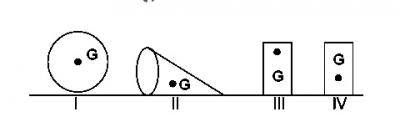
A
II only
B
III only
C
I & IV only
D
II & III only
medium Difficulty
Verified Correct Answer: Option B
Physical Principles & Numerical Solution
- I & II are in neutral equilibrium. They will roll continuously on the table
- III is a body with high centre of gravity (unstable)
- IV is a body with high centre of gravity (stable)
Source: Myschool Past Questions Archive (Record #55787)
Physics
UTME / JAMB 2019
Mechanics and Properties of Matter
Solution
The equilibrium position of objects in any field corresponds to situation of
A
equipotential energy
B
maximum potential energy
C
minimum potential energy
D
minimum kinetic energy
medium Difficulty
Verified Correct Answer: Option C
Physical Principles & Numerical Solution
Potential energy = mgh = (mg)h = force \times distance
⇒ 0 \times d = 0
Source: Myschool Past Questions Archive (Record #55823)
Physics
UTME / JAMB 2019
Mechanics and Properties of Matter
Solution
The height at which the atmosphere ceases to exist is about 80km. If the atmospheric pressure on the ground level is 760mmHg, the pressure at a height of 20km above the ground level is
(ρm = 13.6g/cm\(^3\) ρ = 0.00013g/cm\(^3\) )
A
380mmHg
B
570mmHg
C
190mmHg
D
480mmHg
medium Difficulty
Verified Correct Answer: Option B
Physical Principles & Numerical Solution
ρ\(_m\)h\(_m\) = ρ\(_a\)h\(_a\)
13.6(760 - p) \times 10\(^{-3}\) = 13 \times 10\(^{-5}\)(20 \times 10\(^3\))
760
-
p
=
13 \times 10\(^{-5}\) \times 20 \times 10\(^{3}\)
13.6 \times 10\(^{-3}\)
=
19.12
\times
10\(^{1}\)
760 - p = 191.2
p = 760 - 191.2 ≈ 570mmHg
Source: Myschool Past Questions Archive (Record #55825)
Physics
WAEC / WASSCE 2019
Mechanics and Properties of Matter
Solution
A stone of mass 20g is released from a catapult whose rubber is stretched through 5cm. If the force constant of the rubber is 200Nm\(^{-1}\), calculate the speed with which the stone leaves the catapult.
medium Difficulty
Verified Correct Answer: Option
Physical Principles & Numerical Solution
½Ke\(^{2}\) = ½mv\(^{6}\)
½ x 200 x (0.05)\(^{2}\) = ½ x 0.02 x v\(^{2}\)
v\(^{2}\) = 25
v = 5 m s\(^{-1}\)
Source: Myschool Past Questions Archive (Record #56494)
Physics
WAEC / WASSCE 2019
Mechanics and Properties of Matter
Solution
(a) The diagram above illustrates a projectile motion. Identify each of the physical quantities labeled P, \beta, H and R.
(b) Write an equation to show the relationship between P, g and Rmax’ where g is the acceleration due to gravity and Rmax is maximum R.
medium Difficulty
Verified Correct Answer: Option
Physical Principles & Numerical Solution
The expected answer is
(a) Identification of labelled physical quantities
P - initial velocity/ velocity of projection
b - angle of projection
H - maximum height reached
R - range/horizontal distance (covered)
(b) Equation showing relationship between P, g and Rmax
Rmax = \(\frac{p^2}{g}\)
Source: Myschool Past Questions Archive (Record #56496)
Physics
UTME / JAMB 2019
Mechanics and Properties of Matter
Solution
A cone is in unstable equilibrium, has its potential energy
A
decreased
B
increased
C
unchanged
D
oscillating
medium Difficulty
Verified Correct Answer: Option B
Physical Principles & Numerical Solution
In unstable equilibrium, when the cone is disturbed, it tends to fall further from its equilibrium position, leading to a decrease in height and thus an increase in potential energy.
Source: Myschool Past Questions Archive (Record #55826)
Physics
UTME / JAMB 2019
Mechanics and Properties of Matter
Solution
A mass of 0.5kg is whirled in a vertical circle of radius 2m at a steady rate of 2 rev/s. Calculate the centripetal force
A
164N
B
160N
C
158N
D
172N
medium Difficulty
Verified Correct Answer: Option C
Physical Principles & Numerical Solution
\omega = 2\piF = 2\pi \times 2 = 4\pirad\(^{-1}\)
Centripetal force = mr\omega\(^2\)
⇒ 0.5 \times 2 \times (4\pi)\(^2\)
⇒ 157.75N
Approximately = 158N.
Source: Myschool Past Questions Archive (Record #55827)
Physics
UTME / JAMB 2019
Mechanics and Properties of Matter
Solution
A body was slightly displaced from its equilibrium position. Which one of the following is a condition for its stable equilibrium
A
an increase in the kinetic energy of the body
B
an increase in the potential energy of the body
C
a decrease in the kinetic energy of the body
D
an increase in the height of the body
medium Difficulty
Verified Correct Answer: Option B
Physical Principles & Numerical Solution
Stable equilibrium brings about increase in potential energy as the height rises after displacement.
Source: Myschool Past Questions Archive (Record #55829)
Physics
WAEC / WASSCE 2019
Mechanics and Properties of Matter
Solution
(a) Define diffusion
(b) State two factors that affect the rate of diffusion
medium Difficulty
Verified Correct Answer: Option
Physical Principles & Numerical Solution
(a) Definition of diffusion; The process by which molecules of different substances move randomly among one another.
OR
Intimate mixing of molecules/atoms/particles of different substance (as a result of kinetic energy)
(b) Factors that affect the rate of diffusion
- density of substance
- mass of substance
- temperature
Source: Myschool Past Questions Archive (Record #56512)
Physics
WAEC / WASSCE 2019
Mechanics and Properties of Matter
Solution
(a) (i) State Newton’s Law of Universal Gravitation.
(ii) Define gravitational field.
(b) (i) Derive the equation relating the universal gravitational constant, G, and the acceleration of free fall, g, at the surface of the earth from Newton’s law of universal gravitation.
(ii) State two assumptions for which the relationship in 8(b)(i) holds.
(c) Calculate the force of attraction between a star of mass 2.00 x 1030 kg and the earth assuming the star is located 1.50 x 10⁸ km from the earth. [Mass of the earth = 5.98 x 1024kg; G = 6.67 x 10⁻¹¹N m\(^{2}\) kg-2; g = 10 m s\(^{-2}\)
(d) (i) Define escape velocity.
(ii) State two differences between the acceleration of free fall (g) and the universal gravitational constant (G).
medium Difficulty
Verified Correct Answer: Option
Physical Principles & Numerical Solution
(a) (i) Newton’s law of Universal Gravitation; Any two bodies in the universe attract each other with a force that is (directly) proportional to the product of their masses and inversely proportional to the square of the distance between them.
(ii) Definition of gravitational field; A region/space in which gravitational force is felt / experienced.
(b) (i) Derivation of the equation relating G and g at the surface of the earth
F = \(\frac{GMm}{R^2}\)
mg = \(\frac{GMm}{R^2}\)
g = \(\frac{GM}{R^2}\)
(ii) Assumptions for which equation holds;
- mass of the earth is concentrated at its centre
- earth is spherical
- earth is not rotating
- possesses uniform density.
(c) Calculation of the force of attraction between a star and the earth;
F = \(\frac{GM_sM_e}{r_2}\)
= 6.67 x 10\(^{11}\) [\(\frac {(2 \times 10^{30}) (5.98 \times 10^{24})} {(1.5 \times 10^{11})^2}\)]
= 3.55 x 10\(^{22}\)N
(d) (i) Definition of escape velocity; The minimum uni-directional speed/velocity required by a body to leave the gravitational field/influence of a planet
(ii) Differences between acceleration of free fall (g) and universal gravitational constant (G)
g
G
Its unit is N m2 kg-2
Its unit is m s-2 / N kg-1
It is constant everywhere
It varies from place to place
It is a scalar quantity
It is a vector quantity
Source: Myschool Past Questions Archive (Record #56513)
Physics
WAEC / WASSCE 2019
Mechanics and Properties of Matter
Solution
(a) (i) Explain latent heat.
(ii) State two factors that affect the rate of evaporation of a liquid
(b) Explain each of the following observations:
(i) On a dry day, water in a clay pot is cooler than water in a closed plastic container;
(ii) Food gets cooked faster in a pressure cooker than in an ordinary cooking pot.
(c) State two effects of heat on a substance.
(d) A 40 V electric heater is used to supply a current of 12 A for 1400 s to a body of mass 1.5 kg at the melting point of the body. The body melts and its temperature rises through 60\(^o\)C in an extra 72 s. Determine the:
(i) latent heat of fusion of the body;
(ii)specific heat capacity of the body.
medium Difficulty
Verified Correct Answer: Option
Physical Principles & Numerical Solution
(a)(i) Explanation of latent heat
When a substance is changing state, it absorbs/gives out thermal/heat energy which does not result in temperature change. This heat absorbed or given out during change of state is known as latent heat.
(ii) Factors that affect the rate of evaporation of a liquid
- exposed surface area of the liquid
- temperature of the liquid
- wind / draught
- humidity / amount of water vapour
- nature of the liquid
- air pressure.
(b) Explanation of observations
(i) Water in a clay pot is cooler than water in a closed plastic container
The clay pot has pores which allow evaporation to take place. In the process of evaporation, molecules take latent heat from the bulk of the water, leaving the water cooler; but the plastic container does not have pores (to allow for evaporation).
(ii) Food gets cooked faster in a pressure cooker than in an ordinary cooking pot
With the pressure cooker, increased pressure raises the boiling point of water within a short period. This leads to faster cooking. Ordinary cooking pot operates at normal atmospheric pressure.
(c) Effects of heat on a substance
Change of/in:
- state
- temperature
- dimension
- colour
- electrical resistance
(d) (i) Determination of latent heat of fusion of the body
Heat supplied by electric heater in the first 1400 s
IVt\(_1\) = mlf
mlf = 12 x 40 x 1400
= 6.72 x 10⁵J
(ii) Determination of Specific heat capacity of the body
IVt\(_2\) = mc\(\Delta \theta\)
c = \(\frac{IVt_2}{m \Delta \theta}\) = \(\frac{12 \times 40 \times 72}{1.5 \times 60}\)
= 384 Jk\(^{-1}\) K\(^{-1}\)
Source: Myschool Past Questions Archive (Record #56609)