Question Library
Browse, filter, and study verified past examination questions with step-by-step mathematical reasoning.
Searching 18,000+ Questions...
Sifting topics, KaTeX formulas & verified solutions
Showing 166–180 of 573 verified questions
Sort by:
Mathematics
UTME / JAMB 2011
Algebra
Solution
If \(\begin{vmatrix} 2 & 3 \\ 5 & 3x \end{vmatrix}\) = \(\begin{vmatrix} 4 & 1 \\ 3 & 2x \end{vmatrix}\), find the value of x.
A
-6
B
6
C
-12
D
12
medium Difficulty
Verified Correct Answer: Option A
Step-by-Step Mathematical Solution
\(\begin{vmatrix} 2 & 3 \\ 5 & 3x \end{vmatrix}\) = \(\begin{vmatrix} 4 & 1 \\ 3 & 2x \end{vmatrix}\)
(2 x 3x) - (5 x 3) = (4 x 2x) - (3 x 1)
6x - 15 = 8x - 3
6x - 8x = 15 - 3
-2x = 12
x = \(\frac{12}{-2}\)
= -6
Source: Myschool Past Questions Archive (Record #29429)
Mathematics
UTME / JAMB 2011
Algebra
Solution
Evaluate \(\begin{vmatrix} 4 & 2 & -1 \\ 2 & 3 & -1 \\ -1 & 1 & 3 \end{vmatrix}\)
A
25
B
45
C
15
D
55
medium Difficulty
Verified Correct Answer: Option A
Step-by-Step Mathematical Solution
\(\begin{vmatrix} 4 & 2 & -1 \\ 2 & 3 & -1 \\ -1 & 1 & 3 \end{vmatrix}\)
4 \(\begin{vmatrix} 3 & -1 \\ 1 & 3 \end{vmatrix}\) -2 \(\begin{vmatrix} 2 & -1 \\ -1 & 3\end{vmatrix}\) -1 \(\begin{vmatrix} 2 & 3 \\ -1 & 1 \end{vmatrix}\)
4[(3 x 3) - (-1 x 1)] -2 [(2x 3) - (-1 x -1)] -1 [(2 x 1) - (-1 x 3)]
= 4[9 + 1] -2 [6 - 1] -1 [2 + 3]
= 4(10) - 2(5) - 1(5)
= 40 - 10 - 5
= 25
Source: Myschool Past Questions Archive (Record #29434)
Mathematics
UTME / JAMB 2011
Algebra
Solution
The inverse of matrix N = \(\begin{vmatrix} 2 & 3 \\
1 & 4\end{vmatrix}\) is
A
\(\frac{1}{5}\) \(\begin{vmatrix} 2 & 1 \\ 3 & 4\end{vmatrix}\)
B
\(\frac{1}{5}\) \(\begin{vmatrix} 4 & -3 \\ -1 & 2\end{vmatrix}\)
C
\(\frac{1}{5}\) \(\begin{vmatrix} 2 & -1 \\ -3 & 4\end{vmatrix}\)
D
\(\frac{1}{5}\) \(\begin{vmatrix} 4 & 3 \\ 1 & 2\end{vmatrix}\)
medium Difficulty
Verified Correct Answer: Option B
Step-by-Step Mathematical Solution
N = [2 3]
N-1 = \(\frac{adj N}{|N|}\)
adj N = \(\begin{vmatrix} 4 & -3 \\ -1 & 2 \end{vmatrix}\)
|N| = (2 x4) - (1 x 3)
= 8 - 3
=5
N-1 = \(\frac {1}{5}\) \(\begin{vmatrix} 4 & -3 \\ -1 & 2 \end{vmatrix}\)
Source: Myschool Past Questions Archive (Record #29438)
Mathematics
UTME / JAMB 2011
Algebra
Solution
Find the equation of a line perpendicular to line 2y = 5x + 4 which passes through (4, 2).
A
5y - 2x -18 = 0
B
5y + 2x - 18 = 0
C
5y - 2x + 18 = 0
D
5y + 2x - 2 = 0
medium Difficulty
Verified Correct Answer: Option B
Step-by-Step Mathematical Solution
2y = 5x + 4 (4, 2)
y = \(\frac{5x}{2}\) + 4 comparing with
y = mx + e
m = \(\frac{5}{2}\)
Since they are perpendicular
m1m2 = -1
m2 = \(\frac{-1}{m_1}\) = -1
\(\frac{5}{2}\) = -1 x \(\frac{2}{5}\)
The equator of the line is thus
y = mn + c (4, 2)
2 = -\(\frac{2}{5}\)(4) + c
\(\frac{2}{1}\) + \(\frac{8}{5}\) = c
c = \(\frac{18}{5}\)
y = -\(\frac{2}{5}\)x + \(\frac{18}{5}\)
5y = -2x + 18
or 5y + 2x - 18 = 0
Source: Myschool Past Questions Archive (Record #29482)
Mathematics
WAEC / WASSCE 2011
Algebra
Solution
Solve for x in the equation; \(\frac{3}{5}\)(2x - 1) = \(\frac{1}{4}\)(5x - 3)
A
zero
B
1
C
2
D
3
medium Difficulty
Verified Correct Answer: Option D
Step-by-Step Mathematical Solution
\(\frac{3}{5}\)(2x - 1) = \(\frac{1}{4}\)(5x - 3)
\(\frac{6x}{5} - \frac{3}{5} = \frac{5x}{4} - \frac{3}{4}\)
\(\frac{6x}{5} - \frac{5x}{4} = \frac{3}{5} - \frac{3}{4}\)
\(\frac{24x - 25x}{20} = \frac{12 - 15}{20}\)
\(\frac{-x}{20} = \frac{-3}{20}\)
-20x = -60
x = \(\frac{-60}{-20}\)
x = 3
Source: Myschool Past Questions Archive (Record #36629)
Mathematics
WAEC / WASSCE 2011
Algebra
Solution
Solve the equation; 3x - 2y = 7, x + 2y = -3
A
x = 1, y = -2
B
x = 1, y = 3
C
x = -2, y = -1
D
x = 4, y = -3
medium Difficulty
Verified Correct Answer: Option A
Step-by-Step Mathematical Solution
3x - 2y = 7; Solve by elimination method
x + 2y = -3
3x - 2y = 7.....(i)
-3x + 6y = -9.....(ii)
-8y = 16
y = \(\frac{16}{-8} = -2\)
Put y = -2 into equation (i); 3x - 2y = 7
3x - 2(-2) = 7
3x + 4 = 7
3x = 7 - 4
3x = 3
x = \(\frac{3}{3}\) = 1
Source: Myschool Past Questions Archive (Record #36632)
Mathematics
WAEC / WASSCE 2011
Algebra
Solution
From the equation whose roots are x = \(\frac{1}{2}\) and -\(\frac{2}{3}\)
A
6x2 - x + 2 = 0
B
6x2 - x - 2 = 0
C
6x2 + x + 2 = 0
D
6x2 + x - 2 = 0
medium Difficulty
Verified Correct Answer: Option D
Step-by-Step Mathematical Solution
x = \(\frac{1}{2}\) and x = \(\frac{-2}{3}\)
expand (x - \(\frac{1}{2}\))(x + \(\frac{2}{3}\)) = 0
x(x + \(\frac{2}{3}\)) - \(\frac{1}{2}(x + \frac{2}{3}\)) = 0
x2 + \(\frac{4x - 3x}{6} - \frac{2}{6} = 0\)
\(x^2 + \frac{x}{6} - 2 = 0\)
6x2 + x - 2 = 0
Source: Myschool Past Questions Archive (Record #36650)
Mathematics
WAEC / WASSCE 2011
Algebra
Diagram
Solution
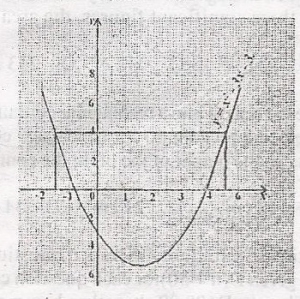
The graph represents the relation y = xo2 - 3x - 3. Find the value of x for which x2 - 3x = 7
Attached Figure / Diagram
A
-1.55, 4.44
B
1.55, -4.55
C
-1.55, -4.55
D
1.55, 4.55
medium Difficulty
Verified Correct Answer: Option A
Step-by-Step Mathematical Solution
x2 - 3x = 7
x2 - 3x - 7 = 0
What can you add to both sides of the equation to give the same value of y = x2 - 3x - 3
The number is 4
x2 - 3x - 7 + 4 = 4
x2 - 3x - 3 = 4
but y = x2 - 3x - 3
y = 4; So are y = 4 draw a line parallel to x axis, to cut or intersect the graph. At these points look down to see the corresponding values on x axis
This give -1.55 and 4.55
Source: Myschool Past Questions Archive (Record #36674)
Mathematics
WAEC / WASSCE 2011
Algebra
Solution
Find the smaller value of x that satisfies the equation x\(^2\) + 7x + 10 = 0
A
-5
B
-2
C
2
D
5
medium Difficulty
Verified Correct Answer: Option A
Step-by-Step Mathematical Solution
x\(^2\) + 7x + 10 = 0
x2 + 5x + 2x + 10 = 0
x(x + 5) + 2(x + 5) = 0
(x + 2)(x + 5) = 0
x + 2 = 0 or x + 5 = 0
x = -2 or x = -5
the smaller value x = -5
Source: Myschool Past Questions Archive (Record #36685)
Mathematics
WAEC / WASSCE 2011
Algebra
Solution
in a quiz competition, a student answers n questions correctly and was given D(n + 50) for each question correctly answered. If he gets D600.00 altogether, how many questions did he answer correctly?
A
18
B
15
C
12
D
10
medium Difficulty
Verified Correct Answer: Option D
Step-by-Step Mathematical Solution
let the number of question = n
n(n + 50) = 600
n2 + 50n - 600 - 0 by quadratic formular
x = \(\frac{b \pm \sqrt{b^2 - 4ac}}{2}\)
n = \(\frac{-50 \pm \sqrt{50^2 - 4(1) (-600)}}{2(1)}\)
= \(\frac{-50 \pm \sqrt{4900}}{2}\)
= \(\frac{-50 + 70}{2}\)
= \(\frac{20}{2}\)
= 10
Source: Myschool Past Questions Archive (Record #36690)
Mathematics
WAEC / WASSCE 2011
Algebra
Diagram
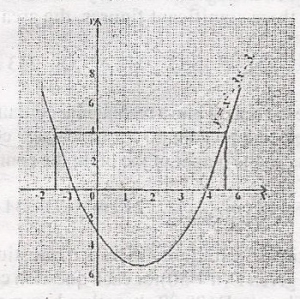
The graph represents the relation y = x\(^2\) - 3x - 3. What is the equation of the line of symmetry of the graph?
Attached Figure / Diagram
A
y = 0.5
B
x = 1.0
C
x = 1.5
D
y = 4.6
medium Difficulty
Verified Correct Answer: Option C
Step-by-Step Mathematical Solution
No expanded working has been attached for this question yet. The verified answer is Option C.
Source: Myschool Past Questions Archive (Record #36709)
Mathematics
WAEC / WASSCE 2011
Algebra
Solution
(a) Divide \(\frac{x^{2} - 4}{x^{2} + x}\) by \(\frac{x^{2} - 4x + 4}{x + 1}\).
(b) The diagram below shows the graphs of \(y = ax^{2} + bx + c\) and \(y = mx + k\) where a, b, c and m are constants. Use the graph(s) to :
(i) find the roots of the equation \(ax^{2} + bx + c = mx + k\);
(ii) determine the values of a, b and c using the coordinates of points L, M and N and hence write down the equation of the curve;
(iii) determine the line of symmetry of the curve \(y = ax^{2} + bx + c\).
medium Difficulty
Verified Correct Answer: Option
Step-by-Step Mathematical Solution
(a) \(\frac{x^{2} - 4}{x^{2} + x} \div \frac{x^{2} - 4x + 4}{x + 1}\)
= \(\frac{x^{2} - 4}{x^{2} + x} \times \frac{x + 1}{x^{2} - 4x + 4}\)
= \(\frac{(x - 2)(x + 2)}{x(x + 1)} \times \frac{x + 1}{x^{2} - 2x - 2x + 4}\) (Using difference of two squares)
= \(\frac{(x - 2)(x + 2)}{x} \times \frac{1}{(x - 2)^{2}}\)
= \(\frac{(x + 2)}{x(x - 2)}.
(b) Roots of \(ax^{2} +bx + c = mx + k\)
For graph \(y = ax^{2} + bx + c\),
\(x = -1\) and \(x = 2\)
\(x + 1 = 0\) and \(x - 2 = 0\)
\((x + 1)(x - 2) = 0\)
\(x^{2} - 2x + x - 2 = 0\)
\(x^{2} - x - 2 = 0 ..... (i)\)
\(-x^{2} + x + 2 = 0 ...... (ii)\)
For graph \(y = mx + k\)
\(m = \frac{y_{2} - y_{1}}{x_{2} - x_{1}} = \frac{1 - (-1)}{1.3 - (-1.3)}\)
\(m = \frac{2}{2.6} = 0.769\)
\(k = 0.25\)
\(x^{2} - x - 2 = 0.769x + 0.25\)
\(x^{2} - x - 0.769x - 2 - 0.25 = 0\)
\(x^{2} - 1.769x - 2.25 = 0\)
Using formula method, \(x = \frac{-b \pm \sqrt{b^{2} - 4ac}}{2a}\)
\(x = \frac{-(-1.769) \pm \sqrt{(-1.769)^{2} - 4(1)(-2.25)}}{2(1)}\)
\(x = \frac{1.769 \pm \sqrt{3.1294 + 9}}{2}\)
\(x = \frac{1.769 \pm 3.483}{2}\)
\(x = \frac{1.769 + 3.483}{2}\) or \(x = \frac{1.769 - 3.483}{2}\)
\(x = \frac{5.252}{2} \approxeq 2.626\) or \(x = \frac{-1.714}{2} \approxeq -0.857\)
(ii) The coordinates of points L, M and N are (-1, 0), (0, 2) and (2, 0) respectively.
Using coordinate for L:
\(0 = a(-1^{2}) + b(-1) + c \implies 0 = a - b + c ..... (1)\)
Using M :
\(2 = a(0^{2}) + b(0) + c \implies c = 2 ...... (2)\)
Using N :
\(0 = a(2^{2}) + b(2) + c \implies 0 = 4a + 2b + c .... (3)\)
From (2), c = 2
\(\therefore (1) : a - b + 2 = 0 \implies a - b = -2 .... (1a)\)
\(\therefore (3) : 4a + 2b + 2 = 0 \implies 4a + 2b = -2 ..... (3a)\)
Solving equations (1a) and (3a) simultaneously, we get
\(a = -1 , b = 1 , c = 2\)
\(\therefore\) Equation of the curve : \(-x^{2} + x + 2 = 0\)
(iii) Line of symmetry = \(x = \frac{-b}{2a}\)
\(y = -x^{2} + x + 2 \)
Line of symmetry = \(\frac{-1}{2(-1)}\)
\(x = \frac{1}{2}\)
Source: Myschool Past Questions Archive (Record #52759)
Mathematics
UTME / JAMB 2010
Algebra
Solution
If \(\begin{vmatrix} x & 3 \\ 2 & 7 \end{vmatrix} = 15\), find the value of x
A
3
B
4
C
5
D
2
medium Difficulty
Verified Correct Answer: Option A
Step-by-Step Mathematical Solution
\(\begin{vmatrix} x & 3 \\ 2 & 7 \end{vmatrix} = 15\)
x x 7 - 2 x 3 = 15
7x - 6 = 15
7x = 15+6
7x = 21
x = 21/7
x = 3
Source: Myschool Past Questions Archive (Record #9804)
Mathematics
UTME / JAMB 2010
Algebra
Solution
What is the locus of point that is equidistant from points P(1,3) and Q(3,5)?
A
y = -χ + 6
B
y = -χ - 6
C
y = χ + 6
D
y = χ - 6
medium Difficulty
Verified Correct Answer: Option A
Step-by-Step Mathematical Solution
Locus of a point equidistant from two fixed points is the perpendicular bisector of the straight line joining the points Gradients of PQ = (5-3 / 3-1) = 2/2 = 1
Gradient bisector = -1
Equation of perpendicular bisector
y - y1 = m(χ - χ1
y - 4 = -χ + 2
y = -χ + 6
Source: Myschool Past Questions Archive (Record #9954)
Mathematics
UTME / JAMB 2010
Algebra
Solution
Evaluate \(\begin{vmatrix} 2 & 0 & 5 \\ 4 & 6 & 3 \\ 8 & 9 & 1 \end{vmatrix}\)
A
5y - 2x -18 = 0
B
102
C
-102
D
-42
medium Difficulty
Verified Correct Answer: Option C
Step-by-Step Mathematical Solution
\(\begin{vmatrix} 2 & 0 & 5 \\ 4 & 6 & 3 \\ 8 & 9 & 1 \end{vmatrix}\)
= 2(6 - 27) - 0(4 - 24) + 5(36 - 48)
= 2(-21) - 0 + 5(-12)
= -42 + 5(-12)
= -42 - 60
= -102
Source: WAEC / JAMB / NECO Classroom Archive (Record #29575)