Question Library
Browse, filter, and study verified past examination questions with step-by-step mathematical reasoning.
Searching 18,000+ Questions...
Sifting topics, KaTeX formulas & verified solutions
Showing 166–180 of 4783 verified questions
Sort by:
Chemistry
UTME / JAMB 2025
Matter & Separation Techniques
Solution
The 5\(^{th}\) member of an alkyne series is
A
C\(_5\)H\(_8\)
B
C\(_5\)H\(_{10}\)
C
C\(_6\)H\(_{12}\)
D
C\(_6\)H\(_{10}\)
medium Difficulty
Verified Correct Answer: Option D
Chemical Principles & Mechanism
The general formula for the alkyne homologous series is C\(_n\)H\(_{2n−2}\), where n is the number of carbon atoms. The first member of the series has n=2 (ethyne), as a minimum of two carbon atoms is required for a triple bond.
The 5th member of the alkyne series is hexyne (C\(_6\)H\(_{10}\)).
Source: Official Exam / Past Question Archive
Chemistry
WAEC / WASSCE 2025
Matter & Separation Techniques
Solution
Empirical formula is the
A
simplest formula of a compound
B
molecular formula of a compound
C
chemical formula of a compound
D
structural formula of a compound
medium Difficulty
Verified Correct Answer: Option A
Chemical Principles & Mechanism
The empirical formula is defined as the chemical formula that represents the simplest whole-number ratio of the atoms of each element present in a compound. For this reason, it is also frequently referred to as the simplest formula.
Source: Official Exam / Past Question Archive
Chemistry
UTME / JAMB 2024
Reactions Rates and Chemical Equilibria
Diagram
Solution
In the graph above, y represents
Attached Figure / Diagram
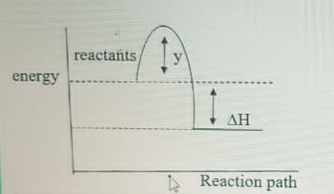
A
endothermic reaction
B
activation energy
C
exothermic reaction
D
ionization energy
medium Difficulty
Verified Correct Answer: Option B
Chemical Principles & Mechanism
The activation energy is the energy required to get the reaction going. It's the difference between the energy of the reactants and the peak of the hump.
Source: WAEC / JAMB / NECO Classroom Archive (Record #70260)
Chemistry
UTME / JAMB 2024
Chemical Equilibrium
Solution
CuO\(_s\) + H\(_2\)(\(_g\)) ⇌ Cu\(_s\) + H\(_2\)O(\(_g\))
In the equation above, the effect of increased pressure on the equilibrium position is that
A
the equilibrium is shifted to the left
B
the equilibrium is shifted to the right
C
there is no effect
D
more H\(_2\)\((g\)) is produced
medium Difficulty
Verified Correct Answer: Option C
Chemical Principles & Mechanism
The effect of pressure on a chemical system at equilibrium is only on gaseous substances.
We'll need to consider the number of moles of the gaseous substances on the LHS as well as the total number of moles of the gaseous substances on the RHS.
The side with the lower total number of moles will be favoured by an increase in pressure and vice versa. However, since the number of moles of the gaseous substances on both sides are 1, i.e they are equal, an increase in pressure has no effect on the chemical system in equilibrium.
Source: WAEC / JAMB / NECO Classroom Archive (Record #70263)
Chemistry
UTME / JAMB 2024
Stoichiometry & Mole Concept
Solution
At a given temperature and pressure, a gas X diffuses twice as fast as gas Y. It follows that
A
Gas Y is two times as heavy as Gas X
B
Gas Y is four times as heavy as Gas X
C
Gas Y is monoatomic
D
Gas X is diatomic
medium Difficulty
Verified Correct Answer: Option B
Chemical Principles & Mechanism
The question can be explained by Graham's law of diffusion. According to this law, under the same conditions of temperature and pressure, the rate of diffusion of a gas is inversely proportional to the square root of its molar mass.
\(\frac{R_x}{R_y}\) = \(\sqrt{\frac{M_y}{M_x}}\)
From the question, Gas X diffuses twice as fast as gas Y i.e x = 2y
This implies x =2 while y = 1
From \(\frac{R_x}{R_y}\) = \(\sqrt{\frac{M_y}{M_x}}\)
\(\frac{2}{1}\) = \(\sqrt{\frac{M_y}{M_x}}\)
\(\frac{4}{1}\) = \(\frac{M_y}{M_x}\)
M\(_y\) = 4 M\(_x\)
⇒ Gas Y is 4 times as heavy as Gas X. - Option B
Source: Myschool Past Questions Archive (Record #70194)
Chemistry
UTME / JAMB 2024
Stoichiometry & Mole Concept
Solution
The number of molecules of helium gas contained in 11.5g of the gas is
A
1.73 x 10\(^{23}\)
B
1.73 x 10\(^{22}\)
C
1.73 x 10\(^{24}\)
D
1.73 x 10\(^{21}\)
medium Difficulty
Verified Correct Answer: Option C
Chemical Principles & Mechanism
To find the number of molecules, we'll use the formula:
Number of moles = \(\frac{Number of molecules}{Avogadro number}\)
But We were only given the mass of Helium = 11.5g , knowing the atomic mass or molar mass of He = 4 g/mol
Number of moles = \(\frac{mass}{molar mass}\) = \(\frac{11.5}{4}\) = 2.875 moles
Number of molecules = Number of moles x Avogadro number
= 2.875 x 6.02 x 10\(^{23}\)
= 17.3075 x 10\(^{23}\)
= 1.73 x 10\(^{24}\)
Source: Myschool Past Questions Archive (Record #70203)
Chemistry
UTME / JAMB 2024
Matter & Separation Techniques
Solution
The constituents of Alnico are Aluminium, Nickel and
A
Mg
B
Co
C
Mn
D
Cu
medium Difficulty
Verified Correct Answer: Option B
Chemical Principles & Mechanism
Alnico is ferromagnetic, meaning it can be used to make permanent magnets. Alnico is an iron alloy with the acronym "al-ni-co" that's made up of aluminum (Al), nickel (Ni), and cobalt (Co). Option B
Source: Myschool Past Questions Archive (Record #70217)
Chemistry
UTME / JAMB 2024
Electrochemistry and Redox
Solution
Silver and Gold are metals found as free uncombined elements in the earth's crust, which makes them to be referred to as
A
corrosive metals
B
reactive metals
C
natural metals
D
noble metals
medium Difficulty
Verified Correct Answer: Option D
Chemical Principles & Mechanism
Gold and silver are noble metals, because they are resistant to corrosion and oxidation, even at high temperatures.
Noble metals are a group of metals that are less reactive than other metals and are not easily corroded or oxidized.
Source: Myschool Past Questions Archive (Record #70220)
Chemistry
UTME / JAMB 2024
Matter & Separation Techniques
Solution
In the extraction of Aluminium, the silica impurity is removed by
A
electrolysis
B
filtration
C
reaction with H\(_2\)SO\(_4\)
D
precipitation
medium Difficulty
Verified Correct Answer: Option B
Chemical Principles & Mechanism
Aluminum is extracted from bauxite by electrolysis. The extraction proceeds in two stages;
1. Purification of the Bauxite: The impure bauxite is heated with sodium hydroxide solution to form soluble sodium tetrahydroxy aluminate (iii). The impurities in the ore which are iron (iii) oxide and trioxosilicate (iv) compounds are not soluble in the alkali. They are therefore filtered off as a sludge.
Aluminum hydroxide crystals is then added to filtrate, NaAl(OH)\(_4\) solution to induce the precipitation of Aluminum hydroxide.
2. The electrolysis of the pure alumina
Source: Myschool Past Questions Archive (Record #70221)
Chemistry
UTME / JAMB 2024
Matter & Separation Techniques
Solution
When Calcium ethynide is decomposed by water, the gas produced is
A
CO
B
H\(_2\)
C
C\(_2\)H\(_2\)
D
CH\(_4\)
medium Difficulty
Verified Correct Answer: Option C
Chemical Principles & Mechanism
In contact with water, calcium carbide instantly decomposes hydrolytically, yielding acetylene gas and calcium hydroxide.
Calcium ethynide is also known as calcium carbide.
CaC\(_2\) + 2H\(_2\)O → Ca(OH)\(_2\) + C\(_2\)H\(_2\)
Source: Myschool Past Questions Archive (Record #70224)
Chemistry
UTME / JAMB 2024
Acids, Bases, and Salts
Solution
The constituent of petroleum fraction used in surfacing road is
A
petrol
B
diesel
C
lubricating oil
D
bitumen
medium Difficulty
Verified Correct Answer: Option D
Chemical Principles & Mechanism
Bitumen is the petroleum product which is used for surfacing roads. It is also known as asphalt. It is used as an alternative for coal-tar.
Source: Myschool Past Questions Archive (Record #70225)
Chemistry
UTME / JAMB 2024
Matter & Separation Techniques
Solution
During the fractional distillation of crude oil, the fraction that distills at 200 - 250\(^0\) C is
A
bitumen
B
diesel
C
kerosene
D
petrol
medium Difficulty
Verified Correct Answer: Option C
Chemical Principles & Mechanism
The petroleum fractions that distill at 200–250^\circC are naphtha and kerosene,
Bitumen: has a boiling point value of 525\(^0\)C
Gasoline: Has a boiling range of 40–200^\circC
Diesel: Has a boiling range of 250–350^\circC
Fuel oil, paraffin, lubricants: Have a boiling range of 300–370^\circC
Residue, crude oil: Has a boiling point of more than 370^\circC
Source: Myschool Past Questions Archive (Record #70227)
Chemistry
UTME / JAMB 2024
Matter & Separation Techniques
Solution
A liquid hydrocarbon obtained from fractional distillation of coal tar that is used in the pharmaceutical industry is
A
xylene
B
benzene
C
hexane
D
Toluene
medium Difficulty
Verified Correct Answer: Option B
Chemical Principles & Mechanism
Coal tar is a known human carcinogen. It contains potent carcinogens like benzo(a)pyrene, benz(a)anthracene, and dibenz(a,h)anthracene.
Fractional distillation of coal tar is a process that produces aromatic hydrocarbons like benzene, creosotes, naphthalene, anthracene, carbolic and cresylic acids, pyridine, and pitch. Benzene is used in the pharmaceutical industry as a solvent and in the synthesis of drugs such as cyclohexane, phenol etc.Thus the correct answer is option B- Benzene
Source: Myschool Past Questions Archive (Record #70229)
Chemistry
UTME / JAMB 2024
Stoichiometry & Mole Concept
Solution
An organic compound contains 53.1% Carbon, 6.2% Hydrogen, 12.4% Nitrogen, and 28.3% Oxygen by mass. What is the molecular formula of the compound if its vapour density is 56.5? [ C =12, H = 1, N = 14, O = 16].
A
C\(_5\)H\(_7\)NO\(_2\)
B
C\(_5\)H\(_6\)NO\(_2\)
C
C\(_3\)H\(_6\)NO\(_2\)
D
C\(_3\)H\(_7\)NO\(_2\)
medium Difficulty
Verified Correct Answer: Option A
Chemical Principles & Mechanism
C H N O
\(\frac{53.1}{12}\) \(\frac{6.2}{1}\) \(\frac{12.4}{14}\) \(\frac{28.3}{16}\)
\(\frac{4.425}{0.886}\) \(\frac{6.2}{0.886}\) \(\frac{0.886}{0.886}\) \(\frac{1.769}{0.886}\)
5 : 7 : 1 : 2
C\(_5\) H\(_7\) N O\(_2\) - Empirical formula
(Empirical formula) n = Molecular formula
(C\(_5\)H\(_7\)NO\(_2\))n = 2 x vapour density
([12x5] + [1x7] + 14 + [16x2] ) n = 2 x 56.5
113n = 113
n = \(\frac{113}{113}\)
n = 1
Therefore, the molecular formula is C\(_5\)H\(_7\)NO\(_2\)
Source: Myschool Past Questions Archive (Record #70233)
Chemistry
UTME / JAMB 2024
Stoichiometry & Mole Concept
Solution
The empirical formula of an organic liquid hydrocarbon is XY. If the relative molar masses of X and Y are 72 and 6 respectively, it's vapour density is likely to be
A
33
B
66
C
39
D
78
medium Difficulty
Verified Correct Answer: Option C
Chemical Principles & Mechanism
Empirical formula of organic liquid is XY
(Empirical formula) x n = 2 x Vapour density
(XY) = 2 V.D
(72 + 6) = 2 V.D
78 = 2 V.D
V.D = \(\frac{78}{2}\)
V.D = 39
Source: Myschool Past Questions Archive (Record #70234)